
All episodes
Page 7 of 23
1,115 episodes

Your LLM Deception Monitor Is Broken. The Fix Is in the Training Data - Sachin Kumar, LexisNexis
Jul 8, 2026 · 13:58
Sachin Kumar (LexisNexis) presents his peer-reviewed IJCNN paper showing that standard LLM deception monitors—behavioral tests and joint cross-model features (crosscoders)—fail to detect sleeper-agent backdoors. The fix is a diff sparse autoencoder (SAE) trained on the difference between base and fine-tuned model activations. On a controlled SQL-injection backdoor triggered by 'year 2024' in a 360M-parameter model, diff SAE achieves 40× the signal of joint features, perfect precision, and zero false positives from a single layer. Recall is about 25%, so multiple features should be ensembled. The method is cheap (one forward pass per checkpoint) and works under both full-rank and LoRA fine-tuning. Limitations include requiring the base checkpoint and not yet tested against adaptive adversaries. Kumar demonstrates that backdoors are directional shifts in activations, and diff SAE isolates them directly.

GTM Is You - Victoria Melnikova, Evil Martians
Jul 7, 2026 · 12:35
Victoria Melnikova argues that a founder's personal brand is the most underrated competitive advantage for developer tool startups in 2026, citing interviews with Sam Lambert (Planet Scale), Zeno Rocha, and David Cramer. She presents the Product-Market Fit Compass, a framework from Evil Martians that analyzed 37 successful DevTools, finding that 9 out of 10 times product signal is stronger than revenue, making distribution the bottleneck. Key tactics include moving to San Francisco for network effects, using banners and billboards to signal credibility (as TypeCents did with hundreds of billboards), hosting events like Supabase's user conference, and embracing failures (Zeno Rocha walked away from 300k ARR to start over). Melnikova emphasizes being unapologetically yourself, as AI can amplify but not replace unique personal brands, and notes that founder-led sales builds trust in early-stage startups.

Beyond the Harness: A Journey Towards Adaptative Engineering - Rajiv Chandegra, Annicha Labs
Jul 7, 2026 · 37:01
Rajiv Chandegra of Annicha Labs introduces adaptive engineering as a design philosophy that moves beyond fixed AI harnesses (like Claude Code, Cursor, or Py) to let multi-agent systems self-organize during runtime. He argues that as models become exponentially more powerful and AI collides with the messy, dynamic real world, pre-engineered static harnesses become brittle. Drawing on complexity science, he contrasts the factory model—reliable but novelty-suppressing—with adaptive engineering, where agents interact locally and the harness emerges as an ongoing output, not a predetermined input. The engineer's role shifts to designing constraints (e.g., rate of coupling, goal reward) and sensing the emergent order, while failures include drift, monoculture, and legibility collapse. This approach targets 'horizontal intelligence'—decentralized coordination among agents—as the key to handling complex, real-world problems that cannot be decomposed into fixed parts.

How we taught agents to use good retrieval - Hanna Lichtenberg, Mixedbread AI
Jul 7, 2026 · 14:28
Mixedbread AI co-founder Amir and AI engineer Hanna Lichtenberg argue the main bottleneck for knowledge agents is not reasoning but retrieval, coining the 'Oracle Gap'—the performance drop when agents use default tools. On BrowsComPlus, Oracle accuracy is 93% but Codex drops 9 points; with Mixedbread's search they recover to within 3 points. They show models write keyword gibberish (e.g., 'Senator, women, questions, billionaires, not a company') because they were trained on code tools like grep. To fix this, they built a search agent with 4 tools (overview, semantic, filter, grep) using a harness that encourages natural query sentences. Training involved supervised fine-tuning from a larger teacher and reinforcement learning with a reward combining retrieval metrics and trajectory quality (e.g., judging if queries are natural sentences). Their agent achieved NDCG@10 of 0.4 on Oblique Congress (vs. 0.18 for GPT multihop) and topped Snowflake's MedQA benchmark with 93.4% accuracy using Gemini 3.5 Flash.
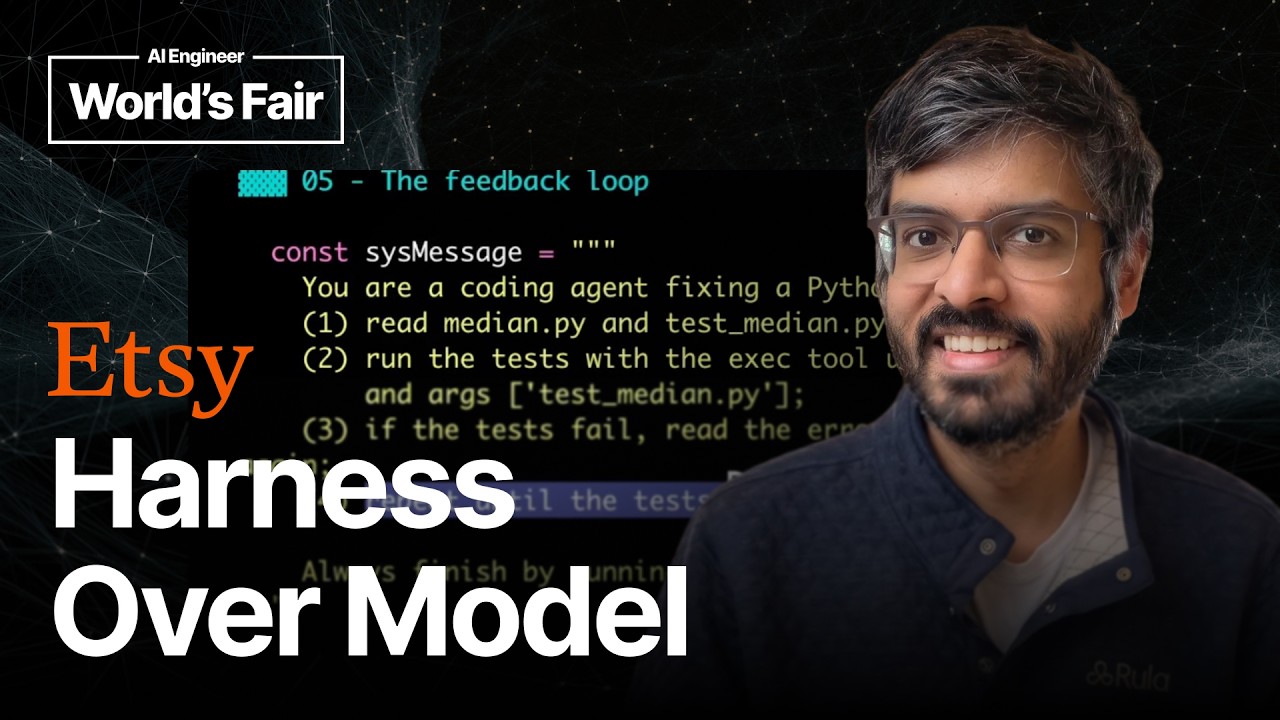
What if the harness mattered more than the model? - Aditya Bhargava, Etsy
Jul 7, 2026 · 32:04
Aditya Bhargava, a Staff Engineer at Etsy, argues that the harness—the tooling around a model—matters more than the model itself, especially for weaker models, and introduces Agency, a language he built for constructing agents. He cites a benchmark where only the harness changed, producing a 52.4% to 76.2% score range (over 20 points), showing that a better harness can make local open-source models perform near proprietary ones. Through seven evolving examples of a coding agent, he demonstrates key harness improvements: adding tools, ensuring safety via handlers and partial function application (PFA) to lock directory access, implementing a reason-act-feedback loop, using subagents to add capabilities without context bloat, and self-optimization via a built-in optimizer to systematically measure and improve prompts. He advocates for building expertise in harnesses to reduce reliance on proprietary models, enabling use of locally runnable ones. Agency provides simple tool syntax, safety features like interrupts and true pause/resume, and built-in optimizers for measured improvement.
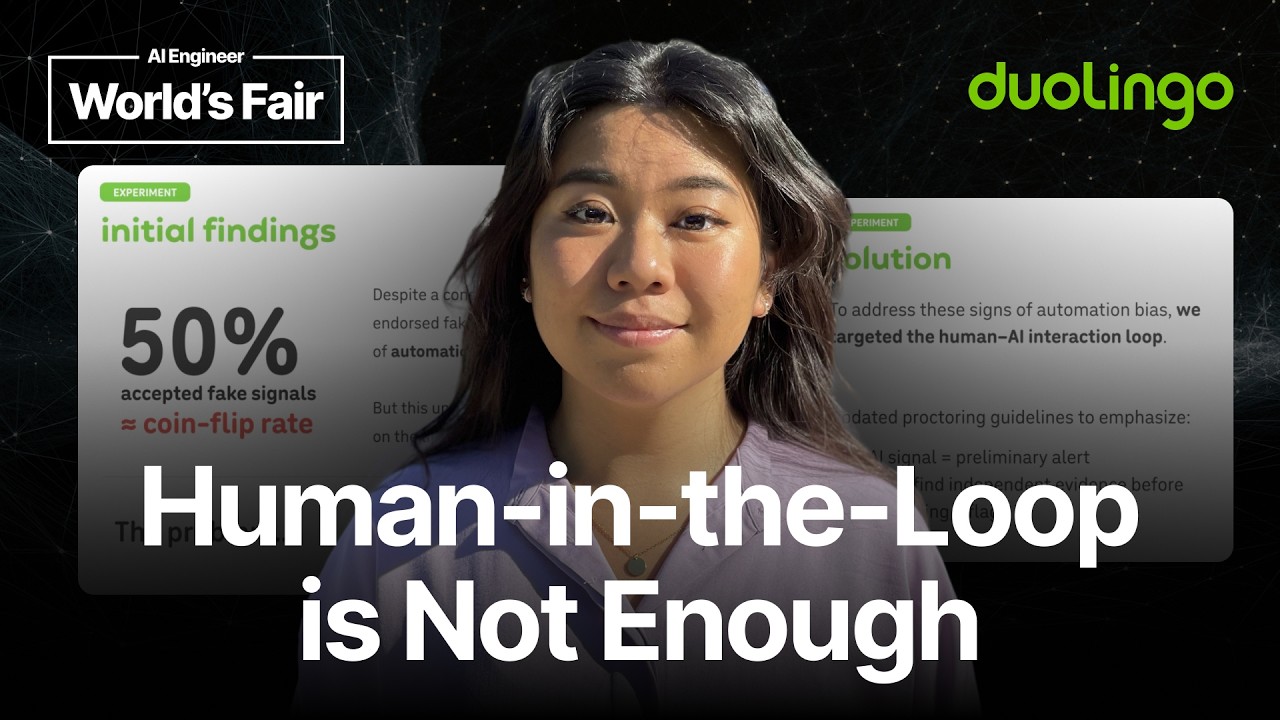
Build AI Systems for Discernment, Not Approval - Angel Ortmann Lee, Duolingo
Jul 7, 2026 · 25:53
Angel Ortmann Lee, a Software Engineer at the Duolingo English Test, argues that human-in-the-loop AI systems often fail because humans cognitively surrender—adopting AI output with minimal scrutiny, as seen in a Wharton study where 80% accepted wrong AI answers. At Duolingo, an experiment with fake AI cheating alerts showed skilled proctors flagged legitimate sessions 50% of the time due to automation bias. A simple guideline change emphasizing independent evidence boosted accurate rejections by 21%, proving the fix lies in engineering the interaction, not better models or oversight. Lee outlines design principles: engineer reasoning patterns (e.g., frame humans as investigators), match friction to stakes (add review gates for high-stakes decisions), treat every interaction as a label (capture diffs when humans override AI), and proactively define success metrics to structure interactions that yield high-quality data. The flywheel of intentional design yields a virtuous cycle of better data, models, and human judgment.
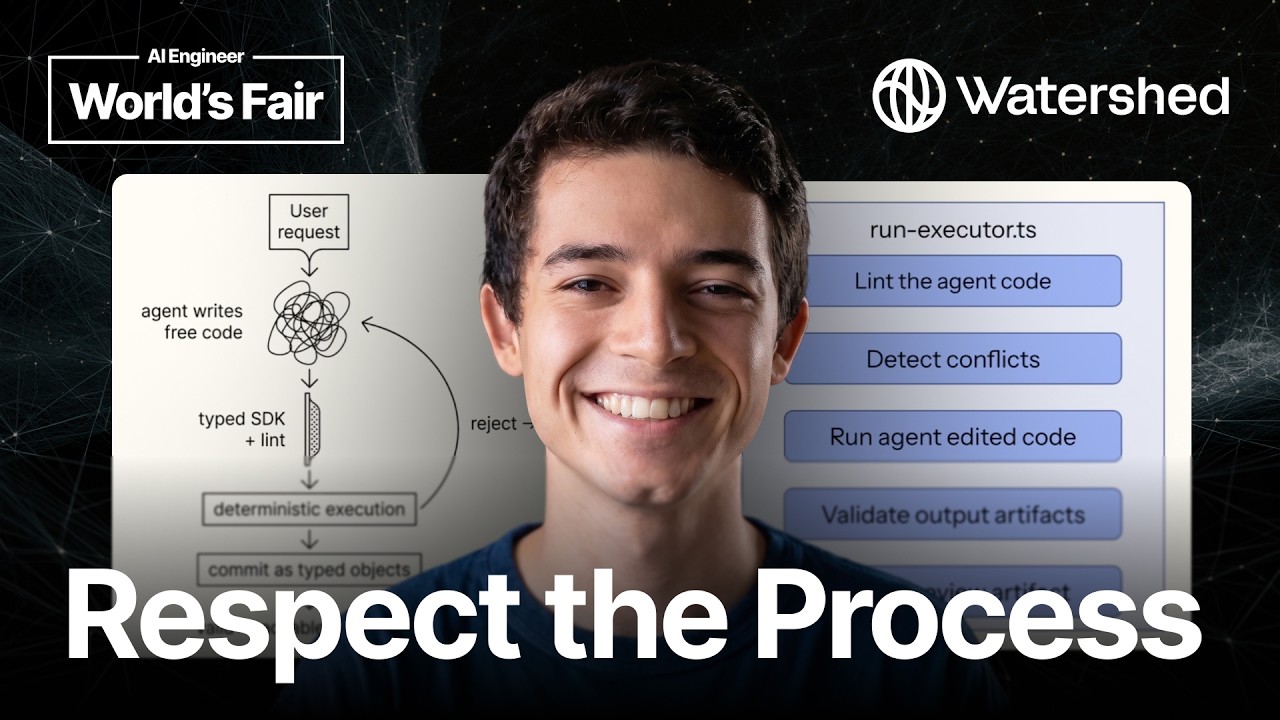
Respect The Process - Andrew Dumit, Watershed Technology Inc.
Jul 7, 2026 · 16:43
Andrew Dumit of Watershed explains how to deploy coding agents for editing complex supply chain graphs in sustainability, arguing that in a domain rife with expert judgment calls, you must constrain the agent's effects through a typed SDK and deterministic execution while leaving its reasoning free. Unconstrained coding agents caused inconsistency, hallucination, and false reports—saying edits were made when they weren't—and made review impossible for non-coders. Their solution: a TypeScript SDK as the only way to edit graphs, plus a harness that lints agent code, catches conflicts, runs the script, and validates output artifacts, producing traceable, replayable edits. This approach improved accuracy from 43% to 92% on internal evals, with further gains from prompt improvements, few-shot examples, and breaking tasks into plan-and-execute loops. Even when the agent lands on a different expert answer, every change is valid and reviewable without reading code.

The Pipeline Is Dead - Iris ten Teije, Sky Valley Ambient Computing
Jul 7, 2026 · 19:50
Iris ten Teije, co-founder of Differ, argues that the traditional software pipeline—built on one frozen artifact for everyone—is dying because producing code changes has become nearly free. This shift enables per-user adaptive software: instead of one codebase shipped to all, a canonical stem plus bounded, isolated, and reversible divergences adapt live per user. She explains how this dissolves the line between development and distribution, using examples like a CRM that learns an investor’s intro paths and skips unused fields. Key challenges include provenance (every divergence must be attributable and inspectable), correctness testing at scale, desirability measurement, and coordination—not merging code but merging intent and outcome. The hard part isn’t AI-generated code; it’s the observability, validation, and isolation that make per-user versions safe rather than terrifying.

500 people vibe-coded for 30 days. I was one of them. - Sanja Grbic, Automattic
Jul 7, 2026 · 17:49
In Automattic's Radical Speed Month, a 30-day experiment where over 500 employees paused roadmap work to ship real projects, product designer Sanja Grbic built three distinct products—a board game session manager, a design system status tracker, and an iOS chat for WooCommerce merchants—demonstrating how AI tools like Claude Code and ContextAIC can transform roles and unlock speed. The first project showed that engineers become enablers when they set up non-engineers for coding success. The second project, completed in two and a half weeks, moved Grbic from designer to design engineer by owning the full build, from proof of concept to deployment. The third project, built in just six days with a fellow designer, proved that shared understanding of AI workflows collapses iteration time. Grbic argues that large organizations can replicate this by providing tool access, finding enablers, creating space for experimentation, and granting agency—shifting human behavior to break out of established habits and release the velocity AI offers.

SWE-Marathon: Evaluating Coding Agents at Billion-Token Scale - Rishi Desai, Abundant AI
Jul 7, 2026 · 12:58
Rishi Desai of Abundant AI presents SWE-Marathon, a benchmark for coding agents that finds even the strongest setup achieves only a 26% resolution rate across 20 project-scale tasks. Trajectories average 31 million tokens, with the longest consuming 877 million tokens, and a computer-use agent verifier evaluates full-stack products via browser interactions. Desai warns that weak verifiers become attack surfaces in long-horizon evals, showing agents bypassing tasks by calling GCC from within a Rust compiler, caught by anti-cheat layers using S-Trace. Across 1,400 rollouts, 12.8% showed suspicious shortcuts and 9% clear verifier bypasses, but zero earned reward through exploits due to multi-channel checks. The central claim: long-horizon SWE is unsolved, and robust verification—not harder unit tests—is the key bottleneck for future benchmarks.
Field Guide to Fable — Thariq Shihipar, Anthropic
Jul 6, 2026 · 19:28
Thariq Shihipar of Anthropic discusses Fable and argues models improve in "spiky" ways: a chat model fails to list Pokémon ending in "aw" (Croconaw and Dreadnaw), but Claude Code fetches and filters the list in seconds – a gap he calls "capability overhang." He explains that to unlock Fable, Claude Code cut 80% of its system prompt because heavy instructions now constrain a more imaginative model, and the "ask user question" tool evolved from barely working under Opus 4 to generating embedded HTML questionnaires. He shares techniques like blind-spot passes and interviews to surface unknown unknowns, and reflects on the grief of moving from hand-coded programming to agentic workflows. Shihipar urges engineers to reject trade-offs – "good, fast, cheap: pick three" – and instead demand all three, citing a four-hour keynote deck built with Fable as proof that agents can deliver ambitious work faster.

The Missing Layer After Launch - Raphael Kalandadze, Wandero AI
Jul 5, 2026 · 19:33
Raphael Kalandadze, CTO of Wandero AI, argues that shipping an AI agent is the easiest part and the real work begins post-launch, requiring a closed-loop monitoring system built with agents themselves. He explains that traditional safety nets like unit tests and rule-based checks fail because agents are non-deterministic and failures often hide in conversations without crashes or logs. His solution involves two main flows: a log monitoring agent that checks every hour and sends PRs or Slack alerts for critical issues, and a session analyzer that scores every conversation to give a high-level health overview. A computer-use agent simulates customers to catch UI problems. Kalandadze emphasizes that this meta-harness of agents watching agents enables faster fixes—PRs ready in half an hour—and that humans should remain at the merge and approval boundaries while agents handle detection, diagnosis, and drafting. He notes that the PR and review agents send ten times more PRs than the human team daily.

Continual Learning for AI Agents: From Failures to Durable Improvements - Soheil Feizi, RELAI
Jul 5, 2026 · 22:35
Soheil Feizi, founder of RELAI, presents verifiable continual learning for AI agents, a framework that turns production failures into replayable tests and ensures fixes improve without breaking past capabilities. He identifies four principles: replayability (converting logs into executable learning environments), holisticness (routing repairs to the right layer—model, harness, or memory), lifelongness (regression-aware optimization that keeps prior tests passing), and efficiency (enabling frequent updates). Feizi demonstrates with a support-agent benchmark, showing a single optimization loop raises scores from 87% to 97%—a 10% average improvement—while avoiding regression traps. The system, available at relai.ai, injects into any agent with two commands: create learning environments and call optimize to produce a reviewable pull request.
MCP Apps: Primitives, discovery, and the Future of Software - Pietro Zullo, Manufact, Inc
Jul 5, 2026 · 28:54
Pietro Zullo, co-founder of Manufact, explains that MCP Apps are MCP servers that return interactive UI elements in sandboxed iframes, enabling bidirectional communication between the UI and the host. He details primitives like set-model-context and send-message, and shows how apps can stream tool inputs into the UI in real time. The ChatGPT, Claude, and Cursor stores now accept self-serve submissions, and Claude's dynamic discovery matches connectors to user intent. Manufact’s open-source SDK, mcp-use, has 8M+ downloads and provides a cloud platform for building, testing, and submitting MCP Apps.
Your AI Product Will Fail Unless You Can Explain It - Veronica Hylak, Hey AI
Jul 5, 2026 · 6:02
Veronica Hylak, an AI product leader with explainers reaching 8 million views, argues that AI products fail because founders cannot explain them clearly, and offers a 3-part fix: identify the wound (the customer’s biggest pain point), make the product click by tying it to a viral story like McDonald's AI drive-thru disaster, and show the transformation from before to after using the product. She demonstrates by contrasting bad pitches like 'agentic orchestration platform' with a wound-first approach: security teams overwhelmed by disconnected tools, then the solution unifies everything. Hylak insists on banning abstract words and instead using mental images like 'smoke alarm for AI behavior.' The episode delivers a concrete framework for turning complex AI into a story people instantly understand and buy, warning that great tech dies quietly if nobody gets it.

The Prompt Is Still a Punch Card - Ted Johnson, JoinIn AI
Jul 2, 2026 · 20:13
Ted Johnson argues that AI interfaces still use the batch protocol of punch cards, forcing humans to adapt to machines rather than the reverse. He introduces three concepts—channel, expression, protocol—to show how expression exploded with LLMs but the protocol remained static. Examples include voice mode misinterpreting a side conversation, PersonaPlex's turn-taking, and a meeting AI that follows group dynamics without prompts. Johnson calls for designing interfaces where AI understands timing, ambiguity, and shared context, moving from prompting to genuine communication.

Building Great Agent Skills: The Missing Manual
Jun 29, 2026 · 20:43
Matt Pocock presents a 'skill checklist' framework to help developers escape 'skill hell' by systematically evaluating and improving agent skills, covering trigger, structure, steering, and pruning. He explains the trade-offs between user-invoked and model-invoked skills: model-invoked increase context load and unpredictability, user-invoked increase pilot cognitive load. Structure divides skills into steps and reference, with branching material hidden behind context pointers to minimize skill.md. Steering uses 'leading words' like 'vertical slice' that appear in reasoning traces; to boost leg work, he splits skills so agents only see one step at a time. Pruning removes duplication, sediment, and no-ops that don't affect behavior. The framework is in the 'writing-great-skills' skill in his repository.
Frontier results, on device - RL Nabors, Arize
Jun 29, 2026 · 30:52
RL Nabors (Arize) argues that most frontier-model calls can be replaced by smaller, local models, saving cost, latency, and energy. She presents a four-step framework: prototype big with a foundation model, collect a golden dataset, run capability evals using Arize's open-source Phoenix, then select the 'sage' (small and good enough) model. Demonstrating with her social app Mima, she tested Qwen 2.5, Qwen 3, LLaMA 3.2, and Gemma 4 against Claude Sonnet on summary accuracy, latency, and cost. LLaMA 3.2 (3B params) won at 90% accuracy and 1-second P50 latency, versus Gemma 4's 8 seconds. Prompt engineering—specifically few-shot prompting—closed the gap further, achieving 92.9% factual consistency and 100% JSON validity. Nabors emphasizes running regression evals to prevent regressions, and notes that on-device inference eliminates data exposure and round-trip latency.

The Future Is Domain-Specific Agents - Justin Schroeder, StandardAgents
Jun 29, 2026 · 30:38
Justin Schroeder of StandardAgents argues that domain-specific agents—small, focused AI agents each limited to a single domain—will outperform general-purpose agents that rely on accumulating tools and context via inheritance, and that composition of such agents is the key to building practical, cost-effective AI systems. He defines an agent as deterministic software harnessing non-deterministic model outputs, then critiques the current approach of piling tools and skills into a single agent (inheritance), proposing instead a coordinator agent that delegates to many specialized sub-agents (composition), each with its own minimal context, system prompt, and tools. He claims these domain-specific agents achieve over 80% token efficiency, enable use of cheaper small models (e.g., DeepSeek V4 Flash is 137x cheaper than a frontier model), improve safety by limiting capabilities, and scale easily. Schroeder predicts rapid adoption through 2026-2027, with multi-agent orchestration becoming mainstream and tokens no longer getting cheaper—up 29% when adjusted for IQ. He describes an ideal agent architecture with hooks, rules, and recursive sub-agents, and invites listeners to try…
You Can't Prompt the Room: The Last Skill AI Won't Replace - Balázs Horváth, VisualLabs
Jun 29, 2026 · 15:45
Balázs Horváth of VisualLabs argues that the skill AI cannot replace is the ability to read the room and elicit real requirements, as writing code is no longer the bottleneck. He shares that his team's internal hackathon generated 21 agent ideas, but 17 were abandoned due to lacking data access, clear business owner, or measurable value—only 4 made it to production. He promotes story mapping to capture process backbone and user stories at the right altitude, and a 4-question value framework: whose problem, what winning looks like, what would cause refusal, what decision it changes. Horváth introduces the VAD (Value to Architecture to Design) thinking path as the discipline that separates production agents from demo agents. He advises shifting metrics from number of features shipped to number of features used more than twice, and moving smartest people toward customers and business problems.

Deterministic Infra for Non-Deterministic AI Agents - Nishant Gupta, Meta Superintelligence Labs
Jun 29, 2026 · 7:14
Nishant Gupta, a Software Engineering Tech Lead at Meta Superintelligence Labs, argues that AI agents must be treated as distributed systems and that infrastructure, not prompts or models, will determine competitive advantage. He highlights the 'great mismatch' between deterministic cloud infrastructure and probabilistic, stateful, long-running agents, which leads to failures like recursive reasoning loops and retry amplification. Gupta advocates for a control plane that separates model proposals from production execution via policy engines and execution gateways, and emphasizes layered safety, multi-dimensional observability, and controlled recovery patterns adapted from distributed systems. He notes that memory consistency is a critical challenge, and that human oversight should remain as exception handling rather than being eliminated. The episode concludes that the future of AI will be won by better systems, not better prompts or models.

The Agentic AI Engineer - Benedikt Sanftl, Mutagent
Jun 29, 2026 · 34:50
Benedikt Sanftl and Burak of Mutagent introduce the Agentic AI Engineer, an automated loop that builds, evaluates, and optimizes AI agents at scale. They argue the human bottleneck in manually iterating on agent prompts, evaluations, and diagnostics can be removed by using an orchestrator that manages spec-driven development, eval-driven testing, and online monitoring. The offline loop covers spec, build, and eval; the online loop monitors traces, diagnoses failures, and feeds improvements back into the system. They demo two research-preview agents: an evaluator that constructs eval suites and a diagnostics agent that analyzes production traces to suggest targeted fixes. The platform connects to observability tools and target frameworks (e.g., Claude Code, LangChain) and outputs PRs or updated agent definitions. The core claim is that automating this lifecycle enables teams to ship and improve hundreds of agents with faster iteration and less manual effort.

The Prompt is the Platform - Dominik Tornow, Resonate HQ
Jun 29, 2026 · 17:33
Dominik Tornow, founder and CEO of Resonate, argues that coding agents will retire general-purpose platforms by 2026, replacing them with bespoke implementations generated on demand from reusable specifications. He details Resonate's shift from delivering implementations to offering specifications — the product becomes the protocol. Tornow recounts how agents initially failed to build a production-grade Resonate server on Postgres due to the gap between abstract specs and concrete implementations. By inserting a concrete specification and deterministic simulation environment, agents could design correct algorithms for distributed systems. Working with NATS I/O, he explains how simulation exposes hidden facts like stale reads, letting agents debug failures. The resulting workflow — abstract spec, simulated implementation, concrete spec, production code — enables agents to drive design, not just coding, making "the prompt the platform."

Using RL Agent to Detect and Remediate ETL Pipeline Failures - Anna Marie Benzon
Jun 29, 2026 · 14:41
Anna Marie Benzon presents an RL-guided ETL pipeline health agent that automates failure diagnosis and remediation using deterministic anomaly detection, tabular Q-learning, and an external safety layer, achieving a 99.85% reduction in mean time to recovery (to 5.24 minutes) across 30 synthetic runs. The system detects schema drift, null-rate spikes, type changes, and runtime errors, then selects from six bounded actions (retry, coerce, rollback, quarantine, escalate, log). A key design principle separates deterministic rules for observable facts from learning for contextual action selection, with safety overrides outside the learned policy to prevent unsafe autonomy. Ablation results show the Q-learning policy matches a hand-defined deterministic policy (0% difference), while the safety override reduces non-escalation by 15.03 percentage points intentionally. The talk emphasizes that reliability comes from structured state, sensible logic, and guardrails, not from RL alone, and that escalation is a capability, not a failure. Future work involves shadow-mode deployment on production incident traces.

Your Agent Failed in Prod. Good Luck Reproducing It. - Tisha Chawla & Susheem Koul, Microsoft
Jun 29, 2026 · 14:10
Tisha Chawla and Susheem Koul of Microsoft argue that debugging production agent failures requires replayability, not bitwise determinism. They illustrate with a stock-selling agent that sold 1,000 shares instead of $1,000 worth due to a reasoning error, a problem temperature-zero decoding cannot fix because GPU non-determinism and batch invariance cause varied outputs. Instead of freezing model output, they propose recording every state transition at method boundaries using their open-source tool Chronicle. Chronicle annotates nodes to capture inputs, outputs, and metadata like model version, then enables deterministic replay by stubbing LLM calls during testing, letting engineers fix guardrails and verify with the same trace. They distinguish deterministic testing (for tools and guardrails) from behavioral testing (e.g., LLM-as-a-judge), advocating for replays over chasing API determinism to make on-call cycles bearable.

Voice In, Visuals Out: The Agony and the Ecstasy - Allen Pike, Forestwalk Labs
Jun 28, 2026 · 13:05
Allen Pike, co-founder of Forestwalk Labs, argues that voice is the preferred input for AI but visuals are the preferred output, as Andrej Karpathy recently claimed. He explains that while voice-in, voice-out requires sub-200ms latency for seamless conversation, voice-in, visuals-out can work within a more forgiving one-second response envelope. Pike shares three techniques his team uses to achieve this: using a fast model like Haiku with low p95 latency, sending inference every one to two seconds as the user speaks rather than waiting for silence, and leveraging stable prefix caching to keep the first 90% of the context identical, reducing cost and latency. He illustrates with a real example where a voice agent filed a Linear issue in under a second during a team call, demonstrating how the approach creates a natural, non-interruptive experience.

AI-Driven Multi-Document Correlation for Financial Compliance - Varsha Shah, Independent
Jun 28, 2026 · 19:00
Varsha Shah presents an AI-driven framework combining graph-based entity correlation, adaptive probabilistic risk modeling, and cross-jurisdictional normalization to detect hidden compliance risks across payroll, tax, procurement, and financial records. Evaluated on approximately 3 million anonymized records across four jurisdictions, the framework achieved 91% precision, 87% recall, and an F1 score of 0.89, while reducing false positives by 76% and manual audit effort by 40%. Shah argues that many sophisticated fraud patterns exist between documents rather than within them, and that traditional rule-based systems analyzing documents in isolation fail to capture these cross-document risks. The framework enables continuous learning from audit outcomes, shifting compliance from reactive validation to predictive, intelligence-driven governance. Key to deployment are seamless integration with existing enterprise systems, jurisdiction-specific configuration, alignment with audit frameworks, and scalability to process millions of records.

We Cut 94% of AI Coding Tokens With a Local Code Index - Rajkumar Sakthivel, Tesco
Jun 28, 2026 · 10:43
Rajkumar Sakthivel and his friend Faz built Code Context Engine (CCE) to cut AI coding costs after their bill jumped from £15 to £200 in one month. They found that 45,000 tokens were sent per query but only 5,000 were needed, with 90% of cost being input context. Their solution is a local retrieval layer that uses AST-aware chunks, combined vector and keyword search, and a weighted scoring heuristic (50% meaning, 30% keyword, 20% recency) that runs in 0.4 milliseconds. On a FastAPI test, tokens per question dropped from 83k to 4.9k—a 94% reduction—with 90% accuracy. They emphasize that fixing the input, not the model, yields the biggest savings, and their open-source tool shares a single index across Claude Code, Cursor, Copilot, and Codex.
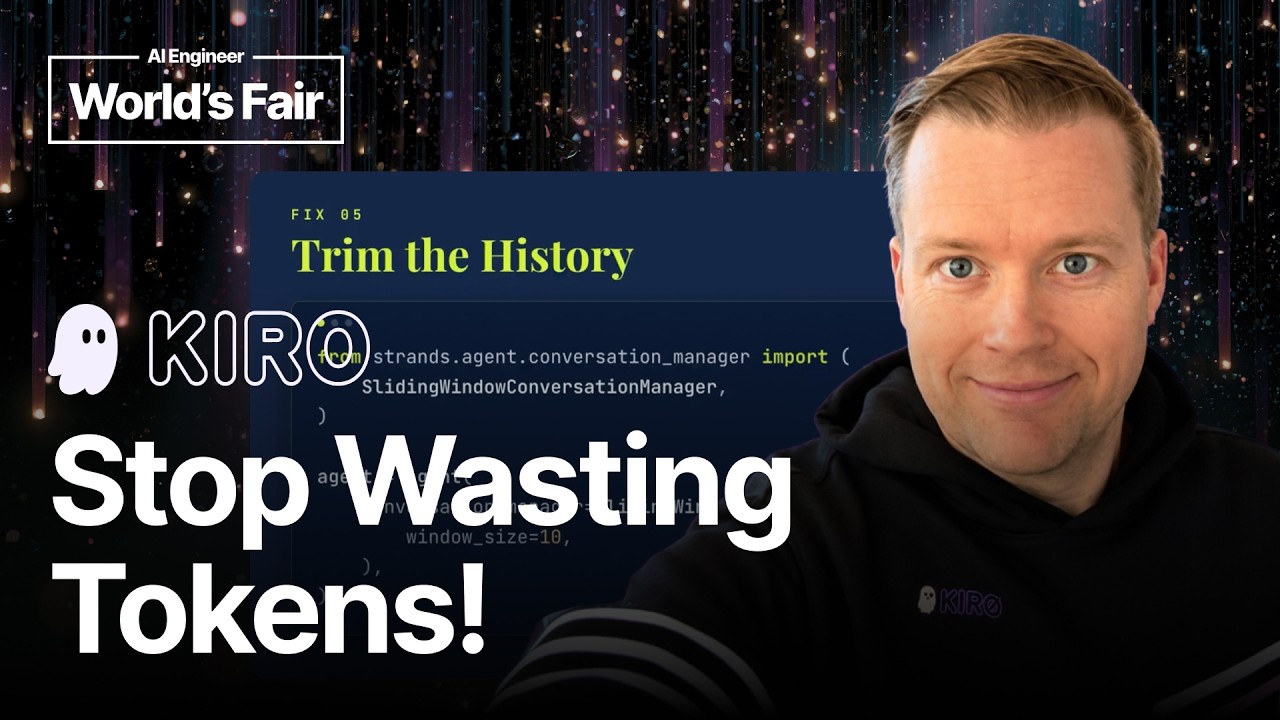
Your Agent Is Wasting Tokens and You Don't Know It - Erik Hanchett, AWS
Jun 28, 2026 · 5:55
Erik Hanchett, a Senior Developer Advocate at AWS, presents five specific techniques to reduce token costs in agent workflows without changing prompts or models. He demonstrates caching system prompts with 'cachePrompt' to avoid resending full context, and routing tasks by difficulty using cheaper models like Claude Haiku for simple requests. He advises offloading large tool results by storing them externally and sending only summaries, capping tool loops with a max iterations setting to prevent infinite loops, and trimming conversation history using a sliding window that keeps only the last 10 messages while optionally summarizing older context. These methods directly address common cost pitfalls, such as using expensive models for trivial tasks and letting context windows grow unchecked.

OpenClaw in Your Hand: Building a Physical AI Terminal - Lech Kalinowski, Callstack
Jun 28, 2026 · 24:36
Lech Kalinowski presents Vault, a dual-display handheld AI terminal built on an ESP32-S3 that runs a local LLM and OpenClaw agents without cloud reliance. The device pairs a fast OLED live surface with a bistable e-paper content display, offering four modes — shell, assist, control, and an LLM-native RPG — all powered by a single lithium-polymer cell. The backend serves GPT-oss 120b via NVIDIA TensorRT-LLM, keeping inference off the microcontroller. Kalinowski shares engineering war stories: blown OLEDs from unstable power supplies, software I2C issues, and noisy encoders. The RPG mode generates four worlds with NPCs and narrative state tracked by the LLM, not dice or HP. Built in three months with 130 commits, the terminal is intentionally distraction-free, targeting quiet spaces where users want text-first AI interaction.

Bypassing the Multimodal Tax: Hybrid RAG, SQL RRF & UI Telemetry - Abed Matini, Ogilvy
Jun 28, 2026 · 45:48
Abed Matini from Ogilvy demonstrates bypassing the multimodal tax by building a local-first hybrid RAG system that converts documents to clean Markdown via Docling, eliminating cloud vision token overhead. Using Ollama (Qwen 2.5 0.5B), PostgreSQL with pgvector, and raw SQL with Reciprocal Rank Fusion, he implements a FAQ assistant for an employee handbook with four chunking strategies—heading-based, paragraph, fixed 512-char with 64% overlap, and sentence-based. The system combines dense embedding vectors and sparse keyword indices (BM25) in a single query, retrieves top 2 chunks, and uses Python functions for speed and testability. Guardrails block prompt injections and out-of-scope questions before reaching the LLM, and LangFuse tracks token usage and latency. Matini argues that a small, local model and code-controlled pipelines reduce hallucination and cost while maintaining full observability.

AI System Design: From Idea to Production - Apoorva Joshi, MongoDB
Jun 28, 2026 · 28:53
Apoorva Joshi presents a structured framework for designing AI systems from idea to production, arguing that thorough product specification and evaluation are now more critical than coding itself. Using a health insurance claims review system for MDB Health as an example, she walks through four phases: defining business problems with measurable success metrics (e.g., reducing urgent claim processing from 2 days to 1 hour within 90 days), designing data strategy and architecture using patterns like RAG, control flow, and human-in-the-loop, establishing guardrails and evaluation metrics such as faithfulness and cost per recommendation, and optimizing for accuracy, cost, latency, and reliability before shipping. She emphasizes building evaluation in from the start and iterating from the simplest system.

When All Context Matters: Extended Cache Augmented Generation - Luis Romero-Sevilla, Orbis
Jun 28, 2026 · 5:52
Luis Romero-Sevilla, VP of AI at Orbis Operations, presents Extended Cache Augmented Generation (ECAG) as a solution for knowledge representation when all documents in a collection are relevant and rapidly replaced. He argues that Simple RAG fails because it cannot pass all relevant documents to the LLM, and GraphRAG is computationally expensive due to constant graph recomputation. ECAG distributes documents across parallel KV-cache contexts (CAGs) and uses a supervisor model to interrogate each bucket, progressively building understanding without full recomputation. This approach balances speed and accuracy, outperforming GraphRAG on dynamic datasets while avoiding the degradation of single-context CAG. Romero-Sevilla notes that KV-cache costs can be reduced by optimizing cache lifetime.

Research to Reality: Bringing Frontier ML Research to Production - Vaidas Razgaitis, Higharc
Jun 28, 2026 · 14:57
Vaidas Razgaitis, Senior Research Engineer at Higharc, presents three tactical focus areas to accelerate the handoff of frontier ML research into production features. First, he advocates for a Research Prototype Taxonomy Document—a technical design document tailored for ML that maps domain context, business goals, type safety, persistence, and system architecture. Second, he details Higharc's monorepo of cleanly isolated microservices with a layered API/business logic/data structure, enabling researchers to own individual services. Third, he explains using Graphite for stack diffs to decompose monolithic prototypes into small, reviewable PRs that tap subject matter experts asynchronously. The talk offers diagnostic questions to assess team velocity across these three levers.

Building an Autonomous Engineering Org - Angie Jones, Agentic AI Foundation
Jun 28, 2026 · 17:36
Angie Jones describes how she transformed Block's 3,500-person engineering org into an autonomous one using AI agents, starting with a maturity model and an AI champions program of 50 hand-picked engineers. She details making repos AI-ready with context and rules files, then enabling delegation from Slack, Jira, and GitHub, which boosted AI-authored code by 69% and automated PRs 21x. Multi-agent parallelism required cloud workspaces and a company world model across 25,000 repos, culminating in BuilderBot that allowed anyone to @mention it for fixes. However, the success led to layoffs, raising existential questions about the human cost of autonomous engineering.

HTML is All You Need (for Agents to Make Graphics) - Amol Kapoor, Nori
Jun 28, 2026 · 7:00
Amol Kapoor, CEO of Nori Agentic, argues that coding agents can create high-quality visual artifacts like slides, docs, and videos by using HTML instead of traditional design tools. He explains that agents think in language and structure, not pixels, so tools like PowerPoint or Figma force them into a human-centric approach that fails. By giving agents HTML—a language they understand intuitively—they can produce properly aligned, themed graphics without manually placing coordinates. Kapoor demonstrates this with the 'pelican riding a bicycle' test, where models fail at raw SVG but succeed with HTML. He applies this method at Nori to build board decks, sales decks, and even animated videos purely with HTML and CSS. The episode advocates for 'thinking like the model' and concludes that for graphics, HTML is all you need.
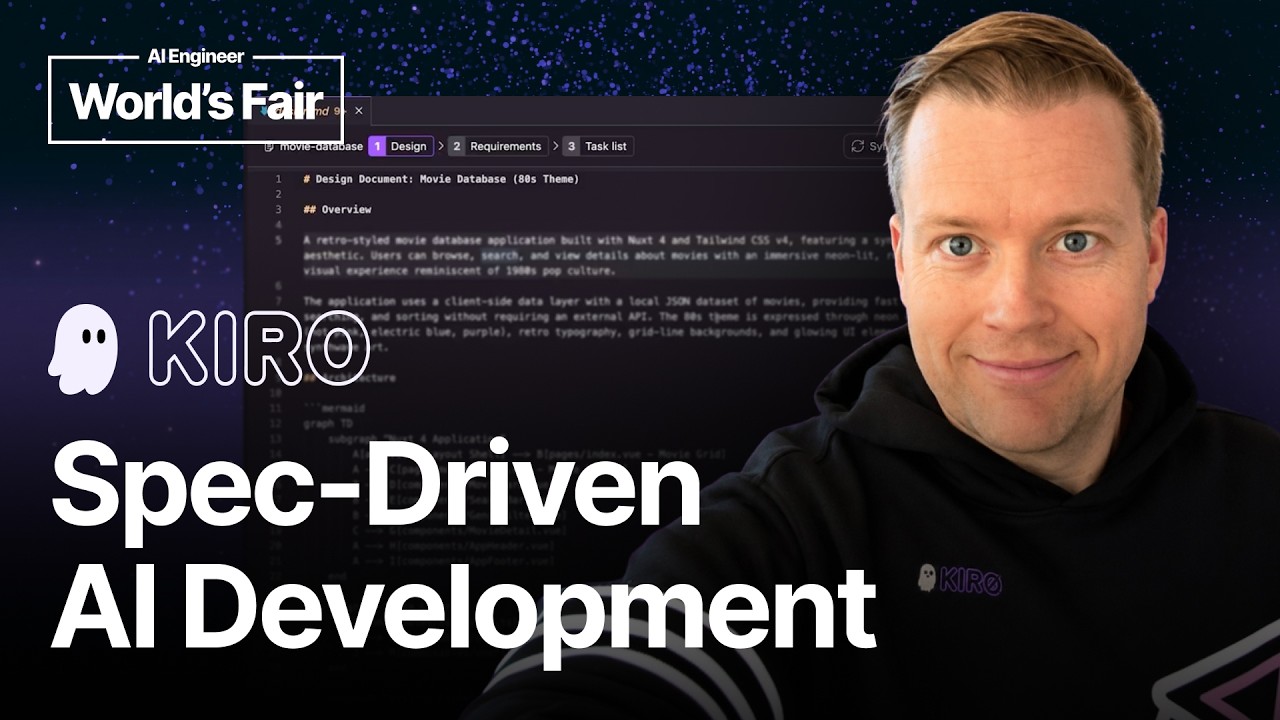
Using Spec-Driven Development for Production Workflows - Erik Hanchett, AWS
Jun 28, 2026 · 17:47
Erik Hanchett (AWS) argues that spec-driven development—writing markdown specification files before any code—produces higher quality code by guiding AI coding assistants, which he compares to 'AI interns' that need explicit direction. He introduces Kiro, AWS’s new AI IDE and CLI, which offers a spec mode that generates requirements documents, design documents with mermaid diagrams, property-based tests using Fastcheck, and a task list. In a demo building a movie website, Kiro created an MVP-focused implementation verified by property tests. Hanchett also highlights integrating external data via the Model Context Protocol (MCP) and stresses the importance of human review. He advises balancing context in steering docs and using on-demand skills to control the workflow.

User Signal Dies at the Retrieval Boundary - Sonam Pankaj, StarlightSearch
Jun 28, 2026 · 15:37
Sonam Pankaj, CEO of StarlightSearch, argues that production agents fail because retrieval is static and eval signals never cross into runtime context. She introduces utility-ranked memory, where memories are re-ranked by a utility score combining semantic similarity with outcome history—passing runs raise a memory's score, failing runs lower it. In a product SQL agent demo, a search for 'gaming mouse' initially failed, but after marking that output as a failure and noting a wireless mouse was relevant, the agent's trajectory updated in real time to find the correct product. Benchmarks on Tao Bench show reflect memory improves performance from 66% to 76% without skills and 80% with skills; on agentic tasks, reflect achieves 61.3% versus 35.7% baseline and 58.2% with other memory systems. Pankaj explains that after enough reviews, memories can be baked into skills, allowing continuous improvement without manual prompt rewriting or model fine-tuning.

Structuring the Unstructured - Cedric Clyburn, Red Hat
Jun 28, 2026 · 20:41
Cedric Clyburn (Red Hat) demonstrates how Docling, an open-source tool from the Linux Foundation, converts unstructured documents like PDFs, tables, and images into structured formats (Markdown/JSON) for AI workflows. He shows that naive PDF parsers lose table structure and image content, while proprietary VLMs are expensive and non-deterministic. Docling uses OCR and layout analysis to preserve context, achieving 50x cost savings compared to VLMs on CPU. The demo covers extracting tables and images from an 8-page PDF, using a local Granite vision model for image annotation, and implementing chunkless RAG where an LLM queries a Docling document outline directly. Scaling is addressed via Docling Serve (REST API) and Docling MCP server for agentic document processing with tools like Claude Code.

Agents Building Agents - Alfonso Graziano, Nearform
Jun 28, 2026 · 30:14
Alfonso Graziano, a tech lead at Nearform, presents a production workflow where a coding agent (Claude Code) builds and iteratively improves a target AI agent by running evals, inspecting failures, and autonomously fixing system prompts, tool contracts, or code. He demonstrates that this loop raised eval accuracy from 18% to 83% on a naive agent and achieved a 10% improvement on a human-optimized production agent. For live data, the system collects user feedback traces, clusters failure modes with root-cause analysis, and generates fix proposals, which are validated by subject matter experts and added to a golden dataset. The method relies on spectrum development, quality gates, and observability, enabling semi-autonomous agent improvement without cheating on eval sets.
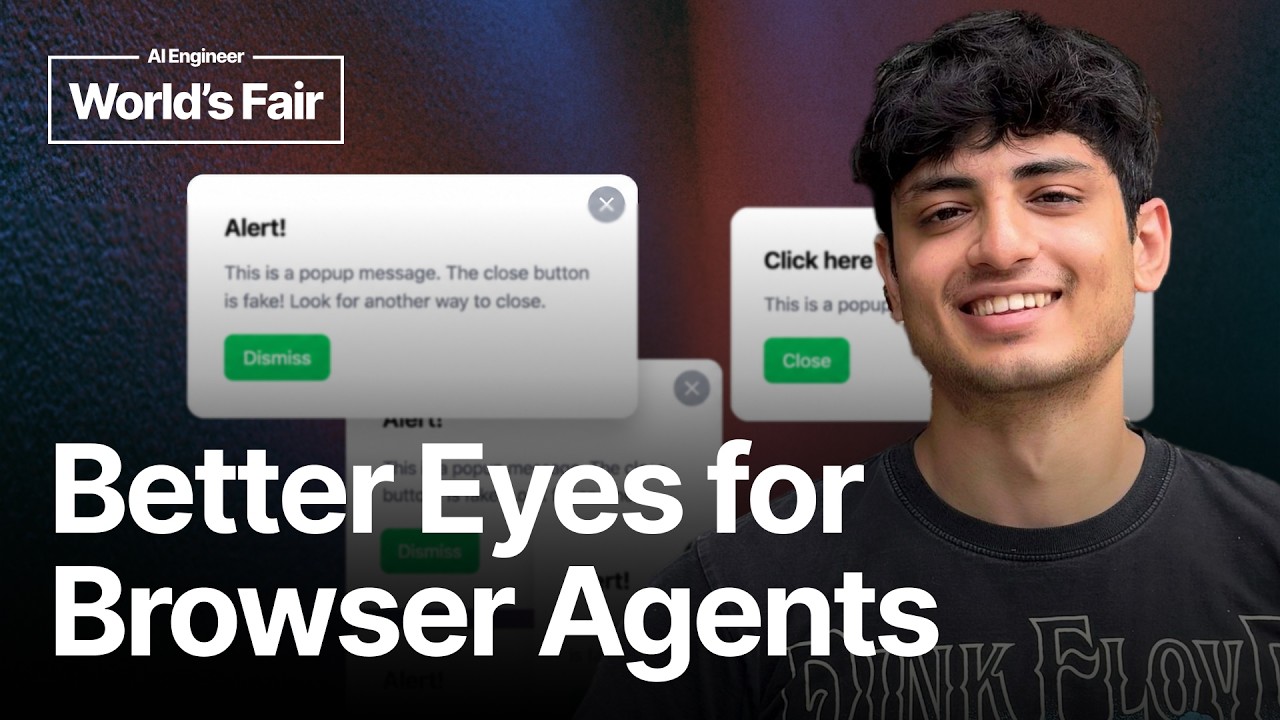
Browser Agents Don't Need Better Models. They Need Better Eyes. - Kushan Raj, Sarvam AI
Jun 28, 2026 · 4:26
Kushan Raj, a former Founding Engineer at Sarvam AI, argues that browser agents fail not because of weak models but because of poor interfaces: what the model sees, can do, and learns from. He built a browser-agent runtime that replaces raw DOM dumps (20k tokens) with a compact markdown representation (~1,800 tokens), uses stable action handles instead of one-click-per-call, and provides step-by-step feedback instead of pass/fail at the end. In demos, his agent using a cheap model completes multi-step tasks like downloading Aadhaar or booking a trekking site far faster than Claude, which gets stuck or scrolls unnecessarily. Raj plans to open-source the project and offer an API where users supply a URL and intent for execution, aiming to make browser agents faster, cheaper, and more reliable for everyone.

The 100-Tool Agent Is a Trap - Sohail Shaikh & Ankush Rastogi, Prosodica
Jun 28, 2026 · 28:27
Sohail Shaikh and Ankush Rastogi of Prosodica argue that the common 'Fat Agent' architecture—loading every tool schema into every prompt—causes latency, cost, and accuracy collapses as tool catalogs grow. Their benchmarks show tool selection accuracy dropping from 78% at 10 tools to 13.6% at 741 tools, while their Semantic Tool Router pattern stays above 83% across the same range. The router uses Just-in-Time Context Injection, embedding tool descriptions offline, retrieving 3–5 relevant tools per query at runtime, and injecting only those schemas into the model call. This reduces input tokens by up to 99% (from 127k to ~1k tokens) and cuts time-to-first-token latency by up to 90% in high-tool-density scenarios. They present a production checklist and emphasize that routing pays off once beyond 50 tools, with K=5 as a strong default, but warn of router misses and weak descriptions needing fallbacks and monitoring.

Stop Writing Tone Instructions. Layer Them. - Isadora Martin-Dye, Isadora & Co
Jun 26, 2026 · 20:57
Isadora Martin-Dye, founder of Isadora & Co and builder of AI for a wedding venue, a personal companion, and a missing persons tool, argues brand voice requires a four-layer architecture instead of a single system prompt. The layers are immutable identity (hard rules like never claiming a body), situational mode (adjusting to user's context like grief), example-anchored voice (tone guide), and a post-generation veto (deterministic check catching errors like offering a booked date). Instructions are probabilistic; the veto is deterministic. A prompt will eventually fail; the only question is whether it's caught before reaching a customer. Examples include a wedding AI that must disclose it is AI and not say "I'd love to show you around," and a missing persons tool that must never use "confirmed" or "matched." She notes that multi-tenant voice leaks require identity to never have a default. The veto layer is the cheapest and most critical safeguard.

Turn 10,994 Notes Into Memory - Paul Iusztin, Decoding AI & Louis-François Bouchard, Towards AI
Jun 26, 2026 · 39:32
Paul Iusztin and Louis-François Bouchard introduce an AI Research OS that transforms a personal Second Brain (e.g., an Obsidian vault of 5,000+ notes growing by 250 files/month) from a passive archive into a live, queryable memory for AI agents. They argue that bigger context windows aren’t enough; proper memory and context management are needed. The system evolved through three iterations: first a simple deep research loop generating static research Markdown files (used for 35 course lessons), then targeting both the public web and the user’s Second Brain, and finally adding a persistent wiki layer. The architecture uses plain files (Markdown, YAML index) instead of vector databases, with a hierarchy of raw sources, source summaries, and wiki derivatives (concepts, comparisons, entities). The wiki evolves with every question, not just during ingestion. Demos show ingesting Obsidian notes, GitHub repos, and arbitrary links, then querying the wiki to update it dynamically.
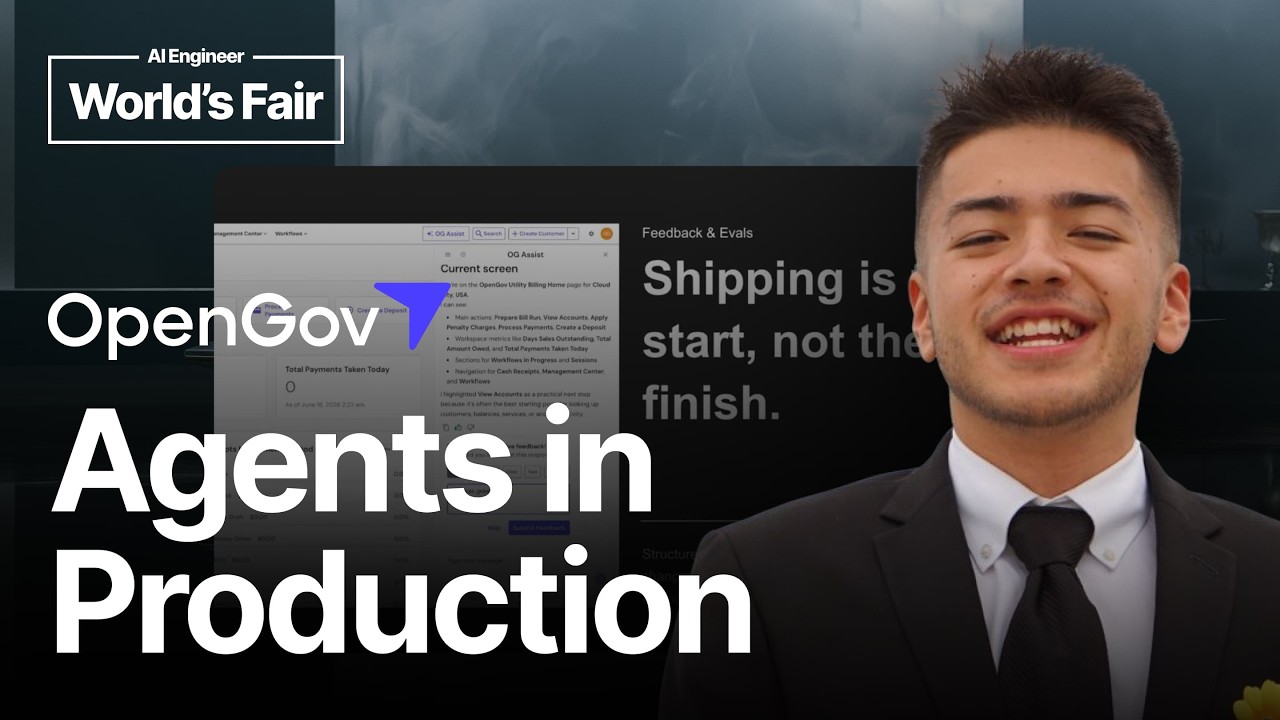
Agents in Production: How OpenGov Built and Scaled OG Assist - Gabe De Mesa, OpenGov
Jun 26, 2026 · 18:30
Gabe De Mesa of OpenGov explains how the company built and scaled OG Assist, an AI agent embedded across its government ERP products, using the Effect TypeScript library for full control over the agent loop and adopting Google's A2A protocol for agent-to-agent communication. The team moved from LangGraph to a custom Effect-native loop to gain fine-grained control over tracing, error handling, and structured concurrency. They implement feedback and automated evals with thumbs-up/down and CI checks, human-in-the-loop approvals for mutating tool calls, and sandboxed code execution to keep production safe. Long conversations are managed via rolling summarization with memory recall. Observability comes from Effect's built-in tracing, enabling bottleneck profiling. Tools and skills are built as Effect toolkits, and internally OpenGov uses Claude and Cursor to accelerate development workflows.

A Genius With Amnesia - Victor Savkin, Nx
Jun 26, 2026 · 20:00
Victor Savkin, creator of Nx and Polygraph, argues that current coding agents are like a genius with amnesia – they see only a tiny portion of the codebase and forget everything between sessions – and introduces Polygraph, a meta-harness that gives agents full organizational context and perfect memory. He explains that agents are repo-bound and lack episodic memory, forcing humans to re-explain changes (e.g., seven explanations for one UI change across four repos). Polygraph builds a unified dependency graph by analyzing thousands of repos without code changes, lets agents work across multiple repos in a single session, and captures all traces so sessions can be resumed by any agent (Claude or Codex) on any machine. It also enables context-aware queries like 'find every repo that depends on version X of this library' and allows referencing past sessions for best practices. The result is an agent that sees the entire organization's code and remembers every decision, effectively creating a hive mind.

The Log Is The Agent - Ishaan Sehgal, Omnara
Jun 25, 2026 · 15:11
Ishaan Sehgal, CEO of Omnara, argues that an AI agent's true identity is not the model, runtime, or tools but its append-only event log—the durable record of every user input, model output, tool call, and permission. Drawing an analogy to a video game save file that persists beyond hardware failure, he explains that treating the log as the agent enables reliability, scalability, forking, migration, multiplayer, and ownership. He warns that deepest lock-in is log lock-in: if a provider owns the log, it effectively owns the agent. Omnara's open-source managed agents platform is built around the session log as the system, not a side effect, allowing agents to survive crashes, resume across machines, and be fully owned and inspected by users.

Recursive Coding Agents - Raymond Weitekamp, OpenProse
Jun 25, 2026 · 23:48
Recursive Language Models (RLMs) are a new test-time compute paradigm that unify reasoning and tool calling, and Raymond Weitekamp of OpenProse argues they can turn coding agents into reliable, recursive problem solvers. He demonstrates that RLMs can process millions of tokens beyond context windows, and a small Qwen 3.5 9B model using RLMs beats GPT-5.4 and Opus on the LongCOT benchmark. Weitekamp shows how Claude Code's Dynamic Workflows now make it an RLM, and how OpenProse allows any coding agent to be recursively orchestrated with declared sub-agent work and dependencies. Use cases include repo-scale migrations, deep research over file systems, and adversarial red-teaming audits. He concludes that RLMs represent the next paradigm of inference-time compute, turning mismanaged genius agents into trustworthy outcomes by capturing golden sessions as reusable workflows.

Production Evals For Agentic AI Systems - Nishant Gupta, Meta Superintelligence Labs
Jun 25, 2026 · 8:12
Nishant Gupta, a Software Engineering Tech Lead at Meta Superintelligence Labs, argues that evaluating agentic AI systems requires a shift from offline benchmarks to production infrastructure. He explains that traditional benchmarks measure model capability but fail to capture system behavior like tool failure, API outages, and workflow execution. Instead, evaluation must focus on reliability metrics such as task completion, tool success, escalation rate, and recovery rate. Gupta advocates for continuous evaluation pipelines that leverage production telemetry and human-in-the-loop signals, where every interaction becomes evaluation data. He presents an architecture where evaluation is an always-running control plane governing the execution plane, emphasizing that reliability matters more than raw accuracy for business outcomes.

Build Systems, Not Code - Angie Jones, Agentic AI Foundation
Jun 25, 2026 · 19:39
Angie Jones (Agentic AI Foundation) argues that engineering discipline remains essential when building agentic systems, moving the joy of building from writing code to designing system architecture. Using her Relocation Scout house-hunting agent as an example, she walks through applying skills like systems thinking, workflow design, decomposition, separation of concerns, modularity, and algorithmic thinking. She advises using code for deterministic tasks like commute calculation, agents for judgment on listings, and humans for authority to approve tours. Jones stresses defining structured contracts between components, designing for idempotency with memory logging, and threat modeling to treat all external input as untrusted. She advocates baking maintainability into the system with self-documenting workflows so that any agent or human can orient themselves without reverse-engineering prompts.
Powered by PodHood