
All episodes
Page 10 of 23
1,115 episodes

Viktor: AI Coworker That Lives in Slack — Fryderyk Wiatrowski
May 11, 2026 · 19:30
Fryderyk Wiatrowski, co-founder of Viktor, explains how his AI employee lives in Slack—no web UI—participating in channels and threads like a teammate, inheriting integrations from whoever connected them first, and handling tasks that take ten minutes. He details the challenges of scaling a personal agent to a company agent: memory management across hundreds of users, managing Slack's complex input surface (threads, DMs, edits, emoji reactions), and preventing context leakage between channels. He shares that swapping the underlying model from Opus to GPT-5.4 caused user backlash due to personality differences, and describes the need to earn proactivity trust to avoid security alarms. Viktor's advantage is shared context—only one person needs to connect an integration for the whole team—but warns against giving it personal email access, as illustrated by a customer story. The episode argues that a great AI coworker requires helping get work done, knowing the company context, and being friendly.
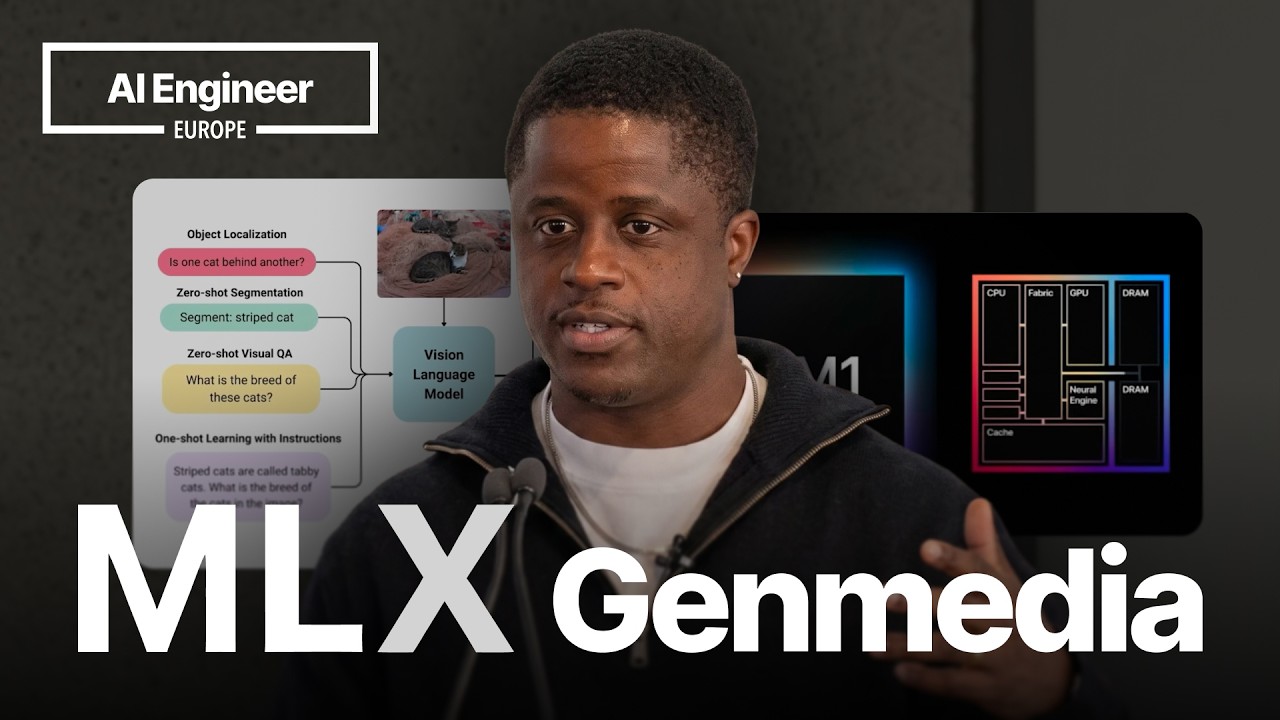
Why MLX — Prince Canuma, Neywa Labs
May 11, 2026 · 23:10
Prince Canuma argues that on-device AI, powered by Apple's MLX framework, is a viable alternative to cloud-dependent services, especially for users in regions with unreliable internet. MLX, an array framework for Apple Silicon, has reached 1.5 million downloads and 4000 ported models, including day-zero support for Gemma 4 and Qwen 3 Omni. Canuma demonstrates real-time vision models (e.g., RF Deter for object detection), sub-100ms text-to-speech via Marvis TTS, and modular speech-to-speech pipelines that run entirely on-device. Community projects showcased include a native voice app (Locally), a robot with real-time voice cloning, and a video generation system that chains coherent stories on 16GB VRAM. A recent breakthrough, Turbo Quant, reduces KV cache by 4x, enabling 1 million context windows on-device. Canuma emphasizes that these capabilities provide accessibility for his blind father and enable agents that hear, see, and respond without phoning home.

Two Roads to Durable Agents: Replay vs. Snapshot — Eric Allam, CEO, Trigger.dev
May 10, 2026 · 16:36
Eric Allam, CEO of Trigger.dev, argues that durable agents require two separate strategies: context durability via an append-only log of LLM interactions, and execution durability via OS-level snapshot and restore. He contrasts this with the replay model, which wraps every step in a journal but becomes unwieldy as agents run for hours. Trigger.dev built snapshot-and-restore on Firecracker microVMs, achieving snapshots as small as 14 MB compressed with sub-second save and hundred-millisecond restore times. The approach preserves files, memory, and subprocesses that a journal cannot capture. Allam notes that IBM mainframes in 1966 pioneered checkpointing, and that Trigger.dev will open-source the tool as FCRun.
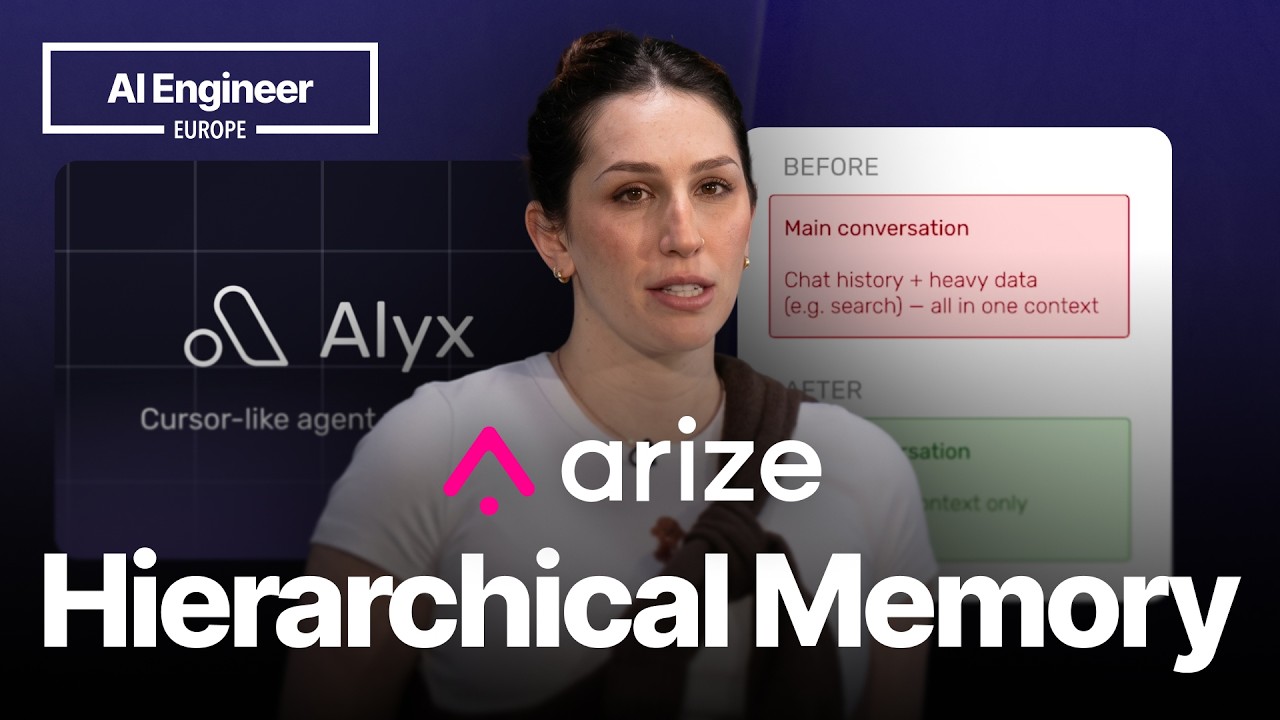
How we solved Context Management in Agents — Sally-Ann Delucia
May 10, 2026 · 16:17
Sally-Ann Delucia of Arize explains how her team solved context management for their AI agent Alex, which analyzes trace data from Arize's observability platform. She details the failure of naive truncation and LLM summarization, and the success of smart truncation preserving head/tail with a retrievable memory store. Long sessions are handled with evals that test context at every 10 turns, and heavy tasks are offloaded to sub-agents to keep main context lean. She notes that Claude Code uses a similar truncation strategy, and emphasizes that context engineering matters more than prompt engineering for agent success.
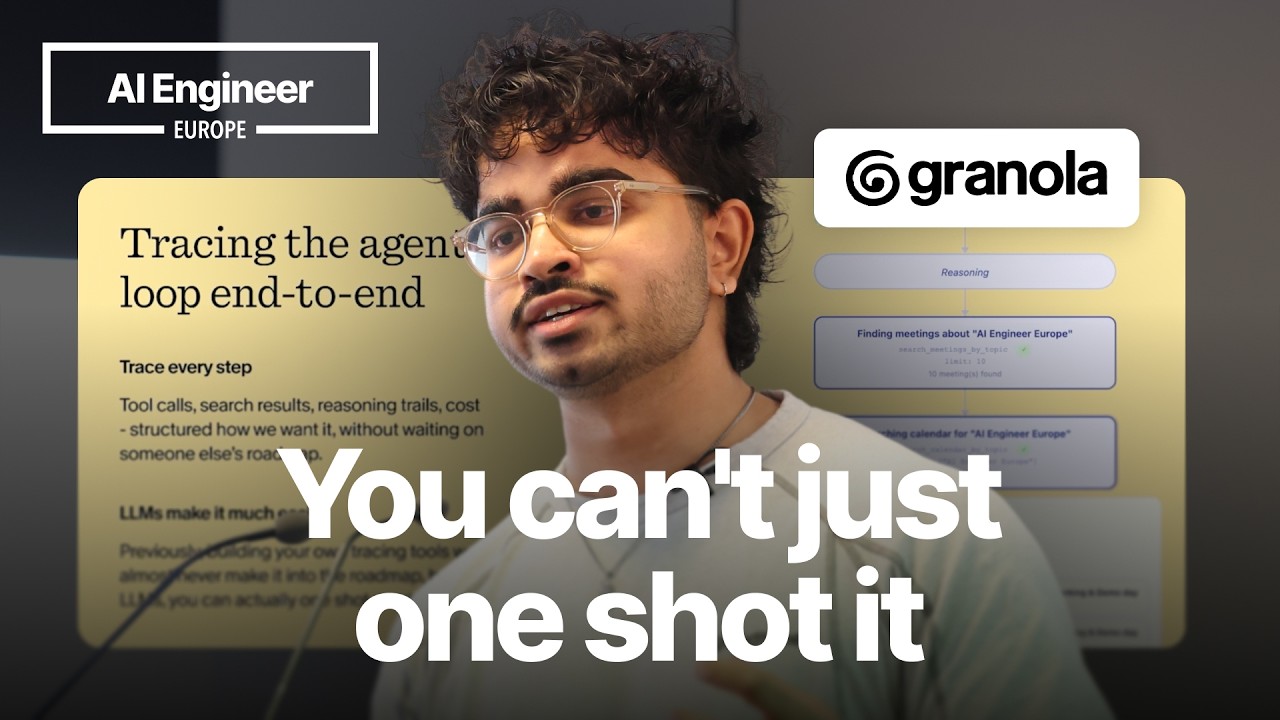
Feedback Loops are All You Need — Mehedi Hassan, Granola
May 10, 2026 · 10:11
Mehedi Hassan, a product engineer at Granola, argues that shipping AI features into production requires building feedback loops rather than one-shotting better prompts. Granola's chat feature for meeting notes revealed problems with web search — token costs ballooning to 10p per chat, overnight provider updates silently degrading results — and with prompt personalization, as a single prompt cannot serve salespeople, engineers, and HR managers equally. To close the gap, Granola built custom internal tracing exposing tool calls, search trails, reasoning, and cost in a UI accessible to non-engineers, not just CloudWatch queries. They also refactored their Electron app's renderer to run as a web app, enabling preview links on every PR and allowing Cursor to automatically test changes and upload screenshots. The result is faster iteration and confidence that shipped features actually work for customers.

Why TTS Models Now Look Like LLMs — Samuel Humeau, Mistral
May 9, 2026 · 22:26
Mistral AI scientist Samuel Humeau explains why text-to-speech models now resemble LLMs, using an autoregressive transformer with neural audio codecs to compress 200 kbps audio into ~500 tokens per second. He demos Mistral's open-weight TTS model, cloning a voice from a few seconds of reference audio and generating speech with 17 ms first-token latency via frame-by-frame streaming. The talk covers the codec-backbone-decoder pipeline, the model's 4B-parameter backbone generating 37 tokens per 80 ms frame via a diffusion decoder, and a live voice agent answering conference schedule questions. Humeau notes the next latency win is handling streaming text input from an LLM, with no settled architecture yet, while keeping the encoder for voice cloning proprietary.
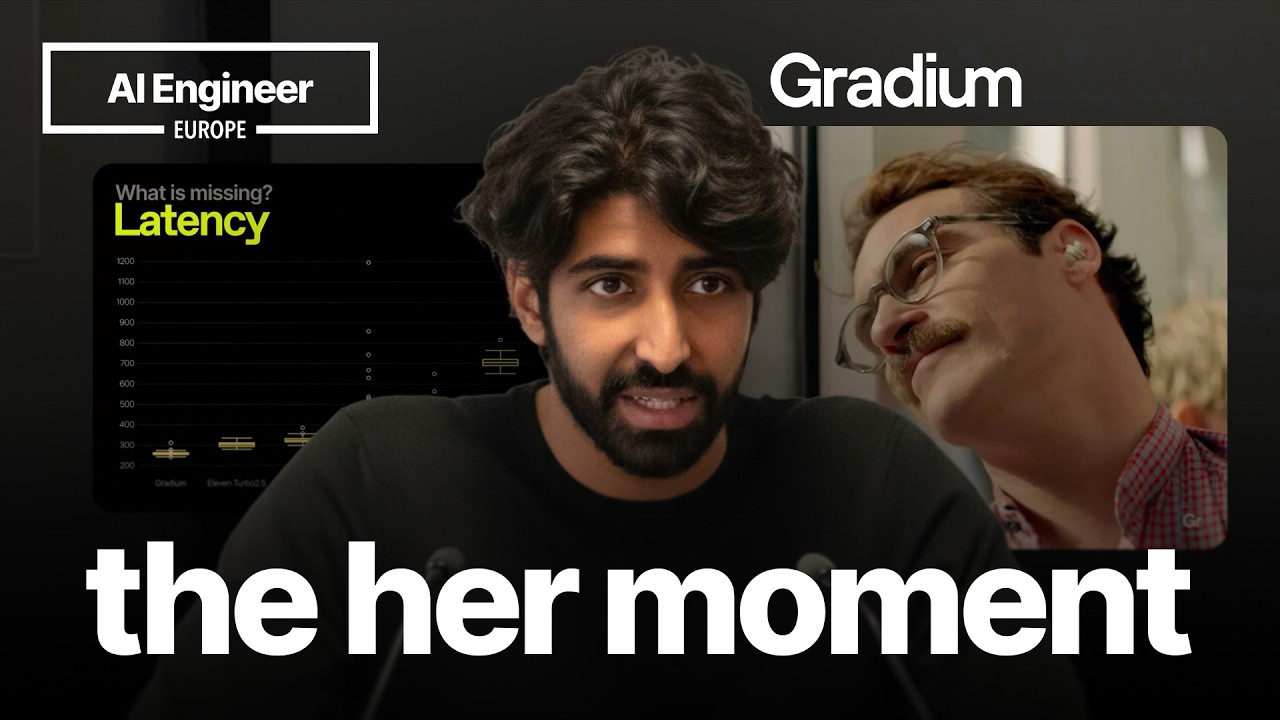
Voice AI: when is the "Her" moment? — Neil Zeghidour, CEO, Gradium AI
May 9, 2026 · 19:27
Neil Zeghidour, CEO of Gradium AI, argues that voice AI remains far from the 'Her' ideal because cascaded systems (speech-to-text, LLM, text-to-speech) suffer from high latency—tool calls alone add 500ms to 4 seconds—while human response time is ~200ms. Speech-to-speech models reduce latency but are half-duplex, meaning they cannot handle overlapping speech or backchanneling, unlike Moshi, Gradium's full-duplex model. However, Moshi lacked intelligence, tool calls, and paralinguistic understanding—the ability to infer tone, hesitation, or discomfort from voice, which is stripped away in text. Cost is another barrier: TTS bills burn through fundraising before user bases grow. Gradium's solution is Phonon, an on-device TTS model running on smartphone CPUs, offering privacy and eliminating API fees. The path forward requires combining full-duplex natural conversation with the reliability and smarts of cascaded systems.

Give Your Chat Agent a Voice — Luke Harries, Head of Growth, ElevenLabs
May 9, 2026 · 8:12
Luke Harries from ElevenLabs argues that the next upgrade for chat agents is a voice layer, not smarter prompts or RAG, and introduces the company's Voice Engine to wrap existing agents via a few lines of code. He demonstrates how text-in, text-out chat agents can be converted to voice agents using a single prompt, leveraging ElevenLabs' advanced turn-taking, emotion-aware interruption detection, and Scribe for speech-to-text. The Voice Engine provides server and client SDKs, plus Shadcn-based UI components, enabling omni-channel deployment like phone calls and Zoom. Harries also addresses tool calling, noting that the wrapper proxies calls to existing agent logic without rebuilding. He predicts that chat agents will either adopt voice or become obsolete.

How Transformers Finally Ate Vision – Isaac Robinson, Roboflow
May 8, 2026 · 17:05
Isaac Robinson, research lead at Roboflow, explains why transformers ultimately beat convolutional neural networks for vision, arguing that massive ViT-specific pretraining and borrowed infrastructure from LLMs overcame the transformer's lack of inductive bias. He traces the evolution from ViT and Swin (windowed attention reducing complexity to n²) through ConvNeXt (reintroducing convolution with transformer-style blocks) to Hiera (stripping biases and recovering them via MAE pretraining), and back to the simple, scalable ViT. Robinson highlights that pretraining methods like MAE and DINOv3 learn the inductive biases CNNs have built-in, while tools like FlashAttention from the LLM world nullify ViT's n⁴ compute scaling penalty. In practice, this pattern appears in the SAM model series: SAM used a ViT backbone, SAM2 switched to Hiera with MAE, and SAM3 returned to the simple ViT. However, these massive models lack deployment flexibility; Roboflow's RF-DETR uses neural architecture search on a foundation model backbone to generate a family of high-performance models, achieving up to 40× speedup over fine-tuning SAM3 while outperforming real-time convolutional detectors.

FLUX, Open Research, and the Future of Visual AI — Stephen Batifol, Black Forest Labs
May 8, 2026 · 22:32
Black Forest Labs (BFL), the team behind Stable Diffusion and Latent Diffusion, has released a series of open FLUX image models pushing toward visual intelligence. After FLUX.1 and the first open-source editing model FLUX Kontext (7–8 second edits), FLUX.2 achieved state-of-the-art text-to-image and multi-reference editing, and FLUX.2 Klein generates and edits in 300–500 milliseconds for near real-time use. BFL also published Self-Flow, a scalable self-supervised approach that trains multimodal models across images, video, audio, and actions without external encoders, outperforming baselines in all modalities. The episode explains how Self-Flow reduces artifacts (e.g., corrects text rendering and anatomy) and converges 70× faster with representation alignment. BFL’s roadmap includes world models that simulate geometry and interaction, aiming to train agents for robotics and automation.
Agentic Search for Context Engineering — Leonie Monigatti, Elastic
May 8, 2026 · 1:03:13
Leonie Monigatti from Elastic argues that context engineering is 80% agentic search—the search tool that decides what to pull from files, databases, memory, and the web. She identifies three failure modes: the agent not calling any tool, calling the wrong tool, or generating incorrect parameters, and shows how detailed tool descriptions and agent skills (progressive disclosure) reduce these. In demos, semantic search fails for keyword 'JEPA' due to embedding similarity; a general-purpose ESQL tool with an agent skill correctly queries the database. Shell/bash tool enables file system search but requires iterative grep, while the custom Gina Grap CLI provides semantic grep for fuzzy queries. Practical recommendations: start with general-purpose tools, log agent behavior, and add specialized tools for frequent queries to balance low floor (easy successes) and high ceiling (complex queries). Hybrid agents combining shell and database tools achieve higher accuracy by verifying results.

Agent Optimization with Pydantic AI: GEPA, Evals, Feedback Loops — Samuel Colvin, Pydantic
May 7, 2026 · 1:20:40
Samuel Colvin shows how to improve production agents without redeploying using Pydantic AI's GEPA, evals, and Logfire managed variables. GEPA uses a genetic algorithm to evolve prompts, achieving 96.7% accuracy — up from 87% with a simple prompt and 92% with an expert prompt — on a Wikipedia-based political relations task. Managed variables let you update prompts, models, and parameters live via a web interface and A/B test targeting. Evals compare against a golden dataset of 650 MPs; Colvin runs 65 cases in 30 seconds using GPT-4.1. He discusses that prompt optimization is most valuable with private data, that implicit user feedback (e.g., user's next action) can build golden datasets, and that overfitting to small test sets is a risk — the GEPA optimizer may exclude valid relations like 'uncle' if they don't appear in the training split.
Vibe Engineering Effect Apps — Michael Arnaldi, Effectful
May 7, 2026 · 1:43:04
Michael Arnaldi demonstrates that cloning the Effect library's repository into a project, rather than relying on prompts, is the most effective way to give coding agents the context they need to build reliably with Effect. Starting from an empty repo, he sets up a Bun, Vitest, and TypeScript project, adds the Effect repo as a git subtree, and creates an agents.md to guide the agent. He then uses the agent to research patterns, resulting in a fully functional Todo HTTP API with OpenAPI docs, SQLite persistence, and tests — all from scratch in under two hours. The workshop stresses that treating the library code as part of the project, combined with strict diagnostics and pattern files, makes agents effective even in unfamiliar codebases. Arnaldi also discusses the importance of workflow systems like Effect Cluster for long-running AI processes, where server failures become likely.
Everything You Need To Know About Agent Observability — Danny Gollapalli & Zubin Koticha, Raindrop
May 7, 2026 · 50:25
Zubin Koticha and Danny Gollapalli of Raindrop argue that agent observability must shift from evals to production monitoring because agent failures are non-deterministic and unbounded. They break down explicit signals (tool error rate, latency, cost) and implicit signals (user frustration, refusals, task failure) detected by trained classifiers and regex, emphasizing that aggregate patterns even from imperfect regex are valuable. Experiments let teams ship changes to a percentage of users and compare semantic signal rates, with statistical relevance often reached after a few hundred events. Self-diagnostics—a simple tool and system prompt—enable agents to report their own failures, capability gaps, and even self-correction behavior, as demonstrated in a live coding agent demo where a disabled write tool caused the agent to use bash and then report the bypass. The episode covers alerting, trace visualization, data export to BigQuery/Snowflake, and the challenge of managing fast-paced experimentation at scale.

Full Walkthrough: Writing & Using Skills — Nick Nisi and Zack Proser
May 6, 2026 · 1:21:03
Zack Proser and Nick Nisi, Developer Experience Engineers at WorkOS, teach how to write portable, composable skills — single markdown files with optional scripts — that train AI tools like Claude, Codex, and Cursor to perform specific tasks consistently. They demonstrate building a repo roast skill that uses deterministic Git commands via script interpolation and progressive disclosure to load targeted references only when needed. The workshop covers structuring skills with front matter (name, description for LLM routing), adding confidence scoring and constraints to improve output, and sharing skills as .skill files or through marketplaces. Advanced topics include using skills in non-coding workflows (e.g., Slack–Linear automation) and composing skills in the WorkOS CLI, which uses the Claude Agent SDK to install auth. Attendees learn to iterate skills by reflecting on past conversations and leveraging Claude's built-in skill builder for evaluation.
The Multi-Agent Architecture That Actually Ships — Luke Alvoeiro, Factory
May 6, 2026 · 18:31
Luke Alvoeiro from Factory presents Missions, a multi-agent architecture that combines delegation, creator-verifier, broadcast, and negotiation into a three-role system of orchestrator, workers, and validators. The central claim is that human attention, not AI intelligence, is now the bottleneck in software engineering. Missions uses validation contracts written before any code to define correctness independently, structured handoffs to maintain context across 16-day runs, and serial execution with targeted internal parallelization to reduce errors. Strategic model selection per role—planning, implementation, validation—compounds advantages across model generations. Production data from building a Slack clone shows 60% of time and tokens spent on implementation, validation never succeeds on first go, and 50% of final code lines are tests with 90% coverage. The system is designed to improve with each model release by keeping orchestration logic in prompts and skills rather than hard-coded state machines.
MCP UI: Extending the frontier — Liad Yosef and Ido Salomon, MCP Apps
May 6, 2026 · 22:21
In this episode, Ido Salomon and Liad Yosef explain MCP Apps, an MCP extension that lets tools send interactive, branded UI instead of plain text responses inside chat hosts like ChatGPT, Claude, VS Code, Cursor, and Copilot. They argue that text-based chat reduces companies to a wall of text, erasing identity, while MCP Apps preserves branding by returning HTML resources that hosts render as secure, interactive components. The architecture ensures every user click sends a message back to the host (not directly to the backend), keeping interactions in context—as demonstrated with a PostHog funnel analysis in Claude. Adoption includes Shopify, Hugging Face, GitHub, ChatGPT, and Claude, with ChatGPT recommending MCP Apps for building ChatGPT Apps. They note 800 million weekly ChatGPT users (10% of world population), calling this a once-in-20-years opportunity to rethink app distribution. Future work covers reusable views, model-UI interaction, and interoperability with generative UI protocols like A2UI and WebMCP, aiming to standardize UI in chat as the new web.

The Small Model Infrastructure Nobody Built (So We Did) — Filip Makraduli, Superlinked
May 5, 2026 · 18:30
Filip Makraduli of Superlinked introduces SAI, an open-source inference engine for small models that addresses gaps in embedding infrastructure by enabling dynamic model loading, hot-swapping, and memory-aware eviction on a single GPU. He argues that provisioning separate GPUs for each small model wastes idle capacity, and that the real challenge lies in supporting diverse model architectures (e.g., BERT, Qwen, Colbert) with different attention mechanisms and positional embeddings. The engine re-implements forward passes with variable-length FlashAttention and handles model swapping via a least recently used eviction policy. Makraduli also explains that context management for agents requires small models to pre-process data, referencing Andrej Karpathy’s graph-based knowledge bases and Chroma’s own model. The talk details the infrastructure layer including routing, auto-scaling with Prometheus, and GPU provisioning using spot instances, all open-sourced as SAI (Superlinked Inference Engine) with Helm charts and Docker images.

Accelerating AI on Edge — Chintan Parikh and Weiyi Wang, Google DeepMind
May 5, 2026 · 23:58
Chintan Parikh and Weiyi Wang from Google DeepMind present Gemma 4E edge models (2B and 4B) and the LiteRT framework for on-device AI, arguing that edge AI delivers latency, privacy, offline capability, and cost savings. The Gemma 4E models introduce agentic capabilities including built-in function calling, structured JSON output, and chain-of-thought reasoning, all optimized for hardware-native support across CPUs, GPUs, and NPUs. LiteRT supports cross-platform deployment on Android, iOS, macOS, Linux, Windows, and IoT devices like Raspberry Pi, with a CLI tool and AI Edge portal for benchmarking. Performance benchmarks show up to 56 tokens per second on iOS, 30x speedups with NPU acceleration, and 35x faster than Llama on mobile. The Gallery app demonstrates on-device skills such as Wikipedia querying, mood tracking, photo-to-music generation, and voice agents, with open-source code and a Hugging Face repository. Q&A addresses use cases like local security camera face recognition, LiteRT vs TensorRT on Orin, multi-agent architectures, and audio model support.
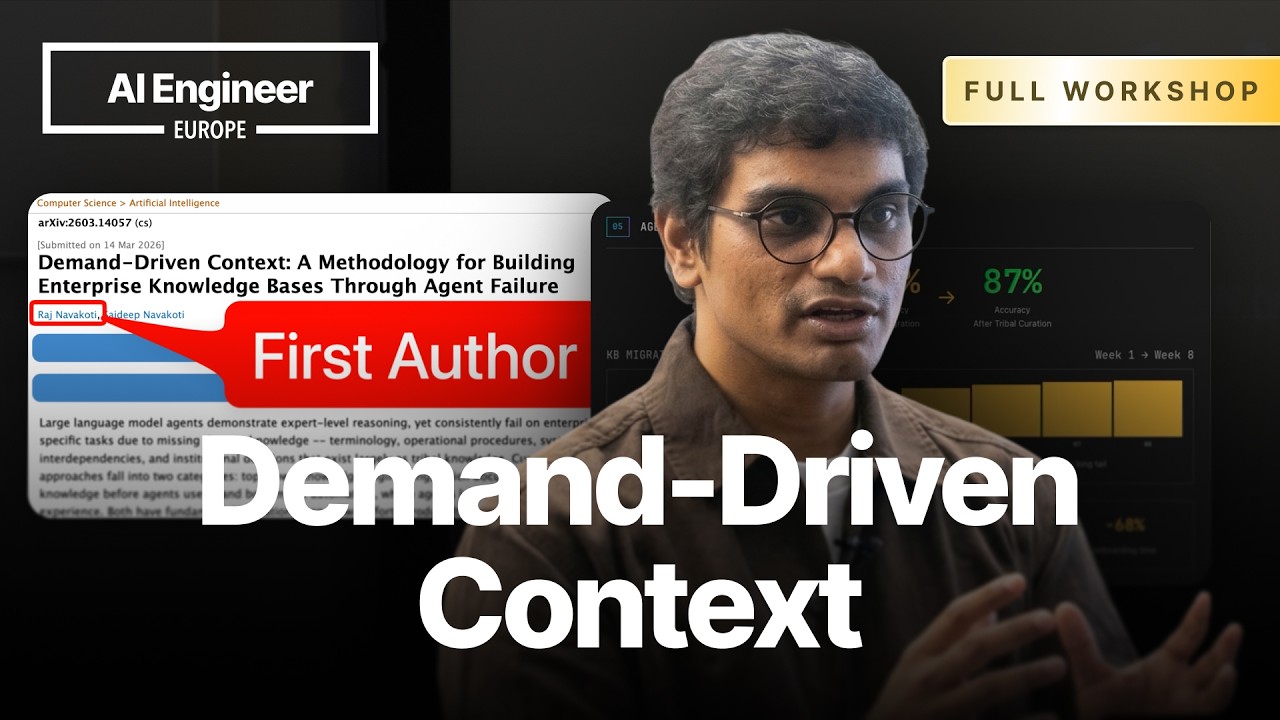
Demand-Driven Context: A Methodology for Coherent Knowledge Bases Through Agent Failure
May 5, 2026 · 1:08:15
Raj Navakoti, a staff software engineer at IKEA, presents a demand-driven context methodology for building coherent knowledge bases by letting AI agents fail on real problems and surfacing missing institutional knowledge. He argues that enterprises should shift from pushing monolithic documentation to a pull approach where agents reveal undocumented tribal knowledge through repeated failures on incidents and Jira tickets. Using a framework with skills, rules, and hooks, he demonstrates how agents can gradually improve confidence scores (from 1.4 to 4.4 over 14 incidents) by documenting discovered context blocks. Navakoti introduces a context gap scanner that automatically analyzes work items against existing documentation to identify critical gaps, outdated information, and duplications. He advocates storing curated knowledge in GitHub for version control and PR-based collaboration, and emphasizes that this approach helps teams know the unknown, enabling agents to manage knowledge rather than just consume it.

Training an LLM from Scratch, Locally — Angelos Perivolaropoulos, ElevenLabs
May 4, 2026 · 1:21:26
Angelos Perivolaropoulos from ElevenLabs walks through building a small GPT-2-like LLM from scratch on a local machine, demonstrating that the core techniques used by major labs are accessible in a few hundred lines of PyTorch code. The workshop uses character-level tokenization (65 tokens) on a Shakespeare dataset to enable fast training with limited compute. The model architecture includes multi-head self-attention, MLP layers, residual connections, and layer normalization, totaling 10 million parameters across six transformer blocks with a 256-token context window. The training loop employs next-token prediction with a warm-up cosine decay learning rate schedule and validation loss to detect overfitting. Inference uses temperature sampling (default 0.7) and top-k sampling to improve creativity. Perivolaropoulos explains that audio and multimodal models share the same transformer foundation but differ in tokenization (e.g., mel-spectrograms for audio) and use specialized losses like L2 or KL divergence, while reasoning models result from post-training base models with high-quality chain-of-thought data.

Skill Issue: How We Used AI to Make Agents Actually Good at Supabase — Pedro Rodrigues, Supabase
May 4, 2026 · 1:18:41
Pedro Rodrigues, AI tooling engineer at Supabase, demonstrates how to write, test, and iterate on Agent Skills to make agents actually good at real systems like Supabase's performance-review app. He explains progressive disclosure—skills load only a short description first, letting the agent decide when to pull in full instructions—and shows that combining skills with MCP tools gives agents both context and actions. In a live demo, Rodrigues reveals a common failure: creating a database view without a security invoker flag bypasses row-level security, letting all users see everyone's salary data. Adding a skill with security checklists guides the agent to include the flag, fixing the bug. He then introduces an eval-driven development cycle using an eval.json file and an LLM-as-judge to automate testing across conditions with and without the skill, cautioning that writing accurate evals is tricky because non-deterministic outputs can mislead. The session offers a practical framework for validating skills, avoiding pitfalls, and measuring what actually improves agent behavior.

Ralph Loops: Build Dumb AI Loops That Ship — Chris Parsons, Cherrypick
May 4, 2026 · 1:48:26
Chris Parsons argues that dumb loops—simple while loops where an AI agent repeatedly executes the same task, evaluates its output, and iterates—outperform complex multi-agent orchestration and planning graphs. In this hands-on workshop, he builds a Pomodoro timer using Claude Code, implementing tickets one by one in a loop that self-corrects with each pass. He demonstrates the 'loop' command in Claude Code for scheduled, continuous execution and shows how to use sub-agents for adversarial validation to avoid self-confirmation bias. The talk covers real-world applications such as a worker loop that processes project steps overnight and a morning loop that generates daily briefings, all designed to offload routine work while keeping human oversight for irreversible decisions. Parsons emphasizes that the bottleneck in AI-augmented teams is often the review process, not coding speed, urging teams to identify and fix their biggest constraint first.

TLMs: Tiny LLMs and Agents on Edge Devices with LiteRT-LM — Cormac Brick, Google
May 3, 2026 · 1:20:58
Cormac Brick from Google AI Edge explains how Tiny LLMs (sub-1B parameters) and on-device agent skills are making edge AI practical. He details LiteRT-LM, an open-source runtime that runs Gemma models on Android, iOS, and embedded systems, achieving over 1,000 tokens/s on high-end phones. Agent skills use progressive disclosure—loading skill details on demand—enabling reliable tool calling on 2B-4B models. For app deployment, fine-tuning boosts tiny model reliability by 20-40 points (e.g., Function Gemma 270M hit 86% accuracy on 10 functions). Synthetic data workflows and modular design (ASR + text polishing) power real apps like AI Edge Eloquent, which runs entirely offline. Safety is managed through system-level checkers and narrow functional scope for tiny models.
Mergeable by default: Building the context engine to save time and tokens — Peter Werry, Unblocked
May 3, 2026 · 1:41:25
Peter Werry of Unblocked argues that context engines—systems that supply AI agents with only the relevant organizational context—are critical to avoid agent doom loops and wasted tokens. He debunks three myths: naive RAG, connecting MCP servers, and bigger context windows do not solve the context problem. Werry describes building a social engineering graph to identify experts and distill team best practices, and shares hard lessons including hiding conflicts and caching answers. In a benchmark task, Unblocked's context engine reduced a 2.5-hour, 21-million-token task to 25 minutes and 10 million tokens. The talk offers a practitioner's guide to building context engines with conflict resolution, personalization, and access control.

Context Is the New Code — Patrick Debois, Tessl
May 3, 2026 · 27:14
Patrick Debois argues that as AI coding agents become more capable, context—prompts, rules, and memory—needs its own engineering discipline, introducing the Context Development Lifecycle: Generate, Evaluate, Distribute, and Observe. He explains how to create reusable prompts like agent MD and pull documentation via MCP, test context using evals with LLM-as-judge and sandboxed execution, package context as skills with registries and dependency management, and observe through agent logs, PR feedback, and production failures to feed improvements back into context. He also notes that context requires its own CI/CD with error budgets due to non-determinism, and highlights the need for context filters and security scanning. The talk draws parallels to DevOps and positions Tessl as a platform implementing these practices.

Human-in-the-Loop Automation with n8n — Liam McGarrigle
May 2, 2026 · 1:19:22
Liam McGarrigle of n8n shows how to build a secure human-in-the-loop automation agent using n8n's visual workflow system, with a Gmail and Google Calendar management agent as the concrete example. He walks through wiring a chat trigger, an AI agent with simple memory, and tools that the agent can call, such as sending emails and creating calendar events. The key addition is a human review node placed between the agent and destructive tools, which intercepts actions and presents them for approval via chat—preventing accidental sends or event creation. McGarrigle emphasizes naming nodes and writing tool descriptions to guide the LLM correctly, and demonstrates using expressions to format readable approval messages. He also covers extending the agent to Slack, adding scheduled runs for autonomous hourly inbox checks, and using sub-agents for specialized tasks. Additional topics include n8n's native MCP server for integration with Claude Code, enterprise Git-based environments for workflow management, and building custom REST APIs within n8n. The session focuses on giving developers observability and control over AI workflows, ensuring agents are not black boxes.
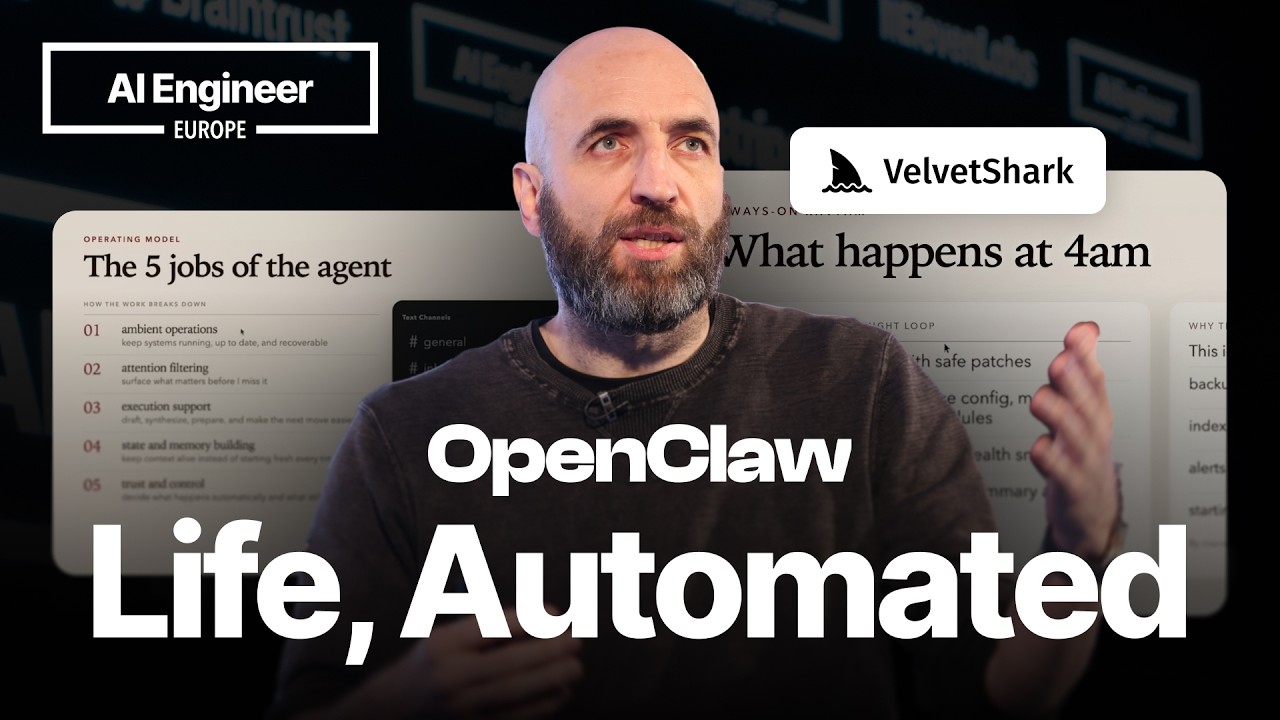
I Gave an AI Agent the Keys to My Life (Here's What Happened) — Radek Sienkiewicz (@velvetshark-com)
May 2, 2026 · 19:34
Radek Sienkiewicz, maintainer of OpenClaw, details how he incrementally gave his AI agent full control over his digital life—from reading files to handling emails, backing up memory at 4am, and drafting business replies. Starting with a single chat channel, he expanded trust step by step, integrating his 3,000-page Obsidian vault for search and memory. The agent now performs ambient operations (overnight updates, indexing), attention filtering (flagging Netflix payment failures, domain renewals), and execution support (drafting email replies) via dedicated Discord channels. Challenges include bad memory compounding, brittle automations, and noisy nodes, which he addresses by keeping the system inspectable in markdown files. The philosophy: optimize for your future self by starting with one pain, growing trust incrementally, and building a knowledge base in markdown.

Software Engineering Is Becoming Plan and Review — Louis Knight-Webb, Vibe Kanban
May 2, 2026 · 20:23
Louis Knight-Webb, founder of Vibe Kanban, argues that software engineering is becoming all about planning and reviewing AI-generated code, not writing it. He presents two approaches: plan-heavy (spending time on specs to minimize review) and review-heavy (letting agents run and correcting output), noting five minutes of planning saves thirty minutes of review. As agents run longer—crossing the five-minute threshold—engineers must parallelize multiple agents and manage workflows, which Vibe Kanban aimed to facilitate. Knight-Webb announces shutting down Vibe Kanban despite 30,000 monthly active users because it resold tokens to enterprises and struggled to make money, advising that enterprise sales are crucial. He reflects on the journey positively, emphasizing learning to work with great people and the importance of hard work.

Mastering AI Pricing — Mayank Pant, Stripe
May 1, 2026 · 24:19
Mayank Pant from Stripe explains that AI companies, growing 3x faster than traditional SaaS, face margin risk from power users and unpredictable compute costs, making hybrid pricing (base fee + usage fee) essential—56% of AI leaders now use it. He presents a five-step framework: define customer-perceived value (e.g., automation, augmentation, enhanced service, improved results), choose a charge metric (consumption, workflow, or outcome-based), adopt hybrid pricing with guardrails like usage caps and automated notifications, and iterate pricing frequently—84% agree fast adaptation is a competitive advantage. Pant illustrates with examples: Gamma charges per deck (not API calls), Intercom prices per resolved ticket. To keep customer-facing prices stable while changing features, he advises abstracting value with credits (e.g., 100 credits/month) that can be internally revalued. Stripe's billing infrastructure supports this iteration, with 78% of AI companies building on Stripe using its subscription, usage, and hybrid billing, plus Metronome for enterprise contracts.

Agents on the Canvas in tldraw — Steve Ruiz, tldraw
May 1, 2026 · 19:54
Steve Ruiz of tldraw details the evolution of AI on the infinite canvas, from early one-shot demos like MakeReal (draw to functional prototype) to multi-agent 'fairies' that collaborate, delegate, and even rewrite the canvas in real time. He explains how the tldraw SDK enables agents to act as virtual collaborators, using structured outputs and tool use to draw, animate, and modify designs. Ruiz demonstrates fairy agents that can work independently or in leader-follower mode, coordinating on tasks like creating wireframes or filling out forms. He also unveils a desktop prototype that lets Claude directly inject JavaScript into the canvas, enabling agents to edit code, modify UI, and even hack other apps like Spotify. The talk emphasizes the shift from sidebar agents to canvas-native collaborators, the challenges of vision model training for 2D spaces, and the safety trade-offs of giving LLMs runtime access in local-first apps.

Shipping complex AI applications — Braintrust & Trainline
May 1, 2026 · 1:38:34
Giran Moodley of Braintrust, joined by Trainline's Oussama Hafferssas and Mayank Soni, demonstrate how to ship production-grade multi-step AI agents by combining rigorous tracing, evaluation with golden datasets, and automated online scoring. They walk through building a support triage agent that progresses from a single prompt to a five-stage tool-calling pipeline, where tracing captures latency, tokens, and costs per step for deep debugging. Trainline shares using Braintrust to run offline evaluations before switching LLM models and to enable cross-functional self-service. The workshop covers identifying failure modes via production logs, tightening prompts, and re-evaluating to complete the feedback loop, emphasizing that observability and iterative evaluation are essential for moving from prototype to reliable production systems.

Agents for Everything Else — swyx
May 1, 2026 · 14:10
swyx, co-founder of AI Engineer Conferences, details how his team of nine full‑time people uses coding agents like Devin and Town to run the conference, moving from a non‑AI stack to agents that handle everything from Figma‑to‑website conversion and schedule management to buying a lobster for the event. He claims these agents save “yak shaving” and increase human productivity because employees enjoy faster feedback cycles, leading to more work like animations and polish. The team now manages a 1,000‑person conference with plans to handle 6,000 in San Francisco without growing headcount. Swyx also advocates for “agents for everything else,” predicting that the primary user of software will shift from humans to bots, making APIs and MCPs more important than dashboards. He urges attendees to adopt agents and “prescribe” them to skeptical coworkers.

Building Conversational Agents — Thor Schaeff and Philipp Schmid, Google DeepMind
Apr 30, 2026 · 1:47:34
Thor Schaeff and Philipp Schmid of Google DeepMind demonstrate building conversational agents with the Gemini Interactions API and Live API, arguing that the new Interactions API simplifies agent development by introducing server-side state management, unified content blocks, and remote MCP support. They walk through creating a coding agent with read/write file and bash tools using Gemini 3 Flash, highlighting how the model uses tool calling to execute commands and return results. The Live API, powering real-time voice and video interactions, supports native multilingual audio, tool calling, and Google Search grounding, though the presenters acknowledge its current limitations in production, including lack of session transcript retrieval and shorter context windows (15 minutes audio-only). They showcase a Live Jukebox demo integrating Lyria 3 music generation and discuss business use cases like Shopify Sidekick, Waymo, and elderly companion apps, emphasizing that while the technology is ready for experimentation, production readiness depends on partner integrations for observability and compliance.

LLM codegen fails and how to stop 'em — Danilo Campos, PostHog
Apr 30, 2026 · 19:18
Danilo Campos, who builds the PostHog wizard, explains how to make LLM code generation reliable by sharing practical strategies from a system that helps 15,000 users per month. He identifies 'Model ROT'—models becoming stale—and counters it by shoving fresh Markdown documentation into context. To avoid weird architecture, he maintains 'model airplanes': thin, auth-shaped simulacra that provide correct integration patterns. He limits improvisation by breadcrumbing the agent step by step, starting with detecting business-value files before even mentioning PostHog. Campos stresses that human errors (contradictory instructions, missing tools) are the biggest threat, solved by asking the agent after each run what could be improved. He also details locking down tool usage to prevent shenanigans like reading .env files, replacing that with a limited key-check and write tool. The core shift: code is a depreciating asset, so 90% of the wizard's value is now in Markdown files and prose, which improve with better models.

Replacing 12K LoC with a 200 LoC Skill — David Gomes, Cursor
Apr 30, 2026 · 19:22
David Gomes shows how Cursor replaced 12,000 lines of code for Git WorkTrees and best-of-en features with roughly 200 lines of Markdown using agent skills and subagents. He explains the original implementation's complexity (15,000 lines deleted) and the new slash commands: /worktree, /best-of-en, /apply, /delete. Pros include less maintenance, ability to switch mid-chat, multi-repo support, and better judging with the parent agent stitching results. Cons: models sometimes forget to stay in the WorkTree over long sessions, perceived slowness, and reduced discoverability. He details future improvements through evals and RL training, plus a native WorkTrees implementation in Cursor 3.0 and exploration of non-Git parallelization primitives.
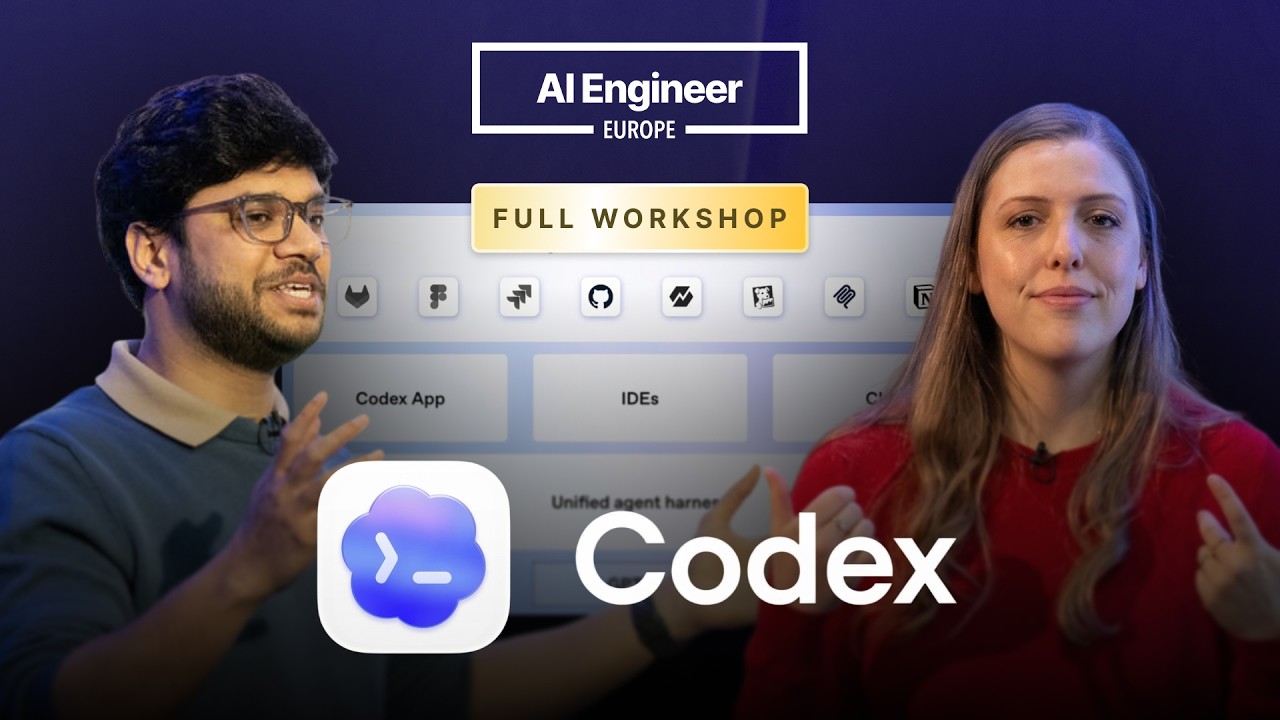
OpenAI Codex Masterclass — Vaibhav Srivastav & Katia Gil Guzman
Apr 29, 2026 · 1:01:59
Katia Gil Guzman and Vaibhav Srivastav showcase OpenAI's Codex as a full software engineering agent, not just a coding assistant, powered by models like GPT-5.4 and GPT-5.3 Codex Spark. They demonstrate plugins bundling skills and MCP servers, automations that run scheduled tasks (e.g., Slack or Gmail summaries), and code review that 100% of OpenAI pull requests use by default. Subagents parallelize work across up to 20 agents for tasks like reviewing 45 persona files, with each subagent configurable by model, sandbox mode, and MCP access. New features include Guardian approvals for privileged operations, hooks for custom triggers, and a Cloud Code plugin. The episode also highlights the milestone of 3 million weekly active users, tripled since January, and covers security scanning for vulnerabilities.

Build & deploy AI-powered apps — Paige Bailey, Google DeepMind
Apr 29, 2026 · 1:03:20
Paige Bailey, engineering lead for developer relations at Google DeepMind, demonstrates how the company's latest multimodal models and AI Studio platform enable rapid prototyping of AI-powered apps at minimal cost. She showcases Gemini 3.1 Flash Lite analyzing YouTube dinosaur videos for under a penny, the new Build feature constructing a fully functional bookshelf cataloger with Firebase database and Google login, and Gemini Live providing real-time multilingual screen interaction. Other demos include Genie 3 generating playable world models from text prompts, NanoBanana 2 performing cost-effective image editing, Veo 3.1 Lite producing stock footage (e.g., a "vegan basketball food truck" featuring Chef Curry), Lyria 3 creating custom music tracks, and Gemma 4 offering open-source multimodal models that run on mobile devices. Bailey emphasizes that the entire stack—grounded by Google Search and code execution—allows developers to ship ideas that would have been startups years ago, with all code exportable for production use.
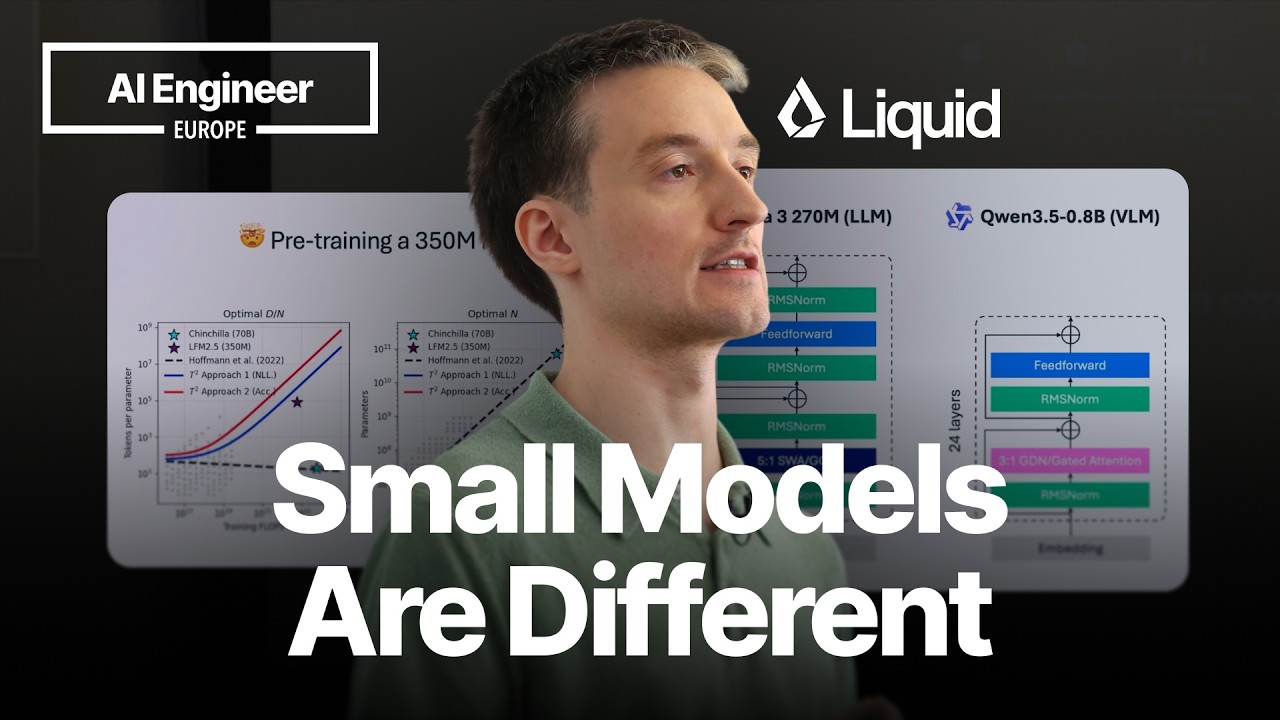
Everything I Learned Training Frontier Small Models — Maxime Labonne, Liquid AI
Apr 29, 2026 · 20:13
Maxime Labonne, head of post-training at Liquid AI, presents the LFM2.5 recipe for training frontier small models, arguing they require specialized approaches distinct from scaled-down big models. He details how Liquid's architecture uses gated short convolutions for latency-sensitive on-device deployment, achieving faster throughput than Gemma 3 or Qwen 3.5. Post-training stages—SFT, on-policy preference alignment, and RL—are tailored for narrow task focus like data extraction and tool use. A key challenge is 'doom loops' (repetition), which reached 15% after mid-training in a 1.2B reasoning model; solutions include preference alignment rejecting looped responses and RL with verifiable rewards and n-gram penalties, nearly eliminating the issue. He advocates combining small models with agentic tools (e.g., web search) to overcome memory limits, as they excel at reasoning and tool use despite lower knowledge capacity. The talk also covers decisions on when to use small vs. large models—latency, privacy, offline use—and notes that distillation alone likely won't fully solve doom loops.
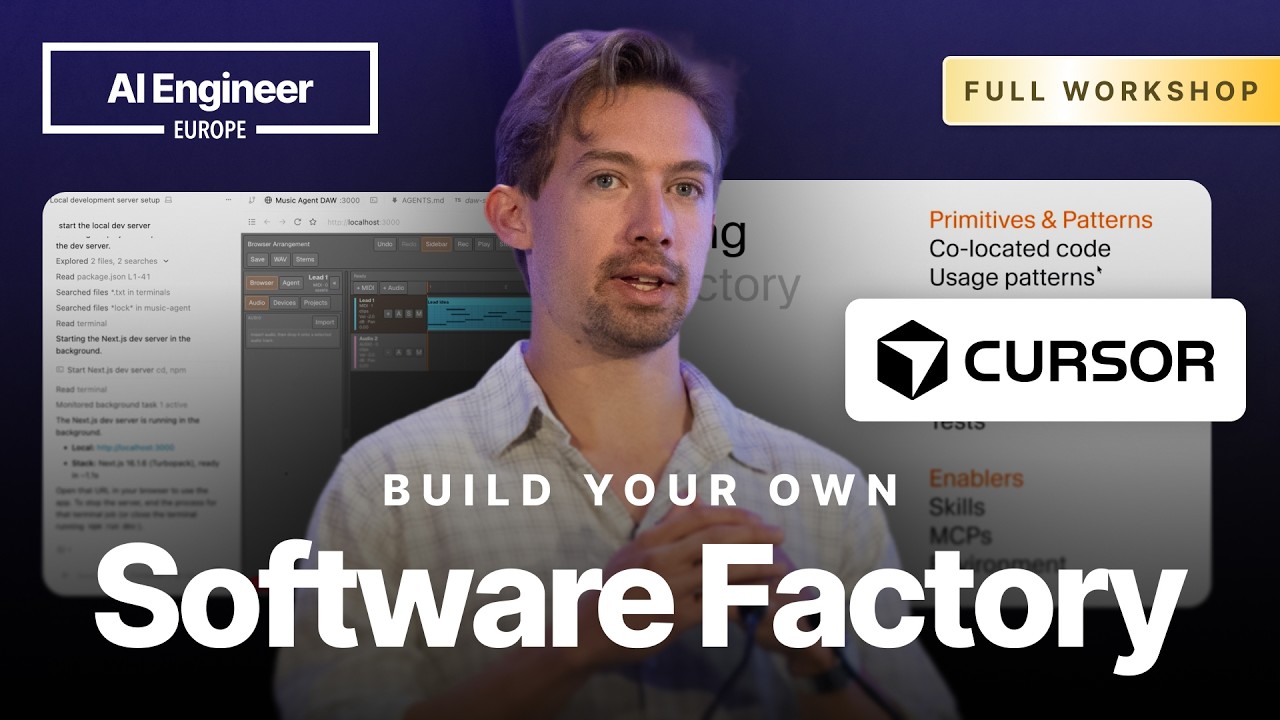
Building your own software factory — Eric Zakariasson, Cursor
Apr 28, 2026 · 1:23:37
Eric Zakariasson, an engineer at Cursor, explains how to build a 'software factory' by scaling from one agent to many, shifting from worker to manager. He outlines six stages of autonomy, from spicy autocomplete to the dark factory, and emphasizes that most teams are stuck at levels two or three. Key primitives include modular codebases, guardrails like rules and hooks that emerge dynamically, enablers such as skills and MCPs, and verifiable systems like automated tests. Cloud agents with isolated VMs allow agents to run asynchronously, test their own work via computer control, and scale to thousands. Eric shares internal automations like daily reviews, PR comment analysis, and continual learning that extracts rules from chat transcripts. He concludes with strategic advice: front-load context, don't outsource critical decisions, and build tools and systems to capture flywheels, noting that human accountability remains essential.
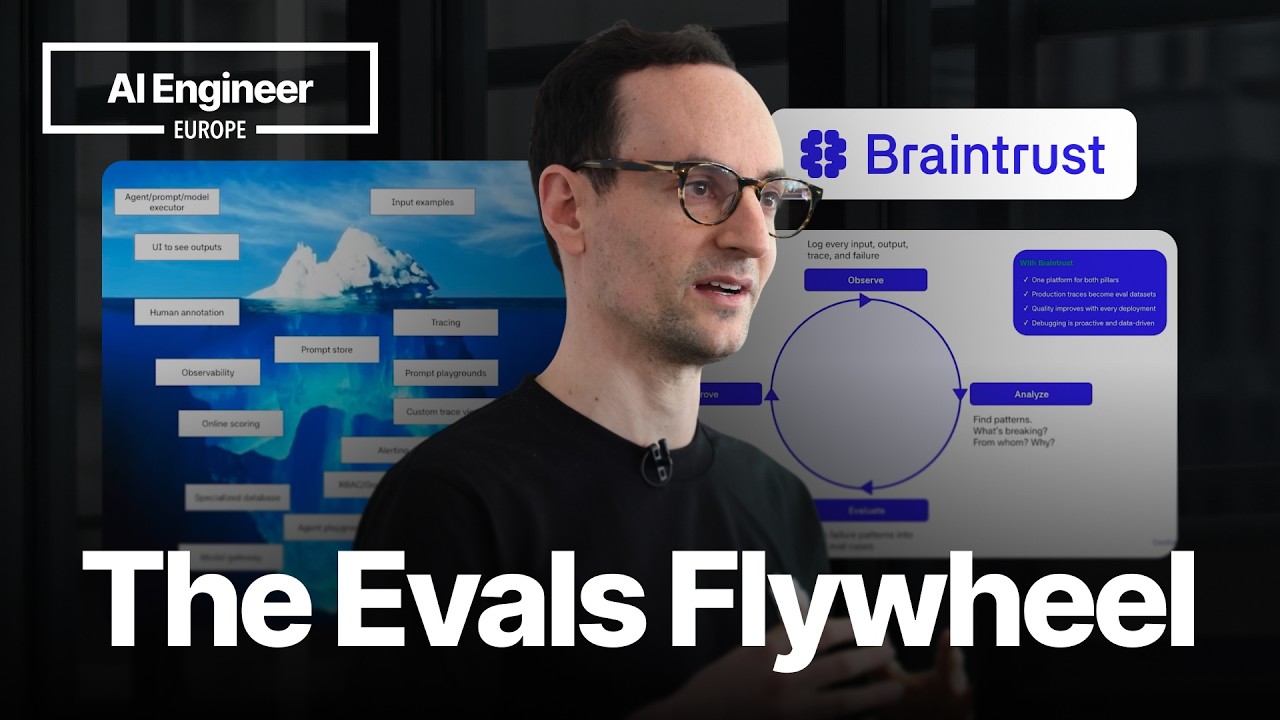
Why building eval platforms is hard — Phil Hetzel, Braintrust
Apr 28, 2026 · 25:39
Phil Hetzel of Braintrust argues that building eval platforms for AI agents is a data systems problem, not just a UI one, because LLMs have extreme variability and agent traces are semi-structured, high-volume, and large. He describes four maturity stages: simple spreadsheet with a for loop, a custom vibe-coded UI with a database, an experimentation playground for non-technical users, and finally a flywheel connecting offline evals with production observability. The core challenge is the data layer—traces can be 10-20 MB per span, requiring low-latency ingestion, aggregate analysis, and full-text search, which traditional databases cannot handle. Future platforms must surface unknown unknowns via topic modeling, support agent-to-agent interactions, and integrate automatic tracing through AI proxies. Braintrust addresses these with a custom data platform that separates hot and cold storage and enables SQL queries directly on traces.
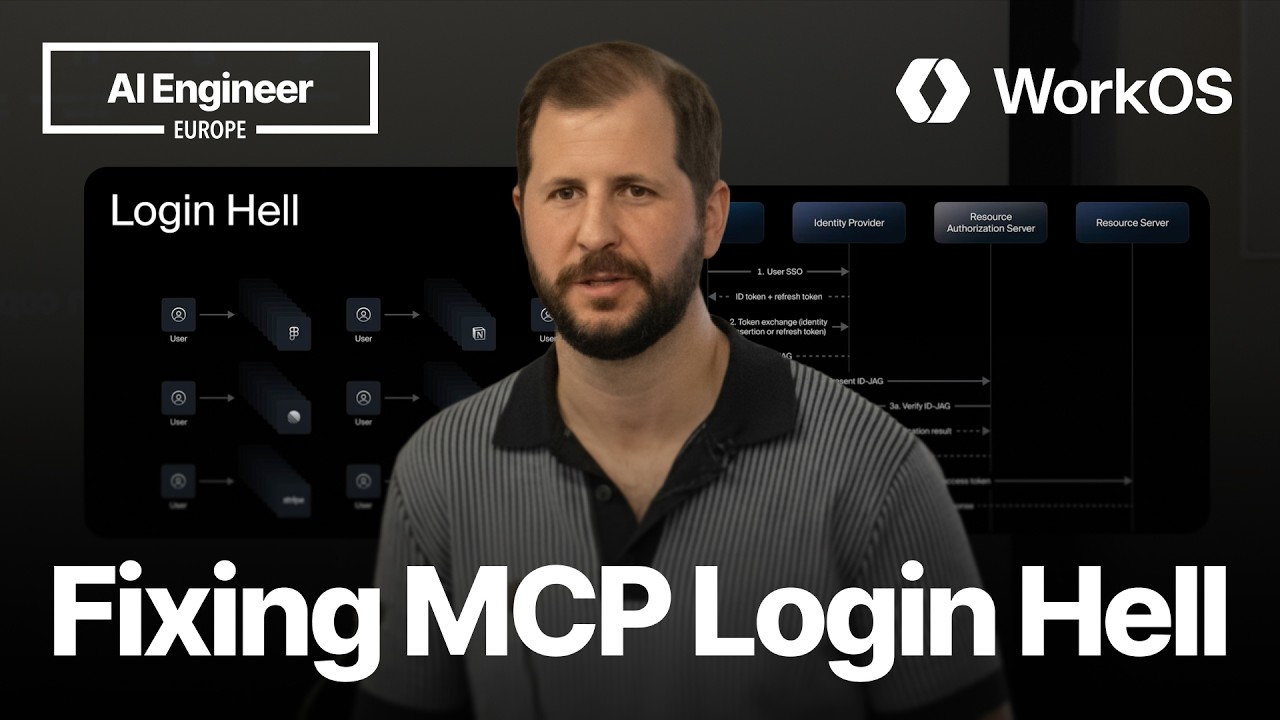
One Login to Rule Them All: Cross-App Access for MCP — Garrett Galow, WorkOS
Apr 28, 2026 · 23:24
Garrett Galow from WorkOS introduces Cross-App Access (XAA) for MCP, solving the problem of repeated OAuth consent screens when connecting agents to multiple services. The flow leverages a three-way trust between the MCP client, server, and an Identity Provider like Okta: a single SSO login issues an IDJag token that is exchanged for short-lived access tokens across all MCP servers without manual intervention. A demo shows Figma automatically connecting after an Okta login. The approach improves security—if the IdP session is revoked, tokens cannot refresh—and requires minimal IT setup: granting permission for the client to request server access. Currently only Okta supports XAA; Azure/Entra does not yet. The session also notes that authorization scopes are not handled by default but are a future consideration.
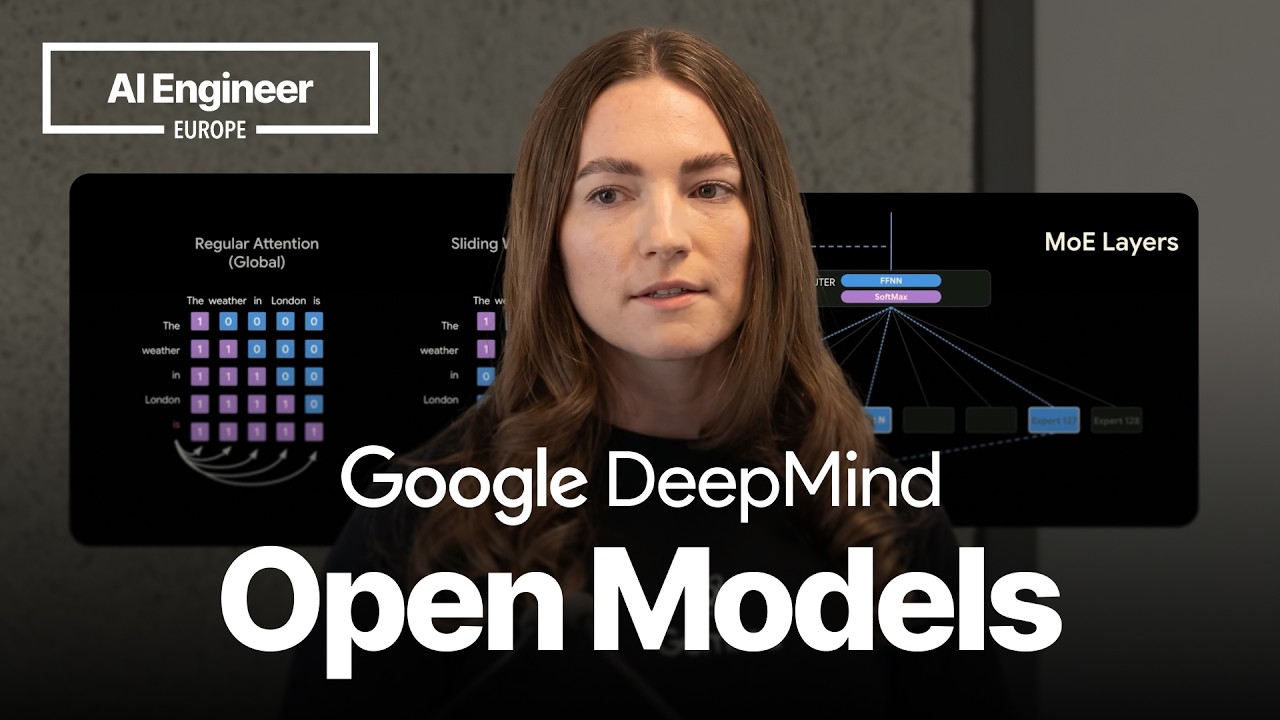
Gemma 4 Deep Dive — Cassidy Hardin, Researcher, Google DeepMind
Apr 27, 2026 · 19:03
Cassidy Hardin, a researcher at Google DeepMind, details the Gemma 4 family of open-source models, claiming they set a new precedent for small-scale performance. The family includes two on-device effective models (E2B and E4B) with Per Layer Embeddings (PLE) stored in flash memory, and two larger models: a 26B mixture-of-experts (MoE) with 128 total experts (8 active) and a 31B dense model that ranked #3 on the LM arena leaderboard, outperforming models 20x its size. Architectural innovations include interleaved local/global attention (5:1 ratio, sliding windows of 512/1024 tokens), grouped query attention (8 queries per key-value in global layers), and native multimodal support with variable aspect ratios and resolutions for vision encoders (550M params for large, 150M for small) plus a 305M parameter conformer for audio. All models are released under Apache 2.0 license, available for self-hosting on Hugging Face and Ollama, or cloud deployment on Vertex AI.

Scaling GitHub for your Agents — Sam Morrow, GitHub
Apr 27, 2026 · 20:35
Sam Morrow, GitHub's MCP server lead, details the architectural challenges and solutions for scaling a remote MCP server to 7 million weekly tool calls. He explains how tool proliferation degraded agent performance—LangChain's research confirmed more tools confuse agents—leading to innovations like tool sets and dynamic discovery, though 100% of users stuck with defaults. To reduce context, GitHub cut tool descriptions by 49% and trimmed output tokens by 75% on list pull requests. Security is addressed via OAuth 2.1 with PKCE and step-up auth; they rejected dynamic client registration to avoid unbounded app databases and rate-limiting issues. The stateless server uses Redis for session storage and builds a fresh server instance per request, enabling horizontal scaling without session affinity. Metrics include 11 million Docker downloads, 30,000 stars, 4,000 forks, and 126 contributors. Morrow predicts compositional tools and automatic server discovery will make thousands of tools the norm.
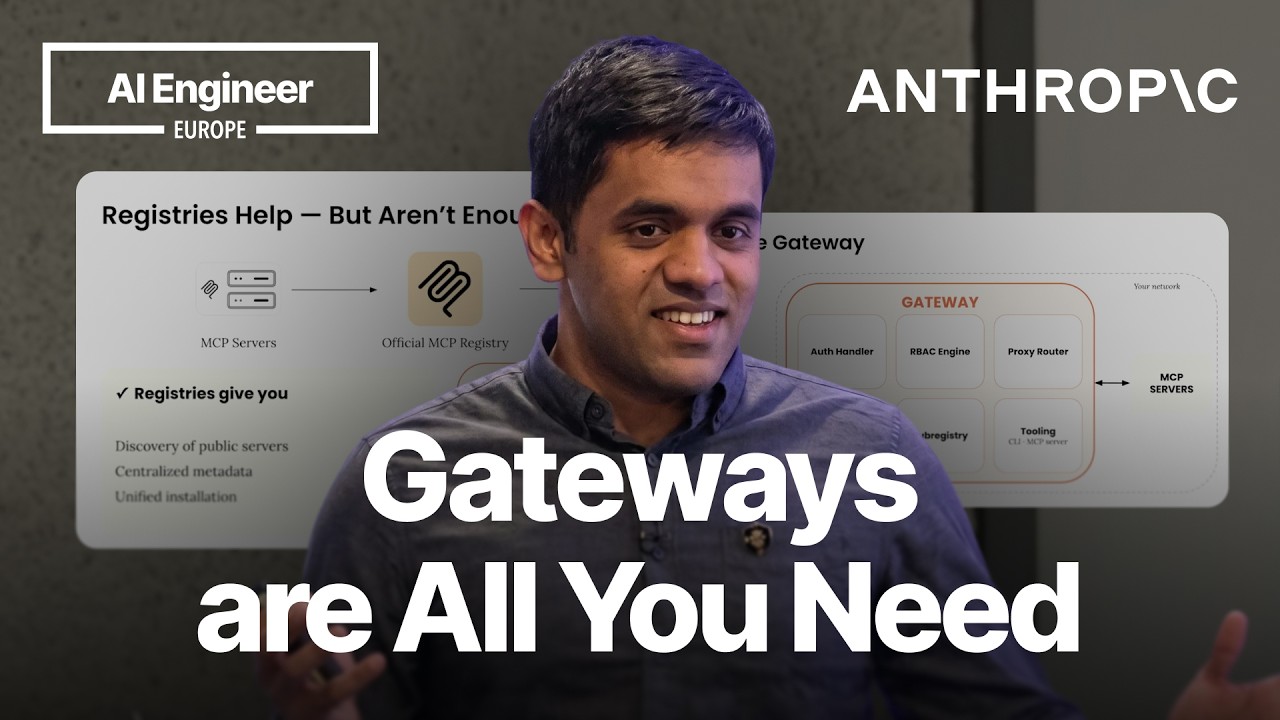
Gateways are All You Need — Karan Sampath, Anthropic
Apr 27, 2026 · 17:48
Karan Sampath, an engineer at Anthropic, argues that enterprises face a 'three-headed hydra' of observability, access control, and security when adopting MCPs, and proposes that unified gateways are the solution. He explains that current decentralized MCP deployments create bottlenecks, limiting enterprises to single-digit MCPs due to opaque usage, lack of role-based scoping, and data exfiltration risks. The gateway, a middleware layer handling auth, proxying, routing, and tunnels, establishes a root of trust. Core components include OAuth integration, a developer CLI, and an internal sub-registry. Benefits include multi-surface integration (Claude.ai, Claude Code), standardized access control, faster iteration without repeated security reviews, and scalable credential management. Sampath envisions decoupling agent architecture from data layers, making gateways invariant as agent surfaces evolve.
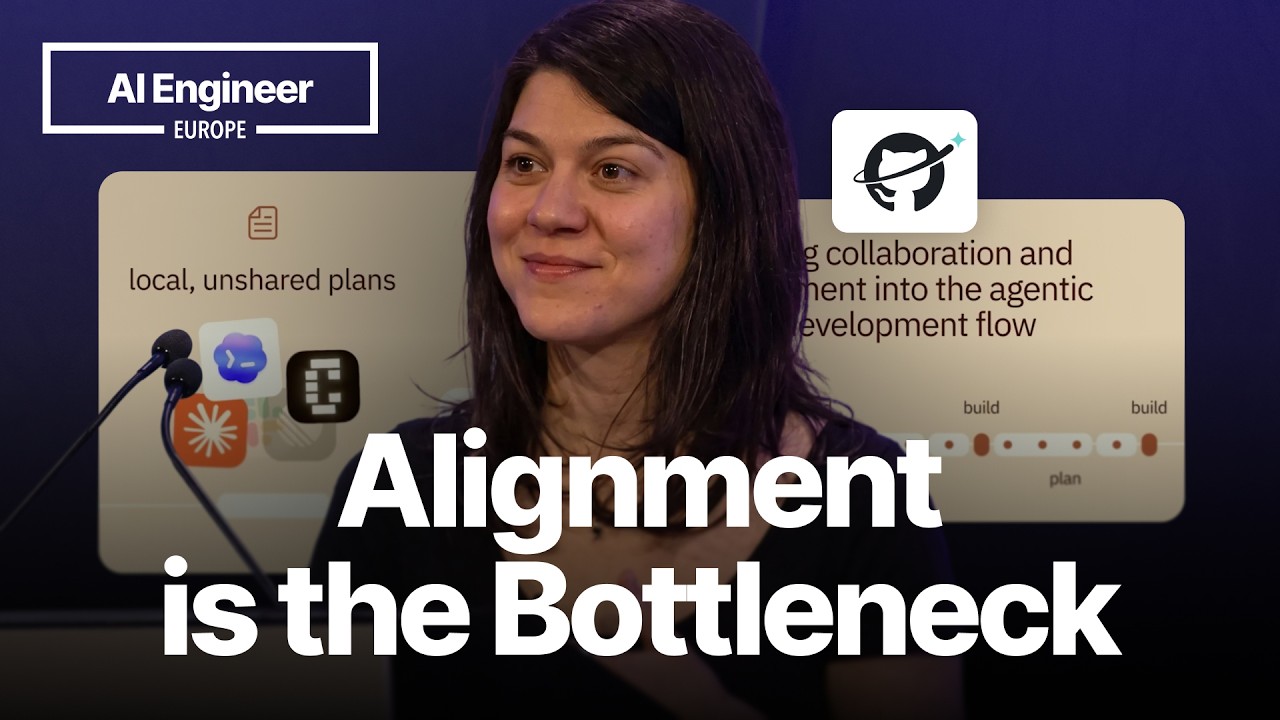
Collaborative AI Engineering: One Dev, Two Dozen Agents, Zero Alignment — Maggie Appleton, GitHub
Apr 26, 2026 · 17:43
Maggie Appleton, a staff research engineer at GitHub Next, argues that the current paradigm of one developer with a fleet of solo agents leads to zero team alignment, making software a team sport that requires shared context. She presents ACE (Agent Collaboration Environment), a multiplayer research prototype that provides shared chat sessions backed by micro VMs and Git branches, enabling real-time collaboration where designers, PMs, and developers can all prompt agents together. The talk emphasizes that implementation is now cheap and fast, so the hard question is "should we build it?" — requiring early, constant alignment to avoid wasted work, coordination debt, and unrequested features. ACE aims to reclaim time for rigorous critical thinking by letting teams plan, build, and review in a single shared space, with proactive agents summarizing team activity and unfinished work. Appleton contends that quality becomes the differentiator in a world of cheap code, and tools like ACE can help teams build a few exceptional things rather than a thousand crappy ones.

MCP = Mega Context Problem - Matt Carey
Apr 25, 2026 · 22:42
Matt Carey from Cloudflare argues that the real bottleneck in connecting agents to APIs via MCP is the context window, not the protocol itself. Cloudflare’s OpenAPI spec is 2.3 million tokens; naive tool generation would consume 1.1 million, overwhelming any agent. To solve this, Carey advocates progressive discovery: CLIs (requiring shell access), tool search (loading only relevant tools), or codemode—letting agents write code against a typed SDK and execute it in Cloudflare’s isolated Workers sandbox. This sandbox provides safe, programmable guardrails (no secrets, limited network access), allowing agents to access all 2,600+ Cloudflare API endpoints from a single MCP server. Carey predicts that as agents become code generators, infrastructure primitives like WorkerD, Deno, and Pydantic will proliferate, and MCP servers will become a lightweight middleware flag (e.g., `MCP: true` in Next.js). The talk demonstrates read-only access to the entire Cloudflare API from an MCP client, showing codemode in action.
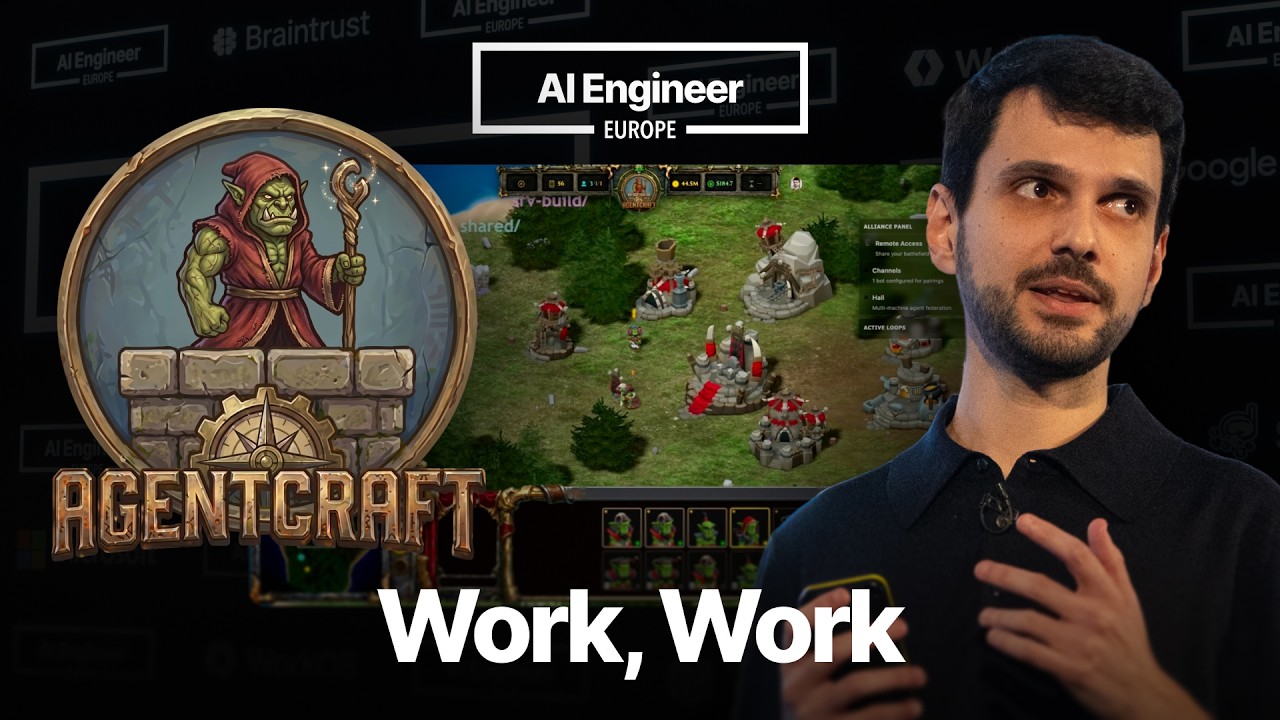
AgentCraft: Putting the Orc in Orchestration — Ido Salomon
Apr 25, 2026 · 11:18
Ido Salomon, creator of AgentCraft, argues that the bottleneck in multi-agent orchestration is not the agents but the humans managing them, and that the skills needed—borrowed from real-time strategy games—are already familiar to gamers. AgentCraft visualizes agents as physical units on a map that projects the file system, allowing users to see which files agents modify and detect collisions via a heat map. To reduce babysitting, Salomon implemented a campaign feature where agents autonomously decompose tasks and plan within containers, shifting the human role to review. Review bundles present changes with screenshots and videos for efficient inspection. Workspaces enable real-time collaboration between humans and agents across teams, with shared visibility and soft coordination. The goal is to raise the ceiling of collaboration through visibility, autonomy, and human-agent interaction.

Full Walkthrough: Workflow for AI Coding — Matt Pocock
Apr 24, 2026 · 1:36:30
Matt Pocock presents a hands-on workshop on building a full AI-assisted coding workflow, arguing that software engineering fundamentals—not hype—make agents effective. He introduces the 'smart zone' and 'dumb zone' of LLMs (performance drops after ~100k tokens) and the 'Memento problem' (agents forget between sessions). His process starts with a 'Grill Me' skill that relentlessly questions the user until shared understanding is reached, then produces a PRD without reading it, slices work into vertical 'tracer bullet' issues, and runs agents AFK using TDD. He advocates designing codebases with deep, testable modules and shows Sandcastle, a TypeScript library for parallel agent execution with separate implementer (Sonnet) and reviewer (Opus). The workshop transforms ambiguous briefs into shippable features while keeping humans in the loop for QA and taste.

What Do Models Still Suck At? - Peter Gostev, Arena.ai, BullshitBench
Apr 24, 2026 · 20:24
Peter Gostev presents data from his BullshitBench and Arena.ai to argue that language models still struggle with nonsense questions and expert-level tasks, despite benchmark charts showing relentless improvement. His BullshitBench reveals that only Claude Sonnet 4.5 and some Qwen models consistently push back on nonsense, while GPT and Gemini models accept it 50% of the time. Arena.ai's dissatisfaction rate among top 25 models has improved from 17% pre-reasoning to about 9% currently, but remains non-zero, and expert categories like gaming, magic, finance, and law show minimal improvement. For software expert prompts, dissatisfaction dropped from 23.5% in Q2 2024 to 13% in Q1 2026, but gaming is a persistent weakness where models fail to create engaging game mechanics. Gostev warns that narrow benchmarks overstate progress and urges focusing on the full distribution of real-world tasks.
Powered by PodHood