
All episodes
Page 13 of 23
1,115 episodes

Developing Taste in Coding Agents: Applied Meta Neuro-Symbolic RL — Ahmad Awais, CommandCode
Nov 24, 2025 · 20:52
Ahmad Awais, founder of Langbase, introduces CommandCode, a coding agent that learns a developer's personal taste and preferences to generate code that feels like their own. Built on Langbase's infrastructure (deploying over 350K agents and 1.2B monthly runs), CommandCode uses a Meta Neuro-Symbolic architecture with reinforcement learning to continuously capture a programmer's invisible architecture of choices—such as preferring TypeScript, PNPM, TSUP, and Commander over other tools—without requiring explicit rule files. Awais demonstrates how CommandCode automatically applies these learned preferences when building a CLI, contrasting it with Claude Code which generates generic output. He argues that taste models represent the next frontier, enabling agents to evolve with the developer and even share tastes across teams or borrow preferences from other developers like design engineers.
The Cure for the Vibe Coding Hangover — Corey J. Gallon, Rexmore
Nov 24, 2025 · 57:02
Corey J. Gallon presents a framework to cure the 'vibe coding hangover'—the despair of building unmaintainable demoware with AI coding agents. He argues that treating AI as a pure productivity tool leads to brittle code and dependency, so his framework centers on ten principles: AI engineering as accelerated learning, the architect-implementer boundary, slowing down to go fast, specification over prompt engineering, defining 'done' before implementing, feature atomicity, dependency-driven development, implementing one atomic feature at a time, context engineering, and 'make it work, make it right, make it fast.' The process splits into a planning phase (vision capture, feature identification, iterative specification, dependency analysis, implementation plan) and an implementation loop that uses multisensory feedback (visual, auditory, tactile) to validate each atomic feature. This framework has been used to build real applications such as litigation support for law firms and real-time appliance monitoring.
AI Copilots for Tech Architecture: The Highest-ROI Use Case You’re Not Building — Boris B., Catio
Nov 24, 2025 · 27:29
Boris Bogatin and Tofiq Boubaz, CEO and CTO of Catio, argue that AI architecture copilots represent the highest-ROI use case most organizations overlook, surpassing coding copilots in strategic impact. They identify three critical challenges—visibility across tech estates, ROI-backed prioritization, and autonomous developer guidance—and propose three pillars: a live digital twin for holistic system visibility, AI-driven multi-agent recommendations tied to business objectives, and a conversational agent embedding governance into developer workflows. The episode details a four-step approach: ingest messy system data, align recommendations with goals, generate compliant designs, and track outcomes. Concluding that companies adopting architecture copilots early will stay modern while laggards drown in technical debt, they invite listeners to catio.tech to pilot the approach.

What Data from 20m Pull Requests Reveal About AI Transformation — Nick Arcolano, Jellyfish
Nov 24, 2025 · 17:57
Nick Arcolano, head of research at Jellyfish, presents data from 20 million pull requests across 200,000 engineers at 1,000 companies to reveal what AI transformation actually looks like. Median AI adoption of interactive coding tools (Copilot, Cursor, Claude Code) jumped from 22% in June 2024 to nearly 90% today, driving a 2x increase in PR throughput and 24% faster cycle times on average. Autonomous agents like Devin and Codex remain negligible—only 44% of companies have tried them, contributing less than 0.2% of PRs. PRs grow 18% larger with AI, but bug rates and reverts show no significant quality impact. Crucially, code architecture determines success: centralized and balanced repos see 4x throughput gains, while highly distributed architectures (many repos per engineer) show no correlation with AI adoption, likely due to cross-repo context limitations. Arcolano advises focusing on adoption first, then addressing architectural barriers to unlock productivity.

AI changes *Nothing* — Dax Raad, OpenCode
Nov 23, 2025 · 16:39
Dax Raad, core contributor to SST and creator of OpenCode, argues that AI changes nothing when building a winning product. In this contrarian talk, he breaks down the three unchanging fundamentals: marketing requires creating things so cool people share them, which AI cannot do because it is too corny; the aha moment demands ruthlessly eliminating friction to get users to that singular moment of understanding, requiring deep taste not algorithmic optimization; retention hinges on building deep primitives first to support power users without sacrificing simplicity for newcomers, a design challenge AI cannot hallucinate. Raad uses examples from ChatGPT's instant aha moment—any input box that responds like a human—and Facebook's poke as a deniable flirting aha moment. He concludes that AI amplifies capabilities but does not save anyone from the hard, creative work of product success.

Z.ai GLM 4.6: What We Learned From 100 Million Open Source Downloads — Yuxuan Zhang, Z.ai
Nov 22, 2025 · 19:39
Yuxuan Zhang from zAI details the technical roadmap behind the GLM 4.6 open-source model series, which has surpassed 100 million downloads and tied for number one on the LMSYS Chatbot Arena alongside GPT-4o and Claude 3.5 Sonnet. The training pipeline uses 15 trillion tokens of pre-training data, followed by 7 trillion tokens of code and reasoning data, repo-level contexts at 32,000 tokens, and 100 billion tokens of long-context agent trajectories up to 128,000 tokens. Zhang introduces SLIME, a hybrid synchronous/asynchronous RL framework that decouples agent-environment interaction from GPU training to avoid bottlenecks. He explains why single-stage RL at 64,000 tokens outperforms multi-stage approaches for preserving long-context abilities, and shows that token-weighted loss converges faster than sequence-average loss for code RL. The multimodal GLM 4.5V model handles native resolution images and video with temporal index tokens, enabling GUI agent capabilities. Deployment is supported via vLLM and SGLang, with an API at z.ai and an open-source coding assistant.

Rishabh Garg, Tesla Optimus — Challenges in High Performance Robotics Systems
Aug 25, 2025 · 12:43
Rishabh Garg, a robotics software engineer at Tesla, explains how unexpected robot behaviors often stem from software and hardware integration issues rather than the control policy itself. Using a toy CAN bus system, he demonstrates how communication delays at 1 Mbps can cause loop execution gaps, leading to jitter and stuttering motors. Solutions such as multithreaded pipelining and synchronization primitives can reduce cycle time but introduce new problems like missed messages and desynchronization. He highlights how logging to disk on a Raspberry Pi can freeze the robot for 30 ms, and how priority inversion in the Linux kernel can cause system dropouts for seconds. The episode delivers concrete techniques for diagnosing and resolving these real-time system challenges.

Building an Agentic Platform — Ben Kus, CTO Box
Aug 24, 2025 · 19:06
Ben Kus, CTO of Box, argues that building an agentic architecture early was critical to overcoming the limitations of pure LLM-based data extraction for enterprise unstructured content. Starting with simple LLM calls in 2023, Box faced accuracy issues on complex documents, OCR failures, and difficulty handling hundreds of fields. They pivoted to an agentic framework using directed graphs, multi-model voting, and LM-as-a-judge with reflection loops, which dramatically improved accuracy and allowed incremental improvement. This architecture also enabled deep research on customer data and clean separation between agentic logic and system scaling. Kus emphasizes that agentic thinking should be applied early, even to seemingly non-agentic tasks like metadata extraction, and that Box avoids fine-tuning in favor of prompt-based agentic orchestration.

Five hard earned lessons about Evals — Ankur Goyal, Braintrust
Aug 23, 2025 · 19:46
Ankur Goyal of Braintrust argues that successful AI applications depend on deliberately engineered evaluations (evals) to reflect real user feedback and drive product improvements. He details three signs of effective evals: launching updates within 24 hours (citing Notion), converting complaints into evals, and using evals offensively to assess use cases before shipping. Evals require custom scorers as specs—not off-the-shelf—and context engineering (optimizing tool definitions and outputs) is the new frontier; shifting outputs from JSON to YAML improves token efficiency. New models can upend everything, as shown by a benchmark that jumped from 10% to viable with Claude 4 Sonnet, so a model-agnostic architecture with proxies is key. Optimize the whole system (data, task, scoring)—Braintrust's Loop auto-optimizes prompts, data, and scorers. In Q&A, he advises human judgment when adding user feedback to evals to avoid overfitting.

Perceptual Evaluations: Evals for Aesthetics — Diego Rodriguez, Krea.ai
Aug 23, 2025 · 16:28
Diego Rodriguez, cofounder of Krea.ai, argues that current AI evaluations fail to capture human perception and aesthetics, leading to metrics that misjudge generative media. He traces how compression standards like JPEG and MP3 exploit human sensory limits yet their artifacts poison AI training data, making models blind to what humans instantly see wrong. Standard metrics like FID score penalize perceptually identical images, while models cannot evaluate subjective qualities like artistic meaning. Rodriguez calls for new "perceptually aware" metrics trained on human opinions, echoing a friend's insight that predicting cars was easy but traffic was hard — the real challenge is evaluating AI's impact on creative expression. Krea.ai, an 8-person startup, invites researchers to join work on aesthetics research and hyper-personalization for generative multimedia.

How BlackRock Builds Custom Knowledge Apps at Scale — Vaibhav Page & Infant Vasanth, BlackRock
Aug 23, 2025 · 18:47
Infant Vasanth and Vaibhav Page of BlackRock explain how the world's largest asset manager scales custom AI knowledge apps for investment operations using a modular, Kubernetes-native framework. They detail challenges like prompt engineering for complex financial instruments, choosing LLM strategies (RAG, chain-of-thought), and deploying apps with cost control and compliance. Their sandbox lets domain experts rapidly iterate on extraction templates with inter-field dependencies and validations, while the app factory turns definitions into production apps. Key takeaways: invest in prompt engineering for domain experts, educate on LLM strategies, evaluate ROI, and design for human-in-the-loop in regulated environments. The framework compressed app development from eight months to days for use cases like setting up securities after IPOs or stock splits.

Form factors for your new AI coworkers — Craig Wattrus, Flatfile
Aug 22, 2025 · 15:35
Craig Wattrus, AI design engineer at Flatfile, argues that designing AI interactions requires treating AI as a new coworker with distinct form factors — invisible, ambient, inline, and conversational — rather than traditional UI. He demonstrates how feeling the material by building tools like a 'chat tuner' to tune AI character shifts from helicopter-parenting to character coaching. Finding the grain involves designing tool UX where AI communicates visually, checks alignment, and hands back control. Courting emergence yields unexpected results: an agent combined two files without being asked and suggested the user contact HR for missing employee IDs. Looking forward, Wattrus explores auto-complete for data transformations, using LLMs to suggest fixes alongside human oversight.
Fuzzing in the GenAI Era — Leonard Tang, Haize Labs
Aug 22, 2025 · 19:12
Leonard Tang of Haize Labs argues that standard evaluation methods fail for GenAI systems due to brittleness (Lipschitz discontinuity), and proposes 'Haizing'—fuzz testing that simulates diverse inputs to uncover corner cases. He details two core problems: scoring outputs via 'judges', where Haize's Verdict library stacks GPT-4 Mini in a self-verified debate ensemble to beat O1 at a third the cost, and RL-tuned judges like a 1.7B parameter model achieving 80.7% on RewardBench. For stimuli generation, he frames it as discrete optimization over natural language, using gradient-based methods and tree search. Case studies include Haizing the largest Hungarian bank's loan calculator, discovering prompt injections in minutes, and boosting a voice agent's ground-truth human agreement by 38% using rubric fanout.
Multi Agent AI and Network Knowledge Graphs for Change — Ola Mabadeje, Cisco
Aug 22, 2025 · 18:49
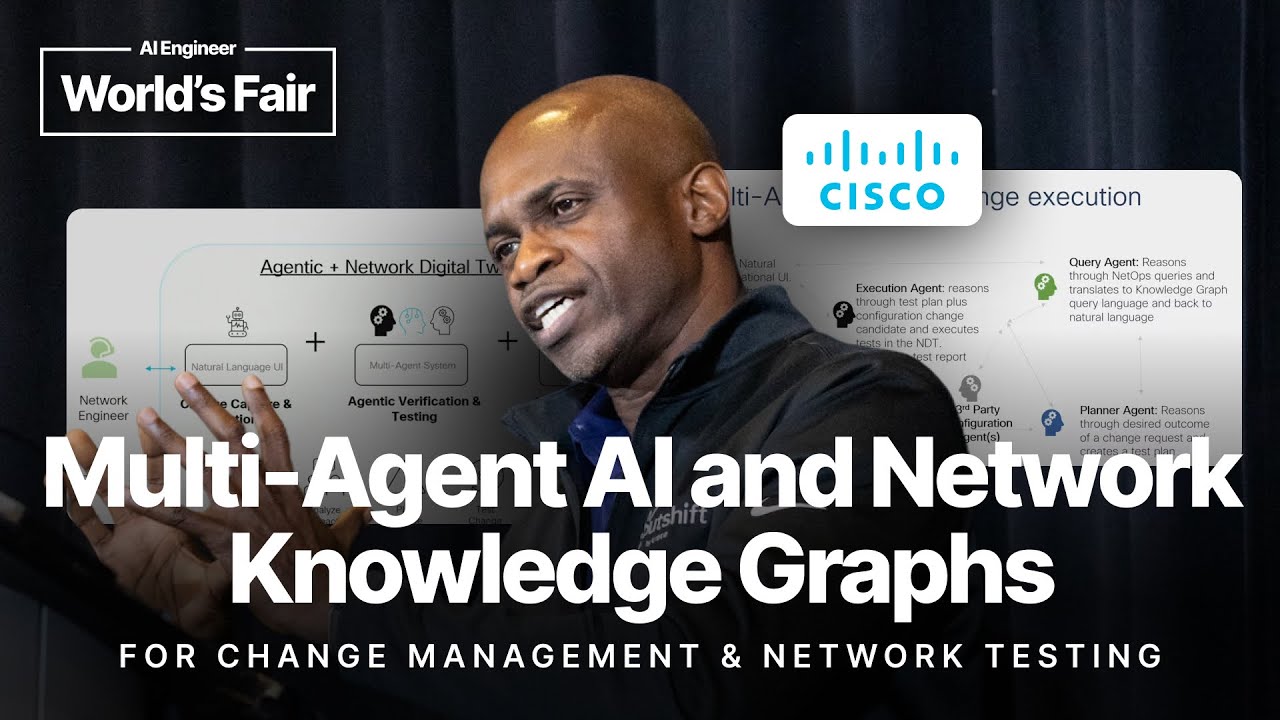
Ola Mabadeje from Cisco's Outshift presents a multi-agent AI system that combines network knowledge graphs with natural language interfaces to improve change management. The solution ingests data from ITSM tools like ServiceNow, uses five specialized agents built on an open framework (agency.org) to automate impact assessment, test planning, and execution within a digital twin. A fine-tuned query agent reduces token usage and latency when querying the ArangoDB knowledge graph, layered using OpenConfig schema. The demo shows agents collaborating to assess a firewall rule change, generate test cases, and run them on a synthetic network, attaching results back to the ticket. Early evaluations focus on extrinsic metrics tied to customer outcomes, with the knowledge graph and open agent framework as key building blocks for scalable network operations.

Wisdom-Driven Knowledge Augmented Generation at Scale - Chin Keong Lam, Patho AI
Aug 22, 2025 · 18:43
Chin Keong Lam, founder and CEO of Patho.ai, argues that Wisdom-Driven Knowledge Graphs (KAG) significantly outperform traditional RAG systems for complex quantitative analysis and expert-level advice. He presents a wisdom-decision-situation feedback loop where knowledge, experience, and insight feed into wisdom, mapped to a practical competitive analysis chatbot for a marketing client. The system uses N8n and a multi-agent architecture with a supervisory Wisdom Agent overseeing insight, knowledge, and strategy agents, all updating a centralized knowledge graph. Lam cites five reasons knowledge graphs beat RAG: capturing complex relationships, improved accuracy, scalability, rich multi-hop query capability, and seamless data integration. He demonstrates how vector RAG fails on numerical reasoning (e.g., Apple revenue query) while KAG returns precise evidence-based answers. Lam recommends a hybrid graph extraction combining LLM extraction with expert pruning, and reports benchmark results of 91% accuracy, 85% flexibility, and strong traceability and scalability.

The Next Unicorns: 7 Top AI startups from the HF0 Residency
Aug 21, 2025 · 22:16
Diego Rodriguez (Krea) presents an AI creative suite that generated 1M images/day for a Fox ad, while OpenHome debuts the first AI smart speaker with 10K developers and 500 free dev kits. Josh’s Coframe made $20M for a travel firm by making websites adaptive, and Eugene’s Featherless AI built QWERTY 72B without transformer attention, claiming scale is dead in favor of reliability. Jonas Bauer’s Upside uses LLMs to structure enterprise data, Lengyue’s OpenAudio introduces S1, the first instructable voice model beating ElevenLabs, and Alex Atallah’s OpenRouter provides a single API for all LLMs, growing 10–100% monthly.

#define AI Engineer - Greg Brockman, OpenAI (ft. Jensen Huang)
Aug 10, 2025 · 41:05
Greg Brockman, co-founder and president of OpenAI, discusses his journey from Stripe's first CTO (growing from 40 to 250 people) to leading AI development, sharing insights on independent study (completing three years of high school math in one year), the engineering-research partnership at OpenAI (emphasizing technical humility), and scaling challenges like ChatGPT hitting 1 million users in five days and ImageGen reaching 100 million in five days. He explains how Codex transforms coding (low double-digit percent of internal PRs written by Codex, 24,000 PRs merged in public GitHub in one day) and introduces "vibe coding" as an empowerment mechanism. In response to Jensen Huang's questions, Brockman predicts a future with diverse AI infrastructure (homogeneous accelerators as default, purpose-built for specific workloads) and a menagerie of domain-specific agents leveraging distillation, driving 10x more economic activity. He identifies basic research as a renewed scaling bottleneck alongside compute, data, algorithms, power, and money.

The Future of Evals - Ankur Goyal, Braintrust
Aug 9, 2025 · 5:14
Ankur Goyal, CEO of Braintrust, argues that evals are being revolutionized by AI agents like Loop, which automatically optimizes prompts, datasets, and scorers. He notes that the average org runs 13 evals daily, with some exceeding 3,000, yet eval workflows remain painfully manual. Loop, powered by frontier models such as Claude 4—which Goyal says performs six times better than prior models—can now autonomously improve prompts and scoring. It runs inside Braintrust, allowing users to review suggested edits side-by-side or enable a fully automated mode. Goyal emphasizes that evals are critical for building reliable AI products, and Loop marks a shift from manual dashboards to AI-driven iteration.

Designing AI-Intensive Applications - swyx
Aug 9, 2025 · 13:02
In this conference talk, swyx (host) proposes the search for a 'Standard Model' in AI engineering, analogous to physics' Standard Model, to guide practitioners. He examines candidate models: LMOS (LLM Operating System), LMSDLC (AI Software Development Lifecycle), and Anthropic's 'building effective agents' framework. Swyx introduces his own SPADE model (Sync, Plan, Analyze, Deliver, Evaluate), derived from building AI News, a daily tool that scrapes Discord, Reddit, and Twitter with thousands of LLM calls. He argues that the ratio of human input to AI output—ranging from 1:1 in ChatGPT to 0:n in ambient agents—is more useful than debating 'workflow versus agent.' The talk emphasizes that early SDLC stages (LLMs, monitoring, RAG) are becoming commodity, while real value comes from evals, security orchestration, and hard engineering. Swyx encourages attendees to identify and refine their own Standard Models to build products people want.

How to look at your data — Jeff Huber (Chroma) + Jason Liu (567)
Aug 6, 2025 · 19:23
Jeff Huber (Chroma CEO) and Jason Liu argue that AI practitioners should look at their data—both inputs and outputs—with fast evals and conversation analysis to systematically improve retrieval and product decisions. Huber advocates for fast evals using golden datasets of query-document pairs over public benchmarks or expensive LLM judges, showing how synthetic queries aligned to real user behavior can empirically compare embedding models; in a Weights & Biases chatbot case study, Voyage 3 large outperformed text-embedding-3-small and others. Jason Liu focuses on outputs: extract structured metadata from conversations, cluster them to find segments, then compare KPIs like performance across clusters to prioritize what to fix, build, or ignore—for example, if 40% of conversations involve data visualization and the agent performs poorly, invest in better plotting tools. This population-level analysis enables impact-weighted decisions, turning vague metrics like 0.5 factuality into actionable insights by segment. The episode emphasizes that retrieval improvements are foundational, and once you have users, looking at conversation structure drives a data-driven product roadmap.

On Engineering AI Systems that Endure The Bitter Lesson - Omar Khattab, DSPy & Databricks
Aug 6, 2025 · 19:12
Omar Khattab, research scientist at Databricks and creator of DSPy, argues that engineering AI systems that endure the rapid pace of model and technique changes requires decoupling high-level task definitions from low-level, swappable components. He reinterprets the Bitter Lesson—that scaling search and learning beats hand-coded domain knowledge—as a warning against premature optimization, which he equates to hard-coding at lower abstraction levels than justified. Khattab criticizes prompts as a poor programming abstraction that entangles task specs, formatting, and model-specific tricks, violating separation of concerns. Instead, he advocates for investing in three orthogonal concerns: natural language specs for things that can't be otherwise expressed, evals to capture true objectives, and code for reliable structure and control flow. DSPy realizes this philosophy through declarative signatures that define what an AI system should do, independent of which LLM, inference strategy (e.g., chain-of-thought, agent), or optimizer (e.g., reinforcement learning, prompt optimization) is used. The takeaway: avoid hand engineering at lower levels than current abstractions allow, and ride…
Evals Are Not Unit Tests — Ido Pesok, Vercel v0
Aug 6, 2025 · 15:22
Ido Pesok, an engineer at Vercel working on v0, argues that evals—not unit tests—are the key to making LLM applications reliable, using the basketball court analogy of understanding your domain (the court), collecting user queries (data points), and scoring passes/fails. He illustrates with the Fruit Letter Counter app, which failed in production despite passing manual tests, because LLMs are inherently non-deterministic. Pesok advises collecting data from thumbs-up/down, logs, and forums, and structuring evals with constants in data and variables in task (e.g., system prompt). He emphasizes deterministic pass/fail scoring, adding extra prompt tags for easy parsing, and integrating evals into CI/CD to detect regressions when changing models or prompts. The episode stresses that improvement without measurement is limited, and evals enable systematic reliability gains.

2025 is the Year of Evals! Just like 2024, and 2023, and … — John Dickerson, CEO Mozilla AI
Aug 6, 2025 · 19:14
John Dickerson, CEO of Mozilla AI and former co-founder of Arthur AI, argues that 2025 is finally the year for AI evaluation (evals) due to three converging forces: ChatGPT making AI tangible to the C-suite, enterprise budget freezes that funnelled funding into GenAI pet projects, and the rise of agentic systems acting autonomously. He traces how ML monitoring existed pre-2022 but lacked C-suite attention, with Jamie Dimon’s JPMC spending only $100 million on AI from 2017 to 2021. The ChatGPT launch on November 30, 2022, unlocked CEO discretionary budgets for GenAI, leading to 2023 science projects, 2024 production deployments, and 2025 scaling. Now, as agents reason and act, connecting evals to downstream business KPIs—risk mitigation, revenue gains—is a first-class discussion for CEOs, CFOs, CISOs, and CTOs. Dickerson notes that evaluation companies have shifted to multi-agent system monitoring, and while LLM-as-judge is popular, biases require human validation, with companies like Mercor hiring experts at $50–200/hour to lockstep multi-agent outputs.

Vibe Coding with Confidence — Itamar Friedman, Qodo
Aug 6, 2025 · 20:55
Itamar Friedman, CEO of Qodo, argues that the command-line interface (CLI) is the future for achieving 'vibe coding with confidence' in enterprise software development. He contrasts vibe coding's greenfield success with the challenges of large codebases, where context, workflows, and multi-agent collaboration are essential. Friedman explains Qodo's multi-agent architecture, including tools for code review (Qodo Merge) and coverage (Qodo Cover), and announces the soft launch of a new CLI tool that lets developers create and pipe agents, supporting MCP and A2A protocols. He envisions a future 'swarm of agents' each specialized with credentials and best practices, enabling end-to-end workflows across the SDLC. The episode emphasizes moving from chat-based agents to command-driven multi-agent systems for reliable, high-quality code generation.

Full Workshop: Realtime Voice AI — Mark Backman, Daily
Aug 3, 2025 · 1:09:41
In this hands-on workshop, Mark Backman and Aleś from Daily demonstrate how to build real-time voice AI agents using Pipecat, their open-source Python framework, and Google's Gemini Multimodal Live API. They explain that Pipecat's modular pipeline orchestrates audio transport, speech-to-text, LLM, and text-to-speech services, allowing developers to plug and play vendors like Deepgram, OpenAI, or Cartesia. The session highlights how speech-to-speech models like Gemini Live simplify architecture by handling transcription, LLM logic, and voice generation in one step, reducing latency to under 800 milliseconds. Key topics include the critical role of voice activity detection (VAD) for natural turn-taking, strategies for managing context windows to maintain accuracy, and the trade-offs between speed and reliability when using tool calls in real-time. Despite conference Wi-Fi issues, the team live-codes a functional bot and demonstrates interruption handling and the Word Wrangler game, showcasing Pipecat's production readiness with hundreds of thousands of daily calls.

Vision AI in 2025 — Peter Robicheaux, Roboflow
Aug 3, 2025 · 17:24
Peter Robicheaux, ML lead at Roboflow, argues vision models are not smart because they fail at basic visual tasks like telling time on a watch or identifying a school bus direction. He attributes this to saturated evals like ImageNet and COCO, and to vision models not leveraging large pre-training like language models. Roboflow introduces RFDetter, a real-time detector using a Dynav2 backbone, achieving second SOTA on COCO and large gains on their new RF100VL dataset of 100 diverse domains. The benchmark shows specialist models fine-tuned on 10-shot examples outperform large VLMs like Qwen2.5 VL 72B, indicating VLMs are strong linguistically but weak visually. Roboflow's platform is free for researchers contributing data back; dataset at rf100vl.org.

Practical tactics to build reliable AI apps — Dmitry Kuchin, Multinear
Aug 3, 2025 · 14:55
Dmitry Kuchin argues that building reliable AI applications requires reverse-engineering evaluation metrics from real-world user scenarios and business outcomes, rather than relying on abstract data science metrics. He recommends using a strong LLM like o3 to generate specific user questions and criteria from knowledge materials, and building these evaluations at the start of development, not the end. This approach lets teams run frequent experiments, catch regressions, and iterate until they have a baseline benchmark. Examples include customer support bots (where the key metric is escalation rate to humans), text-to-SQL (using mock databases), and call center classifiers. Kuchin emphasizes that the process works with any platform and shares his open-source tool Multineer as one option.
How to Improve your Vibe Coding — Ian Butler
Aug 3, 2025 · 7:30
Ian Butler (CEO of BizMyth) presents benchmark data showing that popular coding agents like Devin and Cursor have less than 10% true positive rates for finding bugs, with Cursor producing a 97% false positive rate across 100+ repos and 1,200+ issues. He argues that these agents overrun codebases with false positives, causing alert fatigue and bugs reaching production. To improve vibe coding, he recommends adding bug-focused rules (e.g., OWASP Top 10, explicit bug classes like auth bypasses), managing context by feeding diffs and preventing file summarization, and using thinking models which were significantly better at finding deeper bugs. However, even thinking models show high variability in which bugs they find across runs, indicating agents never holistically examine a file. The talk concludes with a plug for BizMyth.sh, which automates PRs and vulnerability scanning.

Vibes won't cut it — Chris Kelly, Augment Code
Aug 3, 2025 · 15:34
Chris Kelly of Augment Code argues that vibe coding—letting AI write code without review—fails for production systems, where every line of code carries maintenance burden and decisions about architecture, packages, and trade-offs. He contends that code generation is not the job; software engineering is changing code safely, requiring context that LLMs lack despite their human-like output. Claims that generating 30% of code against millions of existing lines leaves little wiggle room, and that complex systems have emergent failures that pattern matching can't fix. He advises documented standards, reproducible environments, easy testing, clear boundaries, and defined tasks—tools every engineer needs. Cites Jeff Atwood: 'The best code is no code at all.' Notes professional engineers are slowest to adopt AI, and suggests code review is the most important skill for an AI-assisted future.

Real World Development with GitHub Copilot and VS Code — Harald Kirschner, Christopher Harrison
Aug 3, 2025 · 1:19:33
Harald Kirschner demonstrates three stages of Vibe Coding with GitHub Copilot and VS Code—YOLO, Structured, and Spectrum—arguing that developers can move from rapid prototyping to maintainable, scalable AI-assisted development. He shows how to use Agent mode, auto-approve settings, and new workspace scaffolding to build a hydration tracking app with React Vite and Material Design without looking at code. The talk covers custom instructions, MCP servers (Playwright, Jest Pad, Perplexity), and custom modes like TDD that enforce test-driven development by writing failing tests first. Kirschner explains how to constrain tools for deterministic behavior using tool sets and recommends committing often, pausing AI when needed, and iterating on instructions. He also discusses spec-driven development, critiquing specs with AI, and the importance of well-structured codebases for AI productivity.
Building Agents at Cloud Scale — Antje Barth, AWS
Aug 2, 2025 · 19:00
AWS Principal Developer Advocate Antje Barth demonstrates how to build and scale AI agents using cloud-native patterns, arguing that specialized agents will reinvent customer experiences. She showcases Alexa Plus, which orchestrates hundreds of expert systems across 600M+ devices and tens of thousands of services, and the Amazon Q Developer CLI agent, shipped in just three weeks. Barth introduces Strands Agents, an open-source Python SDK for building production-ready agents that supports multiple model providers (Claude, Llama, OpenAI) and over 20 prebuilt tools including memory, RAG, and multi-agent workflows. She demonstrates integrating MCP servers via Lambda with DynamoDB for session storage, and previews upcoming A2A protocol support and a future of personal agents connecting to agent stores.

State of Startups and AI 2025 - Sarah Guo, Conviction
Aug 2, 2025 · 23:52
Sarah Guo of Conviction argues that AI's value creation is massive and early, with companies like Cursor reaching $100M ARR in 12 months and Harvey exceeding $70M ARR. She predicts that by end of 2026, AI agents will ship code directly to production, voice AI will replace text for most business communication, and inference costs will drop below a cent per million tokens. Reasoning is a new scaling vector unlocking higher-stakes use cases, and agent startups have increased 50% in the last year. Multimodal models from HeyGen and Eleven are already rocketing past $50M ARR. The model market is more competitive than ever, with GPT-4 costs falling from $30 to $2 per million tokens in 18 months and open-source like DeepSeek competing. Guo advises builders to focus on thick wrappers around LLMs, leveraging domain and workflow knowledge, and warns against generic text boxes: 'The prompt is a bug, not a feature.' Execution, not first-mover advantage, is the moat.
Useful General Intelligence — Danielle Perszyk, Amazon AGI
Aug 2, 2025 · 19:58
Danielle Perszyk, a cognitive scientist at Amazon's AGI SF Lab, argues that general-purpose AI agents like Nova Act must be built to augment human intelligence rather than replace it, drawing parallels to how human cognition relies on controlled hallucinations and social co-evolution. She explains that current agents struggle with basic computer tasks like clicking, typing, and scrolling, so Nova Act combines a specialized version of Amazon Nova trained via RL for UI reliability with an SDK that allows developers to string together atomic actions (act calls) into complex workflows. The lab's vision centers on grounding agents in a shared environment and eventually giving them models of human minds, which requires a common language for humans and agents to reciprocally level up intelligence. Demos with teammates Carolyn (searching apartments) and Fjord (extracting data with Python and parallel browsers) show how Nova Act enables three-line code starts and granular control, positioning the product as a primitive for a cognitive technology that aligns representations and stabilizes human thinking.

The 2025 AI Engineering Report — Barr Yaron, Amplify
Aug 1, 2025 · 12:33
Barr Yaron presents early findings from the 2025 State of AI Engineering survey at the AI Engineer World's Fair. The survey reveals that while titles vary widely, the community is broad and technical, with nearly half of seasoned software engineers having worked with AI for three years or less. Over half of respondents use LLMs for both internal and external use cases, with 3 of the top 5 models for customer-facing products from OpenAI. RAG is the most popular customization method (70%), and fine-tuning is surprisingly common, with 40% using LoRA or QLoRA. More than 50% update models monthly, and 70% update prompts at least monthly. A 'multimodal production gap' exists, with image, video, and audio usage lagging text. 80% say LLMs work well, but less than 20% say the same about agents, though most plan to use them. Evaluation is the top pain point.

Agents vs Workflows: Why Not Both? — Sam Bhagwat, Mastra.ai
Aug 1, 2025 · 15:37
Sam Bhagwat, co-founder of Mastra and author of 'Principles of AI Agents', argues that the debate between agents and workflows is misguided—developers should combine both. He criticizes OpenAI's anti-workflow stance as 'being that guy' and LangChain's graph/node/edge APIs as harmful, advocating for fluent syntax over graph theory. Bhagwat defines agents as turn-based games and workflows as rules-engine dependency chains, noting that nondeterminism makes workflow tracing 10x more important in AI engineering. He demonstrates composition patterns: agents can be steps, workflows can be tools, and nested workflows handle dynamic tool injection. He recommends starting with agent power, then adding workflow control for reliability—e.g., breaking one LLM call into 12 for medical PDFs. Bhagwat concludes that practice trumps theory in this young field.

Why We Don’t Need More Data Centers - Dr. Jasper Zhang, Hyperbolic
Aug 1, 2025 · 14:18
Dr. Jasper Zhang, CEO of Hyperbolic, argues that the AI industry's focus on building more data centers is inefficient because GPUs already sit idle 80% of the time. Instead, he advocates for a GPU marketplace that aggregates supply from fragmented providers, cutting costs by 50–75%—Hyperbolic offers H100s at $0.99/hour versus $2–$11 from traditional clouds. His HyperDOS software connects any Kubernetes cluster in 5 minutes, enabling dynamic rental and release of GPUs. He illustrates with a startup that can reduce compute costs from $43.8 million to $6.9 million by flexibly scaling capacity and selling idle GPUs, effectively boosting productivity 6x on the same budget. Zhang contends that smarter allocation, not just more data centers, is key to sustainable and democratized AI infrastructure.
Infrastructure for the Singularity — Jesse Han, Morph
Aug 1, 2025 · 19:31
Jesse Han of Morph Labs presents Infinibranch, a cloud infrastructure reimagined for AI agents, enabling virtual machine snapshots, branching, and replication in milliseconds, positioning it as 'Git for compute' and the 'cloud for agents.' He demonstrates reasoning time branching, where agents delegate sub-tasks to parallel branches to explore solutions, as seen in a chess demo. Han announces Morph liquid metal, improving performance by an order of magnitude with GPU support in Q4 2025, and Magi 1, a verified superintelligence model trained from scratch to use Infinibranch, launching Q1 2026. He also reveals Christian Szegedi, co-founder of xAI and inventor of batch norm, joining as chief scientist to lead verified superintelligence development.
Hacking the Inference Pareto Frontier - Kyle Kranen, NVIDIA
Aug 1, 2025 · 20:25
Kyle Kranen, architect of NVIDIA Dynamo, explains how to break the inference Pareto frontier by manipulating trade-offs between quality, latency, and cost using a toolkit of techniques. Disaggregation separates prefill and decode phases, achieving up to 2× tokens per second per GPU at fixed latency for LLaMA 70B on 16 H100s. Smart routing maximizes KV cache hits, asymptotically reducing prefill work as deployments scale. Structure from agentic workloads, like inference-time scaling, enables smaller models (e.g., 8B queried 3–4 times) to match larger models' quality at lower cost. KV manipulation offloads caches during tool calls (e.g., 30-second delays) to avoid re-prefill. Dynamism adjusts worker specialization and autoscales prefill/decode ratios in real time to handle shifting user distributions, ensuring disaggregation reaches maximum potential.

Pipecat Cloud: Enterprise Voice Agents Built On Open Source - Kwindla Hultman Kramer, Daily
Jul 31, 2025 · 26:46
Kwindla Hultman Kramer, co-founder of Daily, introduces Pipecat, an open-source, vendor-neutral framework for building voice AI agents, and Pipecat Cloud, a deployment layer optimized for real-time voice. He argues that achieving sub-800-millisecond voice-to-voice response times is critical and that frameworks like Pipecat handle hard problems like turn detection, interruption handling, and context management. Kramer explains that Pipecat supports 60+ models and services, including Gemini and OpenAI, and that Gemini is often 10x cheaper for 30-minute conversations. He notes that while speech-to-speech models like Moshi and Sesame are promising for natural conversation, they currently lag in instruction-following for enterprise use cases. Kramer also addresses global latency challenges, recommending deployment close to inference servers or using open-weight models locally, and highlights Pipecat Cloud's integration with Krisp for background noise reduction and a free open-source smart turn model.
[Full Workshop] Building Conversational AI Agents - Thor Schaeff, ElevenLabs
Jul 31, 2025 · 1:01:42
Thor Schaeff of ElevenLabs demonstrates how to build multilingual conversational AI agents using ElevenLabs' platform, which combines speech-to-text (ASR) with 99-language support, a voice library of over 5,000 voices, and language detection system tools that automatically switch between 31 languages (with plans to expand). The agent pipeline transcribes user speech, feeds it to any LLM (like GPT-4 or Gemini), and streams the response back as speech for low-latency conversations. Schaeff shows real-time language switching in Mandarin, Hindi, and English, and explains how to assign per-language voices (e.g., Chennai-accented Tamil). He addresses safety tooling—voice watermarking, live moderation, and consent verification—and discusses cost (per-minute pricing), latency mitigation via Flash models and RAG, and handling multi-language mixing within a single utterance, though accuracy degrades with more than two languages intermixed.

From Self-driving to Autonomous Voice Agents — Brooke Hopkins, Coval
Jul 31, 2025 · 19:32
Brooke Hopkins, founder of Coval and former Waymo eval lead, argues that reliability lessons from self-driving cars directly apply to building trustworthy voice agents. She explains how Waymo moved from brittle scenario-specific tests to large-scale probabilistic simulations that measure success rates across thousands of runs—a framework now used at Coval to evaluate conversational AI at scale. Key practices include denoising: resimulating a failed scenario 100 times to assess true failure probability, and calibrating LLM-as-judge metrics with human feedback until automated evals align. Hopkins outlines a hierarchical eval strategy: start with text-based task evals for speed, then graduate to voice-to-voice tests for latency and interruptions, and finally hyper-realistic simulations for production edge cases. She predicts that within three years every enterprise will need a voice experience comparable to a mobile app, making integrated evaluation infrastructure a competitive necessity.
Your realtime AI is ngmi — Sean DuBois (OpenAI), Kwindla Kramer (Daily)
Jul 31, 2025 · 16:30
Sean DuBois (OpenAI, Pion) and Kwindla Kramer (Daily, Pipecat) argue that realtime AI systems must be built from the network layer up, with WebRTC essential for voice AI over WebSockets. WebSockets rely on TCP, causing glitches in 10–15% of connections, while WebRTC uses UDP for sub-second voice-to-voice latency (they demonstrate ~500ms target). Kwindla shows a latency breakdown from a Pipecat app, and Sean notes WebRTC handles packet loss, jitter, and bandwidth estimation automatically. They demo Squabbert, a Raspberry Pi stuffed animal using peer-to-peer WebRTC with MLX Whisper and Gemma 3 for local AI. Yashin, a non-technical mom, shares her bilingual learning app built with Sean's guidance, highlighting WebRTC's accessibility.

Why ChatGPT Keeps Interrupting You — Dr. Tom Shapland, LiveKit
Jul 31, 2025 · 27:03
Dr. Tom Shapland of LiveKit explains why voice AI agents like ChatGPT's Advanced Voice Mode keep interrupting users: they rely on a simple VAD that triggers after a silence threshold, unlike humans who predict turn endings using semantics, syntax, and prosody. To solve this, LiveKit developed a semantic end-of-utterance model that considers the last four conversation turns, extending the VAD's silence window when the user is not done. A side-by-side demo shows dramatic reduction in interruptions. Shapland contrasts this with full-duplex models like Moshi and Meta's SyncLLM, which process input and generate speech simultaneously but lack instruction-following. He predicts commercial systems will improve via smarter VAD augmentations and faster cascade pipelines, not full-duplex. The talk also covers handling backchannels (e.g., 'mm-hmm'), the challenge of benchmarking turn-taking, and why OpenAI doesn't yet use LiveKit's model.

Serving Voice AI at $1/hr: Open-source, LoRAs, Latency, Load Balancing - Neil Dwyer, Gabber
Jul 31, 2025 · 16:09
Neil Dwyer, CTO of Gabber, details how his startup serves real-time voice AI for under $1 per hour using open-source Orpheus TTS, LoRAs for emotive voice cloning, and vLLM with FP8 dynamic quantization to achieve 95-105 tokens per second on L40S GPUs. He explains the critical latency challenge of 'head of line silence' in Orpheus (600ms in default voices) and how fine-tuning LoRAs reduces it to ~100ms, fitting within a 1.5-second budget for real-time conversation. Gabber batches multiple LoRA generations per GPU and uses a consistent hash ring for load balancing across servers, enabling popular clones to be dynamically replicated. The talk argues that with current open-source tools, building affordable consumer voice AI is accessible to small teams.
How to defend your sites from AI bots — David Mytton, Arcjet
Jul 30, 2025 · 20:12
David Mytton, founder of Arcjet, explains that nearly 50% of web traffic is now automated, with AI crawlers significantly worsening the problem for site owners. He cites specific cases: Diaspora saw 24% of its traffic from OpenAI's GPTbot, and ReadTheDocs cut bandwidth from 800 GB to 200 GB per day by blocking AI crawlers. Mytton describes the evolving landscape of AI bots—OpenAI alone has at least four types (Search, ChatGPT User, GPTbot, Operator)—and argues that detection requires layered defenses. He walks through eight defenses: robots.txt (voluntary), user agent string verification with reverse DNS, IP reputation (e.g., 12% of bot traffic on Cloudflare comes from AWS), CAPTCHAs (increasingly easy for AI to solve), proof-of-work puzzles (e.g., Anubis proxy), experimental HTTP message signatures (Cloudflare's proposal), fingerprinting via JA4 hash (TLS-level), and rate limiting keyed to fingerprints or session IDs. The practical takeaway is that most sites can manage with user agent verification plus IP checks, but high-value or high-traffic sites need full stacking of these techniques.

The Unofficial Guide to Apple’s Private Cloud Compute - Jmo, CONFSEC
Jul 30, 2025 · 20:36
Jonathan Mortensen explains Apple's Private Cloud Compute (PCC), a paradigm shift in confidential computing that delivers cryptographically provable privacy for AI inference on remote servers. He details Apple's five requirements—stateless computation, enforceable guarantees, non-targetability, no privileged runtime access, and verifiable transparency—and six technical components, including oblivious HTTP, blind signatures, secure enclave, remote attestation, transparency logs, and secure boot. The talk highlights how remote attestation allows an iPhone to verify server software and tie encryption to that verified state, while the transparency log enables public auditing of all deployed binaries. Mortensen notes trade-offs: complete trust in Apple's supply chain, higher latency and compute costs, and no support for custom models or third-party developers. He points to alternative tools like TPMs, SigStore, and confidential VMs for non-Apple environments, and concludes that Apple's approach is being adopted by Azure AI and Meta.

How to Secure Agents using OAuth — Jared Hanson (Keycard, Passport.js)
Jul 30, 2025 · 18:59
Jared Hanson, creator of Passport.js and co-founder of Keycard, argues that OAuth is essential for securing AI agents and MCP, replacing static API keys with dynamic access tokens. He explains OAuth's core concepts: clients, resource servers, and authorization servers, and how OpenID Connect adds identity. Hanson critiques early MCP authorization specs for conflating server roles, but notes fixes now model MCP servers as resource servers. He outlines future challenges: agent-to-agent communication via client credentials, dynamic client registration with push registration for public clients, URL-based PKI for agent identity, remote attestation for edge agents, transactional authorization using rich authorization requests, chain of custody via token exchange, async interactions via non-browser channels, and voice/video security. Hanson frames these as necessary for safe AI deployment and positions Keycard as building identity infrastructure for agents.

How we hacked YC Spring 2025 batch’s AI agents — Rene Brandel, Casco
Jul 30, 2025 · 17:33
Rene Brandel, CEO of Casco, explains how his team hacked seven of sixteen YC Spring 2025 batch AI agents within 30 minutes each, revealing three critical security flaws: cross-user data access via IDOR, arbitrary code execution through code tools, and server-side request forgery (SSRF) from tool endpoints. They extracted personal data by exploiting missing authorization checks, overwrote security controls by writing malicious files into code sandboxes, and stole Git credentials by manipulating a database-schema tool. Brandel emphasizes that agent security extends beyond LLM prompt injection, advises treating agents as users with proper authentication and authorization, and warns against rolling custom code sandboxes, recommending out-of-the-box solutions like E2B. The talk concludes with a Q&A on extracting system prompts and the dangers of local coding agents.

OpenAI on Securing Code-Executing AI Agents — Fouad Matin (Codex, Agent Robustness)
Jul 30, 2025 · 14:00
Fouad Matin, an OpenAI engineer working on agent robustness, argues that code-executing agents like Codex CLI require layered security safeguards as they become capable of autonomously writing and running code. He emphasizes three main defenses: sandboxing agents via containerization (e.g., ChatGPT spins up fully isolated containers) or OS-level sandboxing using SeatBelt on macOS or Seccomp and Landlock on Linux; disabling or limiting internet access to prevent prompt injection and data exfiltration, with configurable allowlists for approved endpoints; and requiring human review through PR approvals and monitoring tasks to catch unintended actions like installing malicious packages. Matin also details new API tools—local shell and apply patch—that enable agents to execute code and apply diffs securely, and recommends using remote containers (available in the Agents SDK and Responses API) as the safest deployment option. He concludes by acknowledging that while LLM-based monitors are valuable, deterministic system-level controls remain essential, and invites applications to OpenAI's new Agent Robustness team.

Evaluating AI Search: A Practical Framework for Augmented AI Systems — Quotient AI + Tavily
Jul 29, 2025 · 20:33
Julia Neagu (CEO of Quotient AI), Deanna Emery (founding AI researcher at Quotient AI), and Maitar Asher (Head of Engineering at Tavily) argue that traditional monitoring approaches like static benchmarks (e.g., SimpleQA) fail to capture the complexity of production AI search because the web is dynamic and truth is subjective. They present a framework combining dynamic datasets generated via a LangGraph-based agent that creates evidence-based Q&A pairs from multiple search providers, and holistic evaluation using three reference-free metrics: answer completeness, document relevance, and hallucination detection. In a two-part experiment comparing six anonymized AI search providers on a static (SimpleQA) and a dynamic benchmark of ~1,000 rows, ranking shifted significantly—provider F went from worst on SimpleQA to best on the dynamic benchmark. Reference-free answer completeness correlated 0.94 with correctness, and document relevance showed an inverse correlation with unknown answers. The speakers stress that evaluation should diagnose issues (e.g., incomplete answers with relevant documents suggest need for more retrieval) and guide improvements, ultimately aiming for…
Powered by PodHood