
All episodes
Page 11 of 23
1,115 episodes

"Software Fundamentals Matter More Than Ever" — Matt Pocock
Apr 23, 2026 · 18:26
Matt Pocock argues that software fundamentals matter more than ever in the AI era, directly countering the 'specs-to-code' movement that treats code as cheap. He shares practical skills like 'Grill Me' to reach a shared design concept with AI, a ubiquitous language from domain-driven design to align terminology, and test-driven development to force small, deliberate steps. Drawing on John Ousterhout's 'deep modules' and Frederick Brooks's 'design concept,' he advocates structuring codebases with simple interfaces behind which AI can implement freely. He warns that bad code is the most expensive it's ever been, as it blocks the productivity gains AI can offer. His reusable skills are available in the GitHub repo MattPocock/skills.
The End of Apps — Kitze, Sizzy.co
Apr 23, 2026 · 20:18
Kitze, creator of Benji and founder of Tinker Club, argues that current productivity apps and AI agents are unreliable and too complex for most users, predicting a future where AI prompts humans instead of the reverse. He traces his 24-year obsession with productivity tools—from a childhood to-do list to building Benji with 60 features—and his move to self-hosting after the ChatGPT moment. Kitze critiques custom agents like OpenClaw as too tinkerer-focused, cloud agents like ChatGPT as too nerfed, and believes local models on devices (Apple, Google Pixel) will win for normies, enabling AI to automatically manage notifications, emails, and tasks. He shares his own experiment, Wolfer, designed for predictable multi-agent orchestration without memory systems, using nested topics for context. The episode delivers a strong claim: the role of AI will invert, with machines prompting humans for decisions while handling all background work.
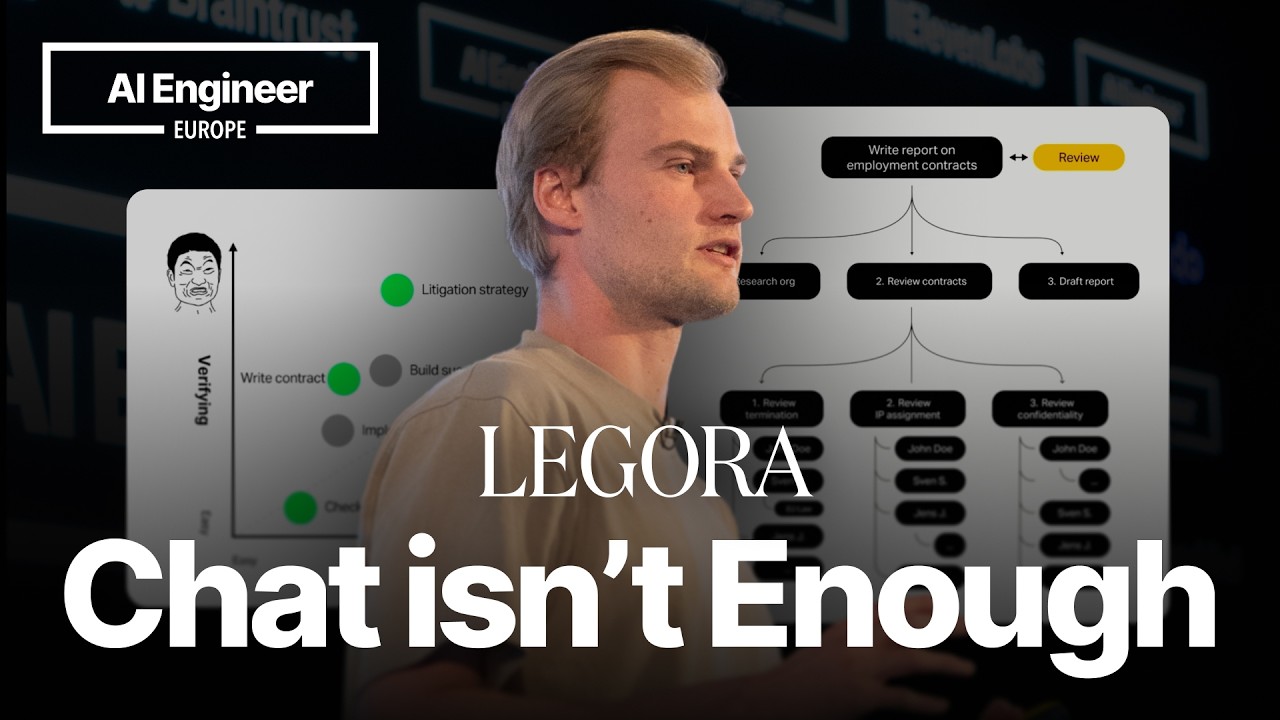
Agents need more than a chat - Jacob Lauritzen, CTO Legora
Apr 22, 2026 · 14:21
Jacob Lauritzen, CTO of Legora, argues that vertical AI agents handling complex work need collaboration interfaces beyond simple chat. He introduces the verifier's rule—tasks easy to verify get solved by AI—and shows how legal work spans from easy-to-verify contract definitions to impossible-to-verify litigation strategy. Lauritzen explains that increasing trust requires making tasks verifiable (e.g., test-driven development, proxy verification with golden contracts) or adding guardrails, while increasing control demands moving from low-control agent trees to planning, then to skills and elicitation where agents ask humans for decisions. He criticizes chat as one-dimensional and low-bandwidth, advocating for high-bandwidth persistent artifacts like documents and tabular reviews where humans can highlight clause three or flag items, enabling effective human-agent collaboration and progressive discovery without losing context.

Building Generative Image & Video models at Scale - Sander Dieleman, Google DeepMind
Apr 21, 2026 · 40:46
Sander Dieleman, a research scientist at Google DeepMind, explains the behind-the-scenes process of building generative image and video models at scale, focusing on diffusion models. He emphasizes that data curation is often underrated and more impactful than model tweaking. Dieleman details how latent diffusion models use learned autoencoders to compress pixels into smaller representations, enabling training on high-resolution video. He describes diffusion as 'spectral autoregression' that generates images coarse-to-fine, and notes that guidance—amplifying the difference between conditional and unconditional predictions—massively improves sample quality at the cost of diversity. On sampling, he contrasts deterministic and stochastic approaches, and covers distillation techniques like consistency models that reduce steps. Dieleman also discusses control signals beyond text, such as camera motion in video generation, and the importance of post-training for conditioning.
How AI is changing Software Engineering: A Conversation with Gergely Orosz, @pragmaticengineer
Apr 21, 2026 · 26:42
Gergely Orosz explains how AI is reshaping software engineering, from token maxing at Meta, Microsoft, and Salesforce—where engineers use AI tools to inflate token counts out of fear of layoffs and performance reviews—to the broader shift in the engineer's role toward orchestrating agents rather than managing people. He notes that big tech companies like Uber, Airbnb, and Shopify are building custom internal AI infra (MCP gateways, coding agents) to stay ahead, even tolerating high churn for a six-month competitive edge. Shopify secured GitHub Copilot a year early by offering feedback from 3,000 engineers. Gergely also shares how The Pragmatic Engineer hit product-market fit: 100 paid subscribers before publishing, reaching 1,000 in six weeks, and becoming the #1 paid tech newsletter by focusing on two deep-dive articles per week for two years.
Taste & Craft: A Conversation with Tuomas Artman, CTO Linear & Gergely Orosz, @pragmaticengineer
Apr 21, 2026 · 29:17
Tuomas Artman, CTO of Linear, warns that AI's ability to instantly ship features risks creating convoluted, low-quality software, arguing that taste and design must guide development. He explains Linear's culture of deliberate product decisions, including a 'zero bug policy' where bugs are fixed within hours, and 'Quality Wednesdays' where engineers find and fix one minute detail each week—resulting in over 2,500 quality fixes. Artman notes that AI lacks human 'taste' and cannot feel user experience nuances like animation timing. He predicts all software engineers will become product engineers, needing to focus on customer needs and UX, and advises aspiring product engineers to build for themselves, talk to customers, and study Apple's Human Interface Guidelines.
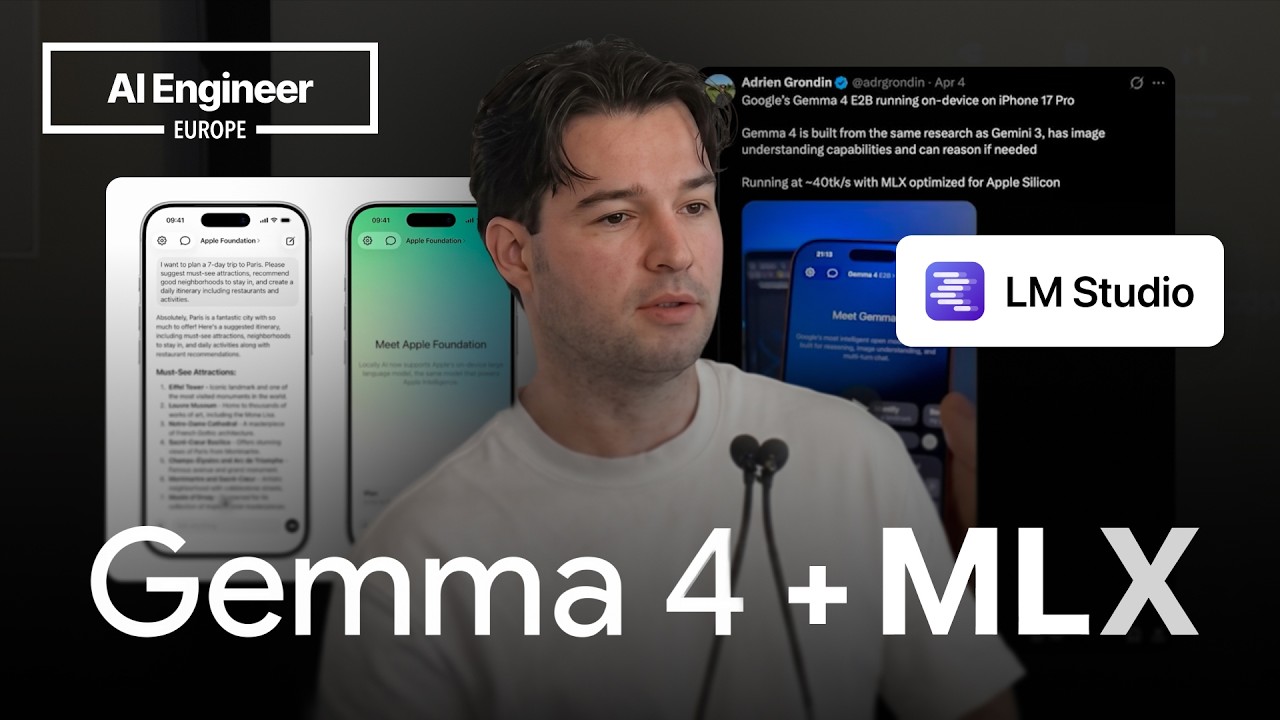
Running LLMs on your iPhone: 40 tok/s Gemma 4 with MLX — Adrien Grondin, Locally AI
Apr 20, 2026 · 10:51
Adrien Grondin, developer of Locally AI, demonstrates how to run Gemma 4 and other LLMs on iPhone using Apple's MLX framework, achieving 40 tokens per second on the latest devices. He explains that MLX is optimized for Apple Silicon and that the open-source mlx-swift-lm GitHub repo enables easy integration into iOS, macOS, and iPadOS apps in under 10 minutes. Grondin recommends quantized models from the Hugging Face MLX community—typically 4-bit to 8-bit—and shows a live demo of Gemma 4 generating text offline. He confirms that mlx-swift-lm supports tool calling, though structured generation is not yet available. He also notes that Locally AI has been acquired by LM Studio, which now lets users run models via MLX or llama.cpp and connect them through OpenAI or Anthropic-compatible APIs.
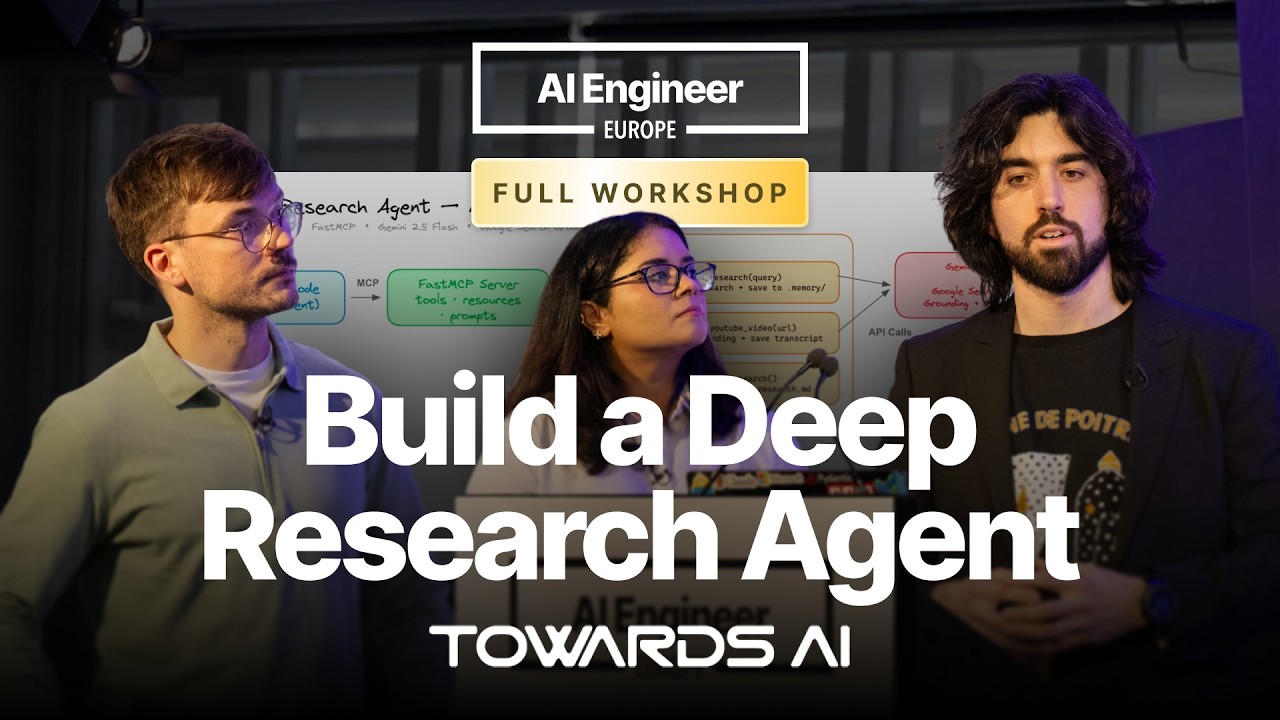
Full Workshop: Build Your Own Deep Research Agents - Louis-François Bouchard, Paul Iusztin, Samridhi
Apr 20, 2026 · 1:57:03
Louis-François Bouchard, Samridhi Vaid, and Paul Iusztin built a combined system of a deep research agent and a deterministic writing workflow to automate high-quality technical content creation, trading flexibility for control. The research agent uses an MCP server (FastMCP) with tools for Google search, YouTube analysis, and report compilation, powered by Gemini and orchestrated by Claude Code. The writing workflow is a static pipeline that loads a user guideline, writing profiles (structure, terminology, character), and few-shot examples into a system prompt, then applies an evaluator-optimizer loop: a reviewer outputs structured pydantic objects with profile/location/comment to flag violations, and the editor applies them in priority order (guideline > research > profile). They stress that research demands autonomy while writing needs constraint, and show how to avoid AI slop by banning specific words and using profiles. For observability, they use Opik to capture all traces, and for evals they built a 20-sample dataset from real LinkedIn posts, split into train/dev/test, to calibrate an LLM judge (binary pass/fail) that they run on dev and test splits to measure F1 and detect…

The New Application Layer - Malte Ubl, CTO Vercel
Apr 20, 2026 · 18:52
Vercel CTO Malte Ubl argues that AI engineering is the legitimate successor to web development and that the real value lies in the application layer, not the model labs. He identifies four effective agent archetypes—24/7 support, compressed research, surfacing existing information, and eliminating boring work—and reveals that over 60% of vercel.com page views now come from AI agents. Ubl predicts model companies will commoditize, driving costs down and empowering engineers, while citing Europe's leadership in AI engineering through Vercel's AI SDK, Pi (a coding agent from Austria), and OpenClaw. He stresses the need for open-mindedness toward paradigm shifts and new infrastructure, such as sandboxed agent runtimes, and warns of impending security challenges.
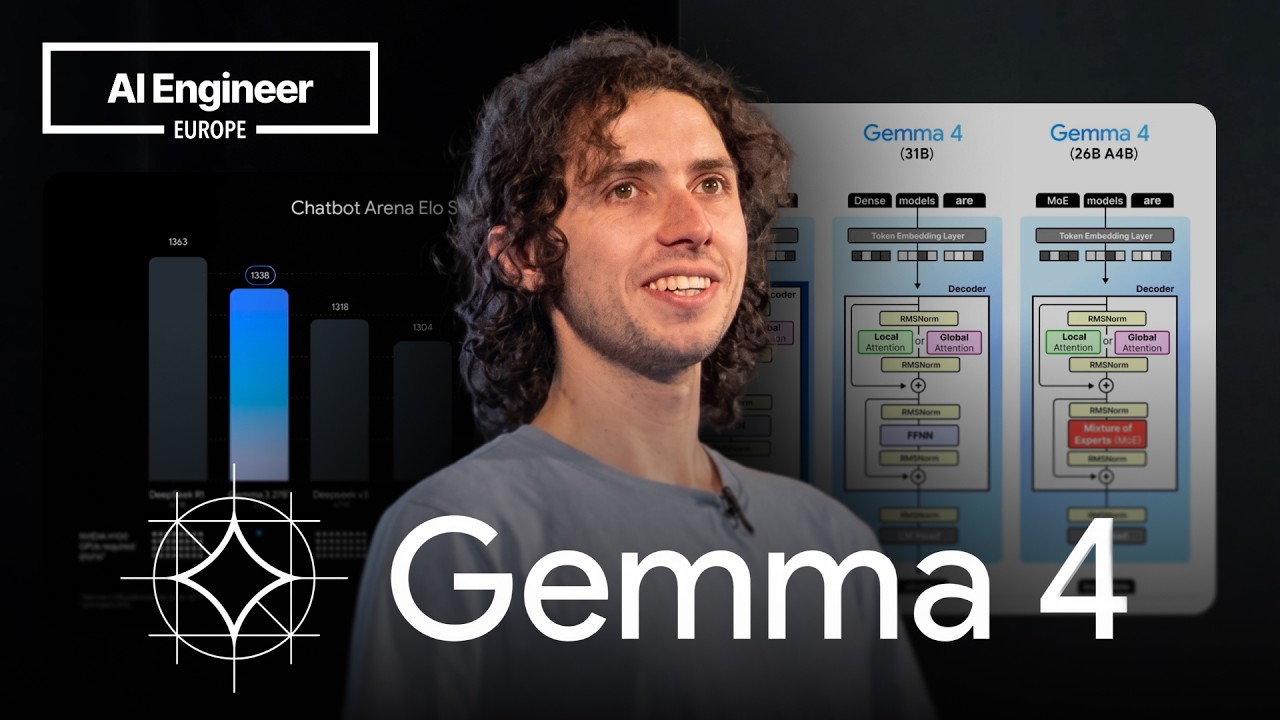
Gemma, DeepMind's Family of Open Models — Omar Sanseviero, Google DeepMind
Apr 20, 2026 · 15:26
Omar Sanseviero presents Gemma 4, Google DeepMind's latest family of open models, which range from 2B to 32B parameters and introduce a novel per-layer embedding (E2B) architecture optimized for on-device inference. The models feature multimodal understanding (images, video, audio), multilingual support across 140+ languages, and are released under an Apache 2 license. Within a week, Gemma 4 reached 10 million downloads, contributing to over 500 million total downloads for the Gemma family and 100,000 community-derived models. Sanseviero highlights official variants like Shield Gemma for content safety and MedGemma for medical tasks, as well as community efforts such as AI Singapore's Southeast Asian language models and Sarvam's sovereign AI initiative for India. He emphasizes real-world applications including cancer therapy pathway discovery and fully offline agentic tasks on phones and Raspberry Pis, arguing that open models are rapidly enabling high-performance, private, and customizable AI across diverse use cases.
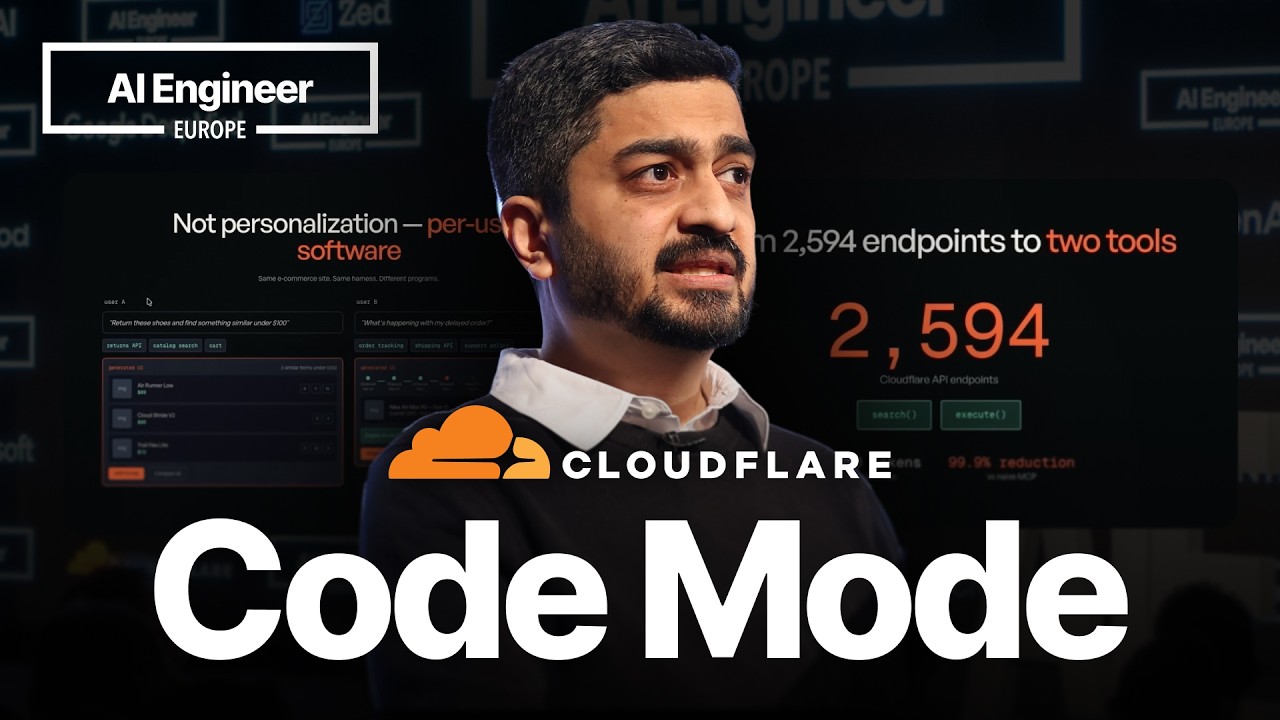
Code Mode: Let the Code do the Talking - Sunil Pai, Cloudflare
Apr 19, 2026 · 19:40
Sunil Pai of Cloudflare presents 'Code Mode,' a paradigm where AI agents generate executable JavaScript instead of using JSON-based tool calls, drastically reducing token usage from 1.2 million to 1,000 for Cloudflare's 2,600 API endpoints. He demonstrates a live (if glitchy) demo of the Mythical server handling a DDoS response in one shot, and shares the 'harness' architecture: a sandboxed, capability-secure environment that grants only explicit APIs. The talk explores emergent behaviors like Kenton Varda's canvas where the model played tic-tac-toe by inspecting raw stroke state, and envisions long-running workflows, generative UI, and a future where code—not buttons—defines user interaction. Pai argues that developers must optimize for agent-facing DX with searchable docs, clear errors, and capability-based security, as the next billion users will be code-generating bots.
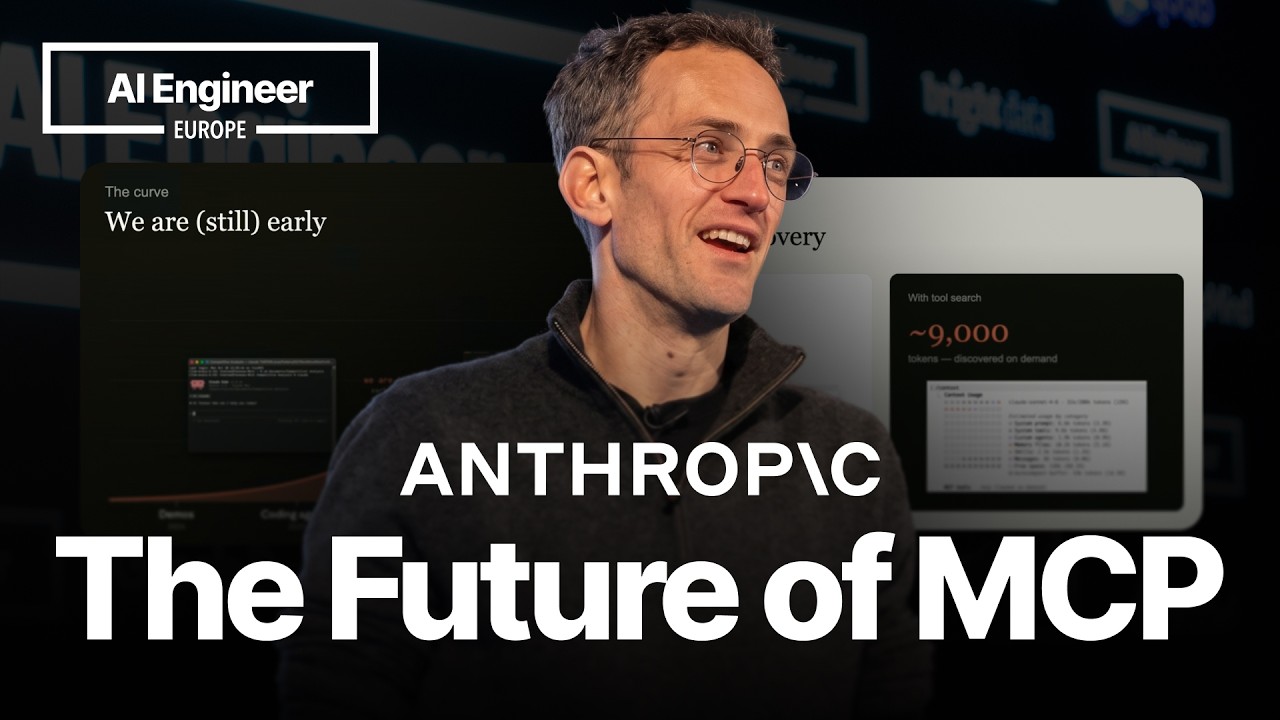
The Future of MCP — David Soria Parra, Anthropic
Apr 19, 2026 · 18:46
David Soria Parra from Anthropic argues that MCP (Model Context Protocol) is the key to connecting agents to tools and data in production, with 110 million monthly downloads—outpacing React's growth at the same stage. He lays out a 2026 connectivity stack combining Skills, MCP, and CLI/Computer Use, each suited for different needs, and emphasizes that best agents will use all three seamlessly. To improve client harnesses, he introduces Progressive Discovery—deferring tool loading via Tool Search to reduce context usage—and Programmatic Tool Calling, where models write scripts to compose tool outputs efficiently. Upcoming MCP protocol improvements include stateless transport (with Google) for easier scaling, async agent-to-agent tasks, enterprise features like Cross App Access and Server Discovery via well-known URLs, and a Skills-over-MCP extension for shipping usage instructions with servers. He calls for community feedback on these directions.

How Google DeepMind is researching the next Frontier of AI for Gemini — Raia Hadsell, VP of Research
Apr 18, 2026 · 20:37
Google DeepMind VP of Research Raia Hadsell presents three non-language-model frontiers of AI: Gemini Embeddings 2, an omnimodal embedding model that unifies text, video, audio, and PDFs into a single semantic vector for fast retrieval; weather forecasting models including GraphCast (spherical GNN for 15-day forecasts), GenCast (probabilistic model 97% more accurate than benchmarks), and FGN (directly predicts cyclones, used by the US National Hurricane Center); and Genie world models that create interactive, memory-rich 3D environments from prompts, enabling real-time dynamic changes for gaming and education.

The Friction is Your Judgment — Armin Ronacher & Cristina Poncela Cubeiro, Earendil
Apr 18, 2026 · 18:38
Armin Ronacher (creator of Flask) and Cristina Poncela Cubeiro argue that while AI coding agents promise frictionless shipping, the resulting loss of human judgment introduces dangerous technical debt and brittleness. They describe the psychological trap of addictive speed and the engineering challenge of agents producing slop that creates hidden failure conditions. To counter this, they advocate for agent-legible codebases that modularize both code components and flow, enforce strict linting rules such as no bare catch-alls and unique function names, and deliberately reintroduce friction in high-stakes decisions like database migrations and permission changes. They note that agents excel at libraries with simple cores but struggle with products built on intertwined concerns, and that human responsibility must remain central as code production outpaces review capacity.

State of the Claw — Peter Steinberger
Apr 17, 2026 · 44:12
Peter Steinberger, creator of OpenClaw, presents a five-month update on the world's fastest-growing open-source project. He details the project's staggering growth—30,000 commits, nearly 2,000 contributors—and the immense security burden: 1,142 advisories (16.6 per day) with 99 critical, often AI-generated slop that demands human vetting. Steinberger refutes media fearmongering, citing how researchers ignore security docs to fabricate scary scenarios. He clarifies OpenAI did not buy OpenClaw; he joined the company while establishing the OpenClaw Foundation to remain vendor-neutral. He emphasizes the importance of local models for data sovereignty and describes his coding workflow of running 5-6 agent sessions simultaneously, iterating on taste and personality. Future visions include ubiquitous agents, 'Dreaming' for memory reconciliation, and modular plugins. For engineers, he champions taste, system design, and learning to say no.

Harness Engineering: How to Build Software When Humans Steer, Agents Execute — Ryan Lopopolo, OpenAI
Apr 17, 2026 · 46:21
Ryan Lopopolo, a member of technical staff at OpenAI, argues that software engineers must shift to 'harness engineering' where agents produce all code and humans focus on delegation, system design, and guardrails. He describes how his team banned editors, using Codex with skills to manipulate apps, and reduced review friction by automating lint rules and review agents. Lopopolo explains that code is free but human time and model context are scarce, so teams should structure repositories for consistency and use 'garbage collection days' to eliminate recurring slop. He shares practical techniques like writing tests about source code (e.g., file length limits) and using review agents that inject prompts. His future vision involves agents autonomously executing long-horizon work based on token budgets and success metrics, freeing humans for higher-level activities.
Building pi in a World of Slop — Mario Zechner
Apr 16, 2026 · 18:25
Mario Zechner explains why he built pi, a self-modifying, extensible agent core, after growing frustrated with Cloud Code and Open Code for their buggy features, uncontrolled context management, and zero extensibility. pi strips away complexity, giving the agent just four tools (read, write, edit, bash) and a minimal system prompt, letting it adapt to the user's workflow rather than vice versa. Extensions are TypeScript modules that hot-reload, enabling users to build custom tools, chat rooms, or even play Doom without forking pi. He then attacks clankers — agent-generated pull requests and issues — that are destroying open source, sharing his own tactics like auto-closing PRs with a human-voice request and de-prioritizing OpenClaw interactions. In Act 3, Zechner argues that agents compound errors with zero learning, producing enterprise-grade complexity in weeks, and that long context windows and agentic search are hacks. His prescription: scope agent tasks, modularize codebases, cap generated code review, and always read every line of critical code yourself.

$1 AI Guardrails: The Unreasonable Effectiveness of Finetuned ModernBERTs – Diego Carpintero
Apr 16, 2026 · 43:53
Diego Carpentero argues that LLM-based attacks—Prompt Injection, Indirect Injection, Model Internals (gibberish suffix), RAG Poisoning, MCP Exploits, and Agentic Escalation—are now the baseline, not the exception, and that model alignment and human review alone are insufficient. He identifies the core problem as a Zero Trust Gap: LLMs natively lack separation between system controls and data, allowing adversaries to override decisions via malicious instructions in inputs or external content. To build a protective layer, Carpentero fine-tunes ModernBERT—a state-of-the-art encoder with Alternating Attention, Unpadding & Sequence Packing, RoPE, and FlashAttention—into a safety discriminator that classifies prompts as safe or unsafe in ~35 milliseconds with 85% accuracy, all for under a dollar. He walks through the fine-tuning pipeline using the IngetGuard dataset and demonstrates live detection of real attack examples from each vector.

Paperclip: Open Source Human Control Plane for AI Labor — Dotta Bippa
Apr 15, 2026 · 24:34
Dotta Bippa introduces Paperclip, an open-source human control plane for AI labor that lets you manage an org chart of agents to run a zero-human company. The tool enables you to hire employees, set goals, automate jobs, and bring your own agent (e.g., Gemini, Claude, Codex) with skills and instructions. Paperclip supports reliable workflows like QA reviews and approvers, and routines for recurring tasks such as summarizing PRs or writing changelogs. Dotta demonstrates creating a Remotion video celebrating Paperclip's 40,000 GitHub stars (now 50,000) by instructing the CEO agent to hire a video writer and apply brand guidelines—something that would have taken a week becomes an afterthought. Paperclip is not just for coding; it handles marketing, sales, and finance. Upcoming features include CEO chat, maximizer mode, multi-user support, cloud deployments, and a desktop app, all aimed at giving humans control over AI labor.
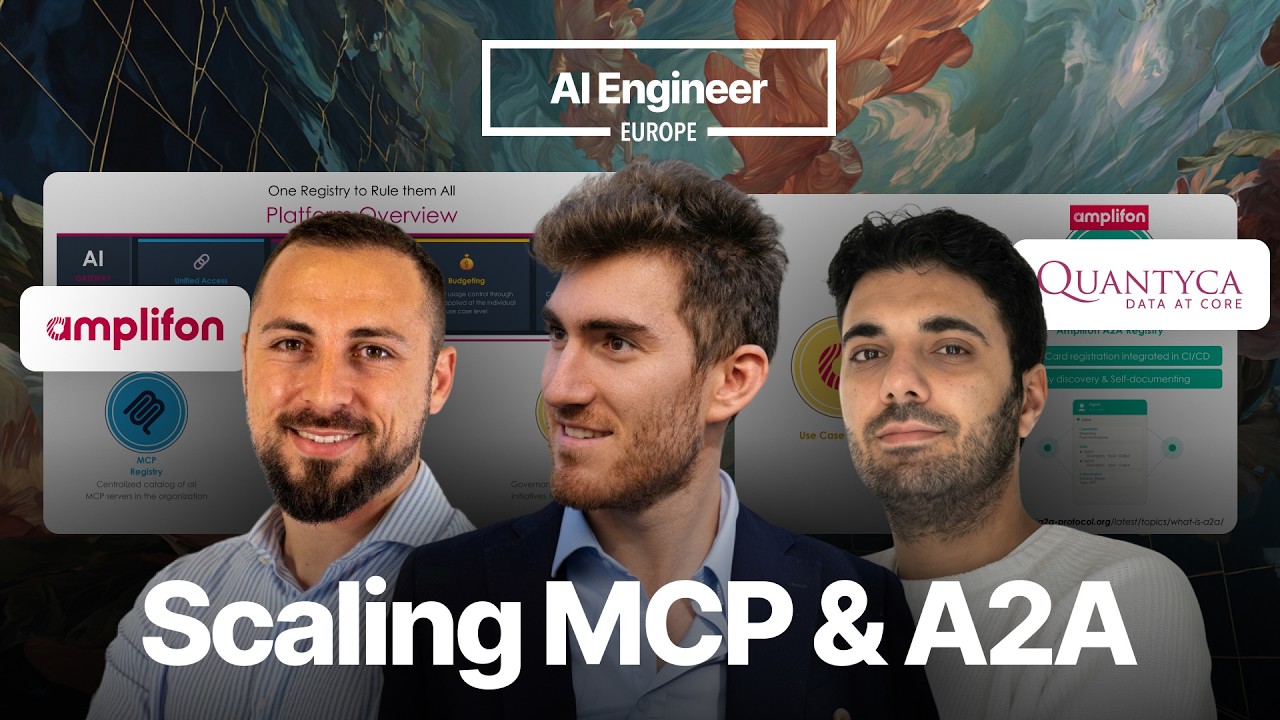
One Registry to Rule them All - Sonny Merla, Mauro Luchetti, & Mattia Redaelli, Quantyca
Apr 10, 2026 · 22:47
Amplifon's AI transformation led to the Amplify program, for which Quantyca built an enterprise-grade registry system for MCP servers and A2A agents. Sonny Merla, Mauro Luchetti, and Mattia Redaelli explain how three registries—MCP, A2A, and use case—are linked via a catalog to provide full lineage, including ownership, environment, authentication, cost attribution, and use case linkage. The solution uses an AI gateway for unified LLM access with Entra ID authentication and budgeting, and provides template repositories on GitHub with CI/CD pipelines that automatically publish agent cards and server metadata to the registries. This enables discovery, governance, and impact analysis across 26 countries and multiple teams, letting developers focus on business logic while avoiding reinventing security and deployment infrastructure.
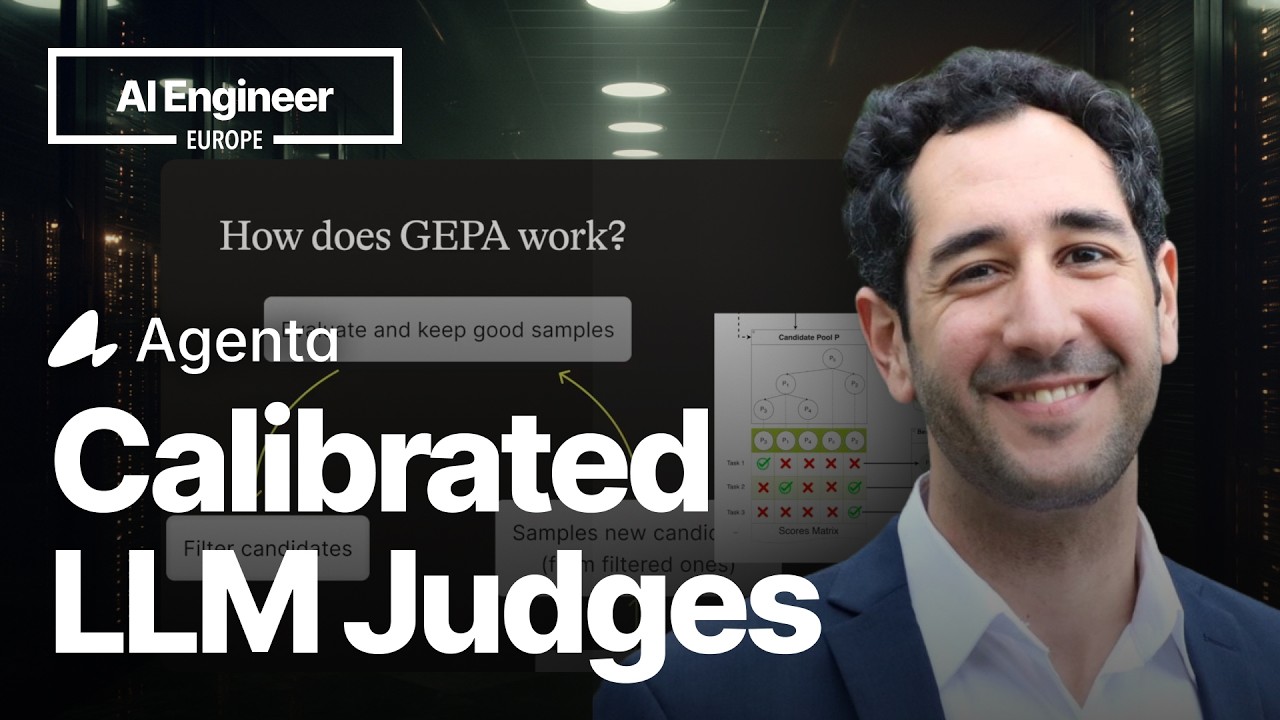
Judge the Judge: Building LLM Evaluators That Actually Work with GEPA — Mahmoud Mabrouk, Agenta AI
Apr 10, 2026 · 40:51
Mahmoud Mabrouk, co-founder of Agenta AI, demonstrates how to build calibrated LLM-as-a-judge evaluators using the GEPA prompt optimization algorithm, arguing that miscalibrated evals are worse than none. He walks through a practical workflow for a customer support agent using the TaoBench airline dataset, covering metric design, data annotation, and GEPA-based optimization. The seed judge achieved 61% accuracy; after optimization, accuracy rose to 74% with reduced bias, though the judge still struggled to fully learn the complex policy. Mabrouk shares key lessons: start with a seed prompt biased toward compliance, use larger models for refinement, overfit to training data first, and beware of high token costs.

AI Didn’t Kill the Web, It Moved in! — Olivier Leplus (AWS) & Yohan Lasorsa (Microsoft)
Apr 10, 2026 · 52:55
Yohan Lasorsa (Microsoft) and Olivier Leplus (AWS) argue that AI isn't replacing the web—it's becoming its native layer, embedded in every stage of development. They demo coding agents that use lightweight 'skills' to automate workflows like fetching GitHub issues and testing via Playwright, then show Chrome's MCP server letting agents debug performance across different network conditions. New on-device Web AI APIs (summarizer, proofreader, prompt API) run models locally in the browser, enabling features like auto-writing reviews from an uploaded product image without cloud calls. Finally, they introduce LLMs.txt for guiding AI agents to relevant documentation and Web MCP—a proposal to register native tools on websites (e.g., 'add to cart') so agentic browsers can execute actions without mimicking human clicks. The episode delivers concrete implementations, from coding to deploying AI-ready web apps.

Running LLMs locally: Practical LLM Performance on DGX Spark — Mozhgan Kabiri chimeh, NVIDIA
Apr 10, 2026 · 10:16
NVIDIA’s Mozhgan Kabiri Chimeh demonstrates that running LLMs locally on the DGX Spark workstation, powered by the GB10 Grace Blackwell superchip and 128GB unified memory, achieves practical performance for models up to 14B parameters. Using a reproducible vLLM benchmarking methodology, she shows that the 14B NVFP4 quantized model delivers 20.19 tokens per second and a time-to-first-token 3.4× faster than the unoptimized 14B base model. The DGX Spark supports the same NVIDIA AI software stack as production environments, enabling local development, fine-tuning, and privacy-sensitive workloads before scaling to the cloud. NVFP4 quantization is highlighted as critical for balancing intelligence and throughput on single-system setups.

Contact Center Voice AI: Low-Latency Intelligence Extraction from Messy Audio Streams — Dippu Singh
Apr 8, 2026 · 22:56
Dippu Singh of Fujitsu North America presents an architecture for real-time voice intelligence in contact centers that reduces post-call work by 50% through structured intent extraction from messy audio streams. The pipeline comprises four stages: voice capture with stereo channel splitting and PII masking, speech-to-text with domain-specific dictionaries, a generative AI core that uses system prompts to output separate JSON bullet points for customer intent and operator actions, and a customer data sync layer that maps LLM output to CRM fields via REST APIs. Key results show after-call work (ACW) dropped from 6.3 to 3.1 minutes, while data entry quality became standardized. Current constraints include STT accuracy for heavy accents, API token costs for long transcripts, and security compliance overhead. The roadmap targets explainable AI for agent coaching, predictive staffing from categorized intent data, and real-time abusive-call detection to protect operators.
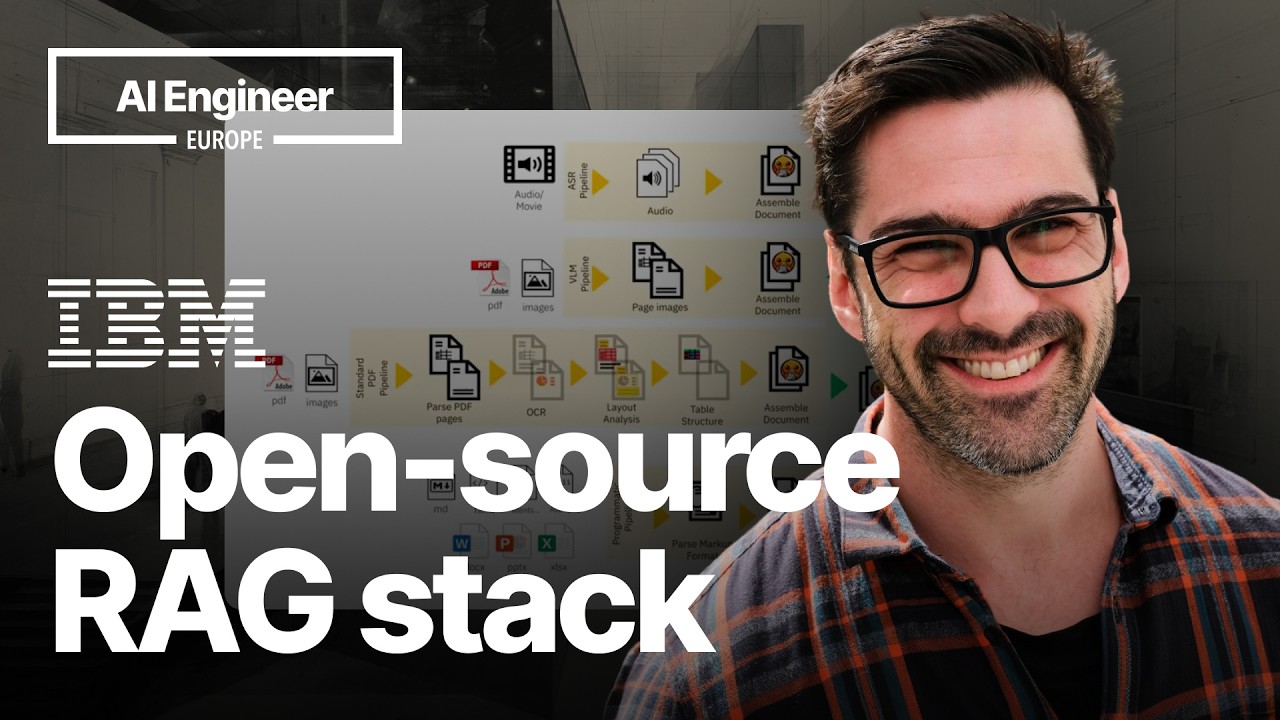
OpenRAG: An open-source stack for RAG — Phil Nash
Apr 8, 2026 · 15:52
Phil Nash introduces OpenRAG, an open-source RAG stack from IBM combining Docling, OpenSearch, and Langflow, arguing that RAG remains hard and custom despite claims it's dead — every business has unique data requiring more than simple vector search. Docling parses PDFs, audio, and more with specialized pipelines, outputting hierarchically chunked text. OpenSearch provides hybrid vector and keyword search using JVector for live indexing and disk-based ANN. Langflow enables visual agentic retrieval where the LLM decides searches with tools like a calculator and MCP servers. The stack supports local models via Ollama, cloud connectors for Google Drive and SharePoint, and an API. Nash demonstrates adding guardrails in Langflow and invites contributions to the open project.

From Chaos to Choreography: Multi-Agent Orchestration Patterns That Actually Work — Sandipan Bhaumik
Apr 8, 2026 · 26:29
Sandipan Bhaumik, Data & AI Tech Lead at Databricks, argues that scaling AI agents from one to five transforms an AI problem into a distributed systems problem, exposing teams to race conditions, stale reads, and cascading failures. He recounts a production deployment where a credit decisioning system incorrectly approved 20% of applicants because a caching layer wasn't invalidated between agents. Bhaumik presents two coordination patterns: choreography (event-driven, decentralized) for simple workflows with high autonomy, and orchestration (central coordinator) for complex workflows needing rollback and observability. He advocates for immutable state snapshots (append-only versions) and data contracts (schema validation at handoffs) to eliminate race conditions, and demonstrates failure recovery using circuit breakers and compensation (saga) patterns. The episode delivers a production-grade architecture on Databricks using LangGraph, Unity Catalog, Delta Lake, and MLflow for tracing, with code examples for state handoff and circuit breaker logic.
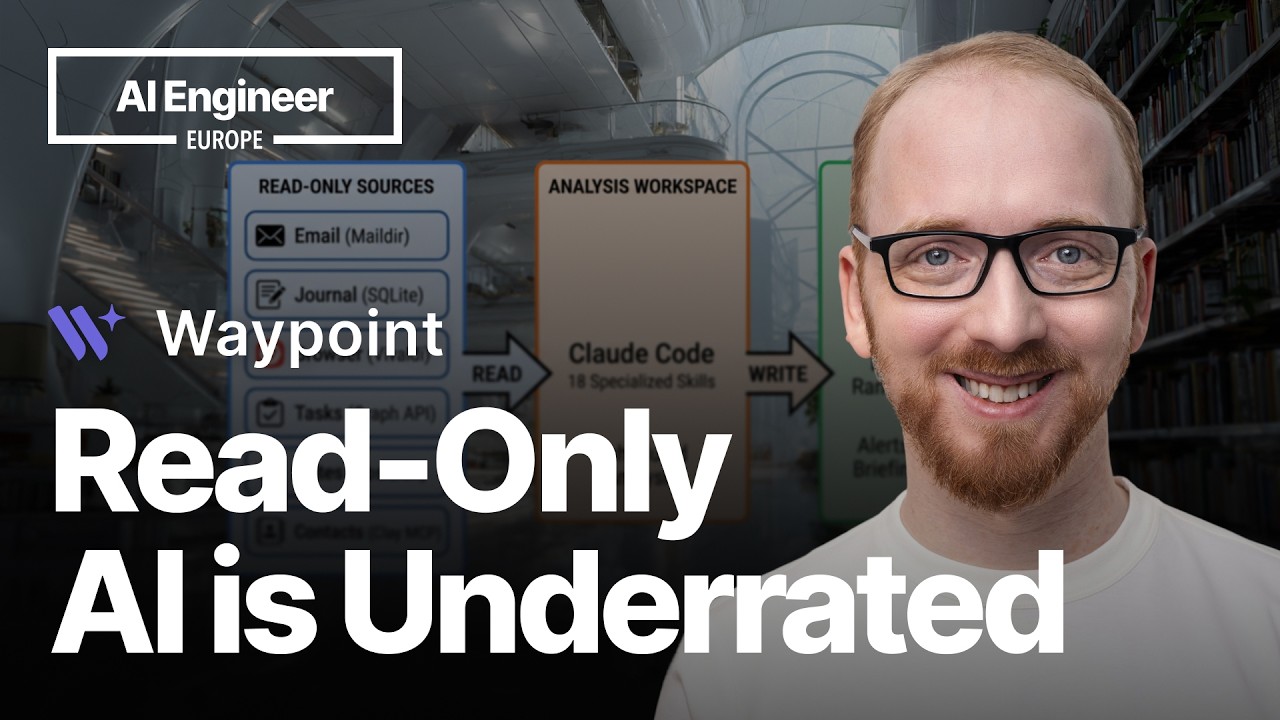
Cognitive Exhaust Fumes, or: Read-Only AI Is Underrated — Šimon Podhajský, Head of AI, Waypoint
Apr 8, 2026 · 11:31
Šimon Podhajský argues that read-only AI systems that analyze personal digital exhaust without the ability to write back are more valuable than agentic AI that acts on users' behalf. He built a system ingesting six read-only sources (email, journal, tasks, CRM, browser sessions, notes) that surfaces insights like intention-action gaps, attention drift, and relationship decay via cross-source pattern detection—things no single source reveals. For example, a weekly reflection skill in Claude synthesizes a brutal review of his week, and a cross-source query maps his recent reading to contacts in his CRM using Vivaldi SQLite and Clay MCP. He emphasizes risk asymmetry: read-only errors cost nothing, while write errors can be unbounded. He also acknowledges security risks like the mosaic effect and Simon Willison's lethal trifecta, noting that shell access still allows exfiltration, but argues that examined risk is better than ignorance.

Platforms for Humans and Machines: Engineering for the Age of Agents — Juan Herreros Elorza
Apr 8, 2026 · 21:15
Juan Herreros Elorza, team lead at Banking Circle, argues that the same platform engineering best practices—self-service, API-first design, local-first workflows, and rich observability—that serve human developers are now prerequisites for AI coding agents to autonomously build, debug, and ship software. Drawing from his experience building the internal platform Atlas, which handles over €1 trillion in cross-border payments annually, he explains how exposing platform capabilities via well-defined APIs (and optionally MCP servers) lets agents iterate locally, fail fast, and close the loop using API-accessible logs and metrics. He stresses structured documentation, including agent.md files and skills, to guide agents on how to contribute to the platform, and recommends combining guardrails for security with context files for best practices. Finally, he advises measuring outcomes like DORA metrics, support requests, and developer satisfaction, and suggests using AI as leverage to finally implement these long-known best practices.

Why, and how you need to sandbox AI-Generated Code? — Harshil Agrawal, Cloudflare
Apr 8, 2026 · 38:27
Harshil Agrawal (Cloudflare) argues AI-generated code is untrusted and must be sandboxed via capability-based security (default deny, explicit allow) against hallucinations, over-helpful LLMs, and prompt injection. He details two approaches: isolates for fast lightweight tasks (e.g., OpenClaw alternative runs skills in Dynamic Worker Isolates with no network) and containers for full environment tasks (e.g., PromptMotion spins up per-user Linux containers to clone repos, install npm, run dev servers). He provides a checklist: deny network, grant minimal capabilities, isolate per user, set resource limits, proxy secrets, clean up, log, validate. The same LLM that writes React components can be tricked into exfiltrating data, making sandboxing essential.

Your Insecure MCP Server Won't Survive Production — Tun Shwe, Lenses
Apr 8, 2026 · 24:34
Tun Shwe and Jeremy Frenay from Lenses.io argue that poorly designed MCP servers are inherently insecure, and propose five core design principles—shrink attack surface, constrain inputs, treat docs as defense, return minimal data, minimize blast radius—that also thwart OWASP's MCP Top 10. They highlight that standard I/O fails under load (20 of 22 requests failing with 20 concurrent connections), forcing a shift to streamable HTTP with OAuth 2.1. Jeremy details Dynamic Client Registration (DCR) and the newer Client ID Metadata Document (CIMD) approach, noting DCR's vulnerabilities (phishing, non-portable registrations) and CIMD's stronger identity verification since November 2025. Beyond OAuth, enterprise deployment requires tool-level RBAC, data masking for PII, full audit logs, and end-to-end tracing to meet regulations like the EU AI Act.
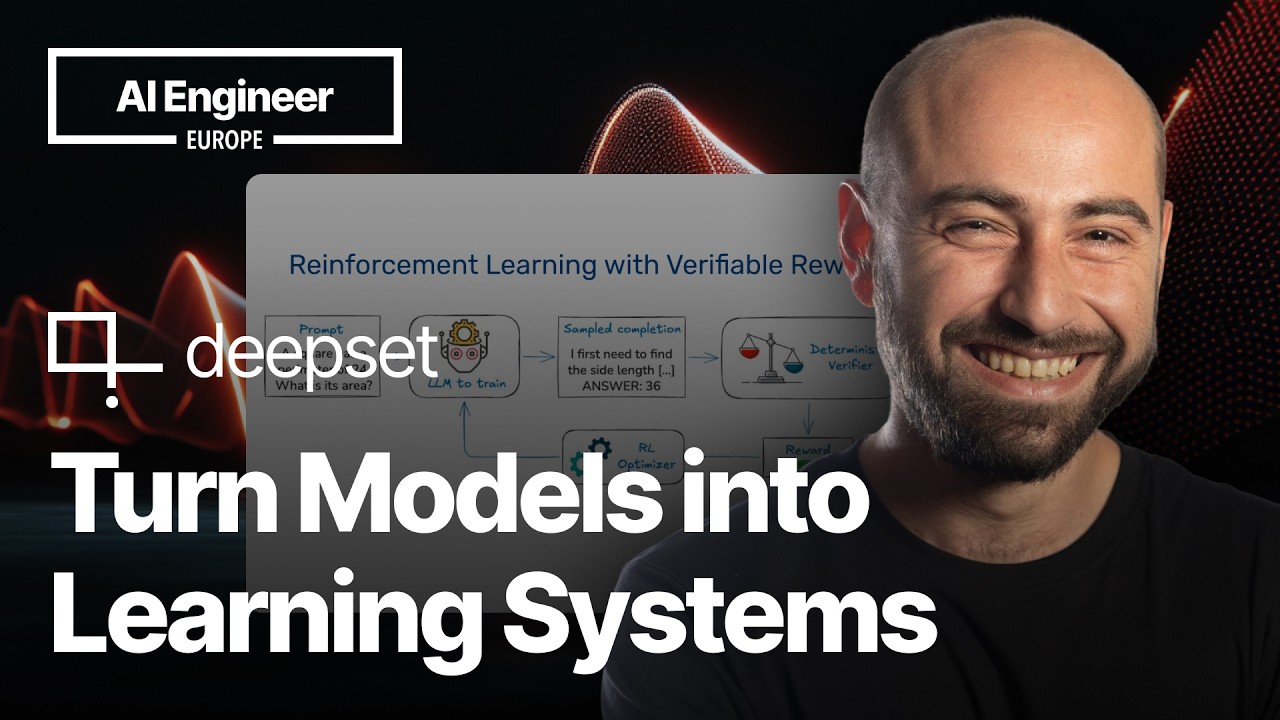
Let LLMs Wander: Engineering RL Environments — Stefano Fiorucci
Apr 8, 2026 · 40:35
Stefano Fiorucci demonstrates how to build Reinforcement Learning environments for language models using the open-source Verifiers library, arguing that training small models with verifiable rewards can surpass large closed models on specific tasks. He maps classic RL concepts to LLMs, introduces Verifiers components for single-turn, multi-turn, and tool environments, and then walks through an experiment where he takes LiquidAI's LLM 2 — a small open model — and transforms it into a tic-tac-toe master via supervised fine-tuning and GRPO-based reinforcement learning. After training, the model dominates random opponents and draws 85% of games against optimal ones, eventually outperforming GPT-5 Mini against identical optimal opponents. Fiorucci shares practical lessons: large batch sizes (≥256) ensure stable training, hidden biases in opponent algorithms can skew results, and starting from a base model (not a reasoning model) avoids truncated thinking traces. He concludes that if you can define a clear reward signal, you can build an environment and train a small specialized model to beat a large closed model at a fraction of the cost.

Bending a Public MCP Server Without Breaking It — Nimrod Hauser, Baz
Apr 8, 2026 · 40:50
Nimrod Hauser, founding engineer at Baz, presents a hands-on guide to adapting third-party MCP servers for production, using Playwright's MCP server as an example. He demonstrates five best practices—curation, wrapping descriptions, deterministic guardrails, composing new tools, and treating tools as deterministic functions—to transform a brittle setup into resilient infrastructure. Hauser shows how curating tools from 21 to 16 reduces context load, while enhanced descriptions guide agents to use accessibility snapshots before clicking. Deterministic path validation prevents agents from saving screenshots outside a designated folder, and a new 'evidence tool' with tailored instructions improves spec review accuracy. The talk culminates with Baz's Spec Reviewer, an agentic code review tool that compares requirements against implementation, successfully passing a test after applying all optimizations.
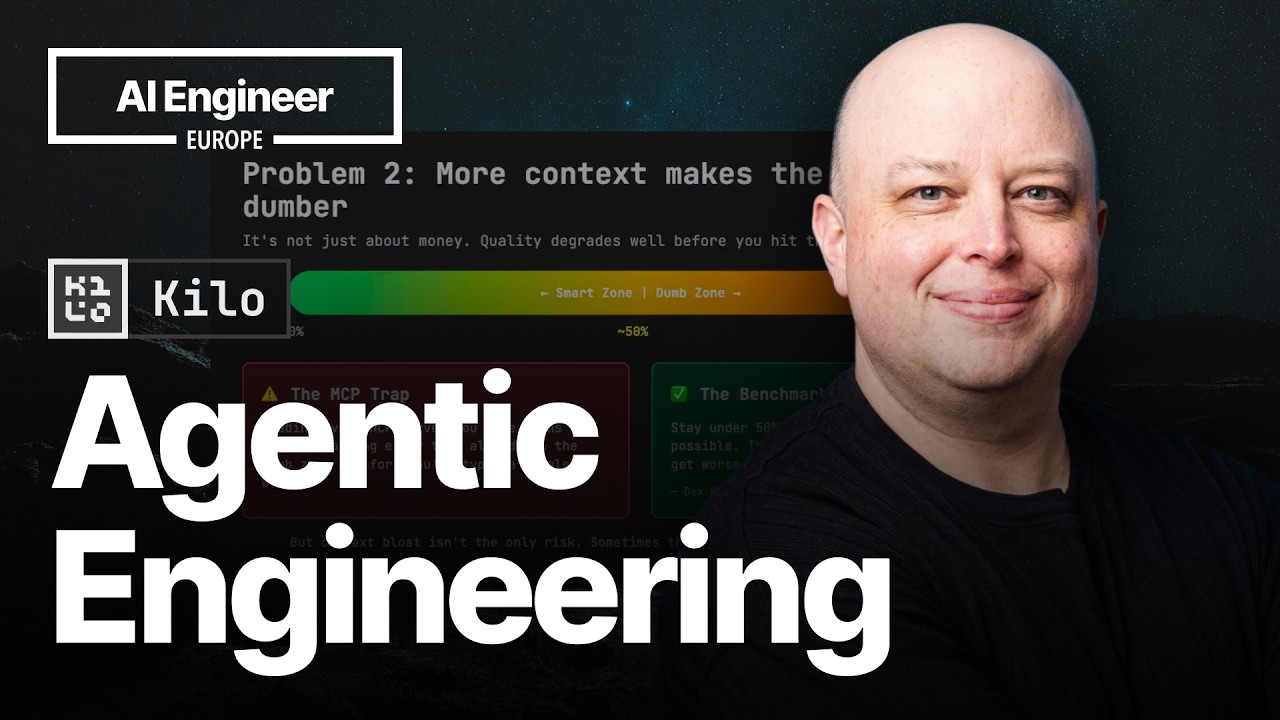
Agentic Engineering: Working With AI, Not Just Using It — Brendan O'Leary
Apr 7, 2026 · 27:03
Brendan O'Leary, a Developer Relations Engineer at Kilo Code, argues that agentic engineering means shifting from using AI as a tool to working with it as a collaborator—like an energetic but inexperienced junior developer. He explains that context engineering—managing what goes into the model's context window—is critical, as too much or bad context degrades output quality. O'Leary recommends a research-plan-implement loop: first understand the system without writing code, then create a detailed plan, and finally execute in a fresh session to keep context lean. He advocates for configuring agents with role-based modes (Ask, Architect, Code), along with agents.md and skills files for persistent rules and reusable workflows. O'Leary also cautions against overusing MCP servers, which add token cost and can confuse the agent, and suggests isolating agent work via Git for easy review. The episode emphasizes that AI cannot replace thinking—it only amplifies the human's preparation and judgment.

How METR measures Long Tasks and Experienced Open Source Dev Productivity - Joel Becker, METR
Jan 19, 2026 · 1:15:52
Joel Becker of METR argues that AI benchmark scores are soaring while real-world developer productivity barely budges, reconciling this gap by presenting METR's time horizon measurements and a 16-developer RCT showing no significant speedup from AI on mature open-source projects. He cites reliability issues, task distribution mismatches, and the J-curve effect from Meta's developer data, noting that experienced users still fail to accelerate. The episode explores why AI struggles with messy enterprise data (e.g., LinkedIn's 5,000 'impressions' tables), the failure of computer-use agents in 'Agent Village,' and the possibility that hardware constraints may slow progress. Becker also previews new metrics like 'watched versus unwatched' time horizons and future studies on greenfield coding and data science.
Identity for AI Agents - Patrick Riley & Carlos Galan, Auth0
Jan 14, 2026 · 1:22:12
Patrick Riley and Carlos Galan from Auth0 (Okta) present new identity and access management features for AI agents, including Async Auth, Token Vault, and MCP integration. Token Vault securely stores and refreshes upstream resource tokens, enabling agents to access APIs on behalf of users. Async Auth allows agents to request user approval for risky operations, such as placing an order, via out-of-band notifications like push to the Guardian app. They demonstrate a Next.js chatbot that uses Token Vault to read a user's stock portfolio and Async Auth to require explicit consent before executing trades. The MCP server is secured with OAuth 2.0, supporting Dynamic Client Registration (DCR) and fine-grained scopes. The solution bridges user identity, agent identity, and upstream API authorization, ensuring agents can act autonomously but with user-defined boundaries.
OpenAI + @Temporalio : Building Durable, Production Ready Agents - Cornelia Davis, Temporal
Jan 12, 2026 · 1:18:30
Cornelia Davis, developer advocate at Temporal, demonstrates how the OpenAI Agents SDK and Temporal combine to build durable, production-ready AI agents. The integration, co-developed by OpenAI and Temporal, wraps agentic loops in Temporal workflows, providing automatic retries, event sourcing, and state management that survive process crashes and network failures. A live demo shows a weather alert agent that calls an LLM, invokes tools like get_weather_alerts and get_ip_address, and recovers seamlessly after the worker is killed. Davis highlights that Temporal’s architecture treats processes as logical entities, allowing agents to run for days and handle human-in-the-loop delays without developer-managed infrastructure. She also explains handoffs and micro-agent orchestration, and points to the AI Cookbook on docs.temporal.io with ready-to-run recipes including the OpenAI Agents SDK integration.

Your MCP Server is Bad (and you should feel bad) - Jeremiah Lowin, Prefect
Jan 12, 2026 · 54:33
Jeremiah Lowin, CEO of Prefect and creator of FastMCP, argues that most MCP servers are poorly designed because they are simply REST API wrappers, leading to confused LLMs and wasted tokens. He presents a framework for agent-native product design based on three dimensions—discovery, iteration, and context—and offers five actionable principles: outcomes over operations, flatten arguments, treat instructions as context, respect the token budget, and curate ruthlessly. Lowin emphasizes that agents fail when given too many tools or complex arguments, citing a hard limit of 50 tools per agent for reliable performance. He shares real-world examples, including a company with 800 endpoints that could not be effectively exposed, and critiques client implementations like Claude Desktop for not respecting spec-compliant features. The central takeaway: MCP servers should be designed as user interfaces for agents, not as developer APIs.

Spec-Driven Development: Agentic Coding at FAANG Scale and Quality — Al Harris, Amazon Kiro
Jan 9, 2026 · 1:03:50
Al Harris, principal engineer at Amazon, presents Spec-Driven Development (SDD) with Kiro, an agentic IDE that transforms prompts into structured requirements (EARS format), designs, and property-based tests to ensure code correctness. He argues that upfront specification—augmented by MCP servers for external context—improves reproducibility and quality over pure vibe coding. The talk includes a live demo: building an S3-backed checkpointer for a LangGraph dad joke generator, then discovering Agent Core’s native memory is more idiomatic. Harris contrasts SDD with Cursor’s planning mode, explains how specs evolve as living documentation, and discusses handling session length, context pruning, and brownfield codebases. The result is a claim that spending 5–10 minutes on specs yields higher accuracy and reliable, testable outputs.

DSPy: The End of Prompt Engineering - Kevin Madura, AlixPartners
Jan 8, 2026 · 1:13:13
Kevin Madura of AlixPartners argues that building robust enterprise AI applications requires shifting from brittle prompt engineering to programming with LLMs using DSPy, a declarative framework that treats prompts as implementation details optimized by the system. He demonstrates how typed interfaces (Signatures) and modular logic (Modules) allow developers to focus on control flow while deferring implementation to the LLM, with Adapters controlling prompt formats (e.g., JSON vs. BAML) to improve performance by 5-10%. The talk's core is Optimizers (like MIPRO and JEPA), which automatically tune prompts by learning from data, shown improving a time entry corrector from 86% to 89% accuracy. Real-world examples include routing files by type (SEC filings vs. contracts), using a 'poor man's RAG' with attachments for multimodal documents, and a boundary detector that segments legal documents from images. Madura emphasizes that DSPy enables transferability across models (e.g., GPT-4.1 to GPT-4.1 Nano) and addresses cost concerns by allowing offline optimization to reduce LLM calls.

Automating Large Scale Refactors with Parallel Agents - Robert Brennan, OpenHands
Jan 8, 2026 · 1:16:21
Robert Brennan, CEO of OpenHands, and colleague Calvin explain how parallel agents can automate large-scale code refactors, demonstrating that breaking tasks into agent-sized batches with human oversight achieves 90% automation. They trace the evolution from context-unaware snippets to autonomous coding agents and now agent orchestration, where multiple agents work in parallel on tasks like CVE remediation — one client saw a 30x improvement in time-to-resolution. Calvin shows a pipeline using OpenHands' SDK to batch code files, run a verifier to detect code smells, and spin up fixer agents that generate focused pull requests. Brennan details strategies: task decomposition into single-PR-sized chunks, dependency ordering, and context sharing via agent.md files. The episode closes with a live-coding walkthrough building a parallel agent script that scans for vulnerabilities and opens individual PRs.

Build a Prompt Learning Loop - SallyAnn DeLucia & Fuad Ali, Arize
Jan 6, 2026 · 52:08
SallyAnn DeLucia and Fuad Ali from Arize present prompt learning, a method to continuously improve AI prompts by using feedback from evals and human annotations. They argue that agent failures often stem from weak instructions rather than weak models, and that adding rules to system prompts can yield 15% improvements on SWE-Bench without fine-tuning or architecture changes. The talk compares prompt learning to GEBA, noting it achieves better results in fewer loops by leveraging text explanations. A case study shows Kline's performance improved from 30% to 45% on SWE-Bench-Lite after optimizing prompts. The workshop demonstrates building an optimization loop that ingests input-output pairs, evaluates them, and iteratively refines the system prompt using OpenAI.

Building durable Agents with Workflow DevKit & AI SDK - Peter Wielander, Vercel
Jan 6, 2026 · 1:09:49
Peter Wielander from Vercel introduces the Workflow DevKit, an open-source library that adds durability, observability, and resumability to AI agents by wrapping them in a workflow pattern. He demonstrates converting a coding agent into a workflow-supported agent, showing how steps like LLM calls and tool executions become isolated, retryable units. The toolkit enables long-running agents that can sleep for days, resume streams after disconnection, and integrate human-in-the-loop via webhooks. Deployable on Vercel or any cloud, it provides built-in observability through a local UI. The Workflow DevKit is currently in beta with general availability targeted for January.

Claude Agent SDK [Full Workshop] — Thariq Shihipar, Anthropic
Jan 5, 2026 · 1:52:25
Thariq Shihipar of Anthropic presents the Claude Agent SDK, arguing that Bash and file-system-based agents outperform traditional tool-only approaches for autonomous tasks. He defines agents as systems that build their own context and trajectory, contrasting with structured workflows. The SDK, built on Claude Code, emphasizes the Bash tool as the most powerful primitive for composability and code generation, enabling non-coding tasks like data analysis. He demonstrates live-coding a Pokémon team advisor that dynamically fetches API data via scripts, and explains security through a 'Swiss cheese defense' of model alignment, AST parsing, and sandboxing. Shihipar also covers skills for progressive context disclosure, sub-agents for parallel work, and hooks for deterministic verification, stressing that agent building is an art of reading transcripts and iterating on context engineering.
Welcome to AIE CODE - Jed Borovik, Google DeepMind
Jan 5, 2026 · 4:10
Jed Borovik, Google DeepMind's Gemini assistant and lead of the Jewels coding agent product engineering team, opens the 2025 AI Engineering Code Summit in New York by declaring that the most important problem in applied AI is code. He frames the event as a single-track summit designed to push the entire AI coding industry forward, not any single company. Borovik highlights the previous leadership track, which covered how AI transforms software organizations, and sets the day's focus on patterns, systems, and products enabling that transformation. He thanks DeepMind as presenting sponsor, noting the timely release of Gemini 3 and Nano Banana Pro, along with Anthropic as platinum sponsor and other gold and silver sponsors. Borovik encourages attendees to visit sponsor booths in the expo area and expresses excitement for the keynotes to come.

Building Intelligent Research Agents with Manus - Ivan Leo, Manus AI (now Meta Superintelligence)
Dec 30, 2025 · 1:21:30
Ivan Leo of Manus AI introduces the Manus API and Manus 1.5, positioning the platform as a general action engine for building intelligent research agents. He demonstrates how the API enables asynchronous task dispatching, file uploads with automatic 48-hour deletion, and webhooks for scalable workflows. The workshop covers creating a Slack bot that integrates Manus's browser operator, file attachments, and connectors to private data sources like Notion. Leo shows real-time demos including a custom French learning app, a conference event scraper with calendar integration, and an invoice processing bot that references company policies. He also discusses the roadmap for memory persistence, document exporting (PPTX/PDF), and enhanced permission systems for browser automation.

Jack Morris: Stuffing Context is not Memory, Updating Weights is
Dec 29, 2025 · 1:02:44
Jack Morris argues that large language models fail at niche, long-tail knowledge tasks, such as optimizing AMD GPU kernels or answering private company queries, because they rely on context windows and RAG, which suffer from quadratic self-attention costs and context rot. He advocates for a third paradigm—training knowledge directly into model weights—using synthetic data generation (e.g., synthetic continued pretraining from Stanford) to expand small datasets and parameter-efficient methods like LoRA or memory layers to avoid catastrophic forgetting. Morris demonstrates that full fine-tuning on a 3M 10-K report causes the model to only regurgitate exact sentences, whereas generating diverse synthetic question-answer pairs enables better generalization. He notes that RL-based fine-tuning (e.g., GRPO) can achieve improvements with as few as 14 parameters, while memory layers offer the best trade-off between learning and forgetting. The episode also explores temporal information handling, federated learning resurgence, and the practical decision boundary between RAG and weight-based injection based on data freshness and volume.
AGI: The Path Forward – Jason Warner & Eiso Kant, Poolside
Dec 27, 2025 · 15:56
Jason Warner and Eiso Kant, co-founders of Poolside, present their vision and roadmap towards AGI-level capabilities for knowledge work, demonstrating their second-generation model Malibu Agent converting ADA code to Rust live on stage. They argue that next-token prediction paired with reinforcement learning is the key breakthrough, a contrarian bet they made two and a half years ago. The episode centers on their work in high-consequence code environments for defense and government, where agents must operate with tight permissions. They announce a large compute cluster of over 40,000 GB300s coming online and a public API release early next year via AWS Bedrock. Warner recounts meeting Kant through a failed GitHub acquisition, and Kant invites the audience to build with their models, emphasizing that future agents will handle tasks over days as intelligence scales.

Shipping AI That Works: An Evaluation Framework for PMs – Aman Khan, Arize
Dec 26, 2025 · 1:26:16
Aman Khan, AI PM at Arize, presents a framework for product managers to evaluate LLM-powered products beyond gut-feel 'vibe checks.' He demonstrates building an AI trip planner with multi-agent LangGraph, then using Arize's tracing and prompt playground to iterate on prompts. Khan shows how to create datasets from production traces, run A/B experiments on prompts, and use LLM-as-a-judge evals for friendliness and discount offers, comparing against human labels to refine evaluators. He argues evals are the new requirements docs, enabling PMs to own the product experience by writing acceptance criteria as eval datasets. The talk covers building eval teams, handling variance with temperature settings, and continuously improving golden datasets with hard examples, citing real-world analogies from self-driving cars at Cruise.

How Claude Code Works - Jared Zoneraich, PromptLayer
Dec 26, 2025 · 1:05:43
Jared Zoneraich from PromptLayer dissects how Claude Code works, arguing its success stems from a radical simplification: a single-threaded master loop with tool calls, relying on capable models rather than complex DAG-based architectures. He breaks down the core internal tools—Bash, FileEdit, Grep—and the to-do planning mechanism that is purely prompt-based and not deterministically enforced. Zoneraich contrasts Claude Code with other coding agents: Codex (Rust core, kernel-level sandboxing), Amp (handoff context management, model-agnostic), and Cursor Composer (UI-first, distilled model). He emphasizes that Bash is the most important tool, acting as a universal adapter, and that context management via sub-agents and summarization is critical. Key takeaways include trusting the model, simple design, rigorous tool testing, and that different agent philosophies (not one winner) will serve different use cases.

Why Agent Hype can fall short of reality – Joel Becker, METR
Dec 24, 2025 · 21:22
Joel Becker, a researcher at METR, examines why AI models that ace benchmarks like SWE-bench fail to boost real-world developer productivity. METR's time horizon measurements show AI capabilities doubling every 6-7 months, with Claude 3.7 Sonnet achieving a 50% success rate on tasks taking humans 4 minutes. Yet a randomized controlled trial of 16 experienced developers on large open-source projects found they were 19% slower when using AI tools like Cursor Pro, contradicting expert predictions of 40% time savings. Becker attributes the gap to high context requirements, low AI reliability, and task complexity—developers spent significant time verifying and correcting AI outputs. The episode warns that benchmark-style evidence, which uses low-context human baselines, overstates AI readiness for messy, interdependent real-world tasks.
Powered by PodHood