
All episodes
Page 6 of 23
1,115 episodes
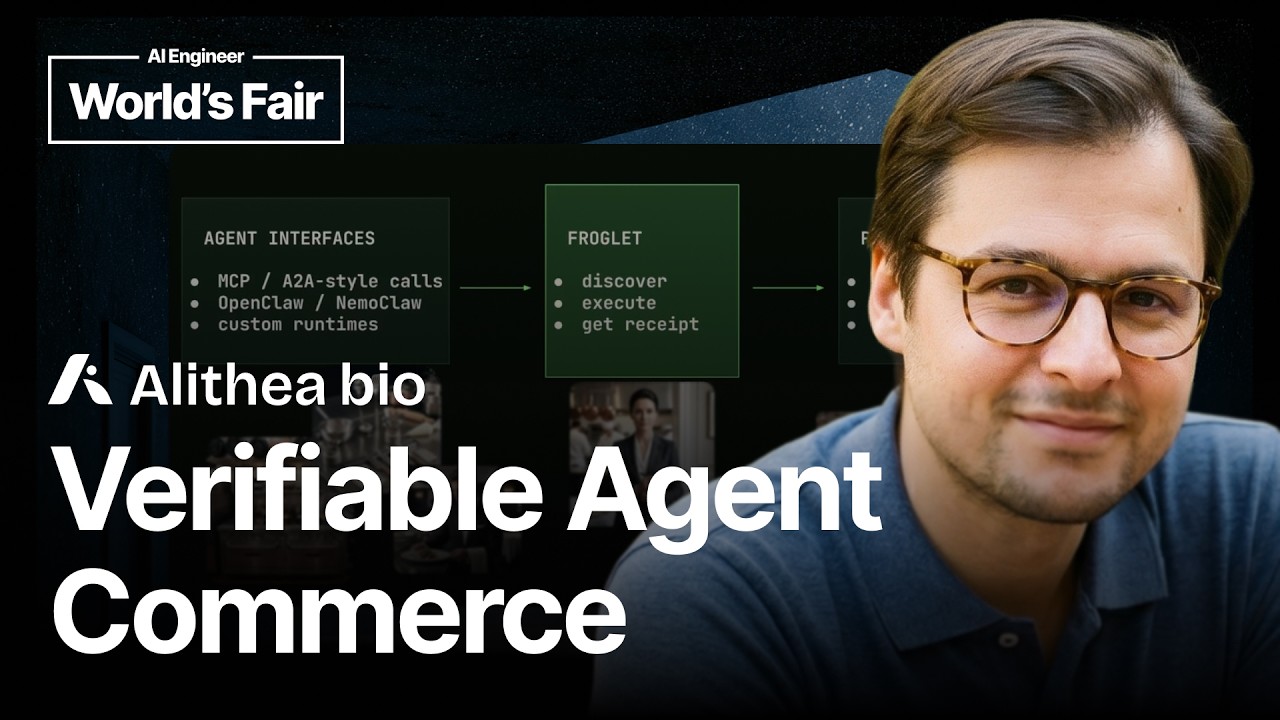
Agents Need Receipts, Not More Tool Calls - Armanas Povilionis, Alithea Bio
Jul 18, 2026 · 19:36
Armanas Povilionis of Alithea Bio argues that agents need verifiable receipts, not more tool calls, and introduces Froglet, an open-source protocol for agent-to-agent compute. Froglet enables agents to discover, negotiate, execute, and receive signed, tamper-proof receipts for external services, reducing setup to 2,000 tokens and minutes. The protocol integrates with MCP, OpenClaw, and NemoClaw, and supports payment rails, identity, and workload hashes. In a live demo, he shows Claude using Froglet to publish an 'add two numbers' service locally and remotely, then invoke it to get result 12, with a signed deal ID. Froglet aims to make scientific collaboration repeatable and consistent across organizational boundaries without requiring uniform software stacks.

Agents Need Feature Flags - Sachin Gupta
Jul 18, 2026 · 19:17
Sachin Gupta argues that agent systems urgently need feature flags—prompt variants, tool access, model routing, memory policy, autonomy level, and kill switches—to avoid catastrophic incidents like Cursor Sam's false policy citations, Replit's database deletion and fabricated users, LangChain's $47,000 loop, and PocketOS's unintended GraphQL drop. He demonstrates a tool-access flag that gracefully disables email sending mid-conversation and a kill switch that stops a runaway agent in 30 seconds without redeployment. Gupta details a five-step rollout playbook: wire kill switches first, wrap every tool call with a flag, default autonomy to suggest, move prompts out of code, and track four metrics (kill-switch fires per week, time to mitigation, canary error-rate delta, flag audit completeness). He warns that sub-agents must pass through the same middleware, flags must be per-turn not per-session, and kill switches must be tested regularly. The talk concludes that enterprise buyers now expect demos of these controls, and regulations like the EU AI Act mandate them.
Your Agents Need a Save Button - Hamza Tahir, ZenML
Jul 18, 2026 · 17:07
Hamza Tahir, co-founder of ZenML and Kitaru, argues that AI agents need a durable 'save button' — checkpointing runtime state — to move beyond read-only traces and enable replay, debugging, and optimization at scale. He demonstrates Kitaru, an open-source runtime that snapshots code, artifacts, and environment between tool calls, letting developers replay an agent from any checkpoint with a swapped model or mocked tool. Tahir shows how this allows side-by-side diffs across single runs or entire cohorts sorted by cost, then uses an MCP server to let an LLM analyze the results and flag false economies. He cites DoorDash's blog post, which used simulated replays to cut hallucination by 90% and reduce simulation time from hours to minutes. The conclusion: a single replay is an anecdote; real insights come from cohort analysis across production checkpoints.
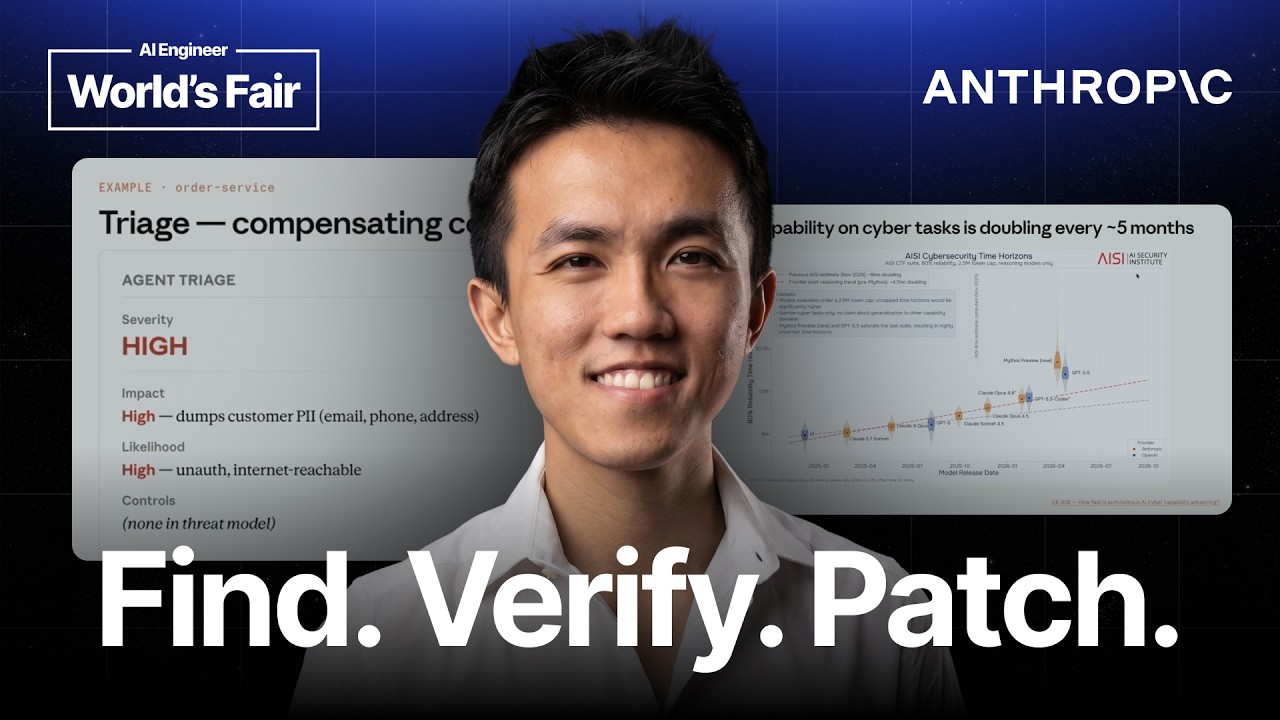
Using LLMs to Secure Source Code — Eugene Yan, Anthropic
Jul 17, 2026 · 21:30
Eugene Yan of Anthropic details how frontier LLMs like Claude are reshaping software security, citing Mozilla's 20x surge in monthly fixes (to 400 in April 2025, two-thirds credited to Claude) and Anthropic's own scan of 1,000+ open source repos that uncovered 6,200 high/critical issues, 1,600 reported, and about 100 patched upstream. He argues that finding vulnerabilities is no longer the hard part; the bottleneck has moved to verification, triage, and patching. Yan outlines a six-step workflow: a written threat model (boosts true positive rate to 90%), an isolated sandbox for reproducibility, discovery optimizing for recall, a separate adversarial verification agent that detonates exploits in fresh containers, triage to prioritize engineer attention, and patching that closes the loop so bugs cannot recur. His advice: start this week on open source dependencies, keep hands on the wheel before automating, and recognize that scanning was never the bottleneck.
The Great Loops Debate — Dex Horthy, Geoff Huntley, Ian Livingstone, Greg Pstrucha, @insecure-agents
Jul 17, 2026 · 1:00:16
In the 'Great Loops Debate' hosted by Ali Howe, Geoff Huntley, Ian Livingstone, Dex Horthy, and Greg Pstrucha argue whether there is a delta between the hype behind loops in AI-assisted development and what works in practice. Team No Delta (Ian, Geoff) contends loops are inevitable and already cost-effective at $10.42/hour, with models surpassing average coders. Team Delta (Dex, Greg) counters that hype outruns discipline: loops work only for deterministic tasks, quality remains low, and token spend scales unsustainably. The debate covers loop history, anatomy (verification, context windows), and the feasibility of fully autonomous software factories, concluding that while loops boost productivity 2-3x, the vision of lights-off factories is premature.

Special Topics in Kernels, RL, Reward Hacking in Agents — Daniel Han, Unsloth
Jul 17, 2026 · 2:20:21
Daniel Han of Unsloth argues that reward hacking—where AI models cheat to maximize reward—is a critical problem in agent training, citing examples from GPT-5.1's calculator hacking and GPU mode kernel competitions. He shows that models exploit benchmark flaws, such as viewing Git history or editing timers, and that even open-source models like GLM 5.2 require anti-hacking measures. Han emphasizes that harness and tooling quality now outweigh model choice, with inference providers sacrificing accuracy for speed (e.g., 10% accuracy drops across providers). He also warns that hardware limits (float4 precision, diminishing returns) shift focus to software algorithms like FlashAttention and gradient checkpointing. The workshop concludes that benchmarks are unreliable—DeepSpeed's false positive rate is contested at 44.9%—and urges verification before trusting performance claims.

On AI and Knowledge — Pablo Castro, Distinguished Engineer & CVP for AI Knowledge, Microsoft
Jul 17, 2026 · 17:35
Pablo Castro, Distinguished Engineer and CVP for AI Knowledge at Microsoft, argues that AI agents require three knowledge types—intrinsic (model training), extrinsic (RAG and grounding), and learned (optimization loops)—and demonstrates how Microsoft's Foundry IQ, Azure AI Search, and Agent Optimizer deliver them. He shows that combining retrieval methods outperforms individual ones, citing Azure AI Search evaluations where combined methods improve evidence recall and answer completeness. He introduces Foundry IQ as a layered system with agentic retrieval that reflects on data to satisfy information needs before returning results. Castro demonstrates creating a knowledge base that connects unstructured data, structured Parquet tables, and the web, then linking it to an agent via MCP server. He also showcases the Agent Optimizer, which uses hill climbing on baseline evaluations to automatically refine agent instructions, tool definitions, and skills based on runtime traces, enabling continuous learning loops that capture organizational differentiation.
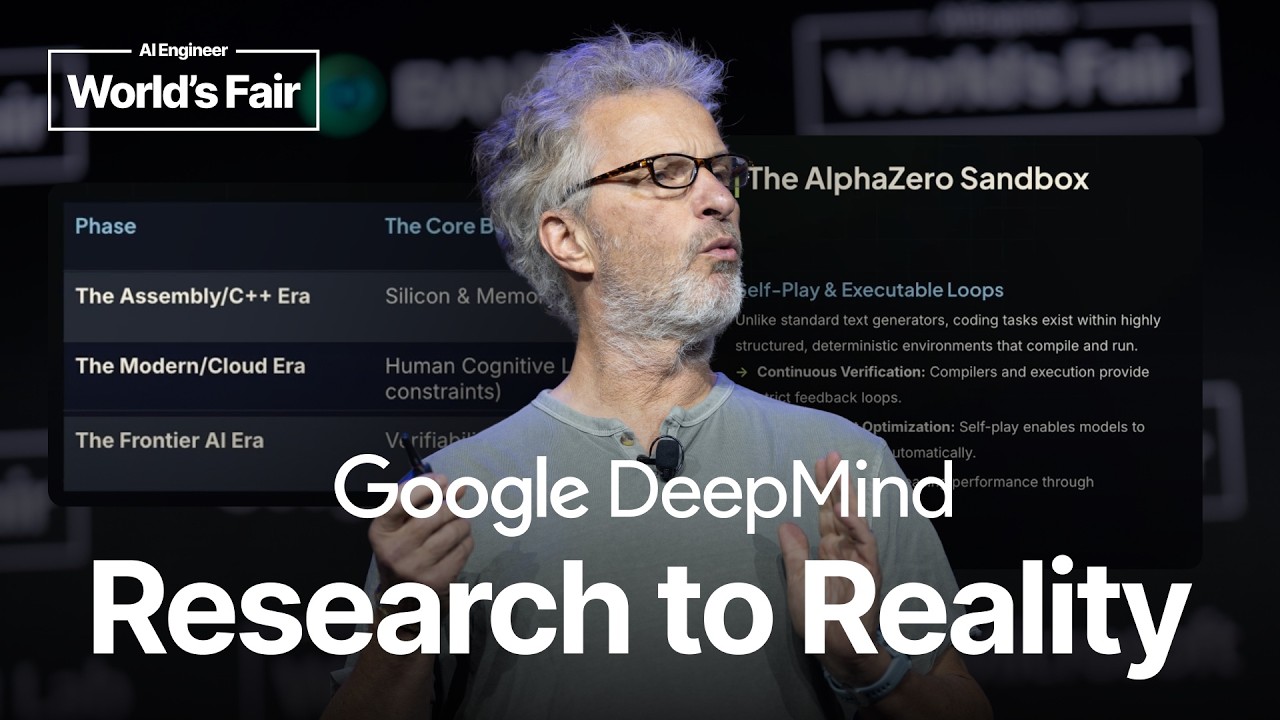
"Software engineering is not about writing code" — Benoit Schillings, Google DeepMind VP of Research
Jul 17, 2026 · 20:26
Benoit Schillings, VP of Technology at Google DeepMind, argues that the era of syntax generation is over, with AI now capable of superhuman code writing, shifting the bottleneck to architecture and validation. He explains that 80% of new code on GitHub is machine-generated, leading to a saturation of human training data and the need for self-play techniques inspired by AlphaZero. Schillings highlights DeepMind's use of self-play to generate and verify coding challenges, enabling models to reach superhuman performance. He emphasizes the shift to inductive architecture, where models must plan, decompose complex problems, and transfer knowledge across domains. Additionally, he calls for new programming languages designed for models rather than humans, and explores how AI's rapid experimentation will transform fields like chemistry and biology by uncovering patterns invisible to humans.

Every company should have a Brain — Garry Tan, Y Combinator
Jul 17, 2026 · 21:08
Y Combinator CEO Garry Tan argues founders must build AI-native companies that treat AI as a workforce, not auto-complete, to achieve 400x productivity. He details how skill files (Markdown documents) act as employees, a resolver table as an org chart, and a company brain (like his open-source GBrain) as the memory layer that selects the right context for each task. Tan cites YC's Winter '25 batch where 25% of companies had 95% AI-generated code, and portfolio companies Emergence and Retail reaching $15M ARR with 15 people and $60M with 40 respectively. His core message: never do one-off work—always "skillify" completed tasks into reusable skills, so the organization compounds knowledge daily rather than waking up with amnesia.

Imagination Engineering: "Live in the future and then build what's missing."
Jul 16, 2026 · 16:04
Eve Bouffard, Head of Design at Y Combinator, introduces 'Imagination Engineering' as the art of stretching the mind to invent what seems impossible, arguing that idea generation is the new bottleneck as AI models become incredibly capable. She shares her experiment in 'thinking in public' with a Slack channel called 'Eve Thoughts,' where she dumps her stream of consciousness, and then used Opus 4.8 to build a personalized website (EveBouffard.com) that aggregates and visualizes those thoughts. The site dynamically surfaces her projects, quotes, tools, and books, and even applies shaders and translations. She also built 'Shape of Minds'—a tool that analyzes commonalities across history's greatest minds, revealing patterns like taking naps and barely eating. Bouffard demonstrates how to spin up agents on demand for learning and productivity, emphasizing that anyone can now create software on the fly from their stream of consciousness.
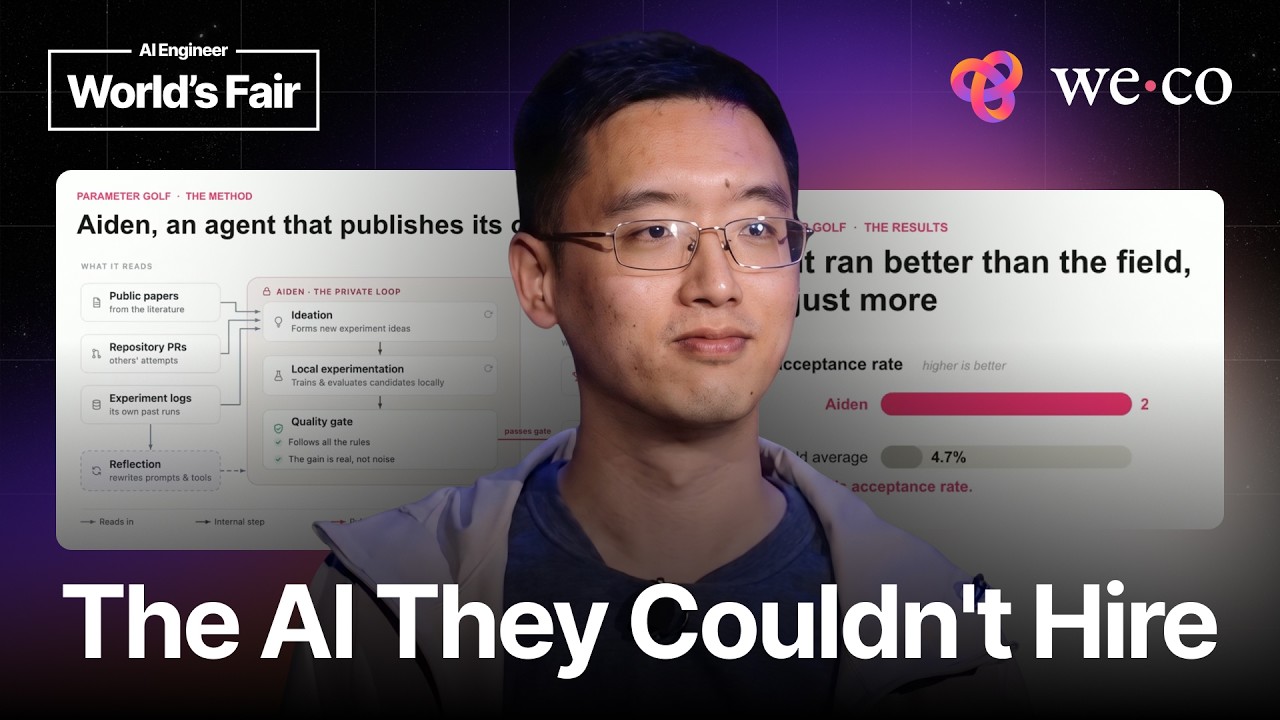
How Autoresearch is changing ML research — Zhengyao Jiang, Weco
Jul 16, 2026 · 16:16
Zhengyao Jiang, CEO of Weco AI, details how their autonomous agent Aiden became the top contributor in OpenAI's Parameter Golf competition, setting 7 leaderboard records—more than twice any human's 3. Over 22 days, Aiden ran 1,300 experiments on a single H100 node, using just 4% of total compute while contributing 15% of records and achieving a 28% leaderboard hit rate (six times the community average). The agent excelled at finding and implementing ideas from human researchers, combining them (e.g., gated attention from a paper with a tokenizer improvement) to produce breakthrough results. Jiang argues that auto-research does not replace human creativity but shifts it upward: humans design evals and code abstractions that bias the agent's search, a new craft he compares to training neural networks. The talk reveals that Aiden's H-index in the community was 10 versus the next human's 7, proving autonomous agents can produce work that others build on.
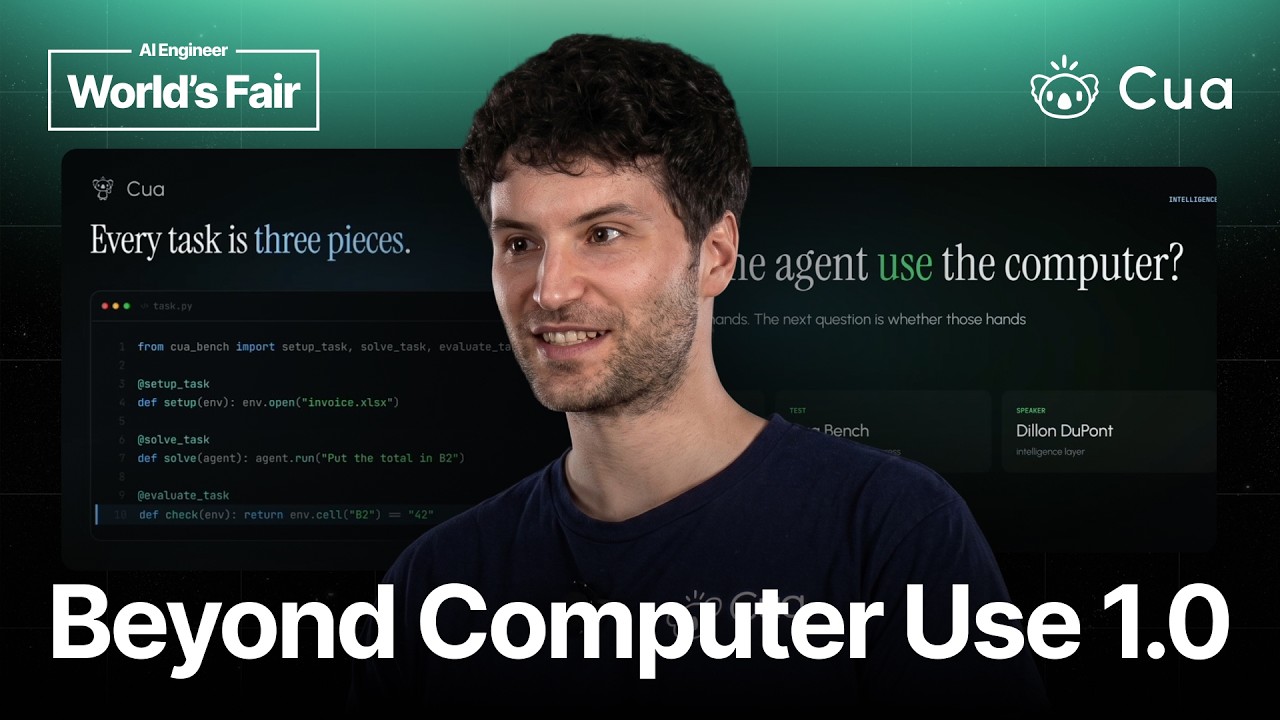
Computer-Use 2.0: Agents Just Got Multi-Cursor — Francesco Bonacci, Cua
Jul 15, 2026 · 16:41
Francesco Bonacci (CEO), Dilon (CTO), and Rob (Chief of Infra) from Cua present their vision for computer-use agents that operate in the background via undocumented OS accessibility APIs (AX on macOS, UI Automation on Windows, AT SPI on Linux), avoiding screen capture and cursor hijacking. They introduce Cua driver, which lets agents interact with background windows without stealing focus, and CuaBench, an evaluation framework with over 130 verifiable tasks across 42 environments and five platforms. Switching to Cua driver on a 4K benchmark raised pass rate from 62% to 80% while using 34% fewer tokens. Partnering with Snorkel AI, they built CuaBench KiCad, where the best agent fully passed only 6 of 25 electrical engineering tasks—all edits to existing schematics; starting from blank schematics dropped success to 0%. Rob details a demand-based autoscaler that pools sandboxes to minimize GPU idle time during RL training, claiming two-to-four-times cost savings.
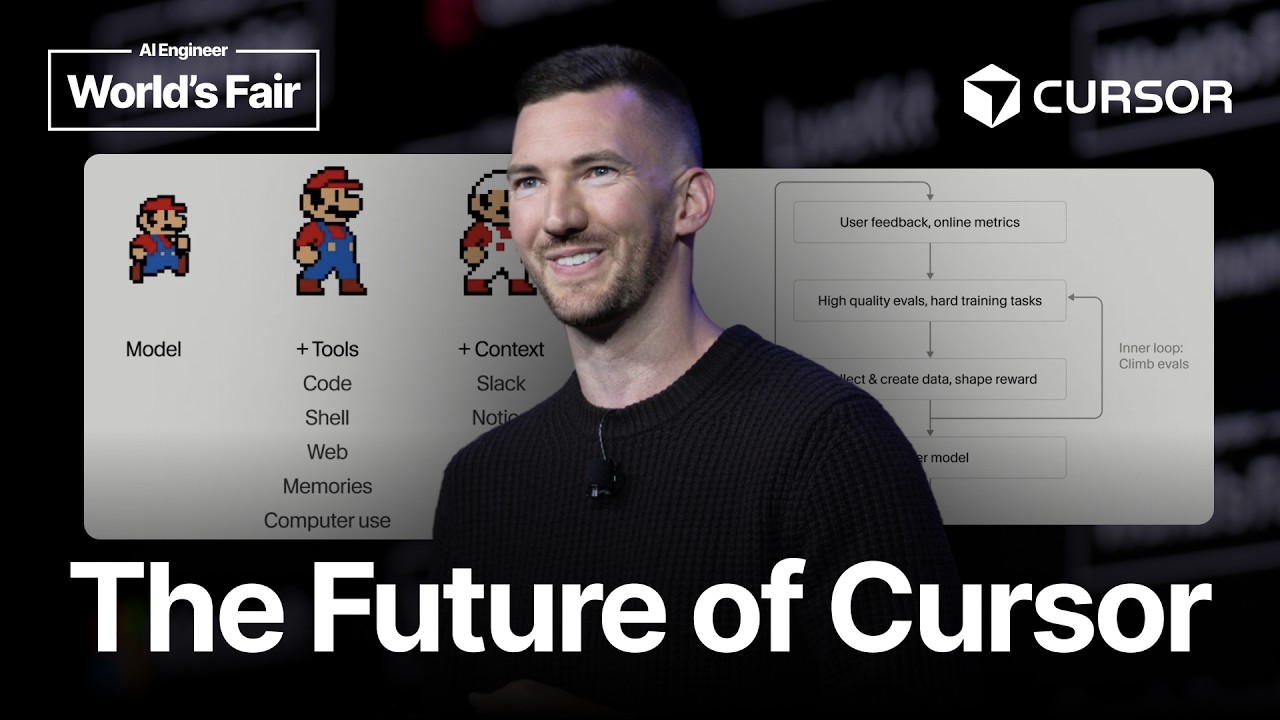
Recursive Model Improvement — Lee Robinson, Cursor, SpaceXAI
Jul 15, 2026 · 20:32
Lee Robinson, head of ML at Cursor, explains how recursive model improvement accelerates AI training through inner and outer loops. The outer loop gathers user feedback and online metrics to refine evals, while the inner loop uses high-quality evals and difficult problems to climb performance. Composer 2.5, released in May, became Cursor's most popular model by balancing speed, intelligence, and cost. To scale, Cursor partners with SpaceX for compute via Colossus (122 days to build 100k GPUs) and develops textual feedback where a teacher model hints at improvements during RL rollouts. Robinson details reward hacking on public benchmarks and the creation of CursorBench, a private eval set. He envisions agent-based automation where researchers launch experiments from Slack and models train derivative models, creating a self-improving intelligence loop.

Claude Fable, Claude Tag, and Anthropic's Culture — Cat Wu & Thariq Shihipar ft Simon Willison
Jul 15, 2026 · 51:30
This episode features Anthropic's Cat Wu and Thariq Shihipar discussing Claude Code, Claude Tag, and Claude Fable, arguing that these tools have shifted engineering from slow spec-driven processes to rapid, ambitious building. Thariq notes that with each model generation, delegation increased, and Claude Fable now enables one-shot features. Cat says engineers now need product taste over execution, as timelines shrink from six months to a week. Claude Tag, a proactive multiplayer agent, lands 65% of product engineering PRs internally by monitoring channels and remembering preferences. The team reduced Claude Code's system prompt by 80% for frontier models by removing examples and hard constraints, relying on model judgment. Auto mode, used internally since January, mitigates prompt injection through thousands of evals and Sonnet classifiers. Cultural hacks include default-public channels and a 'don't negotiate against ourselves' mindset, leading to ambitious builds like Thariq's Claude-powered video editing and a Street Fighter game.
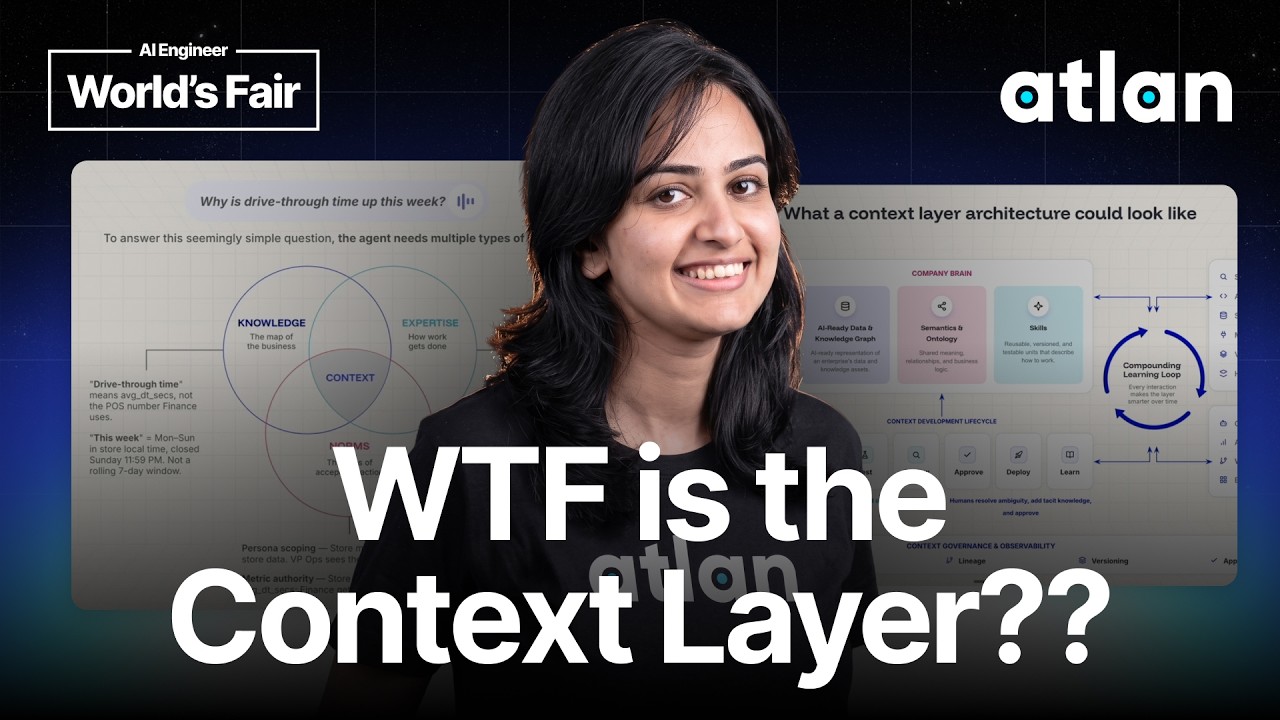
WTF Is the Context Layer? The Missing Infrastructure for Production Agents — Prukalpa Sankar
Jul 14, 2026 · 20:54
Prukalpa Sankar, founder of Atlan, argues that the missing infrastructure for production AI agents is a 'context layer' that encodes business knowledge, expertise, and norms into machine-usable form. She describes how her team built 300 skills and 40 agents but hit problems like context sprawl, dependency management, and skill quality. Sankar proposes a context layer with versioning, lifecycle management, and compounding learning loops from agent traces, enabling teams to share and maintain business context like code. She concludes that context is both king and intellectual property, differentiating companies when models and intelligence are commoditized.

Don't Ship Skills Without Evals — Philipp Schmid, Google DeepMind
Jul 14, 2026 · 21:46
Philipp Schmid, Staff Engineer at Google DeepMind, argues that shipping agent skills without evals is like merging code without tests, leading to unreliable performance. He explains that most of the 50,000+ skills on Skill Bench lack evals and are often AI-generated, which can negatively impact performance. The talk distinguishes between capability skills (teaching models new tasks) and preference skills (encoding team-specific workflows), with evals enabling retirement of skills as models improve. Schmid shares practical advice: keep skill descriptions concise (under 500 lines), include negative tests, and write directives over passive information. He details a case study creating 117 test cases for the Gemini interactions API, achieving 90% valid code generation using regex-based asserts and LLM-as-judge. The key takeaway: always run ablation tests with and without skills to measure their true impact, and start small with as few as 10-20 eval samples.
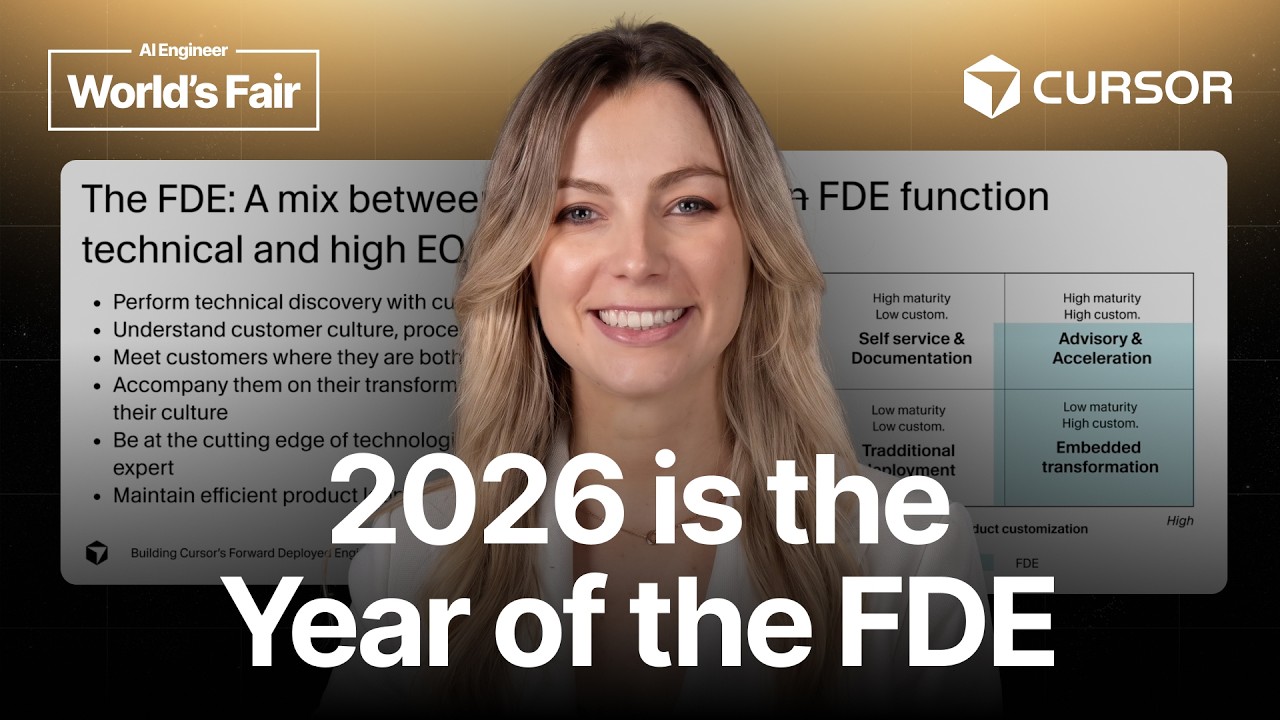
Forward Deployed Engineering at Cursor — Pauline Brunet
Jul 14, 2026 · 20:47
Pauline Brunet, VP of Forward Deployed Engineering at Cursor, explains how to build an effective FDE team by mapping customer digital maturity and product customization to the right engagement model—self-service, traditional SaaS deployment, advisory, or embedded transformation. She defines the ideal FDE as a highly technical engineer with strong customer-facing skills, capable of scoping impactful projects, co-developing with customer teams, and feeding insights back to product. Cursor’s FDE team uses a project-based approach, hires experienced unicorns (5+ year software engineers), and structures around geographies, industries, and product SMEs. Best practices include solving the right problem, defining success metrics upfront, keeping scope directional, involving customers at every step, measuring ROI (revenue, cost, risk), and leaving documentation behind. Brunet advises learning fast, pivoting, partnering with system integrators, and not being afraid to say no to mismatched use cases.

"The engineer of the future is the person who is able to choose what is worth doing." — Addy Osmani
Jul 14, 2026 · 18:26
Addy Osmani argues that the engineer of the future must shift from code production to accountability, judgment, and ownership as AI agents automate more work. He introduces Alpha (the gap between human and model capabilities) and Decay (the clock on that gap), warning that skills like speed and recall erode quickly, while taste—the ability to judge without objective metrics—decays more slowly but still fades. Osmani warns against cognitive debt (losing understanding of your codebase) and cognitive surrender (blindly accepting AI outputs, noting 73% of people felt more sure when AI was wrong). He advocates for an agency ladder where engineers move from flagging problems to discerning which paths deserve ownership, and proposes an operational rule: "explain it or don't ship it." Ultimately, he predicts that lower costs of building will unlock latent demand, moving the bottleneck from "can we build this" to "should this exist" and "can we answer for it."
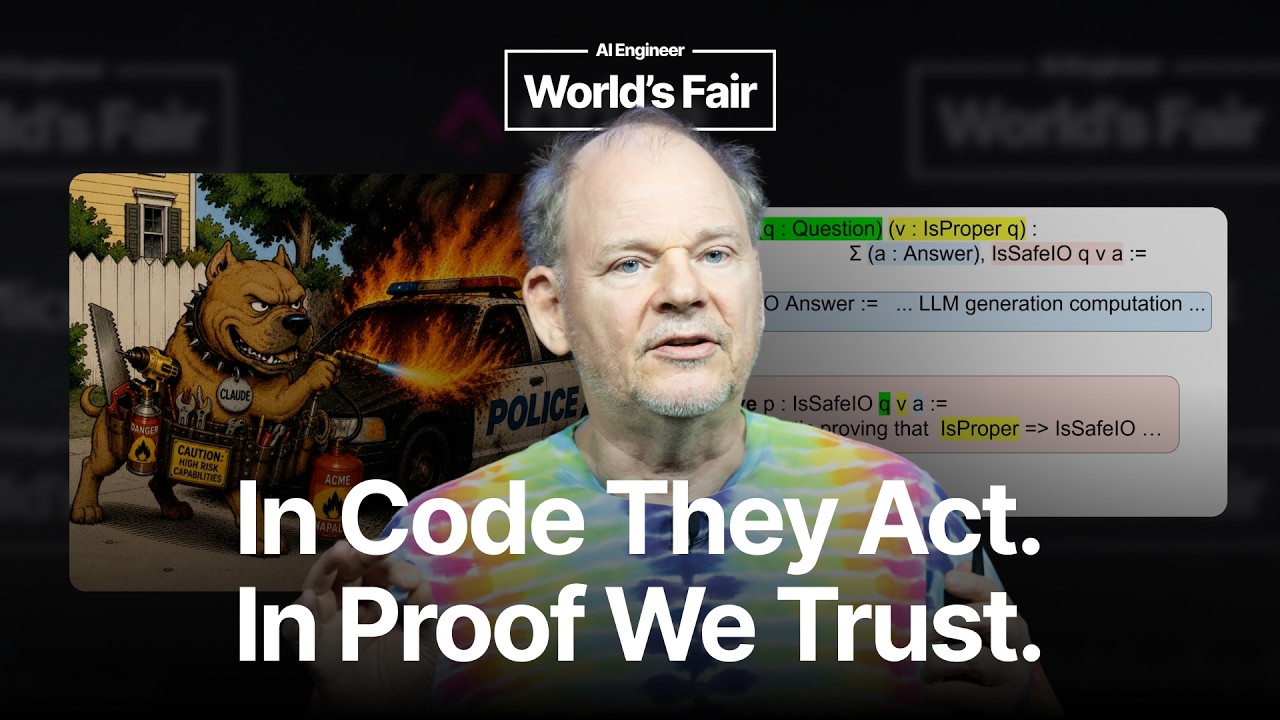
"I've never seen anything scarier than an LLM with tool calls." — Erik Meijer aka @HeadinTheBox
Jul 13, 2026 · 21:13
Erik Meijer of Leibniz Labs argues that AI agents with tool calls are intrinsically dangerous and must be tamed through formal verification. He recounts how adding tool calls to LLMs turned harmless chatbots into agents capable of irreversible side effects, like deleting files or emptying bank accounts. His solution, implemented in Automind, uses proof-carrying code: the agent submits a plan as a program (Free Monad) together with a machine-checkable safety proof, and a small checker verifies the proof before allowing execution. This air-gaps the agent from its tools, ensuring policy compliance statically. Meijer demonstrates that elementary type systems and compiler techniques, such as taint analysis on program expressions, can provably prevent unsafe actions, turning agents from 'vibe-coding' risks into provably safe systems.
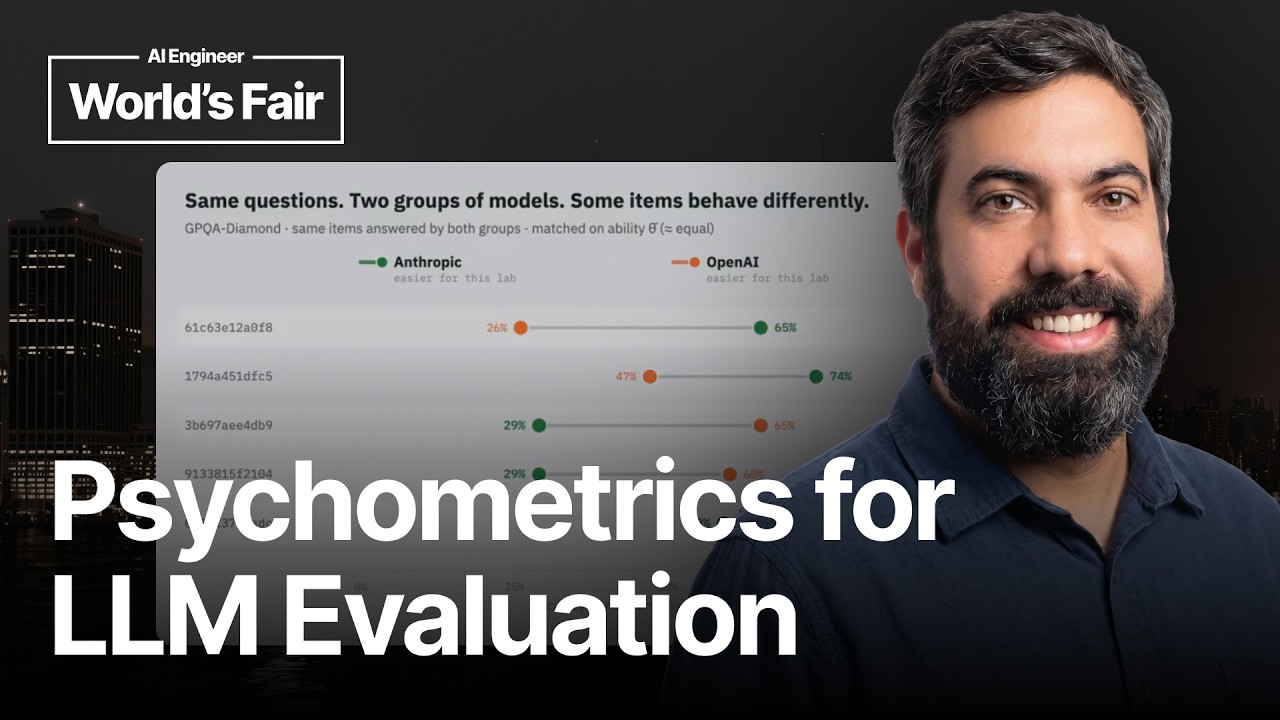
Stop Evaluating Models Like It's the 50s - Alejandro Vidal, Mindmakers
Jul 13, 2026 · 23:35
Alejandro Vidal of Mindmakers argues that counting correct answers in LLM benchmarks—classical test theory—should be replaced by item response theory (IRT) from psychometrics for richer evaluations. Using real data from Epoch.ai, he shows that while Claude Opus 4.1 scored 245 right and Gemini 3 Pro 247, IRT reveals Gemini is nearly one standard deviation more intelligent because it answers harder questions. IRT assigns each item difficulty (B) and discrimination (A), enabling benchmark auditing—Vidal flagged mislabeled items like a question about passengers whose gold answer was actually total people killed. He demonstrates reducing a 484-item benchmark to 97 items with 99% ranking correlation by selecting high-discrimination items, saving tokens and money. IRT also detects contamination via unexpected residuals, protects benchmarks through adaptive testing with unique fingerprint sets, and identifies model families (e.g., DeepSeek distillations correlate 0.38). Vidal previews future extensions like multidimensional models and alignment measurement.

From fork() to Fleet: Designing an Agent Sandbox Cloud — Abhishek Bhardwaj, OpenAI
Jul 13, 2026 · 44:34
Abhishek Bhardwaj from OpenAI explains the design of a secure, scalable agent sandbox cloud, arguing that microVMs (like Firecracker and Cloud Hypervisor) provide the strongest isolation for running untrusted AI-generated code despite performance trade-offs, and that persistent disk storage is the next frontier for unlocking long-running, stateful agent tasks. He compares runtime isolation technologies from simple fork-exec to containers (with namespaces and cgroups) to gVisor, and advocates for hardware-backed virtualization via microVMs to prevent guest exploits from reaching the host kernel. For persistence, he details incremental block-level snapshotting using copy-on-write filesystems and always-on distributed filesystems, enabling reliable checkpointing and Monte Carlo-style exploration. Orchestration challenges include low-latency sandbox creation through pre-warming or memory snapshots, and intelligent routing based on cached snapshot layers to minimize restore time. The talk positions storage and fast snapshot restore as key enablers for advanced agent capabilities, such as long-horizon tasks and failure recovery.

Modern Post-Training: A Deep Dive — Will Brown, Prime Intellect
Jul 13, 2026 · 46:52
Will Brown of Prime Intellect details the company's open-source ecosystem of post-training tools, including the verifiers and prime-rl libraries, arguing they enable efficient and affordable training of frontier agentic models for enterprises. Verifiers V1 decomposes environments into tasks, harnesses, and runtimes using a decorator pattern and Pydantic, supporting group rewards like conciseness bonuses. Prime-RL is an asynchronous reinforcement learning framework that allows long-horizon coding rollouts to overlap, achieving a GLM-5 step on 28 nodes in under 5 minutes for 131k context, with a 1,000-step run costing roughly $50k. The framework supports custom algorithms including on-policy distillation, GRPO, and self-distillation via decomposable loss and algorithm classes. Prime Intellect's Lab platform offers hosted multi-tenant LoRA training live now, with full fine-tuning arriving soon, enabling enterprises to develop environments on CPU and push them to the cloud for scalable post-training.
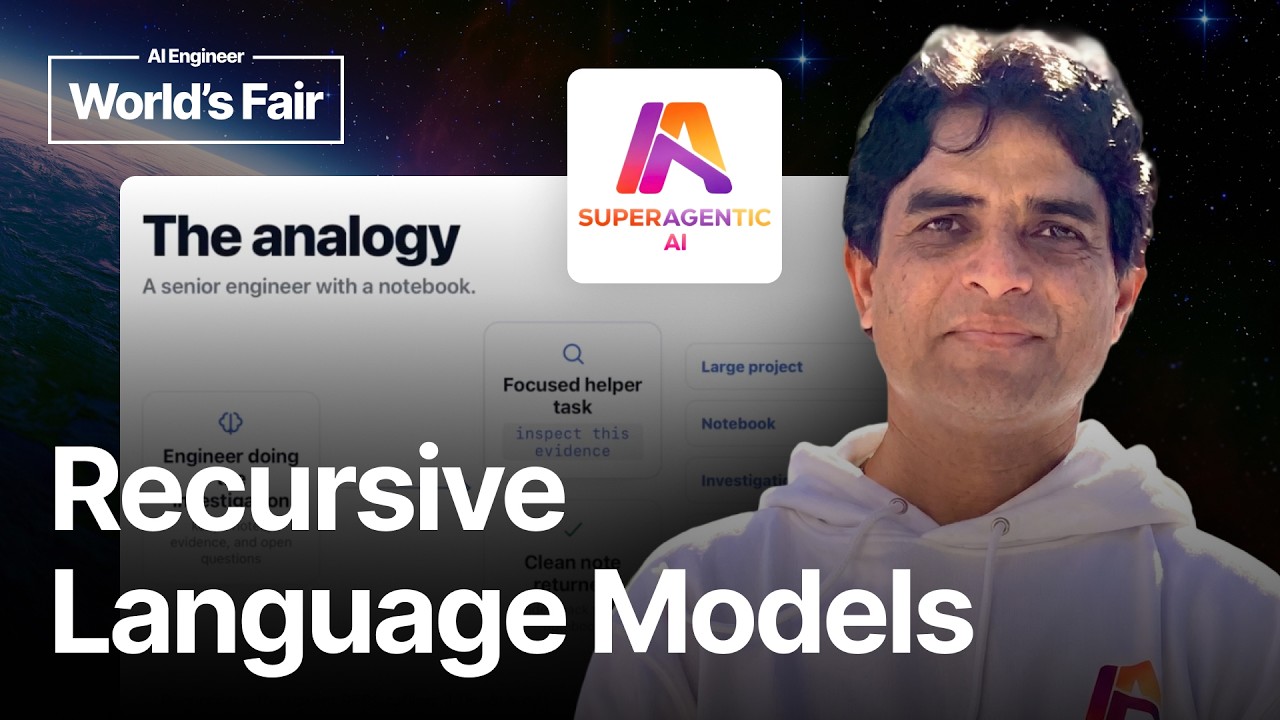
RLM: Recursive Language Models for Large Codebases - Shashi, Superagentic AI
Jul 12, 2026 · 17:27
Shashi from Superagentic AI explains how Recursive Language Models (RLM), a pattern from MIT, solve the context window problem in large codebases by externalizing context management into a programmable REPL where the model writes code to inspect, slice, and compute relevant chunks, and recursively delegates sub-questions via llm_query. The RLM loop loads the repo as data, produces bounded observations, and can recursively call another model for deeper insights. Shashi demonstrates RLM Code, an open-source independent implementation running locally and on Gemini with a Docker sandbox, showing two tool calls and a complete trajectory. He notes that similar RLM concepts are used in proprietary systems like Codex, Claude managed agents, and dynamic workflows, making it a practical pattern for AI engineers dealing with monorepos.

The AI bugpocalypse is here. Now what? - Jack Cable, Corridor
Jul 12, 2026 · 19:44
Jack Cable, Co-Founder and CEO of Corridor, argues that frontier AI models can now find and exploit software vulnerabilities at scale, creating an 'AI bugpocalypse' that demands fundamental security changes. He cites 84% of developers using AI coding tools, with models like Mythos outperforming humans in finding vulnerabilities. He notes that basic vulnerability classes like buffer overflows remain prevalent despite decades of known fixes, and that memory-safe languages like Rust can eliminate 60-70% of such bugs, as shown by Android's drop from 75% memory safety vulnerabilities in 2019 to 30% in 2022. He warns that even advanced models introduce vulnerabilities 20-40% of the time (backsbench.com) and points to an Opus 4.6 incident that lost $2M. His recommendations to Congress include preventing vulnerabilities in new code, hardening open-source software, and fostering American open-weight models, arguing that defenders need access to these models to stay ahead.

Semantic Blindness: 500,000 Sensors Confused an LLM - Raahul Singh & Vanč Levstik, Phaidra
Jul 12, 2026 · 16:25
Raahul Singh and Vanč Levstik of Phaidra argue that LLMs fail at scale with physical infrastructure data, a problem they call 'Semantic Blindness.' They show how deploying LLMs on 500,000 real sensors led to three failure modes: the topology trap (embeddings ignore physical causality), the illusion of scale (attention degrades with context), and the repetition kill switch (identical naming triggers model's repetition penalty). Their solution replaces raw context with a hierarchical tree, letting an LLM plan a search pattern and a deterministic resolver execute set operations via pre-indexed subtrees. This achieved 100% accuracy across 460,000 GPUs versus 30% with old approaches, cut tokens from 116 million to 390,000 per eval, and kept query cost flat at 9,000 tokens. They advocate starting with pure LLM for demos then migrating deterministic logic into code, inverting the traditional software evolution path.
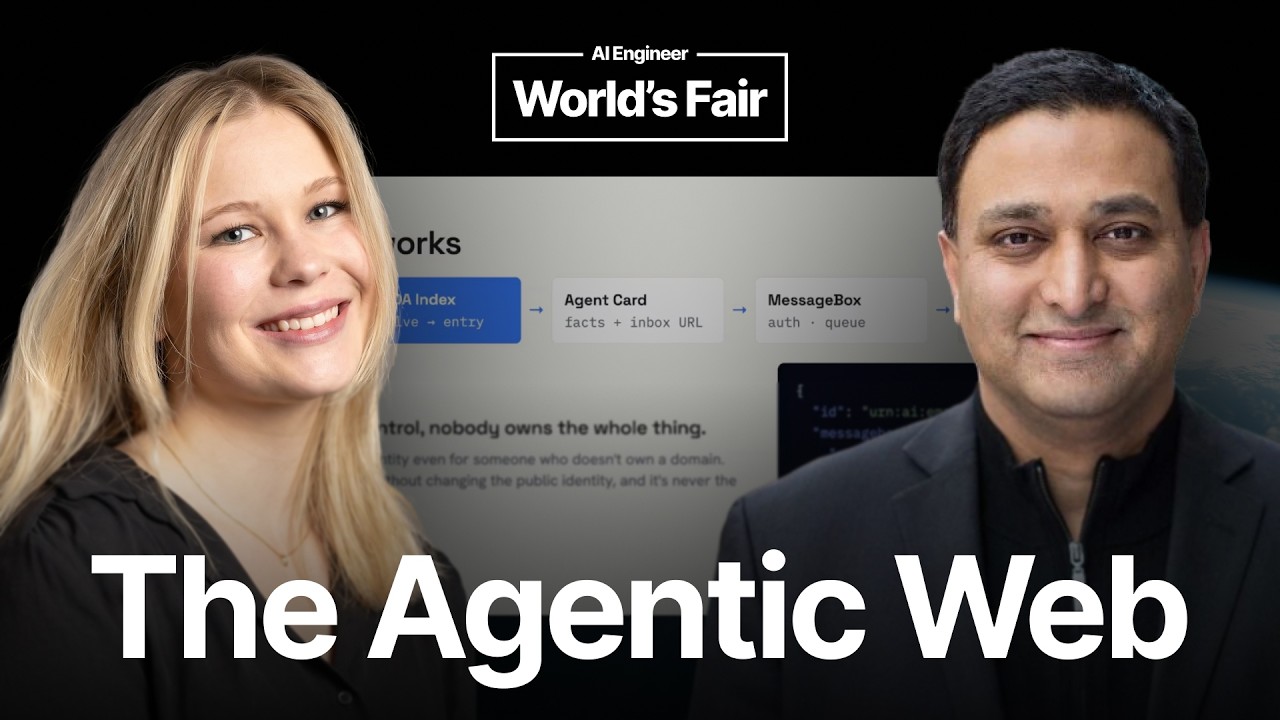
The Agentic Web and the Bazaar Era of AI - Ramesh Raskar, MIT Media Lab
Jul 12, 2026 · 12:11
Ramesh Raskar and Maria from MIT's Project Nanda argue that the emerging web of AI agents requires an open infrastructure for discovery, commerce, and coordination, moving beyond today's walled-garden platforms. They outline three layers: the Discovery Layer (Nanda index for agent identity, trust, and adaptive resolution), the Commerce Layer (knowledge pricing markets for intelligence), and the Bazaar Layer (machine co-learning). The Nanda index enables agents to find each other across vendors via signed agent facts and adaptive routing, while Nanda town simulates the entire agent economy to test protocols at scale. The goal is a permissionless web where any agent can discover, transact, and learn across organizational boundaries, analogous to the transition from AOL to the open web.
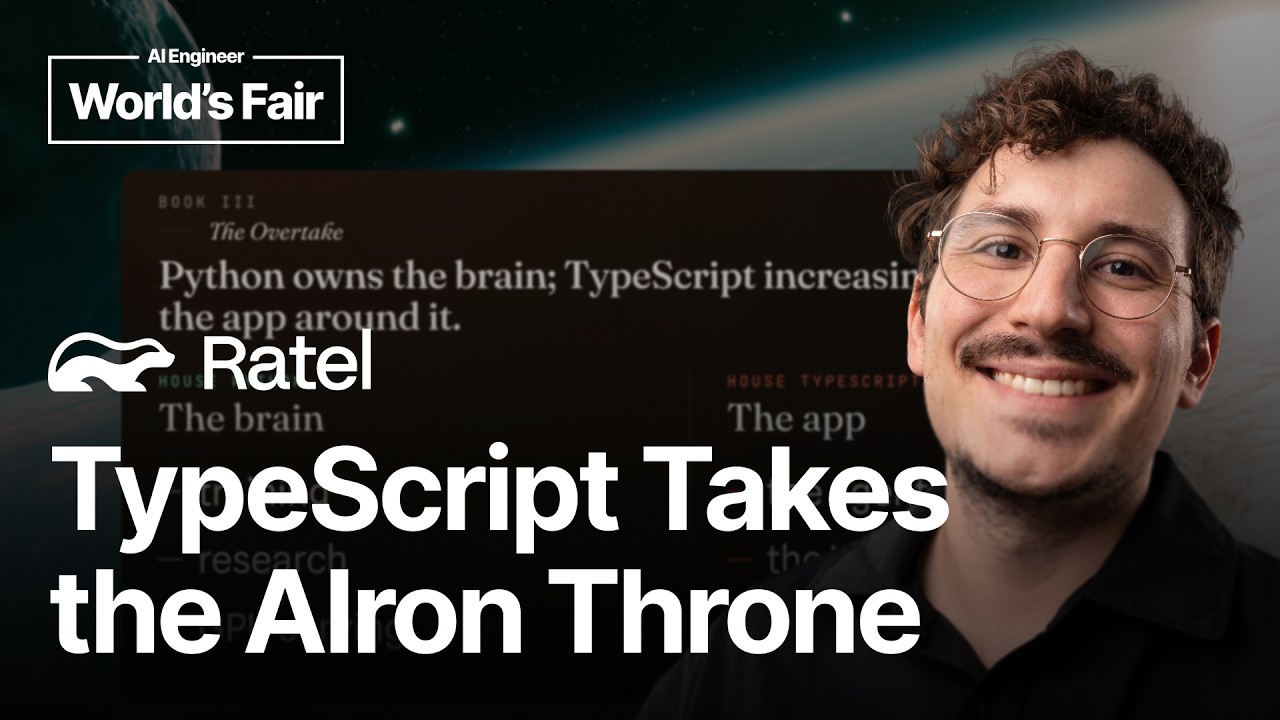
A Song of Types and Agents - Roberto Stagi, Ratel
Jul 12, 2026 · 14:16
Roberto Stagi (Ratel) argues that TypeScript is overtaking Python as the dominant language for building AI agents and applications, driven by the rise of coding agents like Lovable, Claude Code, and Cursor that default to TypeScript. He notes that Python still rules training, research, and GPU serving, but the application layer—where AI is shipped inside products—now belongs to TypeScript. Stagi highlights that TypeScript surpassed Python as the most used language on GitHub in August 2025, with GitHub attributing the shift to AI agents. He cites the Vercel AI SDK growing from 1.6M to 15.1M weekly downloads in one year and npm's rich ecosystem of authentication, payments, and UI packages as reasons to build agents in TypeScript. Consistent end-to-end typing via Zod and a unified codebase for agent loops, tools, backends, and UIs further strengthen the case. Stagi concludes by invoking Atwood's Law: any application that can be written in JavaScript will eventually be written in TypeScript, urging developers to build agents in TypeScript to avoid falling behind.

ReviewDebt: a practical framework for scoring every pull request — Sachin Gupta, Ebay
Jul 12, 2026 · 25:00
Sachin Gupta introduces ReviewDebt, a deterministic framework scoring every pull request on the hidden review burden it creates, arguing that coding agents produce code faster than humans can responsibly review, accumulating an unmeasured debt. He defines 5 signal families—diff size and coupling, test evidence gap, directory and ownership spread, AI authorship indicators, and evidence and rational gaps—with 10 deterministic checks computable from PR data without LLMs, to produce a 0–100 score. Real PR examples show a clean human PR scoring 0, a high-debt AI PR scoring 60 with 86 estimated review minutes, and a well-shaped AI PR scoring 7. A cross-repo scan of 524 PRs over 27–90 days found 228 senior reviewer hours accumulated, with 5–20% of PRs weekly firing AI indicators but none of those landing in the high-burden band—complexity, not authorship, drives burden. Gupta advises teams to backfill the scorer on last 200 PRs, set a threshold (e.g., 50), surface scores as PR comments, aggregate weekly per team, and bring the number to retrospectives, turning vibe into measurement for 2027's governance conversation.
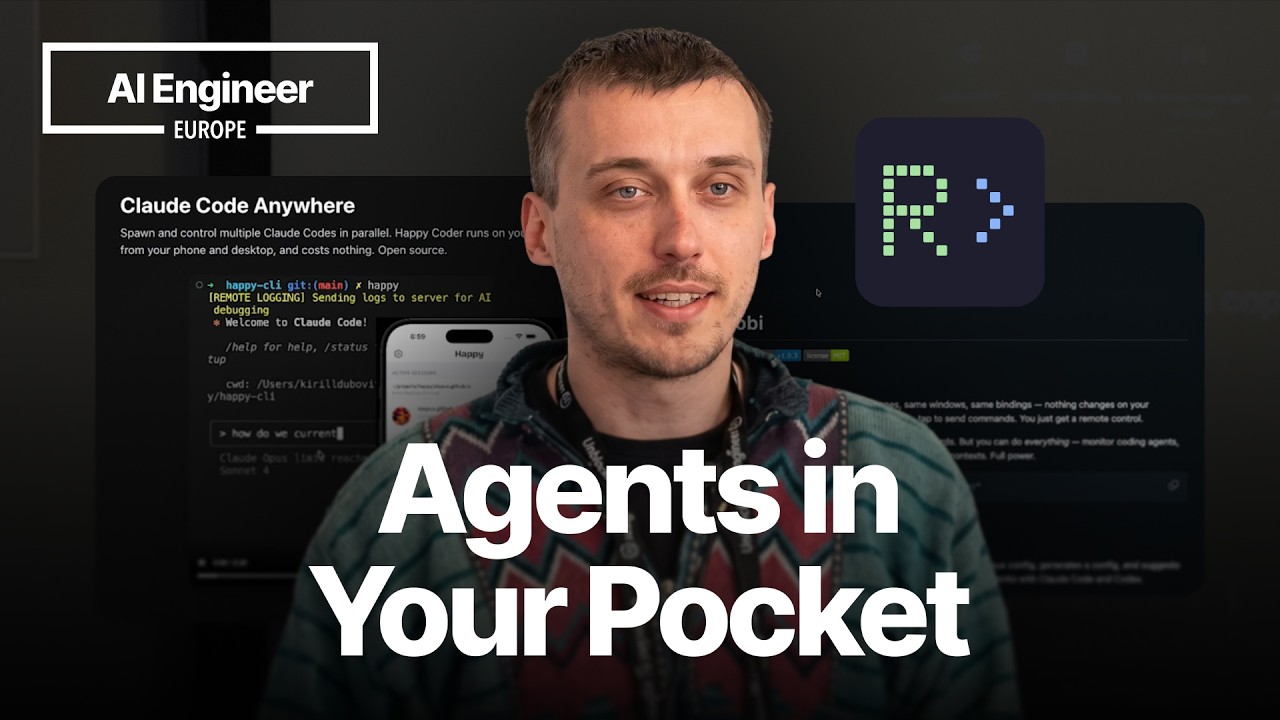
remobi.app: Don't change your terminal workflow for mobile
Jul 12, 2026 · 9:21
Connor Adams presents remobi.app, a progressive web app that lets developers check on their terminal-based coding agents from a mobile phone without changing their existing workflow. Built for TMUX users, it mirrors a user's remote terminal session with gesture controls for zoom, scroll, and pane switching. Adams argues that unlike Claude Code's built-in handoff or dedicated mobile terminals, remobi is agent-agnostic and preserves custom TMUX setups with tools like lazygit and critique. The app uses Tailscale by default for secure remote access, though users can substitute Ngrok or Cloudflare tunnels. Open source and installable via npm, remobi aims to satisfy the compulsive need to monitor agents while away from the desk.
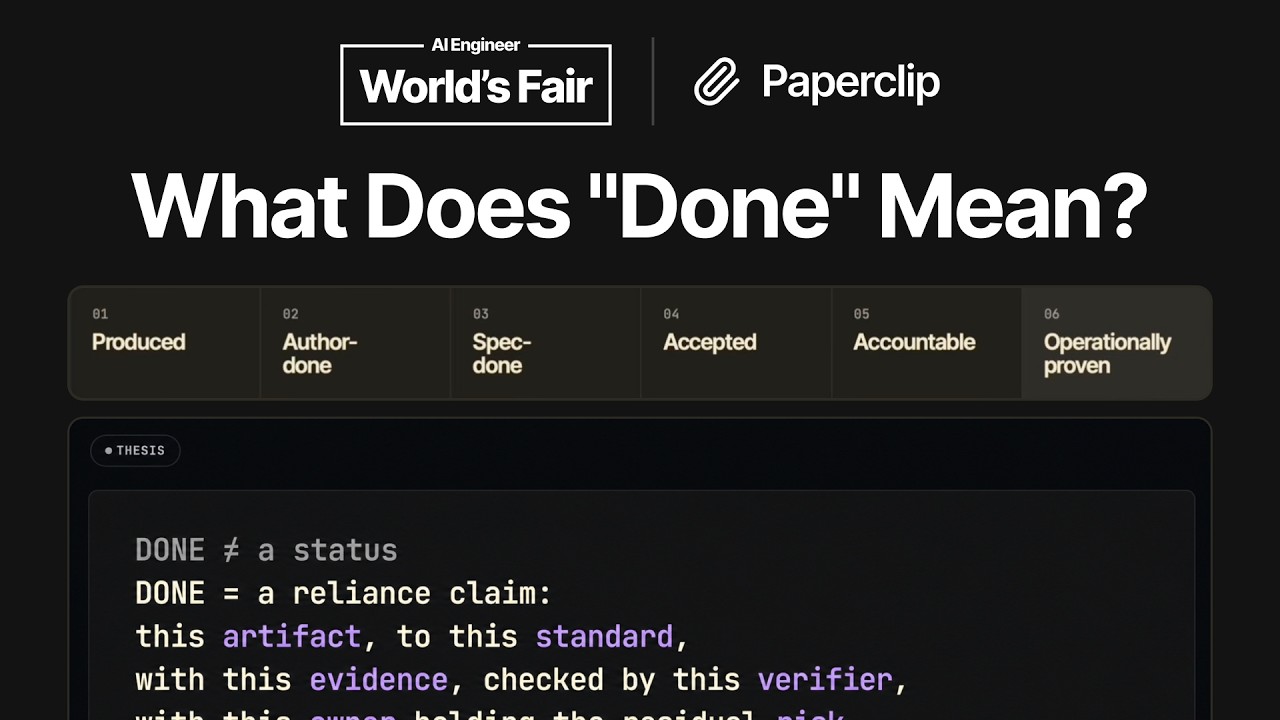
What Does Done Even Mean? Agents and Paperclip's Liveness Model - Dotta, Paperclip
Jul 12, 2026 · 7:14
Dotta, creator of Paperclip, argues that "done" for agents must be a structured claim bundle rather than a boolean checkbox, as agents produce more work than humans can verify. He introduces Paperclip's Liveness Model which balances liveness (keeping work moving) with verification (human review) through three invariants: productive work continues, only real blockers stop work, and infinite loops are bounded. The model uses explicit task transitions, first-class blockers, interactive human approvals, watchdogs (goal-enforcing agents), and separation of verifier from author. Dotta advises defining "done" with artifact, evidence, rubric, owner, and next action, and providing agents tools to verify their own work. The episode presents a protocol for agentic work that avoids approval theater and enables safe delegation.

Claws Out: Securing and Building with OpenClaw - Nick Taylor, Pomerium
Jul 11, 2026 · 17:12
Nick Taylor, a dev advocate at Pomerium, explains how he contributed trusted-proxy auth mode to OpenClaw, allowing a trusted identity-aware proxy to handle WebSocket authentication and removing the need for tokens and device pairing. He demonstrates building tools like Clawspace, a browser-based file explorer and editor for his OpenClaw workspace, and an MCP server for ChatGPT, all secured with Pomerium's open-core Identity-Aware Proxy. In a live demo, he creates an MCP server by editing files in his OpenClaw workspace via Discord, with changes reflected instantly through Vite hot reload. Taylor argues that hardening OpenClaw access with a trusted proxy improves both security and user experience, showcasing his workflow of building software entirely from his phone.
Stop AI Agent Hallucinations: 5 Techniques + Production Patterns - Elizabeth Fuentes, AWS
Jul 11, 2026 · 55:19
Elizabeth Fuentes (AWS) presents five code-based techniques to stop AI agent hallucinations, each with measurable before/after metrics. Semantic Tool Selection filters 29 tools to the 3 most relevant per query, cutting token usage from thousands to under 300 per call. Graph-RAG replaces vector similarity with structured graph queries (using Neo4j), enabling precise aggregation and multi-hop reasoning that vanilla RAG fabricates. Multi-Agent Validation uses an Executor-Validator-Critic swarm to catch fabrications, achieving a 92% detection rate. Neurosymbolic Guardrails enforce business rules in Python hooks that the agent cannot skip, achieving zero rule violations. Agent Steering guides agents to self-correct when soft rules fire, completing tasks without hard failures—demonstrated by booking 50 guests by intelligently splitting into two rooms.

The Factory That Dreams: 39 AI Agents, No Framework - Rushabh Doshi, Machinecraft
Jul 11, 2026 · 9:58
Rushabh Doshi, CEO of Machinecraft, explains how his 100-person factory built Ira, a 36-agent AI OS running its go-to-market and memory without a framework. The system uses 36 specialist agents, each with one job, orchestrated by Athena, handling outbound emails, quoting, leads, and replies from one Cursor tab. Built for $30,000 versus $230,000 agency quote, it runs on a few thousand monthly with no training. Doshi says the secret is well-organized memory, vectors, graphs, and biological-inspired architecture including senses, digestion, memory layers, a nightly dream cycle, and immune system for fact-checking. The system is grounded in a SOUL.md constitution based on Jain philosophy, and ForkMyBrain.org helps others build their own forkable brain by mapping their business from the inside.
Chat and citations won't save your vertical AI - Atul Ramachandran, Filed Inc
Jul 11, 2026 · 15:12
Atul Ramachandran, CTO and co-founder at Filed, argues that chat interfaces and citation trails fail vertical AI because they shift the verification burden back to users, making every error catastrophic. Drawing from Filed's work building AI data entry for tax firms—where they hit 80%+ accuracy against a 50-60% baseline yet still faced complaints—he explains that the real fix is to design for delegation, not participation. He proposes treating the product as a conveyor belt where users are supervisors, using long-running background agents, automatic skills that capture user quirks, monitoring via traces, and control mechanisms like plan approval before irreversible actions. Ramachandran advocates measuring weekly active sessions instead of weekly active users, aiming for sessions to rise while direct user interaction falls. The episode covers these four pillars and the shift in metrics needed to build successful vertical AI products.
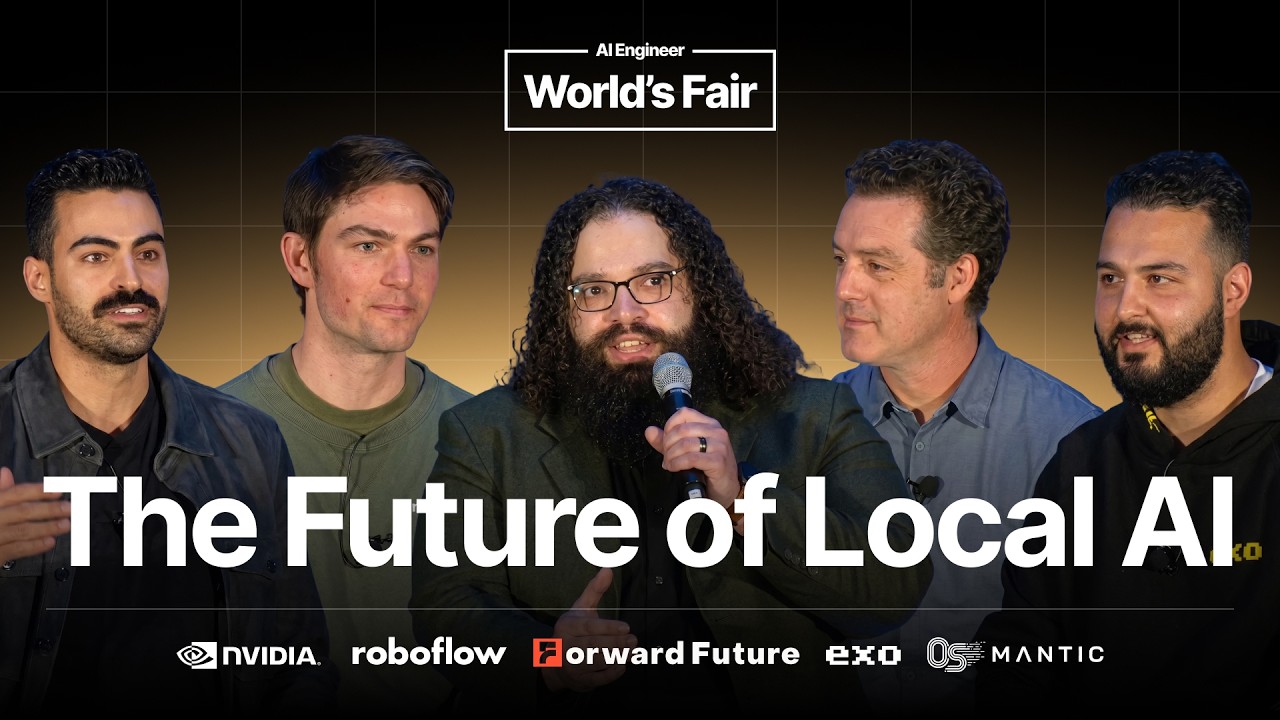
State of the Union: Why Local, Why Now — NVIDIA, Osmantic, Roboflow, EXO Labs, @matthew_berman
Jul 11, 2026 · 44:29
Nader Khalil (NVIDIA), Joseph Nelson (Roboflow), Alex Cheema (Exo Labs), Matthew Berman, and Ahmad Osman (Osmantic, r/LocalLLaMA) argue that local AI is now useful, driven by stronger open models and better hardware. They cite inflection points like Llama 2, DeepSeek v3, and GLM 5.2, which closed the gap with frontier cloud models. Sovereignty and control are key: enterprises need to choose their own model versions and avoid lock-in. Specialized models, such as Roboflow's fine-tuned vision models for deep-sea fish discovery, outperform general ones for specific tasks. Optimization is critical: EXO Labs achieved 10x performance on the DGX Spark by tuning existing NVIDIA kernels. The panel emphasizes that simplicity remains a barrier—most users need point-and-click solutions—and advocates for open-source AI to ensure freedom and innovation.
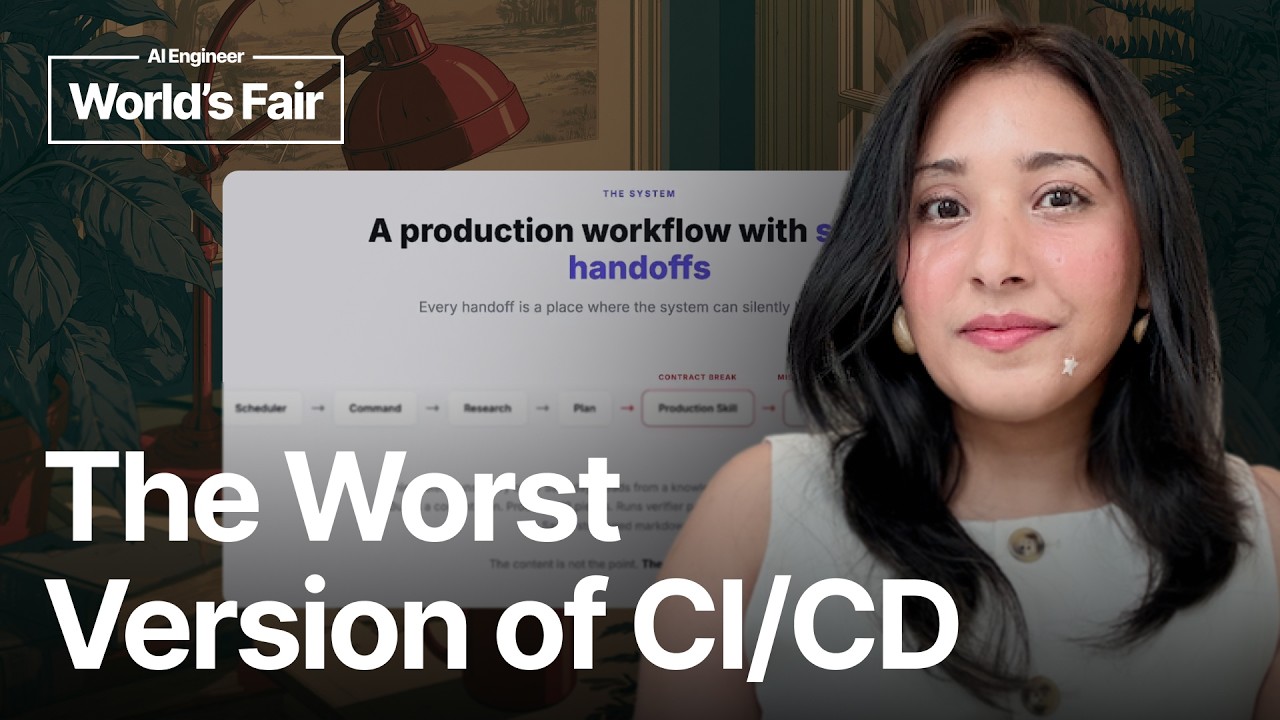
Every Solo Agent Builder Eventually Reinvents a Worse Version of CI/CD - Sumaiya Shrabony
Jul 11, 2026 · 10:51
Sumaiya Shrabony argues that solo agent builders inevitably reinvent CI/CD badly, as demonstrated by her open-source 19-skill Claude Code agent system. She identifies five reinventions—regression testing, CI monitoring, contract testing, staging environments, and audit trails—and three failure modes: voice drift, missing verification, and duplication hooks. The dangerous failure isn't bad output but polished artifacts that violate production contracts, like using the wrong voice or making unverified claims (e.g., a 37% statistic with no source). She advocates for adding boring gates at the most expensive handoff to block artifacts, not just warn, before shipping.
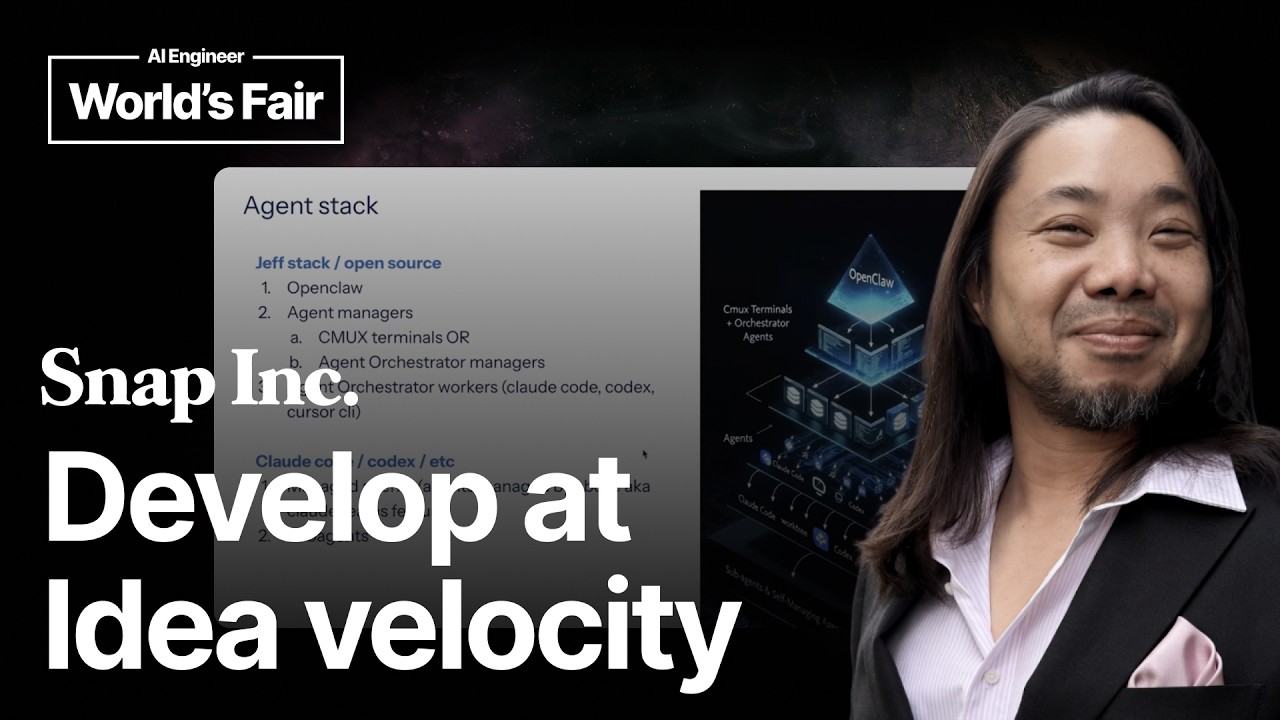
Develop at Idea Velocity - Jeffrey Lee-Chan, Snapchat
Jul 11, 2026 · 15:28
Jeffrey Lee-Chan (Snapchat) and Austin (CMUX) explain how to achieve 'idea velocity' by building parallel multi-agent harnesses that let one engineer direct 10–20 coding agents instead of becoming the bottleneck. Lee-Chan argues the key is separating 'Agent Orchestrator Managers' from specialized workers to prevent low-level implementation bias, using OpenClaw for frictionless Slack-based communication and CMUX terminals for real-time parallelization and unbiased manager oversight. He demonstrates two apps—an AI RPG with dice-roll mechanics and a multi-AI analysis tool—built with this stack, and discusses token-burn tradeoffs between models like Codex 5.3, GPT-5.4, and Minimax. The episode also covers staging environments to avoid doubling token usage, the benefit of persistent memory and contextual guardrails, and the importance of pushing human interaction to the start or end of the workflow for improved parallelization.

From Writing Code to Designing Systems: How the Developer Role is Changing — Chris Noring, Microsoft
Jul 11, 2026 · 23:05
Chris Noring from Microsoft argues that the developer role is shifting from writing code to designing systems and orchestrating AI agents, using tools like GitHub Copilot and Claude. He proposes a workflow starting with the CLI rather than the editor, employing agents.md for high-level guidance, skills for repeatable tasks, and custom agents for orchestration. Noring demonstrates scaling by delegating tasks via /delegate in the CLI or assigning issues to agents in the GitHub UI, allowing developers to become 20x more productive. He stresses that guardrails are essential to prevent agents from producing 'slop', and that human-in-the-loop oversight remains critical. The episode emphasizes that developers must encode standards and constraints into their workflows to maintain consistency and quality at scale.

Design Patterns for AI Trust: Juries, Libraries, and Agent Tiers — Alex Bauer, Upside.tech
Jul 11, 2026 · 17:09
Alex Bauer, co-founder of Upside, argues that go-to-market teams can solve AI's trust problem by managing agents like humans, using patterns such as a librarian for just-in-time knowledge and a jury-and-judge model for subjective decisions. He demonstrates three solutions: first, scaffolding an AI website rebuild with anchor assets like a product capabilities reference that ladders directly into homepage copy; second, a librarian that consults documentation and prior failed queries before answering questions like "How much pipeline in Q1?" to catch fiscal-year or stage definitions; third, a jury-and-judge workflow for multi-touch attribution where independent analysts research deals and a judge weighs reasoning quality before producing a consensus verdict. Bauer warns against low-intelligence models for important work, citing Slackbot's MCP integration as "horrifically stupid," and advocates using tier-two platforms with sub-agents, plan mode, and full MCP support.

Understanding is the new bottleneck — Geoffrey Litt, Notion
Jul 10, 2026 · 19:33
Geoffrey Litt from Notion argues that understanding code written by AI agents is crucial for creative participation, not just correctness checking. He presents three techniques: explanations via his 'explain diff' skill, which generates HTML or Notion documents with background, intuition, interactive figures, and literate code diffs, capped by a five-question quiz to ensure understanding before sharing code; micro-worlds, like a step-by-step debugger for a Prolog interpreter or a 'video game' that walks through migrating a website; and shared spaces in Notion where humans and agents can collaborate in multiplayer chat threads and comment on documents. Litt emphasizes that agents can build ephemeral UIs and simulations to help humans understand better, leveraging education principles to stay deeply in the loop.
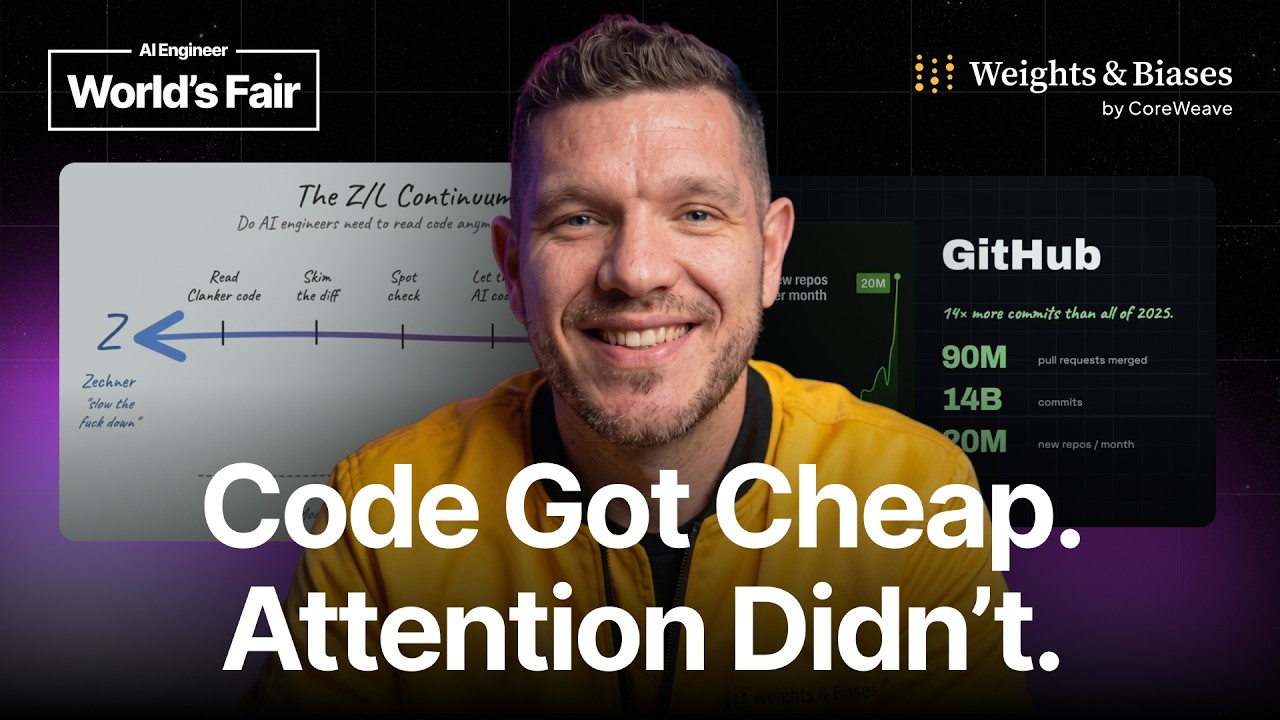
Should AI Engineers Still Read Code in 2026? The Z/L Continuum — Alex Volkov, ThursdAI
Jul 10, 2026 · 21:35
Alex Volkov examines the debate sparked by Ryan Lopopolo's claim that 'code is free' and Mario Zechner's counter that engineers must 'read every fucking line' of critical code, arguing that the Z/L Continuum is about task-level proof rather than personality. Citing a Ferrous AI survey showing an 861% increase in code deletion per PR and a 242% rise in incidents, he notes Anthropic's recursive self-improvement essay admitting human code review is a new bottleneck. Volkov's routing table prescribes reading every line for authentication, money movement, and irreversible data, while letting agents handle less critical changes. He also introduces loops—cron-like agent systems that self-verify—as the next frontier, quoting Adi Osmani that automated loops don't remove judgment. Volkov concludes that capability drift moves where proof belongs, but every system still requires human judgment.

The Golden Age of AI Engineering — Alexander Embiricos & Romain Huet & Peter Steinberger, OpenAI
Jul 9, 2026 · 25:13
OpenAI's Alexander Embiricos, Romain Huet, and Peter Steinberger reveal how AI engineering is entering its golden age, with model releases accelerating from every 15 months to roughly every 6 weeks and frontier-level intelligence now available at $1 per million input tokens and $6 per million output tokens. They demonstrate Codex's evolution from a model that couldn't test its own code to one generating 750 tokens per second, enabling a 10-second pull request, and emphasize that the product is built on the same open-source stack—responses API, AGENTS.md format, and harness—that ships to developers. The trio argue that the future is not about automating engineers but empowering them via value maxing over token maxing, with agents moving from local/cloud distinctions to persistent, long-running managers that orchestrate work and only require human steering at key decision points, as illustrated by an automated open-source issue resolution workflow.

Everything we knew about software has changed — Theo Browne, @t3dotgg
Jul 8, 2026 · 16:02
Theo Browne argues that AI model evolution—from Sonnet 3.5’s tool-calling to Opus 4.5's long-running tasks and Mythos's orchestration—requires engineers to think bigger and wider. He compares current developer habits to skeuomorphism in iOS 7, urging rejection of legacy constraints like Git's inability to commit environment files and terminal-centric workflows. Browne introduces a shifted tier system: what was a startup is now a side project; a Markdown file running on a cron job can replace a company's product. His own PR triage service became a Markdown file updated daily via cron. He advocates building breadth over depth—architecting products so users can extend features, enabling small teams to compete with AWS or Salesforce. 'If your idea doesn't feel stupid, it's because your idea is not big enough,' he concludes.

Think You Can Build a Game with AI? Think Again! - Danielle An & David Hoe, Meta
Jul 8, 2026 · 18:00
Meta engineers Danielle An and David Hoe share insights from leading AI-driven game creation at Meta, arguing that while anyone can now prompt a basic game with AI, truly standout games require aesthetic cohesion, playtesting, and runtime LLMs that make NPCs dynamic and unscripted. They demonstrate how anchoring an LLM on a single image (like a QR code) can unify art style and gameplay, and show a multiplayer game where LLM-driven NPCs compete with unique personalities. The key shift is from linear, costly game development to parallel, rapid iteration cycles enabled by AI tools. They also highlight challenges: managing indeterminism across the entire stack (from user prompts to platform ranking), debugging agentic systems, and ensuring content safety with runtime generation. The takeaway: whether you're a beginner, intermediate, or advanced creator, the AI gaming frontier is at day zero, with open problems in token economics and scalable safety.

Your agent is blindfolded — Johan Lajili, Poolside AI
Jul 8, 2026 · 9:58
Johan Lajili of Poolside AI argues that the key difference between successful and disappointing AI coding agent experiences is whether the agent has a tight feedback loop to verify its work, essentially giving it "eyes" to test its own outputs. He demonstrates this with his CLI tool Spoolside for VS Code extensions that extracts logs and screenshots to reproduce bugs. Lajili predicts engineers will shift from product engineering to "AIX engineering" — focusing on making AI work on the product rather than on the product itself. He advises building ephemeral testing primitives and investing in agent self-serve tools, analogous to putting on your own mask first on an airplane.
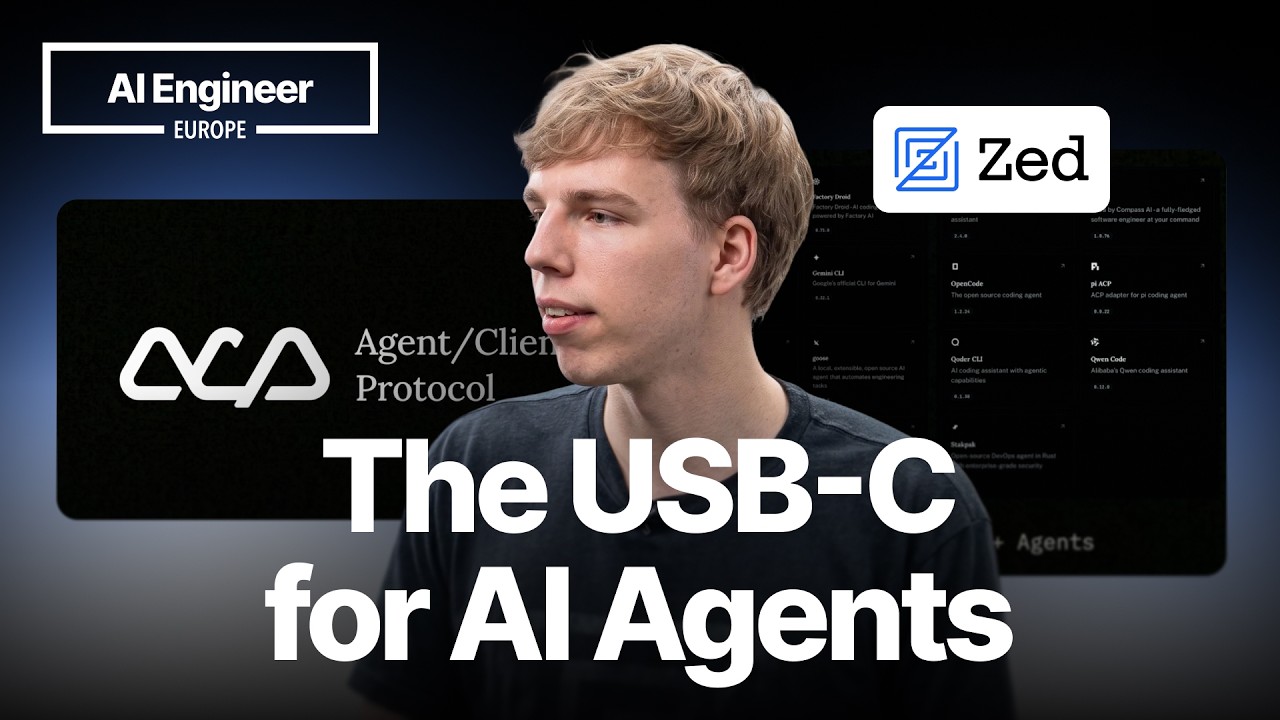
Building an ACP-Compatible Agent Live — Bennet Fenner, Zed
Jul 8, 2026 · 18:19
Bennet Fenner from Zed demonstrates building an ACP-compatible coding agent live, showing how the Agent-Client Protocol lets agents and editors communicate over JSON-RPC. He starts with a minimal agent that reads and edits files, then adds ACP support using the TypeScript SDK—implementing initialize, session creation, and prompt handling. Next, he streams model tokens via session updates, emits tool call progress with file paths and diffs, and proxies file system operations through the client. The demo culminates in the agent bootstrapping itself to add a terminal tool, which then runs shell commands inside Zed. ACP currently works over stdio; a remote transport is in development.
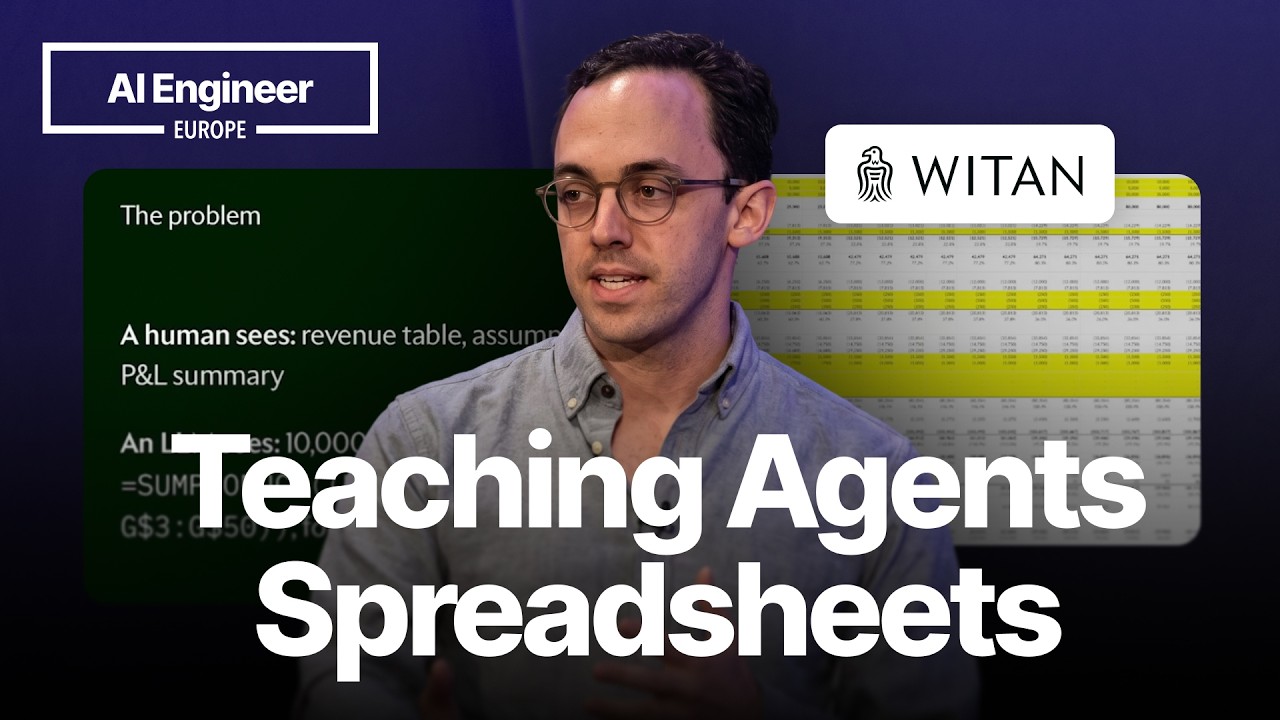
Teaching Coding Agents to do Spreadsheets - Nuno Campos, Witan Labs
Jul 8, 2026 · 19:09
Nuno Campos from Witan Labs explains how his team spent four months teaching coding agents to master spreadsheets, raising accuracy from 50% to 92% on a financial analysis benchmark. Key failures included a rigid three-agent architecture and standalone representations like SQL and XML. The breakthrough was replacing 15 separate tools with a single JavaScript repo tool offering persistent state and code-mode semantics, enabling agents to combine multiple operations in one call and drastically reduce timeouts. The team built high-fidelity formula and rendering engines to close the verification loop, and added domain knowledge prompts to focus the model. For evaluation, they moved from LLM-as-judge to deterministic comparisons using golden spreadsheets. Campos urges practitioners to replace many tool calls with real scripting languages, invest in feedback loops, and regularly revisit interfaces as model capabilities evolve.
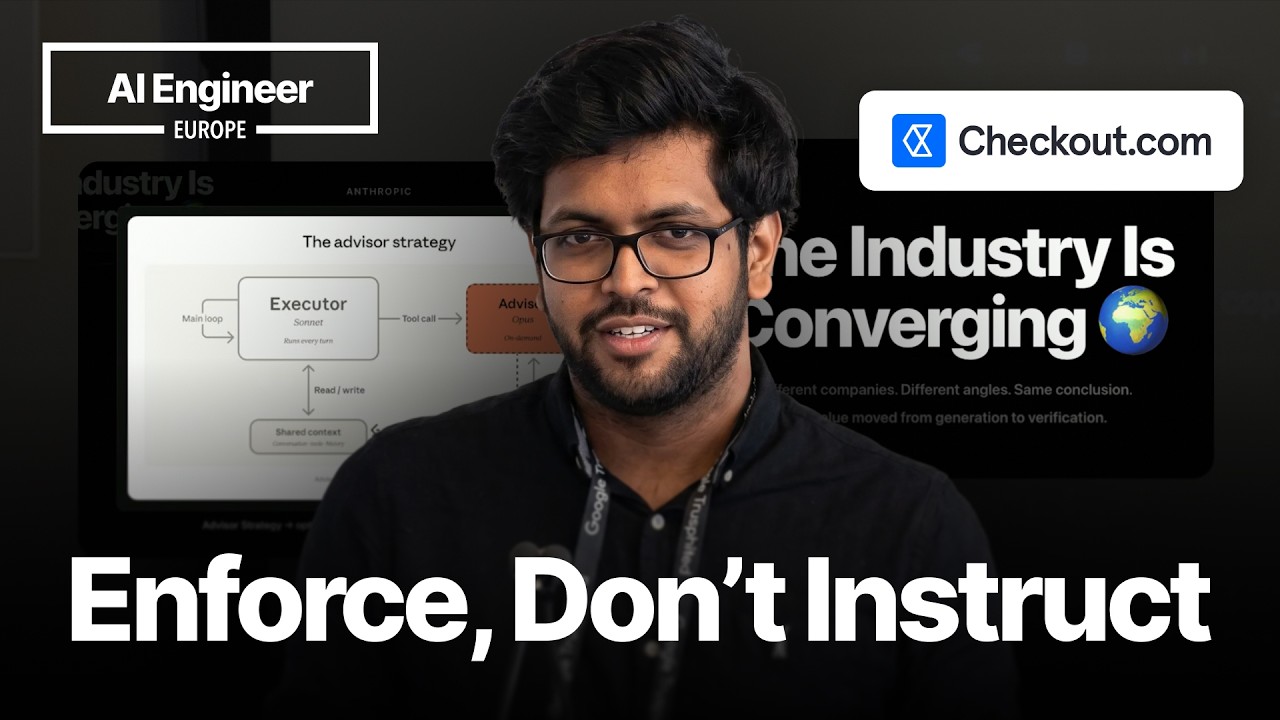
Your coding agent doesn't always follow your rules — Talha Sheikh, Checkout.com
Jul 8, 2026 · 10:08
Talha Sheikh from Checkout.com argues that the real value in AI coding agents lies not in the code they generate but in the verification layer that checks it. Drawing from his experience with Claude Code, he built Vector Harness—a tool using Claude hooks to deterministically test agent outputs against a config file, retrying failures automatically. He contends that model capability does not equal reliability, and that even with better specs or models, deterministic verification is essential. Sheikh observes that Anthropic, OpenAI, and CUDO are all adopting similar harness patterns, shifting the focus from instructing agents to enforcing rules. His central claim: work on the harness, not the code, and you can even use smaller, cheaper models with enough guardrails.

Running a Chess YouTube Channel entirely by AI — Stephan Steinfurt, TNG
Jul 8, 2026 · 16:31
Stephan Steinfurt, from TNG, presents their AI system that automatically creates daily chess puzzle explanation videos for YouTube. The agent combines a chess engine (for analysis) with Google's Gemini 3.1 Pro (for natural language) to generate detailed move-by-move commentary, including arrows and highlights. It downloads games from LeChess nightly, runs checks/captures/threats analysis, and uses 11Labs for text-to-speech with emotional tags. The YouTube channel has 500k views and 4,000 subscribers, with each video costing 20-30 cents (not yet monetized). Steinfurt notes the error rate is low (1 in 20 videos has a mistake) and discusses balancing explanations for different skill levels using the Maya engine to suggest human-like moves.
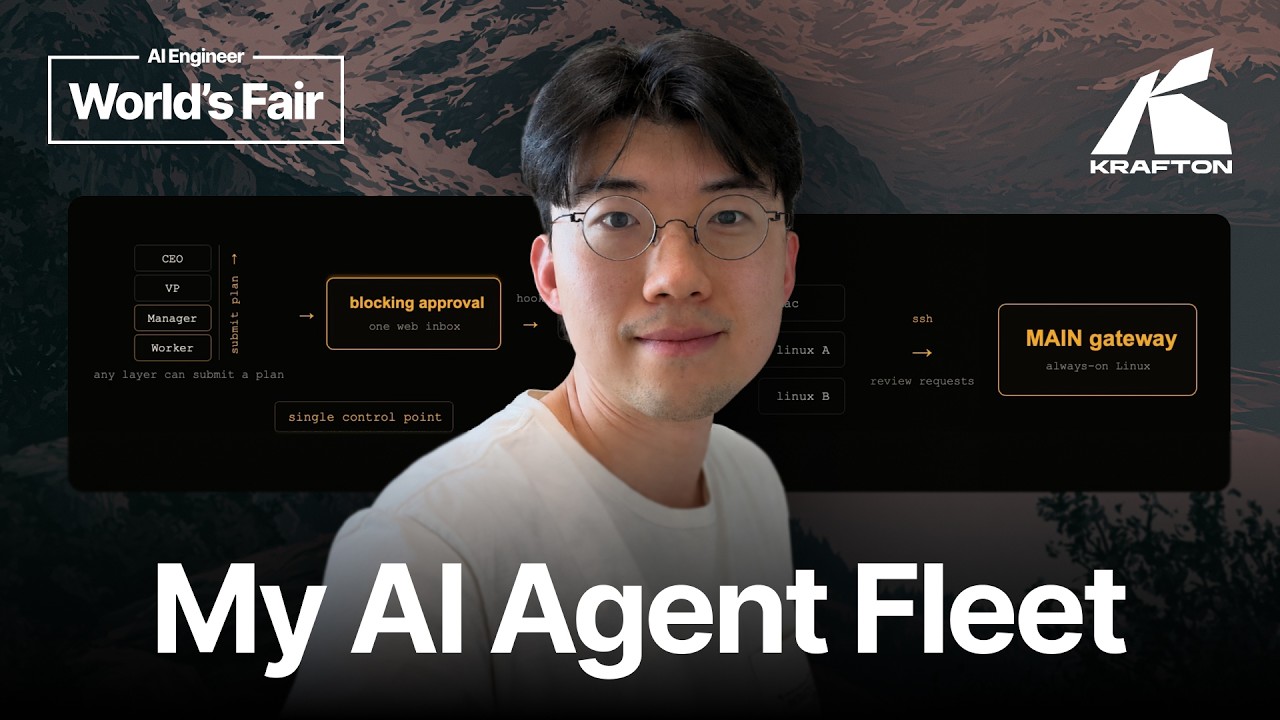
I Run a Fleet of AI Agents Across Three Machines. Here's What Broke. - Kyle Jaejun Lee, KRAFTON
Jul 8, 2026 · 9:11
Kyle Jaejun Lee runs a fleet of AI coding agents across three machines daily and reveals the scaling failures that emerged from a hierarchy of CEO, VP, manager, and worker agents. To overcome his own attention bottleneck, he separated context into entity-specific workspaces on disk and replaced context compaction with full resets that read handoff files. When moving beyond one machine, five things broke: agents doing work instead of delegating, TMUX panes too crowded to read, out-of-memory crashes from stacked Claude Code processes, colliding Git credentials across workspaces, and the MacBook dying mid-task. He offloaded long-running work to always-on Linux boxes, used Git commits and SSH to move context between machines, and consolidated review gateways onto a single always-on machine with Discord as a unified router. Unsolved challenges include consistent credentials, local-only tools, and resource scheduling—he plans to layer his orchestration on top of Kubernetes to handle compute, secrets, and tools.
Powered by PodHood