


Intro0:00
Amazing. Um, it is—oh, sorry, pardon me.
Um, it is so lovely to be here. So I wanted to share today, uh, some thoughts that I have around who gets to be at the frontier of discovery. So, modern computer science as a field has only existed for the last 77 years.
It's kind of bizarre when you think about it. So World War II, uh, all the transistor technology that was developed for radio, we finally had our first versions of the computer. But when you think about it, that's only two generations of people working on these tools.
However, within that time, even for computer science, who and what and what topics we work on has dramatically changed. And I think it's an interesting setting because, actually, if you look back across science as a whole, how we do discovery has been markedly different, uh, at different points in time.
So when we started, the whole idea of a researcher was what we call, like, a gentleman scientist. Typically someone with adequate wealth to dabble in a discovery. And these were all individuals, independent researchers. Uh, when we, uh, see, like, the first associations emerge with the Royal Society in the 1600s, the idea of being a scientist as a full-time job was very special.
Gentlemen scientists1:07
And these became the predominant spaces for discovery. Why am I talking about this? Because, to be honest, like, the professionalization of science, uh, led to what I would call, and, you know, my good friend Rosanne Lou calls, the unreasonably narrow path.
Narrow path1:49
So I'm an AI researcher. Uh, this is Yann's actual career. Uh, and it's interesting, if you were to be an AI researcher at the forefront, you basically had to follow this exact narrow path. You had to get into theright PhD program.
You had to then go to theright industry lab. You had to do sufficiently interesting work, and then finally you got to contribute to the frontier. This was my story too. So a lot of my work has been on efficiency at scale.
Uh, I did my PhD, uh, and worked at DeepMind and a lot of different frontier labs. But this was, in many ways, um, a very aggressively filtered system. If you did not make it, or you were not curious about theright problem at theright time, you didn't have, um, a place to play at a frontier lab.
And this is, like, the standard successful scientist. Like, you have a famous advisor, hopefully. Uh, you hopefully get one or two important internships. And what's interesting about this is computer science was really about representing the world. And it was, like, all the tools that do that.
But the reason why most people go on to computer scientists was the question at the end of it. Like, if you can represent the world, what questions can you answer? So today I'm going to talk about what I think is, like, one of the most profound and interesting topics, which is, like, why this is so important for computer science and how this is changing.
So I'll also speak to this. It was double-compounded in computer science because of the need for compute. So this resulted in jokes. Um, it's fun that Murvey was here. This is her tweet about GPU poor versus GPU rich.
GPU divide3:13
Uh, it led to barriers of entry on who can contribute to frontier AI. So I put here company A, company B, company C. But to be honest, if we pulled, I think there would be significant majority votes about who those companies are.
But basically, a handful of frontier labs have been able to build the technology we use. Um, it's also determined who gets to participate in breakthroughs and who doesn't. So, uh, this is a map of, like, what Stanford calls, uh, where statistically or significant breakthroughs have come through, come from.
And you can see whole sections of the world are completely left out. And so for me, uh, this is a very important question worth answering. Who gets to shape the frontier? Who gets to answer the questions at the end of the pursuit?
We've seen that the shift has dramatically changed from academia to industry. And it's also meant that we ship the same model to everyone. Uh, why that's particularly interesting is that most people intuitively understand that you shouldn't ship the same model to billions of people.
And they also understand that it's not a particularly good use of compute,right? You're spending the same amount of compute on everything. And some problems are hard, and some are very easy. So where does that leave us? What's my talk for today?
Um, I would like to say that we are ripe for a revolution. And we are ripe for a revolution in who gets to participate at the frontier of AI. Uh, I'll tell you two reasons why I'm bullish on this.
Um, I'll definitely cover one, and then I'll actually see interest, uh, and timing because I want to leave plenty of time for questions. I think that's, you know, unless you have a few questions and a bit of banter, these things can be kind of boring.
So we'll see. But I'll cover one, definitely, that I'm actively thinking about. And this is, what if we could allow anyone to build the same frontier intelligence, um, as that in labs? And I've been in a few labs.
I've done my tour of duty. And this is the core question I care about now. It's like, how do you build intelligence that continuously adapts and that builders everywhere can have more control? So instead of taking years of training to learn how to build the tools, scientists just skipped to the questions.
AutoScientist5:21
So a few weeks ago, we released AutoScientist. And AutoScientist is really about how do you automate the training of models itself. Um, I'll share a few things that are really interesting about this. So one, it's, um, co-optimized the entire loop.
So it's like from data to alignment. Uh, and it, it chooses and self-evolves based upon the domain and the type of data. Um, what's interesting as well is that it actually outperforms research staff. And mainly because, like, a lot of our research staff has experience with certain model types.
And we're testing it across many different model architectures, different, different size models, um, as well as, like, dense and mixture of experts. And that search base is a lot broader. And so exploiting it using, like, how do you, how do you self-improve from experience and scale is very effective.
Co-optimization6:09
Um, I think this is very interesting. This only worked when we co-optimized the data. Uh, so there's a lot of auto research projectsright now which basically treat data as, like, um, the agent decides whether to create data or not or what to do.
Frankly, we did not get the returns for, like, how much you can squeeze out of performance until you control for data quality. So we actually co-optimized based on all the adaptation we did of the data exactly what we would do with the model.
And that was super interesting. It speaks to, like, the need to control the entire flow. Um, what's fun about this is, like, really what AutoScientist is doing is it combines all the knowledge it gained from the adaptive data component with also the knowledge of the domain and also the ability to self-improve for a domain and to learn from other components of that domain.
Um, what, what is a cheeky fact, and this is quite fun, you'll notice all these percentages for win rates are, like, 60 plus. Um, that's because we put the budget stopping it, stopping it above 60. So, like, once it was above 60, the our, our agentic flow could exit.
But we've since, like, removed that barrier. And, like, you can see it just go up over time, which is super fascinating. Um, and then I think what's interesting is, like, it changes a lot of the hyperparameters. Typically, the humans are much more wary about changing all at once.
And so you get massive exploitation of the search base. I see this as crucial for, like, how do you reduce the amount of compute you use for customization because you train with much more predictability. But also, how do you, um, leverage, like, your domain knowledge to really unlock how you build frontier AI?
Um, and this was fun. We, we did, uh, we announced a beta, like, four weeks ago. The excitement is most acute for, like, medical and sciences. And that's largely, I think, and legal and, and code as well. But these are, like, domains where typically current models fall short.
And also domains where, um, in many ways, like, the degree of last-mile customization is really acute. Um, and this is the core point. I, you know, I think this is fun. I think I might even have time to cover the other point I wanted to make about why now is very important for, like, changing who shapes.
But this really, the main factor that this does is it increases your innovation cycle. Like, and it also increases the likelihood that when you train and spend compute, you'll succeed. And those combined factors are super interesting. Like, one thing that we're doing next is extending that.
So even your test time compute should be adaptive based on your task. Um, so this kind of brings me back to where I started and, like, kind of the grumpy statement I said, which is, like, you know, we have this verified, super narrow, compounding issue of barriers to entry.
One is, like, that you need to do this, um, very narrow funnel of who gets to build frontier AI. And the other is that, um, typically compute and cost really dominate. Um, we want to change that. Like, we decided, okay, we're going to cover languages from day one, 242 languages.
And also, like, a big interest for us is actually non-verifiable tasks. I think this is super interesting because, um, this is really the bulk of, like, everyday tasks that people do. And, um, it's really where the meat of, like, what is interesting for progress is going to be over the next year.
Mission9:05
Um, and this leads me into our mandate. We care deeply about how do you accelerate learning in a way that models should be able to, um, learn from their environment. Soright now, we've moved from an era of, like, the, the model is monolithic.
You know, when I was at, um, different parts of my research career, basically your whole team would be around building a model. You give it to someone else to serve. And, like, you have someone else do the front end.
And actually now, like, the most important intelligence is a model who interacts. And so this idea of how efficiently are you going to interact? How will you continuously learn from the environment is pretty core. And, um, I think about it a lot.
So, um, let's see. I think I do have time,right? How are we doing for time? Oh, I do. I have plenty. This is lovely. So we'll have time for questions. And I'll share a little bit about what I think, um, the next, uh, component is.
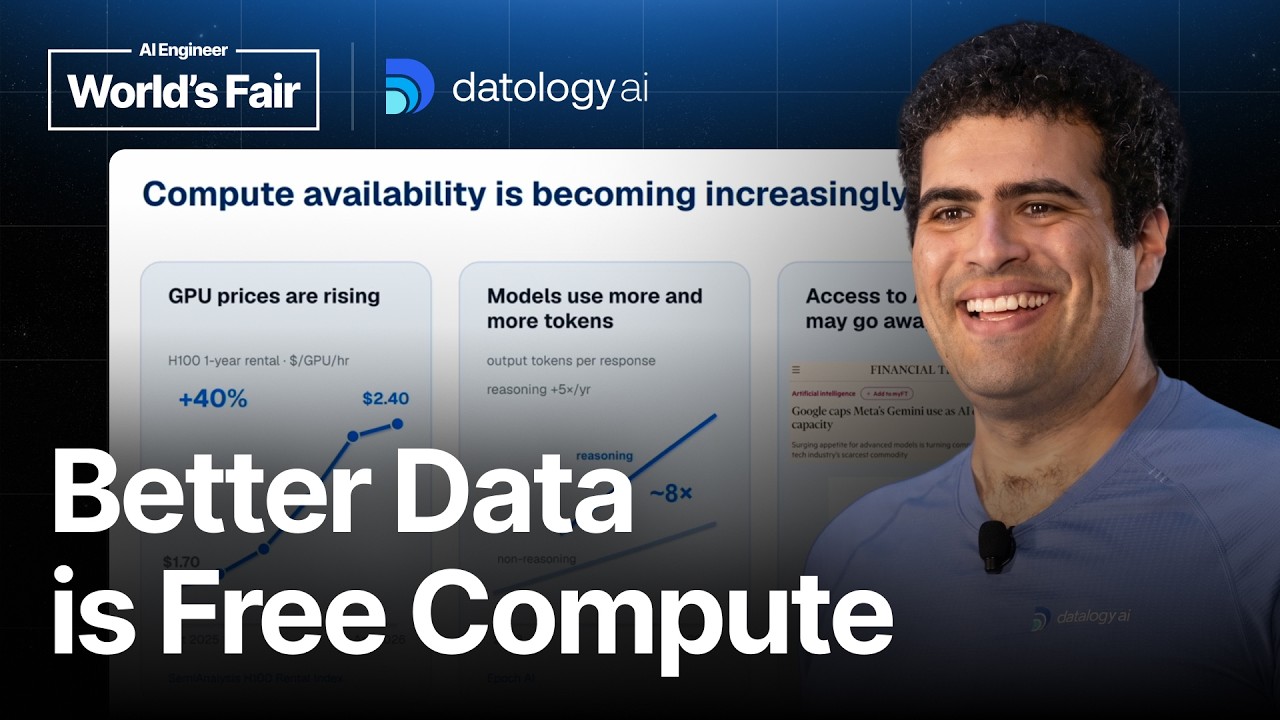
I think core to this, so if we just did AutoScientist, but it still took enormous compute to do frontier AI trainings, I think we'd be in a bit of a pickle,right? Like, I'd be saying, oh, great, you can use this agent, but don't worry, just bring your, uh, 10,000 GPUs with you.
But I think there's another trend, which I think makes this very important timing. And rooms like this probably much more optimistic than, like, have been in a few years ago about who can build frontier AI. Um, and one of that is, like, the rules of, like, where you get rate of return for compute are totally changing.
So, um, I wrote a very, uh, paper about this called Slow Death of Scaling. Um, but empirically, we do now know that, um, pretraining size in particular is not your most lucrative axis of scale. And what does this mean?
Scaling slowdown10:46
Like, if pretraining scale isn't going to dominate performance, it actually really greatly changes who can create the best recipes for innovation. Because pretraining compute typically has to be co-located. Um, it has to be, uh, in many ways, large volume to accommodate for redundancy.
Inference compute and other places where you actually apply compute, typically you can have much more, like, distributed. It's also much more higher return given the amount of flops. And so it's interesting when we talk about what is the state of pretraining compute, we know it's not giving the same returns largely because our architecture is saturated.
So, um, we see much smaller models outperforming much larger ones. Uh, this is, like, the OpenLLM leaderboard. And this is, like, the daily submission of, like, the best small model under 13B versus all the larger models. Um, and you can see over time that ratio totally flips.
Um, and also there's kind of the grumpy assessment that most recent models that have severely, um, played with just increasing model size haven't provided the same stepwise change, um, as their predecessors. And a lot of that is because where the most returns for performance are now are on a broader action space.
Um, and this is really what I was getting at when we move from an algorithm to we are expanding optimization space in new places. And what's fun about that is that these are new places where, um, the barriers to entry are much more nimble and where recipe and algorithm and research matters again.
Um, and things like how do you automate that discovery? Um, and so this is what I'll state. And I think then we should open up for questions. Um, and I would encourage good grumpy questions or fun positions. Let's make the use of the time.
I know I was told earlier that almost no talk to have time for questions. I find that so disappointing. So, um, so we'll need some brave people to start the conversation. Um, but I will say this means we'll better off.
And I would say it's a very good time to be, like, working on intelligence because instead of just a handful of people getting to sh getting to create it, it's much more now about the question you want to answer at the end of the day.
The reason why people did a computer science PhD was to learn the tools to get to the question. And now you can just get to the question, which is super meaningful. Um, okay, let me open up. Where should we start?
We, um, have an abundance. I, I hear there's no microphone. So if you want to ask a question, you want to make a statement, I will indulge a statement if it's interesting. Um, and, uh, yeah, go for it.
Q&A13:27
Just raise your hand and I'll, I'll repeat it afterwards. Let me just get to the end of this in case people want to reach me afterwards. Nice. Um, yes, go ahead. Gentlemen in the fourth row, go for it.
You, you mentioned, uh, you know, uh, AI frontier will be more democratized. Can you point to, like, how?
So I think how is twofold. One is, um, there's very few people who know how to train frontier models. I would say realistically, probably less than 5,000 in the world at scale. I think that type of knowledge, that's a very exploitable search base.
And actually, as humans, all those configurations, we're not particularly good at. It's kind of like secret knowledge we pass as if, you know, we're apprentices. Um, so that's one. Like, once you, um, automate a, a lot of that knowledge, you just accelerate innovation cycles, which means that you can explore and do more questions.
Typically, what people, I think, often miss is that the cost of, um, uh, asking something informs what is asked. And if you make it cheaper to ask something, you change, like, the volume of things that are asked, which is super interesting.
The other reason, though, I do think it's very much a facet of, like, the changing nature of compute. So, um, agentic compute, post-training compute matters a significant amount for performance. That does not require the same type of, um, I dare I say, hoarding of GPUs.
But, like, I think it, it's very different compute purchasing dynamics. And again, it means that the person with the best idea has a higher chance of winning, um, which is fun. Nice. What else? Who wants to go? I see, uh, up.
Yeah, we can go up here. And then I saw a, a hand back there. Okay, yes, I do see you. The glare is hi, but you go first and then we'll come up here.
Safety debate15:21
So frontier labs care a lot about safety. So one of the challenges in stripping is adaptable models. Somebody will take your safe model and adapt those to be unsafe. Uh, how, how do you see that playing out?
Yeah, so the question, I'll just repeat it. So because I think there's, um, probably people who want to know who I'm in the room. So the question was, um, one of the, I guess, uh, the counterpoints from some frontier labs about not, uh, enabling frontier AI outside is that it's a safety question.
So I think it would be, uh, I definitely am not one of those people who, who says that, um, open source doesn't carry any risk. So when you make a tool more readily available, there's a profile of risk associated with it.
Um, AutoScientist is, to be fair, like, it's about enabling people to customize their models. You can think of that as, like, a slightly different question from whether those are open source. It's giving people way more control. Whether that's local or private or within their company, it's about, like, how do they own their own intelligence?
Um, what do I think broadly about the impact of, um, open source on safety? You can do so much. Uh, the dynamic has often conflated, like, that real risk of, like, wider access with, um, a slight sense that, that it, it, it restrains who can actually participate.
And I think that's a delicate balance. And I think you have to acknowledge risk by also navigating that and acknowledging that it limits who can participate. Yeah. So nuanced answer. So I, I guess I should be more bombastic on that one.
But I, I guess I have been in this discussion a few times. And I find the binary views on other sides, I feel like they miss a lot. But anyways, okay, go ahead.
Uh, are there any specific, uh, research ideas or technologies that kind of, you know, uh, fit into this paradigm that you're excited about?
Oh, I think for, for automating and speeding up learning, one of the core questions is how do you balance what you store in the parametric space and the non-parametric space? And actually, one of the most interesting things, I mentioned that this only worked because we co-optimize data and model.
Um, it will only work to do, like, an, uh, AutoScientist for harnesses if you also co-optimize it with the model. And so it's interesting. It's actually a long horizon problem. And that's super fascinating to think about where you're optimizing the choices for each and co-training, which is cool.
Nice. Uh, I think we have time for maybe two more and then we can pass on to the next speaker. Nice. Go ahead.
Uh, so you talked a little bit about this, uh, actually working on the post-training side of models is, like, cheaper than doing pretraining, obviously. But, like, still, especially talking, like, really large models, like reinforcement learning, even fine-tuning, it's still pretty, like, GPU intensive.
Compute costs17:45
So, like, you talked a little bit about, like, smaller models, but I still think that most, like, frontier smaller models still rely on, like, the bigger knowledge to distill knowledge, like, downwards, not even to be trained. So how do you see this, like, actually, like, for the future, how to work, like, with these smaller models, how they can start working without the team training, without depending on these larger models?
Yeah, actually that's an excellent point. I think the question amounts to two points. One, a larger model is necessary for distillation benefits. And then second, so frontier models are still pretty large. Um, so I think for the second one, frontier models are still pretty large.
Yes. I don't think I'm arguing that you, um, I, I my argument is slightly different. My argument is that no frontier AI lab is going to 4X the size of their model again for pretraining. So it's almost like we know we're at an upper ceiling for this architecture.
If someone comes out with a new architecture, that's totally different. You can the architecture determines your ceiling. And I'm saying we are probably at the ceiling of size, which means that that's fun because it means, okay, it's what you innovate within that.
Um, so, so size does matter. I think that's, that's a very good point to bring up. Um, meaning I'm not advocating everyone uses 0.8B, but I am saying that we now have a more equal feeling playing field at the, the top.
Second point is interesting. Distillation, like, um, uh, the impact certainly. So data quality in general means you use capacity a lot more. So you, uh, what you will see in pretraining is instead of, uh, the size, people are just moving post-training further back, which is very fascinating and a bigger lever.
So, um, I agree distillation is helpful. It's just that, again, we've hit the ceiling. And so, uh, it's, uh, almost like no one is going to supersize their model. Um, or if they do, it's not clear it's beneficial except for a small size of the distribution, which is, um, very much the long tail.
And that's kind of interesting, like, where that trade-off is worth that much pretraining compute. So very good question. Uh, one more and then I think we are done. Yes, go ahead.
Open source20:07
Any plans for open source AutoScientist?
Yeah, it's actually Embetta. So you can, um, I shared here, you can try it Embetta. So we actually are offering the GPUs for free. Um, okay. Oh, that's a nice question. I, I promise I don't know this gentleman.
Um, but yes, I think, uh, actually we're trying to remove the compute hurdle and I think it's quite cool to see. So, um, feel free to take a look at the beta. Nice. Lovely. Thank you so much. Really nice.
Thank you.