
Training Data Curation
Episodes from AI Engineer about Training Data Curation.
23 episodes
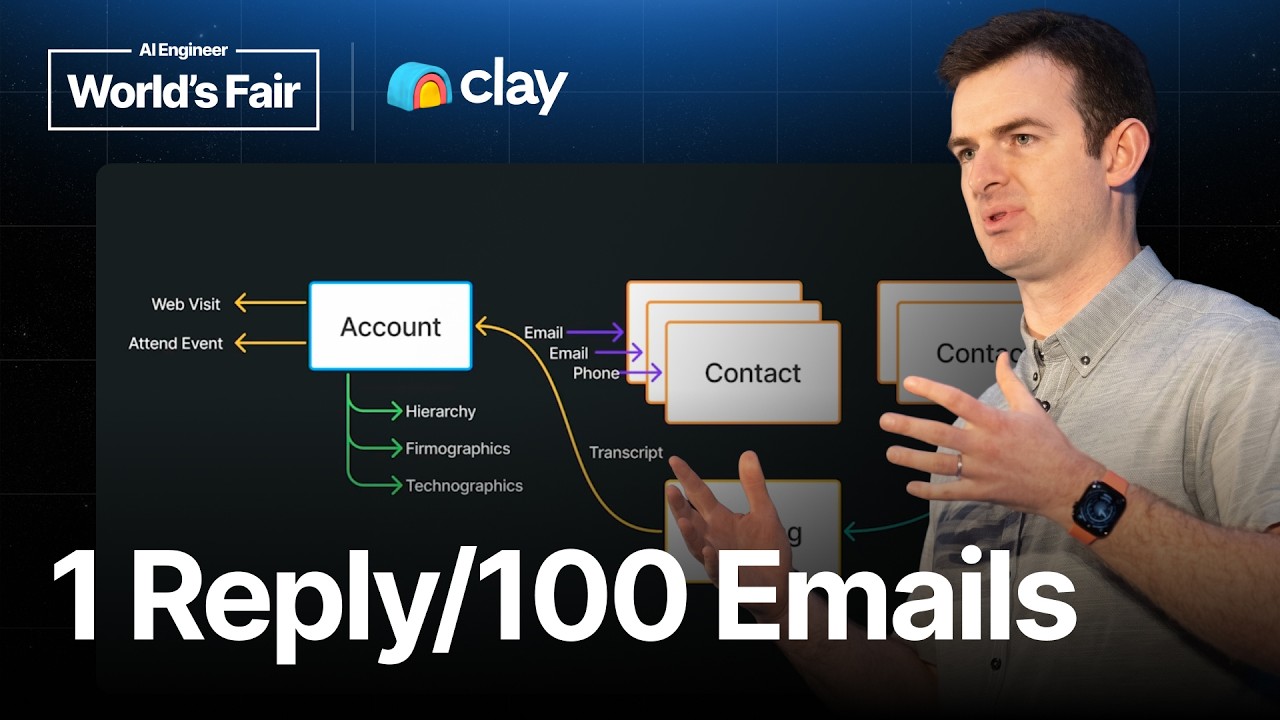
GTM Engineering: The Technical Bits — Everett Berry, Clay
Aug 26, 2026 · 19:04
Everett Berry of Clay explains GTM engineering, the discipline of letting go-to-market teams ship as fast as engineering teams, by covering its hardest technical areas. Data first: accounts never hold still, so teams waterfall across hundreds of vendors—Forager alone yields half of phone numbers—and must run evals to trust providers. Orchestration is the second problem, a data engineering puzzle across 20–30 tools that sync behind your back; Clay's fix is a graph of general purpose nodes. Third are long-running agents, one per account, dormant until triggered, holding state across a deal cycle; human-agent interface is the hardest problem. Execution is the fourth: with cold email reply rates at 0.5–1%, reps spread domains, route replies home, and suppress channels when meetings book.

Don’t be data poor — Anuj Iravane, Anterior
Aug 19, 2026 · 16:46
Anuj Iravane, who leads AI at Anterior, explains why the company builds synthetic medical data by reversing its inference workflow: the real faxed records it needs most are protected patient data its contracts forbid keeping. With about 70% of medical communication still moving by fax, Anterior starts from a label, samples a reasoning trace from policies modeled explicitly as decision trees, then builds a coarse-to-fine patient journey and documents, making labels correct by construction. Clinicians own the pipeline as interchangeable skills, and roughly 90% of datasets are now synthetic; in a blind review they separated synthetic from real only about 60% of the time. The payoff is creating edge cases on demand and testing workflows before deployment instead of waiting on customer data.
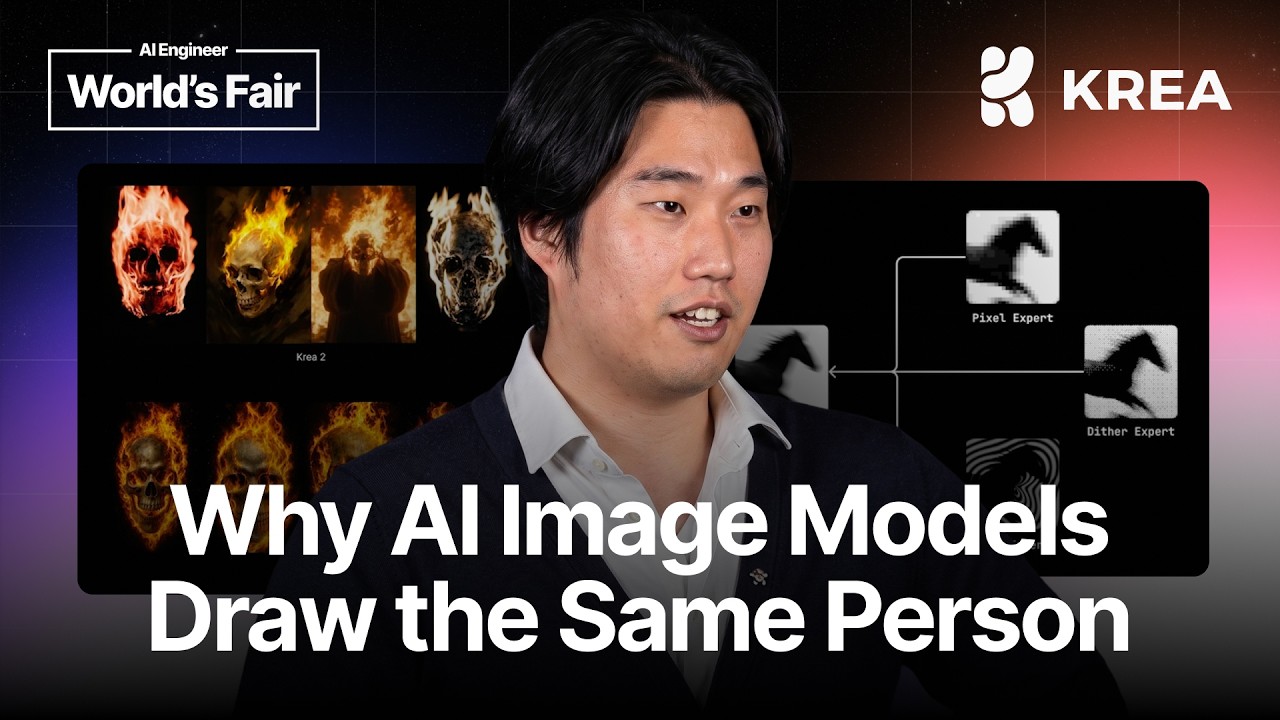
Training Krea 2: What matters in generative model training — Sangwu Lee, Krea.ai
Aug 18, 2026 · 21:46
Sangwu Lee of Krea.ai explains what went into training Krea 2, its open-sourced image foundation model, arguing that once architecture is locked, data is everything. To keep stylistic diversity over the 'most boring average person' consistency of production models, Krea filters billions of images: no AI images, OCR and vision-language captions, hash and embedding dedup, distilled VLM classifiers, sparse autoencoders as unsupervised taggers for watermarks and borders. World knowledge is checked against Wikipedia concepts by PageRank. Training goes from 256 to 1K resolution through pre-training, mid-training, SFT, preference optimization, and GRPO-style RL, plus a prompt expander. Lee wants a single clean transformer without VAEs/text encoders and VLM-generated bounding boxes or scene graphs.

The Rise of CaaS: Context-as-a-Service for Agentic AI — Omer Primor, Bright Data
Aug 14, 2026 · 22:20
Omer Primor of Bright Data argues that rented AI search and context-as-a-service (CaaS) lose to a self-built pipeline once query volume passes a tipping point. The web is context, not data, and it decays: social content goes stale within a day, news/finance/retail within 30 days, so context is never a one-time snapshot. His test enriching 100 sponsor companies across 25 fields found general search beat dedicated CaaS vendors on coverage, because CaaS only answers from data it already holds; costs were similar, but frequency is the real killer — every repeated query costs the same when nothing changed. He built scrapers for LinkedIn, jobs, and Crunchbase in a day, priced setup at $5,000, and put the crossover just over 15,000 entities. Owned context compounds while rented decays.
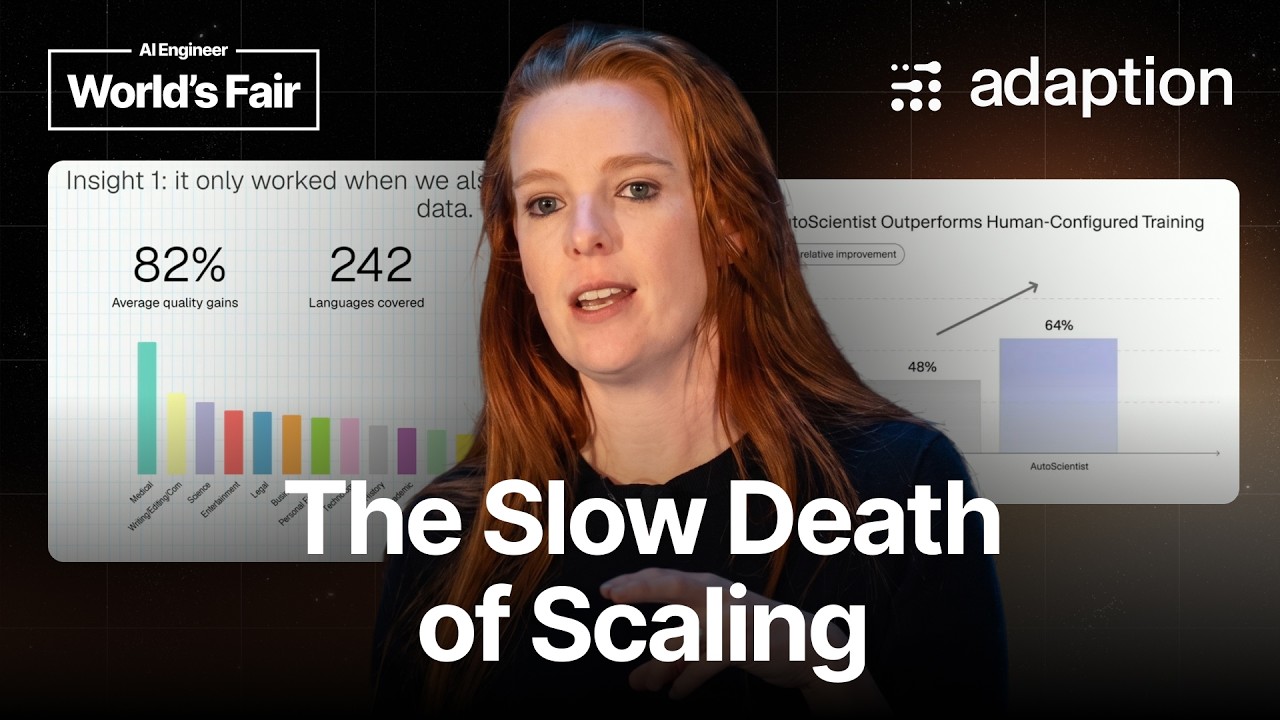
Adaption Labs: Gradient-Free Continual Learning — Sara Hooker, Adaption
Aug 12, 2026 · 20:51
Sara Hooker of Adaption Labs argues that the frontier of AI discovery is about to widen, moving beyond the 'unreasonably narrow path' of elite PhDs and industry labs. She introduces AutoScientist, which automates model training by co-optimizing data and model, outperforming research staff and achieving win rates above 60% (a budget cap since removed). Hooker also presents the 'slow death of scaling,' claiming pretraining size is no longer the most lucrative axis, as smaller models now outperform larger ones on the OpenLLM leaderboard. This shift makes compute more distributable, enabling more people to contribute to frontier AI. She addresses safety concerns, distillation dependencies, and offers free GPU access to AutoScientist beta users.
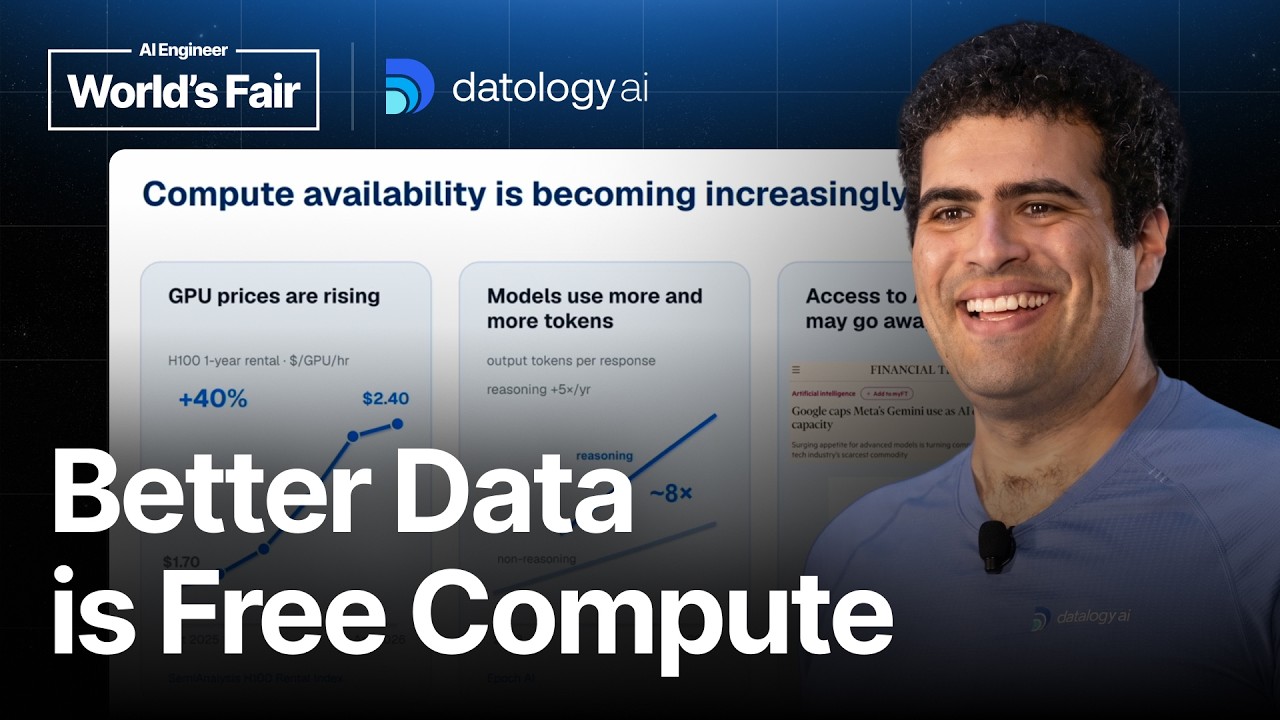
Data Quality Is the Compute Multiplier — Ari Morcos, DatologyAI
Jul 31, 2026 · 19:05
DatologyAI CEO Ari Morcos argues data quality is the compute multiplier: better data steepens scaling, so the same compute buys better models. His oil-refinery approach—clean, curate, create, compose—uses synthetic rephrasing for diversity; curation let a VLM beat the public Pareto frontier with 145x less training compute and match Qwen 3.5 with 35x fewer flops per correct answer. Curating English also boosts non-English via cross-lingual transfer. For Thomson Reuters, mid-training on curated legal data lifted LegalBench 5 points without catastrophic forgetting and tripled post-training gains. Arcee's Trinity Large, trained on 17 trillion curated tokens, matched GLM-5 and Kimi and beat Claude on some tasks for under $20 million, proving data curation is cheaper than compute.

Learning on the Job: The Future of Post-Training — Raymond Feng, Applied Compute
Jul 31, 2026 · 18:20
Raymond Feng of Applied Compute argues post-training must move from controlled Q&A and synthetic environments into real enterprise harnesses, enabling models to learn on the job. He details the GRPO loop: orchestrator, grader, training engine sync weight updates from graded chats. Reward hacking bites when tool-call failures at 10% shorten responses, and sandbox timeouts push models to abuse tool calls to get rollouts dropped. Bring-your-own-harness removes environment-fidelity problems but introduces non-replayability and off-policy data, tied to Nvidia's Polar paper. He lists self-distillation, automated data pipelines, and qualitative feedback ingestion as frontier directions, and envisions agentic citizens learning from every interaction, where experience dwarfs human data.

Data and Environment Curation for Post-Training LLMs — Mahesh Sathiamoorthy, Bespoke Labs
Jul 31, 2026 · 19:12
Mahesh Sathiamoorthy, CEO of Bespoke Labs, argues that data and RL environments, not algorithms, are the bottleneck in post-training LLMs, and shares open-source work including OpenThoughts and Curator. He details the OpenThoughts curation recipe, built with Stanford, Berkeley, and UW, whose counterintuitive lessons include that sampling multiple answers per question works well, stronger teachers are not always better, and synthetic rewriting failed for agent tasks. He notes that for agents, SFT still contributes most of the gains, with RL only adding the last few percentages. A concrete production case: Credit Karma needed compliant credit card recommendations, and tagging fine-tuning data lifted compliance metrics while improving latency and throughput. He closes with the full stack needed to build RL environments and post-train agents.
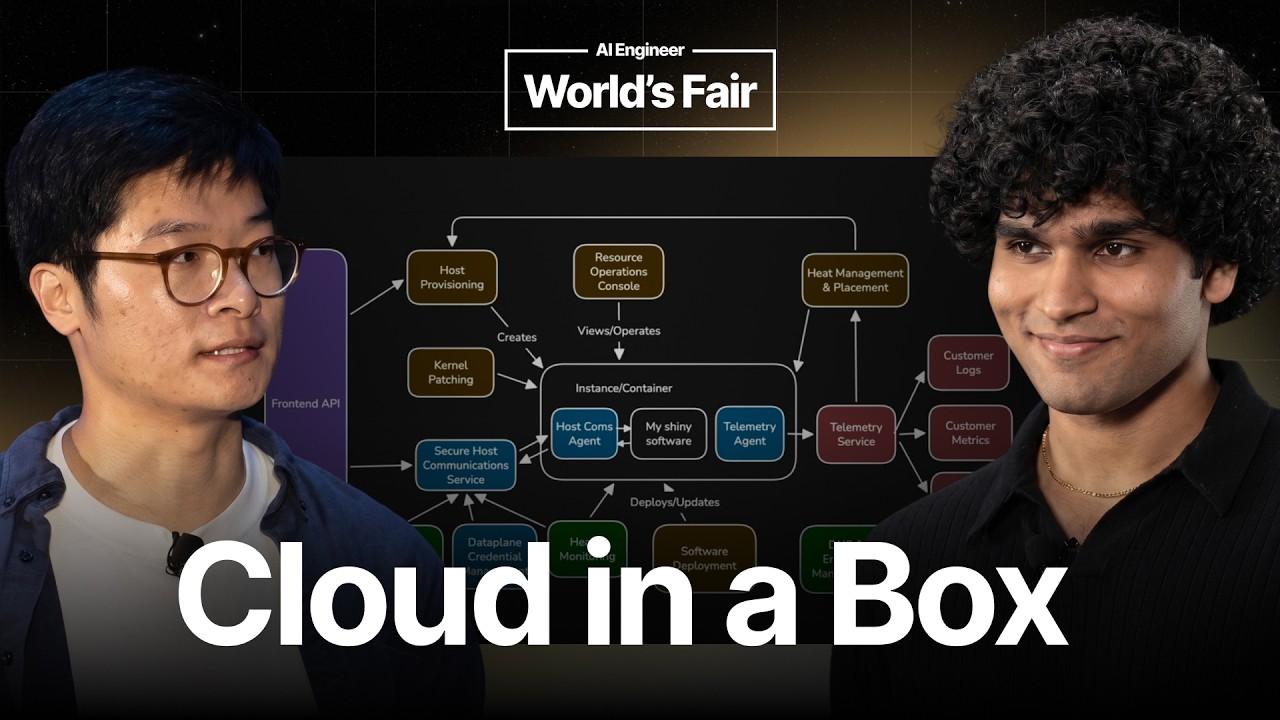
Emulated: The Data for Fully Autonomous Software Engineers and Companies — Joseph Wang
Jul 31, 2026 · 16:33
Joseph Wang and his co-founder Sid from Emulated argue that AI agents struggle with infrastructure work because training data misses the messy reality of production, so Emulated simulates entire companies inside sandboxes. Tasks run 50 to 100 turns, with live traffic, failing nodes, data corruption, clock skew, deployments, and customer conversations — not clean code diffs. They argue single-node sandboxes break down when provisioning real resources like VPCs, subnets, and security groups, and meeting bars for throttling, auth, and authorization, plus managing costs and gradual rollouts. Their goal is making agents own entire companies by emulating the real world at full fidelity; they start with infra because domain expertise improves data quality and infra's problem statements are clear.
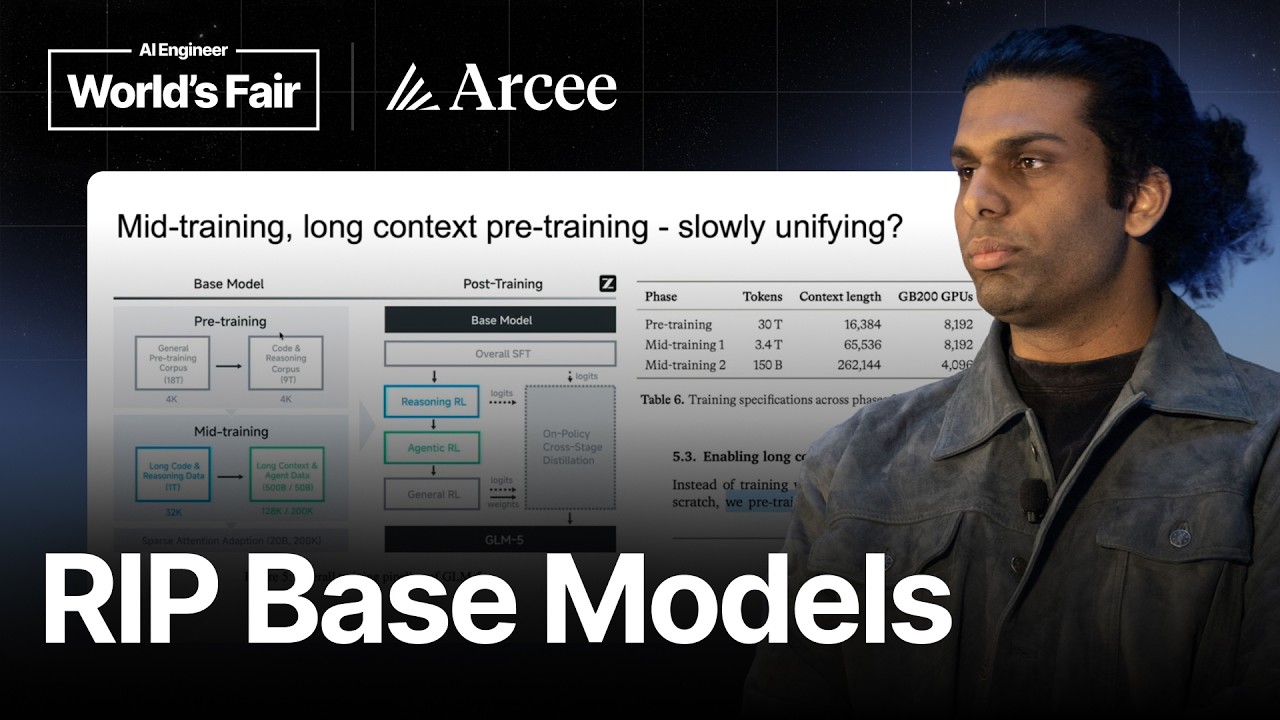
The Base Model Is Dead — Varun Singh, Arcee AI
Jul 31, 2026 · 17:45
Varun Singh, pre-training lead at Arcee AI, argues the base model is dead: it no longer just mirrors web text but must carry the prior that reinforcement learning builds on. He traces how web text fell from 85% of GPT-3's mix to 15% in MAI Thinking 1, with code and STEM dominating, and how Nemotron 3 Ultra pulls SFT-style Q&A data back into pre-training. Synthetic rephrasing, as used in Arcee's Trinity Large and Kimi K2, upsamples information to teach task shapes early. He warns that without post-training-flavored data early, MoE load balancing can break when SFT distributions differ, citing MAI's cranking of the balancing coefficient. He frames training as supervised learning vs RL, noting RL compute now rivals or exceeds pre-training, as with Compose 2.5, and argues the base model's job is to provide atomic skills for RL to compose.

Why Off-the-Shelf AI Doesn't Understand Money — Udi Menkes, Intuit
Jul 29, 2026 · 19:50
Udi Menkes, principal PM at Intuit, argues that off-the-shelf frontier models deliver a 'fluent bluff' when advising on money: advice that sounds right but is dangerous because models have read about money but lack experience. He shows a rental property example where a frontier model told a landlord in negative cash flow to acquire a second property, while a model grounded in real outcomes recommended raising rent 5-10%. Intuit's head-to-head test across 100,000 businesses found frontier models gave advice that would harm businesses 40% of the time, while a mid-sized grounded model outperformed them by training on millions of state-action-outcome records from QuickBooks data. A Princeton study confirmed frontier models given $1M went bankrupt within 500 days, while a simple rule-based system beat them. Menkes says the moat belongs to whoever owns the best system of context, and advises leaders to find verified outcomes in their own data to ground AI.

State of Data — Sean Cai, Independent / State of Data
Jul 26, 2026 · 18:22
Sean Cai argues data markets, not compute, are now the binding constraint for turning generalist AI into expert systems, with the supply chain unbundling from vertical giants into specialist vendors. He distinguishes Type I (real workflow capture) from contrived Type II data, noting the industry sells Type II as Type I. He introduces Verifier's Law—ease of training proportional to task verifiability—to predict domain maturity: code first, then biology, security, finance. He exposes benchmark psychosis: a single number under one scaffold is a noisy sample, requiring cross-harness differencing. Labs like Anthropic's data spending forecasts product launches (e.g., cybersecurity data in January led to Claude Cyber in March). Data companies like Mercor pivot to enterprise, and Cai builds Antikythera mechanisms to monetize real-world workflows and provide RL-as-a-service.

The Messy Reality of Scale: Synthetic Data and Pre-Training — Marah Abdin & Robert McHardy, poolside
Jul 26, 2026 · 17:31
Marah Abdin and Robert McHardy from poolside detail their synthetic data pipeline and pre-training tribulations at scale, culminating in a new 118-billion-parameter model for agentic coding that outperforms competitors. Marah describes using synthetic data to rephrase content and fill gaps, with a configurable pipeline (Hive) involving agents, orchestrators, and supervisors, covering rephrasing, multistage workflows, cross-domain porting, and multi-turn chats. Robert recounts failures like broken GPUs causing data corruption, a BF16 accumulation bug that stalled training, and a race condition in FP8 kernels silently corrupting 0.5% of gradients, all caught by model replica hashing. Their Laguna S model (118B total, 8B active) trained on 30 trillion tokens across 4,000 GPUs beats GLM 4.5 Air and other models on coding benchmarks like BigCodeBench and SpeedBench agentless, while remaining competitive on general knowledge.
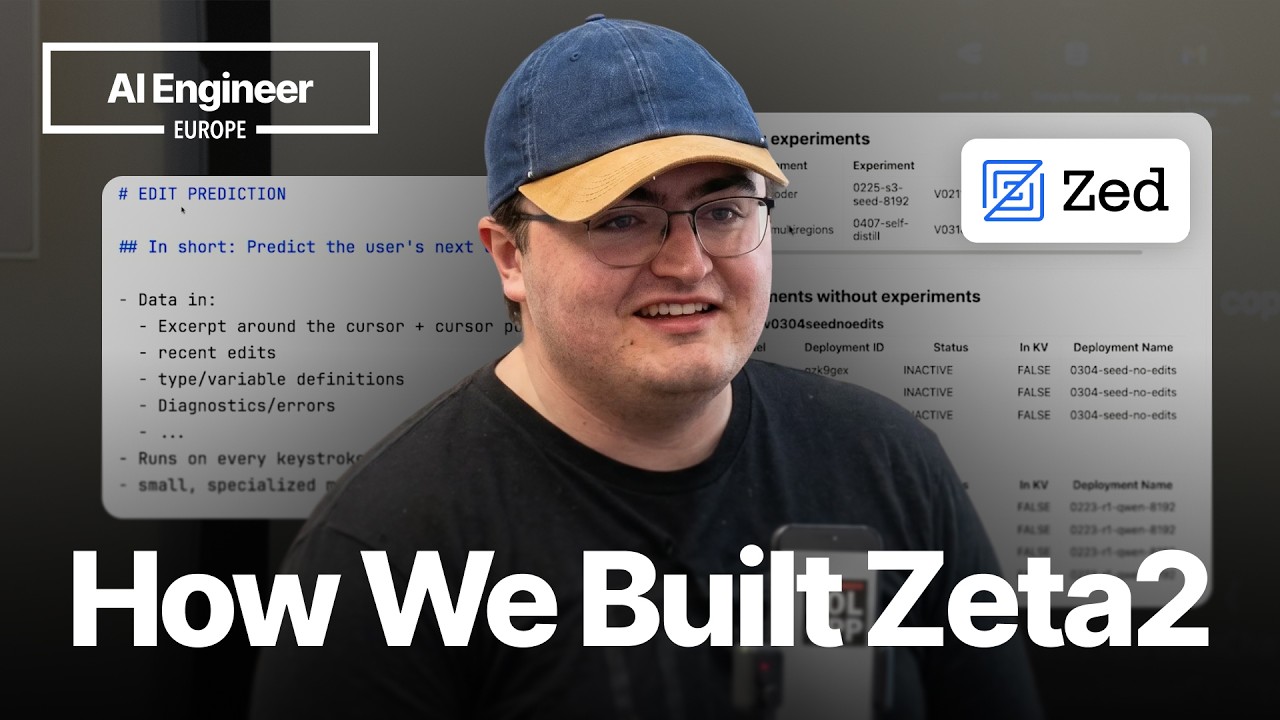
How We Built Zeta2: Training an Edit Prediction Model in Production — Ben Kunkle, Zed
May 30, 2026 · 10:50
Ben Kunkle, edit predictions lead at Zed, explains how they built Zeta2, a small specialized model for edit prediction in production. The pipeline pulls opt-in production edit traces, distills them through a frontier teacher, and routes bad predictions through a repair step before formatting for the student. To validate settled data, Zed originally ran 10 frontier model predictions per example and measured Levenshtein distance to the final state, but for 100,000 training examples that is a million frontier model requests — prohibitively expensive. The fix: Zeta2's student model now approaches teacher quality, so they run it 50 times instead at negligible cost. Ideal training examples sit in the middle of the Levenshtein distance distribution: too close to the settled state is obvious, too far is noise. A metric called reversal ratio — how often the model undoes exactly what the user just typed — was the key diagnostic for catching bad model behavior before shipping.

Z.ai GLM 4.6: What We Learned From 100 Million Open Source Downloads — Yuxuan Zhang, Z.ai
Nov 22, 2025 · 19:39
Yuxuan Zhang from zAI details the technical roadmap behind the GLM 4.6 open-source model series, which has surpassed 100 million downloads and tied for number one on the LMSYS Chatbot Arena alongside GPT-4o and Claude 3.5 Sonnet. The training pipeline uses 15 trillion tokens of pre-training data, followed by 7 trillion tokens of code and reasoning data, repo-level contexts at 32,000 tokens, and 100 billion tokens of long-context agent trajectories up to 128,000 tokens. Zhang introduces SLIME, a hybrid synchronous/asynchronous RL framework that decouples agent-environment interaction from GPU training to avoid bottlenecks. He explains why single-stage RL at 64,000 tokens outperforms multi-stage approaches for preserving long-context abilities, and shows that token-weighted loss converges faster than sequence-average loss for code RL. The multimodal GLM 4.5V model handles native resolution images and video with temporal index tokens, enabling GUI agent capabilities. Deployment is supported via vLLM and SGLang, with an API at z.ai and an open-source coding assistant.
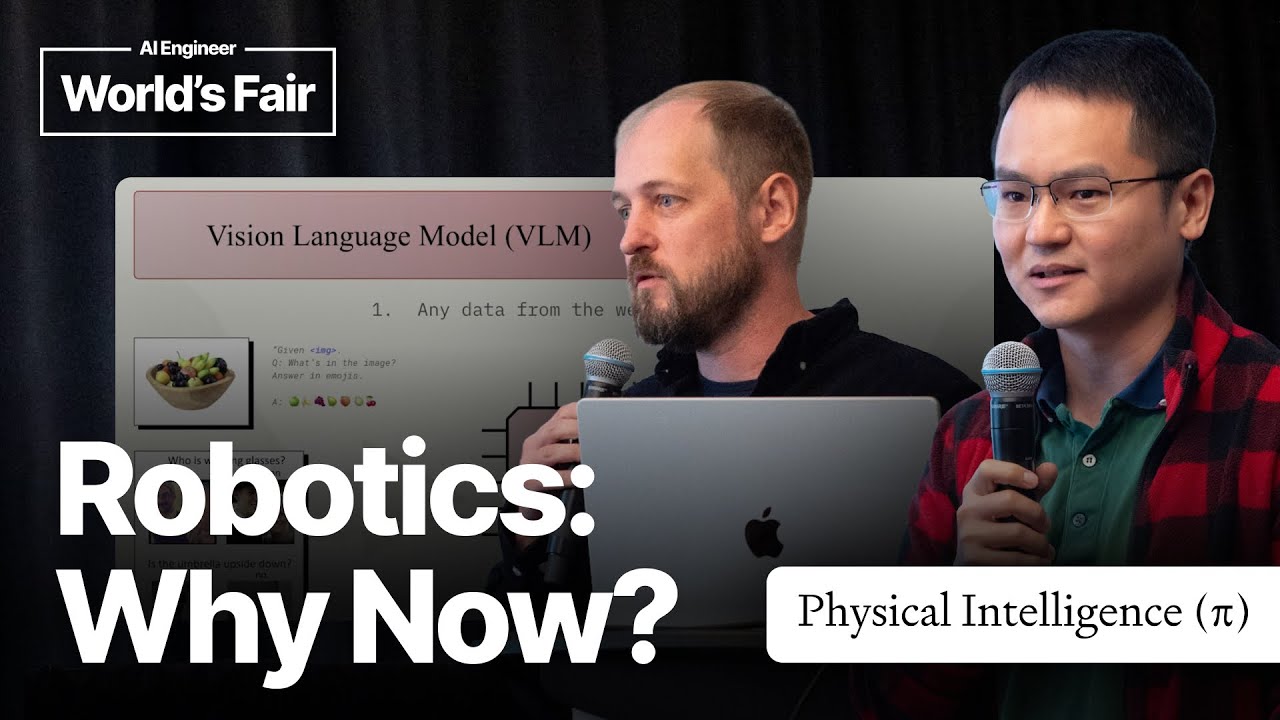
Robotics: why now? - Quan Vuong and Jost Tobias Springberg, Physical Intelligence
Jul 26, 2025 · 18:07
Physical Intelligence's Quan Vuong and Jost Tobias Springberg describe their mission to build a model that can control any robot to do any task, arguing that software intelligence is the main bottleneck in robotics. They explain Vision Language Action models (VLAs) as adaptations of vision language models that output robot actions instead of text. To train these models, they built a data engine from scratch, collecting 10,000 hours of successful episodes via teleoperation in six months. Their latest model, PAIO-5, achieves open-world generalization by training on data from multiple homes, matching or surpassing performance on held-out scenes. They demonstrate this with a policy that performs long-horizon tasks like cleaning an unseen bedroom for up to 10 minutes autonomously. They also highlight a remote coffee-making demonstration on a robot they never touched, showing model portability across hardware.
A Taxonomy for Next-gen Reasoning — Nathan Lambert, Allen Institute (AI2) & Interconnects.ai
Jul 19, 2025 · 19:21
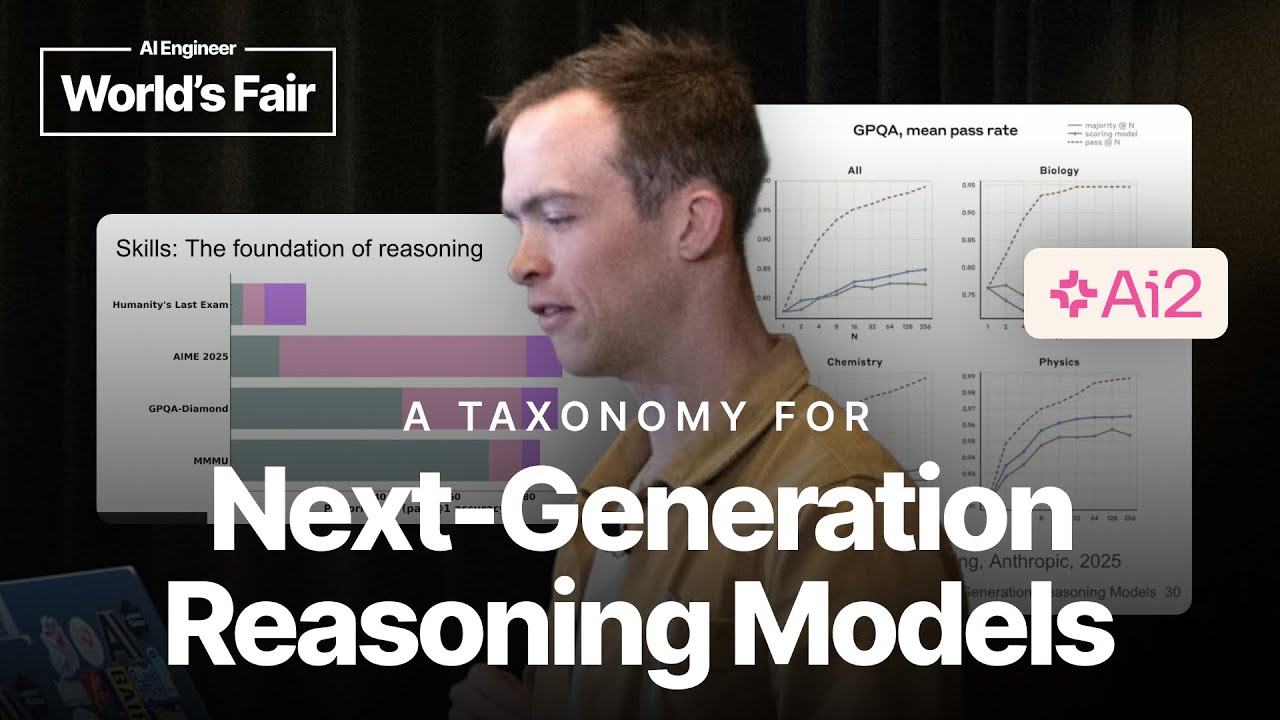
Nathan Lambert, senior research scientist at AI2 and founder of Interconnects.ai, argues that next-generation reasoning models require a taxonomy of four traits: skills, calibration, strategy, and abstraction. While current models excel at math and code (skills), they overthink easy problems, wasting tokens and latency—calibration is needed to match output length to task difficulty. The real frontier is planning: models must learn strategy (choosing the right direction) and abstraction (breaking problems into tractable sub-tasks) to enable long-horizon agents like Deep Research and Claude Code. Lambert traces how OpenAI's Q*→Strawberry→o1 took 12–18 months of human data to teach backtracking and verification; planning should be easier because humans can write 5-step plans. He predicts post-training compute could reach parity with pre-training, citing DeepSeek's shift from 0.18% post-training compute in V3 to an estimated 10–20% for R1. The path forward: collect diverse verifiable questions, filter by difficulty, run stable RL—then scale.

OpenThoughts: Data Recipes for Reasoning Models — Ryan Marten, Bespoke Labs
Jul 19, 2025 · 19:59
Ryan Marten, co-lead of the OpenThoughts collaboration and founding engineer at Bespoke Labs, reveals the missing data recipe for open-source reasoning models, presenting OpenThoughts 3, a state-of-the-art 7B reasoning dataset that outperforms DeepSeek R1 Qwen 7B and Nematron Nano on benchmarks like AIME, Live Code Bench, and GPQA Diamond. Through over 1,000 experiments and 5,000 datasets, key findings include that sampling multiple reasoning traces per question scales performance by 16x, Qwen 32B surpasses DeepSeek R1 as a teacher model, synthetic question generation is highly effective, and filtering by difficulty or response length works better than embeddings. Surprisingly, verification of answers in SFT distillation did not improve results, and focusing on fewer high-quality sources outperformed maximizing diversity. For domain-specific reasoning, Marten advises starting with the OpenThoughts recipe, using synthetic data generation (via the open-source Curator library), and rigorous evaluation (via EvalComet). A legal reasoning example shows that distillation can surpass the teacher model. All resources are open-source.

Training Albatross An Expert Finance LLM: Leo Pekelis
Feb 13, 2025 · 16:20
Leo Pekelis, chief scientist at Gradient, explains how they transformed an open-source model into Albatross, a finance LLM that tops leaderboards on both general and domain-specific tasks. The key was an automated data pipeline using membership inference to curate finance data from a massive corpus, followed by continual pre-training and alignment via supervised fine-tuning and preference optimization. He also details a one-million-token context extension on a Llama 3-based model that achieves 100% needle-in-the-haystack scores, enabling in-context learning with thousands of examples to reduce hallucinations. The models, v-alpha-tross and the extended-context Llama 3, are open-sourced on Hugging Face.

The GenAI Maturity Curve or You Probably Don't Need Fine Tuning: Kyle Corbitt
Feb 9, 2025 · 18:03
Kyle Corbitt, CEO of OpenPipe, argues that most teams don't yet need fine-tuning and should start with prompted models like GPT-4. He presents a GenAI maturity curve where the trigger to fine-tune is when you hit constraints on cost, latency, or quality consistency—for example, if GPT-4 is 80-90% correct but inconsistent on the last 10-20%. Fine-tuning shifts the paradigm frontier outward, enabling models like fine-tuned LLaMA 38B to outperform GPT-4 at 1/25th the cost. The process has four steps: capture production logs to know your input distribution, prepare high-quality data (using GPT-4 outputs or iterative labeling), train with one-click tools, and evaluate with inner-loop (LLM-as-judge) and outer-loop (business metrics) evals. OpenPipe and other providers make deployment trivial via OpenAI-compatible APIs. The talk delivers a concrete decision framework and a walkthrough so any engineer can fine-tune in under an hour.

LLM Quality Optimization Bootcamp: Thierry Moreau and Pedro Torruella
Feb 8, 2025 · 53:05
Thierry Moreau of OctoAI demonstrates how to fine-tune Llama 3 8B on a PII redaction task using OpenPipe and OctoAI, achieving 47% better accuracy and a 200x cost reduction (from $30 to $0.15 per million tokens) compared to GPT-4 Turbo. He explains that fine-tuning should follow prompt engineering and RAG, and works best for specialized tasks like function calling. The talk walks through building a fine-tuning dataset from the PI Masking 200k dataset, using OpenPipe to train a LoRA for $40, deploying it on OctoAI, and evaluating it to show the fine-tuned model scores 0.97 accuracy versus GPT-4’s 0.68. Moreau emphasizes that this continuous deployment cycle requires monitoring data drift and retraining, but tools like OpenPipe and OctoAI make it accessible even for teams without deep ML expertise.
The Hierarchy of Needs for Training Dataset Development: Chang She and Noah Shpak
Oct 15, 2024 · 16:32
Chang She (CEO of LanceDB) and Noah Shpak (AI data platform lead at Character AI) argue that data infrastructure is the critical bottleneck for LLM training, and LanceDB's columnar format solves the 'new cap theorem' for AI: needing fast scans, random access, and handling large multimodal blobs simultaneously. Noah explains how Character AI structures pre-training around wide domain coverage and post-training around granular analytics like token counts and difficulty scores, using synthetic data, quality scoring, and dataset selection to improve models. Chang details how Lance format provides zero-copy schema evolution, time travel, and indexing extensions for vector, scalar, and full-text search, enabling a single table to serve SQL analytics, PyTorch training, and production vector search. The episode emphasizes that speed and iterative dataset management are key to accelerating AI research, with LanceDB facilitating cheap random access and low-infra billion-scale vector search.
Domain adaptation and fine-tuning for domain-specific LLMs: Abi Aryan
Nov 14, 2023 · 25:09
Abi Aryan's talk covers domain adaptation and fine-tuning for large language models, contrasting prompting, RAGs, and three fine-tuning methods: adaptive, behavioral, and parameter-efficient. Adaptive fine-tuning adds small adapter modules (0.15% of parameters) for new domains like biochemical engineering; behavioral fine-tuning optimizes label space for a single task; and parameter-efficient methods like LoRA and QLoRA reduce model size via low-rank adaptation and four-bit precision, ideal for low-resource devices. Aryan emphasizes data quality—deduplication reduces memorization—and practical tips: batch size of 32 or 64, starting with 100 epochs, using Adam optimizer, gradient checkpointing for memory savings, and in-context learning with dynamic examples to handle drift. Evaluation should combine metric-based (Bleu, Rouge), tool-based (Weights & Biases), model-based, and human-in-the-loop approaches, though full pipeline considerations (data collection, base model choice, storage) are critical for robust applications.
Powered by PodHood