


Intro0:00
Hello. Allright, uh, let's get started. So, wel- welcome to the talk "Give the Agent a Budget, Not a Token." Um, quick intro about me: my name is Sachin, I'm an engineer on the CI team at Anthropic. We basically build and manage all of the test machinery for all the code that people write.
So everything from test quarantining to merge automation to CI autoscaling to merge queues, everything and anything in between. It's basically the plumbing that allows a few thousand engineers every day to ship code safely. I've been at the company for a little over 10 months.
I'm based out of Seattle, and outside of work I love dialing my espressos and climbing some crazy mountains. So, a lot of cool agent demos. They start with the same way, really. So someone gives an agent a god token and gives it access to some sort of tool list and just watches it go.
And it does go. Like, in this particular example, it'll spin up like a cute little coffee website. It'll build all the pages, deploy them, bring it up live, and it's done in 3 seconds. People will nod, people will clap, and someone will ship it into production.
And this talk is basically about what happens after that, after the demo ships, once the agent is starting to do some, like, real work in production. So here's what "after" looked like in one of our scenarios. So what you're looking at is like a real command.
The agent was trying to clean up after itself. It was basically listing a bunch of workloads that were no longer interesting or useful to itself, and then it found them and deleted them. Now, that's completely reasonable, except one stage in the pipeline basically evaluated to nothing, and the filter dropped out, and now the selector matched everything.
The incident1:35
So you can see it took out about 200 workloads, which ended up impacting about 20 engineers' worth of stuff, and all of that was gone in 90 seconds. Nobody was being malicious in this case. Like, the agent genuinely thought it was tidying up after itself.
Some of these workloads were long-running training jobs and stuff. Maybe some of these were not even checkpointed. And it was just, like, hours of progress that was gone, poof, in, like, 90 seconds and stuff,right? The problem in this case is that this idea of, like, "Here's a token and here's a tool list," that is just, like, not enough.
Like, it just doesn't scale when the agent is starting to do some, like, real work in production.
So here's just a brief summary of, like, what we're going to talk about today. I'm going to walk through three primitives and asymmetric verbs. We're going to look at some, like, rate limits. We're going to look at this idea of, like, trip wires over allow lists.
And then I'm going to talk about this one lens that which I call the undo test that you can sort of use to size up the other three primitives. So three things that you basically enforce, and then one question you sort of ask about all of them.
So here's basically what bugged me after the cleanup was done for the incident that I was just showing you. The agent technically hadn't done anything that I couldn't have done. It was using my token after all. The failure wasn't the model itself.
Token vs budget3:07
The failure was that I was giving the agent unbounded amount of power to do something that I wasn't watching super intently. And it was we basically solved this same kind of problem, except not for agents, but, like, the first time you onboarded, like, a junior engineer onto your own teams,right?
So just think about it. Like, we don't basically sit around watching every engineer or newboarded person just, like, type out every keystroke on their keyboard,right? Like, we're not behind their chairs just watching everything that they're doing. There is always a path on whenever a new engineer wants to ask for something.
There is always an escalation path. The catastrophic stuff is just structurally out of reach for them. So the other side of the coin is that the agents are very different. They never get tired. They never sleep. And every so often they're just, like, very confidently wrong.
And if I'm being honest, that's maybe most of us on the first month of our job anyways. And so what we're going to talk about in a little bit is just this idea of, like, your onboarding checklist, but written down as policy for agents.
So that and that brings me to the word in the title of my talk here, is that the standard fix for an incident like that is basically that you narrow the token scope,right? Like, you just take the deletes away, effectively.
You would technically never do that for, like, a new hire,right? Like, you wouldn't take the whole verb away from them. And it also doesn't work for an agent either. Maybe it works for about a week, maybe two, but then you eventually end up in a situation where the agent is genuinely trying to delete something that it feels like is just not in the infrastructure, and you will just be there sitting and pressing enter by hand all over again.
The core concept with the token that I feel like is wrong is that a token is a boolean. It's just a yes or no. It's a static list of scopes. You either have it or you don't have it.
So if the token list is too tight, then your agent is effectively useless. If the token list is too wide, then you're maybe writing, like, a postmortem. A budget is a very different shape. A budget is not just, like, one number.
It just has, like, four different dimensions,right? How much can the agent do? How fast can it do it? What can it undo on its own? And then who's noticing while it's actually taking those actions? And that's roughly the umbrella for, like, my four primitives, is that each of the things that follow, they're basically being one of the things along these dimensions, and they're going to replace a yes or no question with a budget.
So I'm going to start off with this first verb, which I call asymmetric verbs. And by verbs I simply mean operations or actions that an agent can take. So, like, it could be API calls, it could be CLI commands, it could be really anything.
Asymmetric verbs5:48
And they're asymmetric because the same sized action, even though it looks same size, they can have very different blast radius in actuality, depending on which direction it goes. So the core point is that you need to stop thinking about resources for a second and think about verbs.
So specifically, think about what happens when one of the verbs goes wrong. So some verbs, they fail out loud. So in this particular example, let's say if an agent decides to unskip a test and say it's the wrong call, the worst that would happen is CI would go red for a bunch of people.
Same with paging. Like, if an agent decides to page a human and if it's the wrong call, the worst that's happening is that it's a nuisance for the on-call, but there is always a human to correct it. There are other verbs that fail silently,right?
So if the agent decides to skip a test due to whatever reason it shouldn't have, nothing technically turns red. A real bug can actually walk into production with green checks, and nobody would notice it until much later. So unskip and skip, in this example, they're effectively they're the same kind of action, but the difference is which of the failures would show up on a dashboard and which one wouldn't.
And so the core idea is that you give access to verbs that can fail out loudly on a dashboard to your agent, and for the other ones, just involve a human.
Just a bit of context on CI stuff and how this plays out for us is that we have a test quarantining service behind the scenes, and it basically holds a list of all the tests that are currently skipped because an on-call decided that it had to they had to, like, break glass in a certain situation whenever there was, like, an incident or something.
Now, the agent has the ability to re-enable any one of these owned, depending on, like, when it evaluates when the tests are working fine and stuff. Again, if it's the wrong call, the worst that would happen is a bunch of different builds and tests would just, like, start showing up red, and then a human can actually put them back very cheaply.
The skip is a break glass verb itself,right? Like, it's basically, as I mentioned, what our on-call would reach for during a very critical situation, during under pressure and stuff. And so in that scenario, if, like, an agent actually gets it wrong, a real production bug can actually a real bug can walk into production.
So this needs a human, and it will always leave an audit trail. And the key detail is that the agent itself is not responsible for writing the row or the audit trail itself. There is a proxy in the middle that I've highlighted that I'm going to talk about in a little bit, which is responsible for stamping the caller's main identity on every call, whether it's a skip or an unskip.
Rate limits8:21
The agent technically never holds the pen on its own provenance. The second primitive is about rate limits. It's a pretty standard concept, but and this is the most concrete form of, like, the budget idea as a whole. So a ceiling that refills.
So every caller gets a small amount of disruptive actions per time window, so you can spend them however you want. There's no approval, there's no waiting. And if you cross the line, the request simply bounces back with a count saying that you're actually exceeding your count, your budget.
You wait a bit, and then the limit essentially refills. And that's the whole thing. So the agent gets full autonomy within the limit, and there is a hard ceiling on how bad a single loop can get. And every write effectively gets a rate limit.
There are no exceptions to that. What changes is the size of the rate limit. So if I'm trying to delete a bunch of workloads in my own namespace, like, my rate limit might be higher. But if I'm trying to touch resources in a shared namespace, my budget or my rate limits might be smaller.
So this is effectively the solution for the incident that I was showing earlier. After the incident, the team sort of that sits next to mine, they built an admission webhook of sorts, whose sole job is to cap the number of deletes at a fixed number per hour, per resource kind, per namespace.
There is always a bypass flag because sometimes you genuinely want to delete more than you're allowed for in maybe some on-call scenario or whatever. And the part that I absolutely love in this case is that inside a cloud code session or inside an agent session, effectively, the bypass flag simply refuses to do anything.
All it's going to do is tell the agent to ask the human to run the command itself. So the agent effectively gets the rate limit, and the human keeps the override, and nobody effectively has to file a ticket for the limit because it just, like, refills.
The third primitive is about this concept of trip wires over allow lists. So in my mind, like, an allow list is effectively a guess that you're making up front about what the agent needs or about model behavior or agent behavior itself.
Trip wires10:06
I feel like it's pretty static, and you write it up front before you have any data on, like, how the agent is behaving in different situations. A trip wire, on the other hand, is how you get that data, like, after the fact.
So for cheap actions, you let the agent act, and every action gets recorded with the actor sort of stamp, identity stamp. And these two kind of go well together. Like, rate limits are the enforcement. They put a hard limit on the rate itself.
Trip wires are how you find out what actually happened so you've got something to react to. So you effectively watch the aggregate and not, like, individual calls. And usually when a trip wire goes off, the fix is, like, maybe one or two lines in the agent's context and not really a big code change.
The core point is that allow lists don't really get better over time. They can get stale, but trip wires do get better over time. So here's, like, a loop in practice for us. So, like, we track one number, which is the number of investigation threads that our agent is launching per hour for a given test job failure.
So one morning, say the number was way above the baseline, and the trip wire pages on-call. And that part's important because a trip wire that nobody sees is practically useless. It pages after the write has already happened, after the limit has been crossed, not before.
It's effectively the smoke detector, not the lock on the door. The agent has spun up, in this particular scenario, a bunch of, like, investigation threads for dozens of jobs that were all failing with the same kind of error signature.
Each thread effectively looked reasonable on its own, but, like, if you took them in aggregate, you would realize that it was actually an infrastructure failure that was causing the same test failure signatures across the board. So the fix in this case was as simply as telling the agent on, like, hey, the next time you encounter something like this, maybe try to correlate a bunch of different failures and test jobs and stuff before launching a separate investigation thread.
So that correlation is important. And the next time when this happened, it did exactly that because that example and that line of, like, how it should react and, like, how it should, like, debug things wasright there to guide it.
So that's three rough primitives. Now, the lens I mentioned at the start is this idea of undo test. And this one's slightly different. It's not something you effectively enforce in code. It's the question you ask when you're sizing the other three.
Undo test12:13
So it's two questions, really. One, can the agent put it back by itself? And how bad would the impact be if it actually got it wrong? And this sounds like asymmetric verbs in a sense, but it's kind of different because the verbs ask whether you would notice the failure, and undo asks whether you can recover from it.
So if the agent can effectively roll back its own change and the blast radius is acceptable to you, you effectively log it and you let it go. If either of the answers is no, then you effectively need a second key.
And the second key is not something that the agent holds itself. It has to be someone else. And there has to be an audit record so that you can track on, like, what happened, why the second key was involved, and stuff like that.
Let me just show you this another example of, like, how this works outside of, like, the CI domain specifically. So our agent has a key for one of our feature flag services. So on the canary side, which is basically our staging traffic and a bunch of, like, dog pooding customers, the agent effectively has the full dial.
Feature flags13:08
It has the ability to ramp up a specific feature flag, roll it out to all of the canary traffic, and it can take it all the way from 0 to 100. And it also has the ability to sort of look at any bugs that are being filed and toggle it back off and on.
What the agent's key is not scoped to do is for promoting the flag to real production. The best an agent can do for now, in a lot of cases, is that it can propose that someone actually promote the feature flag in production because it's been tested out in canary.
But that's pretty much it. The second key in this scenario is not necessarily a new auth system. It's a scoped key for production and a scoped key for canary.
So this is what it looks like day to day for me personally. It's like, I ask Claude Tag in our Slack channel to own the entire loop on rolling out a flag. It can basically ask me a clarifying question on whether this is for internal dog pooding group or early access or whatever.
And the important part is that I'm not in the middle of any of these things. Every action that the agent is taking is stamped with its own identity and not mine. And that stamp is basically what ties the whole thing together.
So these primitives, they compose together nicely because each one asks a different question,right? The verbs ask what the agent is touching. The rate limit asks how often. And the trip wires catch what happened afterwards. And the undo test is sort of the lens that I personally use to size all these three.
Now, the original sort of cold open delete that I was showing you, the incident itself, the rate limit itself would have capped it at a few couple of tens of workloads itself. The undo test, if you would be thinking about it, it would basically tell you that you can't undelete a running job in someone else's namespace.
So anything past the cap basically needs a human with the second key. So the important part is that you don't need all the checks in every write scenario. Only some of these might be relevant for, like, whatever kind of action you're trying to evaluate.
And if any of these really sound familiar, it should, because this is effectively some sort of onboarding checklist for your engineers. Like, what can a new engineer touch? How much rope do they get? Who signs off on their operations?
And how do we know it's effectively working? We just wrote it for people. It's now the same checklist that we want for agents.
So where does all the policy that I've been talking about really live? It's two places, and I feel like you need both. The first one is text. That's prompts. That's your context files marked down the agent reads before it can act.
Text and infra15:31
And this is where you can explain your why, the intent. We got exactly the same sentence that I was showing earlier written down in a markdown file. It works about 80% of the time. The upside is that it's very cheap to change, and you can explain the reasoning.
The downside is you have to garden it because the files can grow over time. And at the end of the day, it's just advice. Text can shape the intent, but there is no enforcement anywhere. The second place is infrastructure, which is the proxy layer for us.
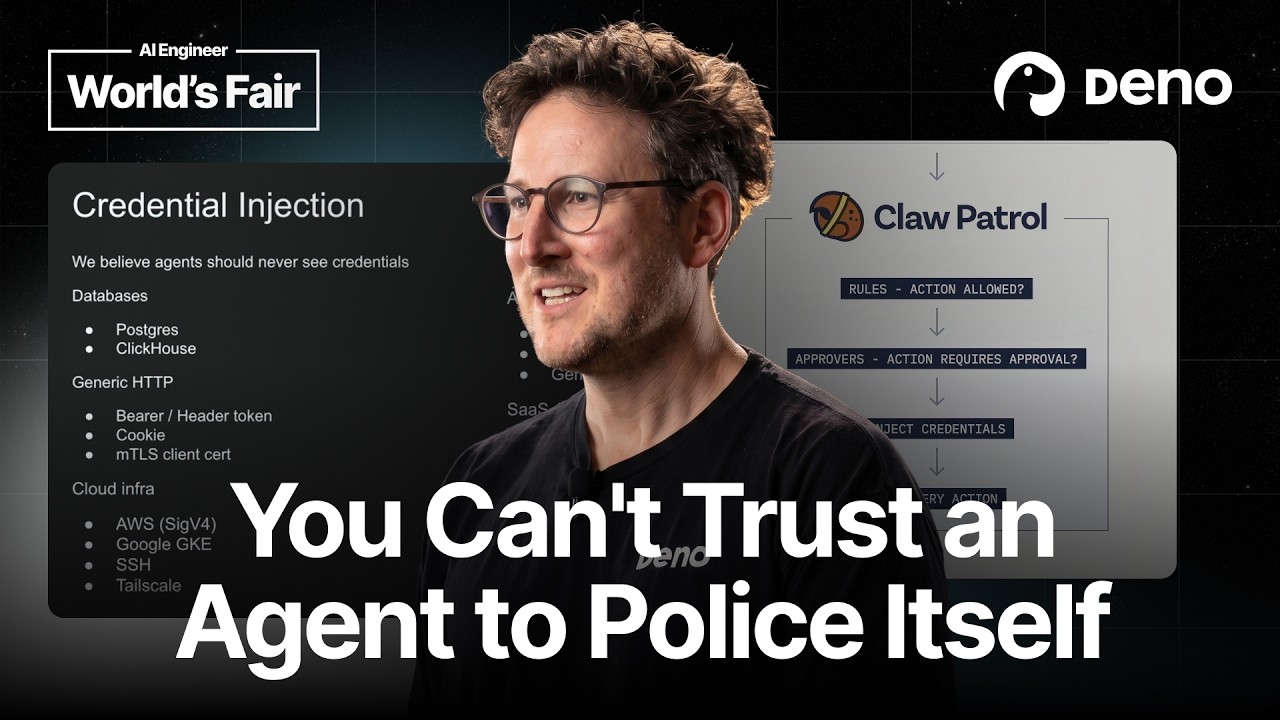
So the proxy is not reading the prompt. It doesn't know why the agent wants to do something, and it doesn't really care. It will see a delete happening. It will see, like, a budget being crossed, and it will simply return a 403, and that's the whole conversation, really.
It's narrow. It's deterministic. It counts, compares. It can allow or delete or deny. What it can't do is explain the why. And a clever, like, prompt injection cannot really talk it out of the rule itself. So you need both.
The text shapes what an agent is trying to do, and infra is bounding how wrong can it go.
So zooming out, this is where the infrastructure sort of really lives for us. So, like, every agent session has its own proxy runningright next to it. The agent starts off by reading its own context file, the markdown files that I was showing earlier.
Proxy layer16:43
That's the text layer. And every outbound call goes through the proxy after that point, which is the infrastructure layer. So the proxy is not, like, whatever the agent is trying to do. The proxy is only responsible for stamping that action with the agent's identity.
Like, if the agent is trying to launch a bunch of jobs in a Kubernetes cluster, the proxy is not following it. What is following it is the stamp itself, the identity itself. So in this example, the cluster would write the stamp onto the job as a label.
And every child job or anything that's happening afterwards simply inherits the same identity. And every safeguard that is there in the rest of our systems, they are simply reading that, like, one label. Whether it's ownership, whether it's quotas, rate limits, approvals, trip wires, whatever it is, they're all keyed on the same stamp, and the agent never got to touch it.
So that's roughly the shape of it. But before I wrap up, I want to spend, like, 30 seconds on why it has to be a proxy layer, like, a different layer that is doing the stamping on this identity and not the caller itself.
Identity17:44
Because without it, the agent can roughly pick a different name, and every limit that you've basically set resets. So say the agent has the ability to set its own identity in a header,right? So let's say it hits a specific limit.
And what's the easiest fix from an agent's point of view that it can do? Like, it'll just change the header. In this case, it'll just say instead of Sachin, Sachin 2. And voila, you just have a fresh budget to work with.
Now, in this case, you technically don't have a rate limit. You just have a suggestion. With the proxy in the path, the agent never gets to say who it is. The proxy already knows. It's the thing that's holding real credentials, and it stamps every call with the identity that it already knows, not the one that the agent claims.
And because proxy is the one that is stamping, you also get this per-session ID so that you're able to differentiate different sessions that are running all for you and see which one's overreacting or which one's not acting as it's supposed to be.
So again, just stuff that I want you to take home with is give the agent access to verbs that would fail out loud and keep the human on the ones that can fail out quietly. Two, you put a ceiling on every write, and that has the ability to refill on its own so nobody's effectively filing tickets.
Recap18:50
Three, you watch the aggregate and not the individual calls. That helps you understand the agent's behavior. And then you fix whatever you can with a sentence. And four, you use the undo test to sort of size all of these three or any other primitives that you have for your own write operations.
And underneath all of this is this concept of identity, which has to come from the infrastructure, not from the request. I feel like that's one rule. If you get that one ruleright, everything else is just tuning. Thank you.