
Product & Strategy
Episodes from AI Engineer about Product & Strategy.
152 episodes

The Signal Layer: What to Build When Anything Can Be Built — Lena Hall, Akamai
Aug 29, 2026 · 19:44
Lena Hall of Akamai says when AI lets everyone build anything, the scarce skill is choosing what to point it at and keeping it undistorted — a 'signal layer' — since competitors get the same leverage the same morning. She calls AI a 'convergence machine' that makes average work worthless, and rejects taste as a trainable differentiator; what survives is judgment about events not yet happened and relationships models can't observe. Citing Hamming, she says AI gave everyone an attack on every problem, making the rare skill choosing which problem deserves one. Signal distorts via founders compressing context, org layers rerounding to average, and AI remixing claims into promises — a 94% eval became a promise. Trust has no grader; define and protect your signal and use AI for the rest.

From Tokenmaxxing to Trusted Throughput — Mingsheng Hong, Ironclad
Aug 29, 2026 · 23:04
Mingsheng Hong, VP of Engineering focused on AI at Ironclad, argues token dashboards are smoke detectors, not leaderboards, and the goal is trusted throughput—merged, customer-validated PRs weighted by complexity—not token minimization. Don't cut cost before measuring value; Ironclad's metric evolved from lines of code to open PRs to merged PRs to merges weighted by an LLM-assigned complexity score, because a ten-line concurrency fix beats boilerplate. He identifies review and CI as new bottlenecks, where slow pipelines encourage giant batched PRs; he recommends AI as first-pass reviewer, killing flaky tests, capping agent retry loops, and measuring ready-to-merged time. He advises prompt caching, context pruning, and buying infrastructure while building context-specific playbooks in-house.

The Half Life of Agent Infrastructure — Ben Kus, Box
Aug 29, 2026 · 19:26
Ben Kus, CTO of Box, explains why AI agent infrastructure has a half-life of months, not the three-to-five years typical of enterprise software. He retracts his own graph-based agent approach from last year's talk, and recounts asking an engineer to rebuild working agentic search twice in quick succession. At Box's scale — over an exabyte of data and around a trillion tokens — models, agent design, and retrieval have each shifted repeatedly. His advice: prepare teams to expect change, build abstractions that let underlying layers be swapped, and switch only when eval sets show measurable gains in cost, speed, quality, or capability. Box now reviews every AI technology on a six-month clock, and he suggests judging vendors by how well they handled past changes.

Which AI startups actually land enterprise contracts? — Brian Lewis, Millennium
Aug 29, 2026 · 18:45
Brian Lewis of Millennium, a hedge fund, explains why only ~5% of AI vendor demo calls end in signed contracts: on the buying side, 10-15 startups per pain point become two or three demos, zero or one pilot, and one contract per four pilots. He catalogs failures—a vendor asking customers to self-report gateway telemetry so it could charge margin on traffic it never carried, a 'zero retention' vendor revealing data it shouldn't have, betas engineered around permissive retention, and a core API down for hours on a trading day. His larger claim: 60% of becoming AI-native is unsexy work—entitlements, integration, change management—and agents inherit whatever foundations you have, so fix the boring 60% first. He advises startups to treat Millennium-grade security and ops as the bar.

How do you diffuse AI into the real world? — Varun Shenoy, Long Lake
Aug 28, 2026 · 17:46
Varun Shenoy, co-founder of Long Lake, argues that AI diffusion into real-world services requires operator-owners, not vendors, and explains how his firm buys and runs 35 services businesses — including a $6.3 billion take-private of American Express Global Business Travel — to make agents complete economically relevant tasks. He frames adoption as a generational shift like electricity, and details a ladder from copilots to async agents to AI coworkers, earned by proving value. Long Lake represents knowledge work as code, captures traces and ground truth from work like roof repairs and book closing to build evals, and treats continual learning and enablement as one snowball loop. He concludes that co-designing software with a 100-year-old firm cannot happen over Zoom; it requires showing up in person, running conference stands, and asking questions on a mountain bike.

How Anthropic Builds: Lessons from Labs — Mike Krieger, Anthropic
Aug 27, 2026 · 26:11
Instagram co-founder Mike Krieger, now an individual contributor at Anthropic's Labs, argues for being 'unreasonable' with Claude—he had it port a few hundred thousand lines of Python to TypeScript over a weekend. He attributes timid asks to first-gen AI's boxed tools; cites Instagram-era habits (pre-measure everything, knobs); and explains tagging Claude in Slack as multiplayer delegation. Labs runs two-week 'persevere or pivot' reviews, bet leads manage nobody, and code review is bottlenecked by comprehension, so 2,000-line PRs travel with artifacts explaining intent and tradeoffs. He also sketches Claude Design's future, urges unship of product complexity, and advises startups to bet on verticals like finance. On burnout: no job is so important you cannot be offline for two days.

How AI Agents Let GTM Teams Scale — Justin Joyce, Cloudflare
Aug 26, 2026 · 19:15
Cloudflare principal sales operations manager Justin Joyce argues traditional go-to-market does not scale, so his team built a three-pillar agentic system on Cloudflare Workers and Durable Objects. To scale analysis, role-specific skill files let non-SQL users query data, cutting two-hour analyses to five minutes. To scale insight, weekly summaries are drafted by one agent, verified by a second, and toned by a third, tested on every run for two to three months. For self-service, Cloudflare OS gives reps forecast briefs, QBR decks, account plans and renewal prep with centrally curated expert skills. The result is 2X efficiency, with harder problems ahead in quoting, approvals and CRM writes.
Knowledge Systems: The New GTM Stack — Jeffrey Wang, Exa
Aug 26, 2026 · 18:49
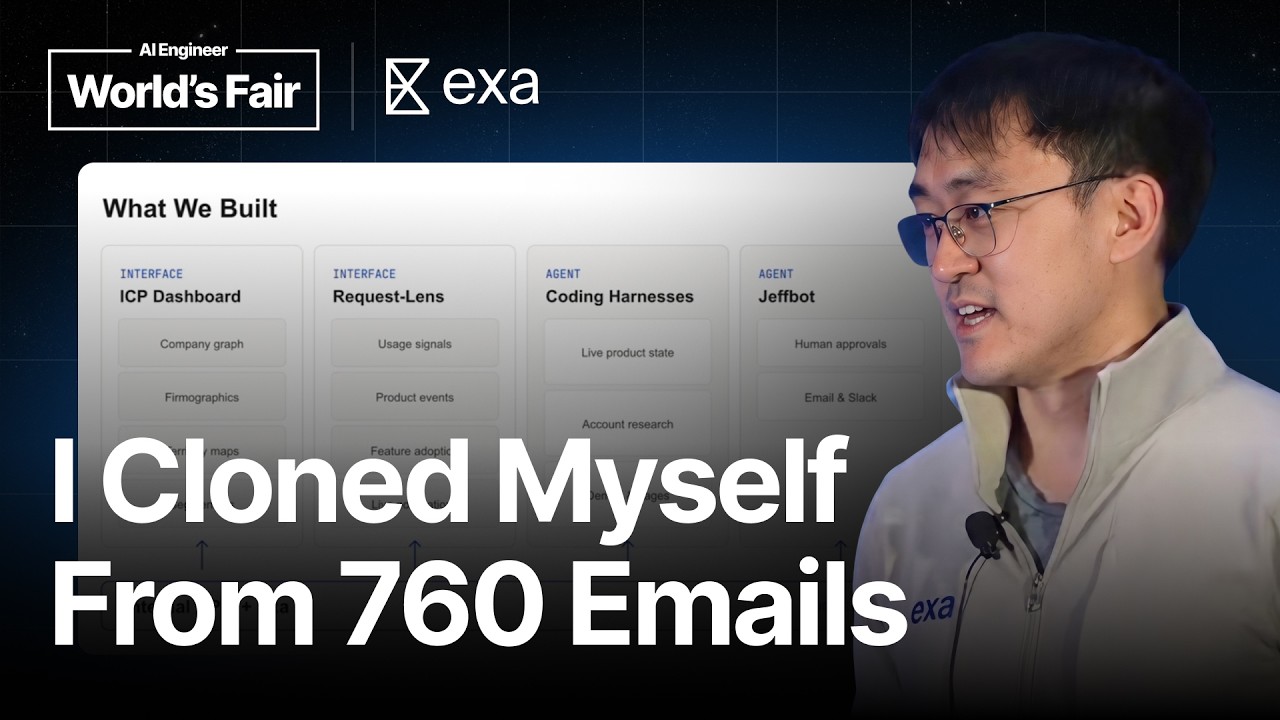
Jeffrey Wang, cofounder of Exa, argues go-to-market is an AI engineering problem and details Exa's stack: an ICP dashboard classifying nearly every company in its addressable market with anticipated spend, and Request Lens alerting on meaningful customer events. The team runs about a dozen Slack agents plus Jeffbot, an AI clone of Wang trained on 760 emails—he averages 18 words and signs 'best' not 'sincerely'—and limited to drafts when others use it. He closes on three principles: agent-first means API-first, not everything should be a chatbot, and buy-versus-build is false—Salesforce exposed as MCP is arbitrarily customizable. He also notes an eight- or nine-person FDE org runs deals and builds the sales systems.

Building GTM AI Agents: Lessons from Deploying to 6,000 Users — Sait Izmit, Snowflake
Aug 26, 2026 · 20:39
Sait Izmit of Snowflake says winning over 6,000 go-to-market users comes down to quality over coverage: he wrote 150 sales questions before testing, accepted 50% first accuracy, and chose 50 questions at 95% over 100 at 70%. The Snowflake Cowork agent, live since September, has answered over a million questions (~40,000 weekly); 60% of data arrived post-launch, and it now spans 15 semantic views, 85 tables, 3,000 columns, MCPs, and 20 skills. After pilot and a 600-user 10% beta with 70% retention, GA showed only 20% of the org tried it, so Izmit spends 60-70% of his time on demos and sales meetings. He warns the wow factor collapses quickly, so teams must move from data chat to workflow automation, build fast with today's stack, accept rearchitecture, and mine logs for feedback loops.

The Building Blocks of GTM Orchestration — Arman Vaziri, Ramp
Aug 26, 2026 · 19:55
Arman Vaziri, who leads product and sales led growth engineering at Ramp, details go-to-market orchestration: an intent — offering Pro V1 golf balls to golfers at East Coast construction companies — becomes targeted outbound, paid creative, landing page and in-app nudges. He argues the bottleneck was never ideas but messy data, rep busy work, and coordination cost; Ramp's answer was an internal CDP on Kafka and Postgres, plus embedded unstructured data for search. Pre-meeting briefs for account managers map attendee emails to accounts and run as durable Temporal threads; a skill library for custom brief formats drove adoption. For smaller teams, build narrow automations first — three years ago two people used GPT-3.5 for outbound — because nobody gets a year to design a perfect architecture.
AI in GTM at Notion — Flora Liu
Aug 26, 2026 · 21:15
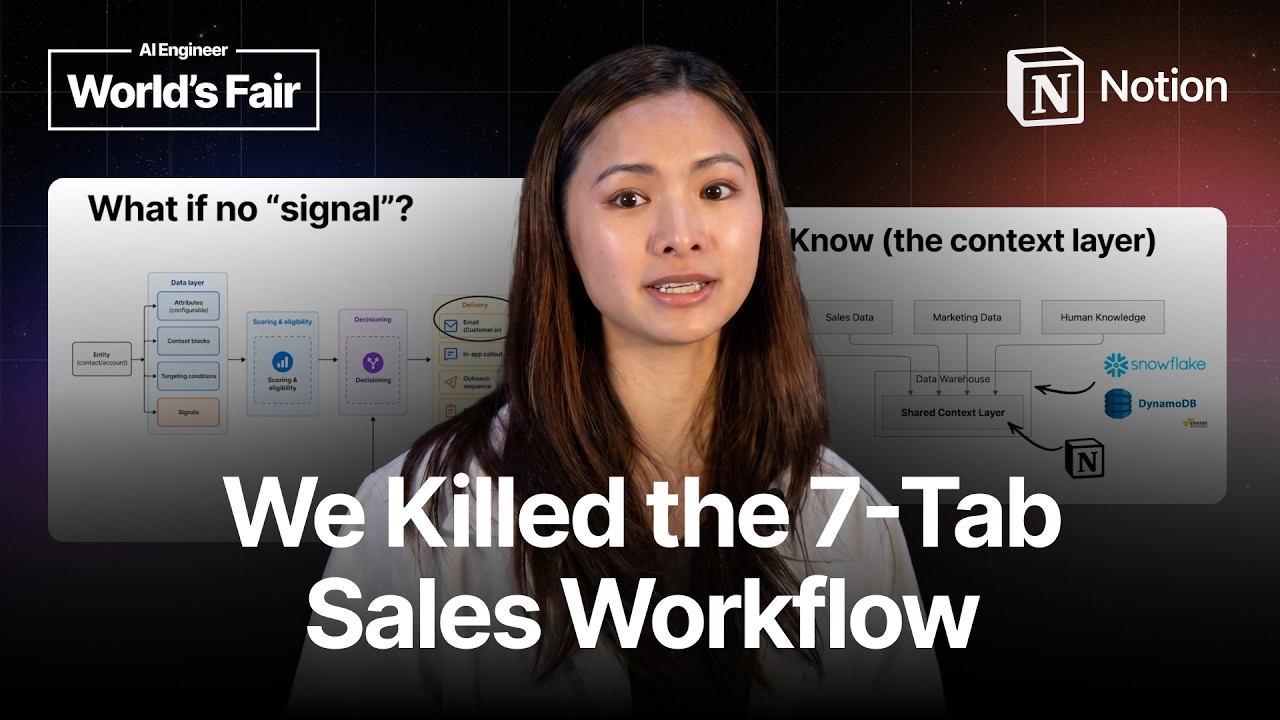
Flora Liu, an engineer on Notion's GTM team, argues GTM is now a distributed systems problem, not marketing ops, and details how Notion built a unified decisioning system across self-serve and sales-assist. Workflows reduce to four questions — what do we know, what should happen next, how to execute safely, did it work — built as Know, Decide, Act, Learn layers. Snowflake computes the profile, DynamoDB serves it in milliseconds, and Notion is the substrate where humans and agents operate on the same context; signals become Temporal workflows. Agents research and draft, humans approve customer actions, and contact-sales forms are untrusted input. After 13 weeks, enterprise reps log more qualified opportunities, and context-aware recommendations made users 63% more likely to take next step.

Reverse-Engineering the AI Buyer — Aliisa Rosenthal, Acrew Capital
Aug 26, 2026 · 19:10
Aliisa Rosenthal, who helped take OpenAI's enterprise business from a couple million to several billion in revenue, argues founders should build the automated sales machine before hiring humans. ChatGPT launched with no enterprise features; nine months later they shipped an expensive product, but self-serve cannibalized it four months on. Advice: capture phone numbers at signup, reply to every inbound (10,000 a day), never give buyers homework, avoid pilots via reference calls, data evals, or 90-day opt-outs. $60 per user per month was too high; a low base fee plus usage spread. Automate security, don't pull up-market, hire AI-native sellers when buyers need contact, and use forward deployed engineers sparingly—scarce but sticky. First 10 customers should be handpicked design partners, and POCs aren't self-serve.

Coding Agents Don't Scale Themselves. Neither Do Your Teams. — Patrick Debois, Tessl
Aug 22, 2026 · 22:06
Patrick Debois of Tessl argues that the 'dark factory' of autonomous coding agents won't work in most organizations because teams and platforms aren't set up for it, not because the technology fails. Developers who rebelled at 'writing better prompts' re-engaged once tooling opened a technical path; skeptics are ideal for context authoring, and retros target repeated agent failures, not code. Planning splits into well-scoped agent tasks and conversational human work; Debois tracks two metrics: human touches per result (down) and shared fixes that help everyone, not one 10x person. Platform teams must own paved roads, registries, eval systems, and spend visibility; that's the shift from solo developer to multiplayer system, and hiring tests AI leverage, engineering taste, and collaboration.
Preferences Over Benchmarks: Model Routing — Archana Kamath & Tyler Gillam, DigitalOcean
Aug 22, 2026 · 15:54
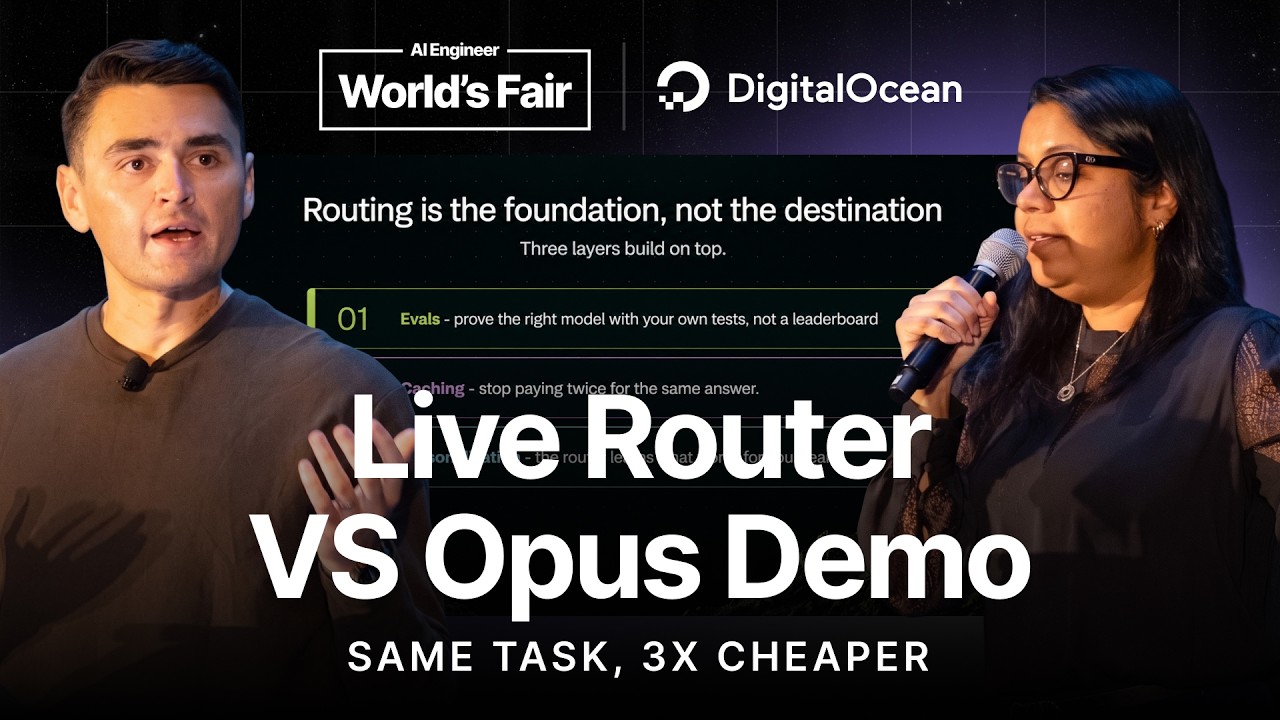
DigitalOcean's Archana Kamath and Tyler Gillam argue that no single best AI model exists, so choosing models by benchmark leaderboards is the wrong instinct; the right model depends on the request's task, cost, latency, system prompts, and end-user preferences. They demo their open-source inference router, built into DigitalOcean's AI-native cloud, which uses a purpose-built mixture-of-experts model to decide in under 200 milliseconds, costs nothing extra, and needs no code changes. In a live coding-agent comparison, the router matched premium quality while spending 14 cents versus 44 cents over a session and scored 90% correctness versus Opus's 95% with fewer tokens and faster speed. They frame routing as a foundation layer for evals, caching, and personalization, with no vendor lock-in.

The Missing Layer: Design Taste in AI Agents — Hassan El Mghari, Together AI
Aug 21, 2026 · 14:10
Hassan El Mghari, developer experience lead at Together AI, argues design taste, not model capability, decides whether AI apps reach millions or read as vibe-coded slop. He ships about 10 apps a year — a few with millions of users — and credits design for that reach. His design skill Hallmark, launched six weeks ago to 10,000+ users, turns AI slop tells like purple gradients and italic headers into gates and supplies themes, since strong inspiration produces better work. He starts in Codex or Claude Code and iterates with cheaper open-source GLM 5.2, whose landing page was nearly indistinguishable from Opus 4.8. He advises saving screenshots as references, using longer prompts from voice notes, one or two features per prompt, and a skill file or AGENTS.md — but agent output is only a base.

Your Fine-Tuned Model Is Tech Debt: A 50x ROI House of Cards — Dan Bjornn, Lease End
Aug 20, 2026 · 16:39
Dan Bjornn, senior data scientist at Lease End, explains why his team's fine-tuned LLM for customer intent—despite bringing in $12 million at a 50x ROI—became tech debt. The fine-tuning pipeline took a week per retrain, with training itself the shortest step, and each fix caused regressions, so bugs were triaged by tolerable customer pain. He calls this the calcification tax: the model locked them into one provider and an outdated architecture, preventing upgrades. The rebuild swapped the tuned model for skills, prompts, and context on a model-agnostic framework, letting fixes ship in under an hour as uploaded files. Accuracy went up, cost per message rose, but total cost fell. Bjornn concludes fine-tune only when you cannot call a frontier model, and even then the decision must beat the tax.
Prototyping as Leadership: How a CTO Ships with AI Agents — Hursh Agrawal, The Browser Company
Aug 20, 2026 · 18:18
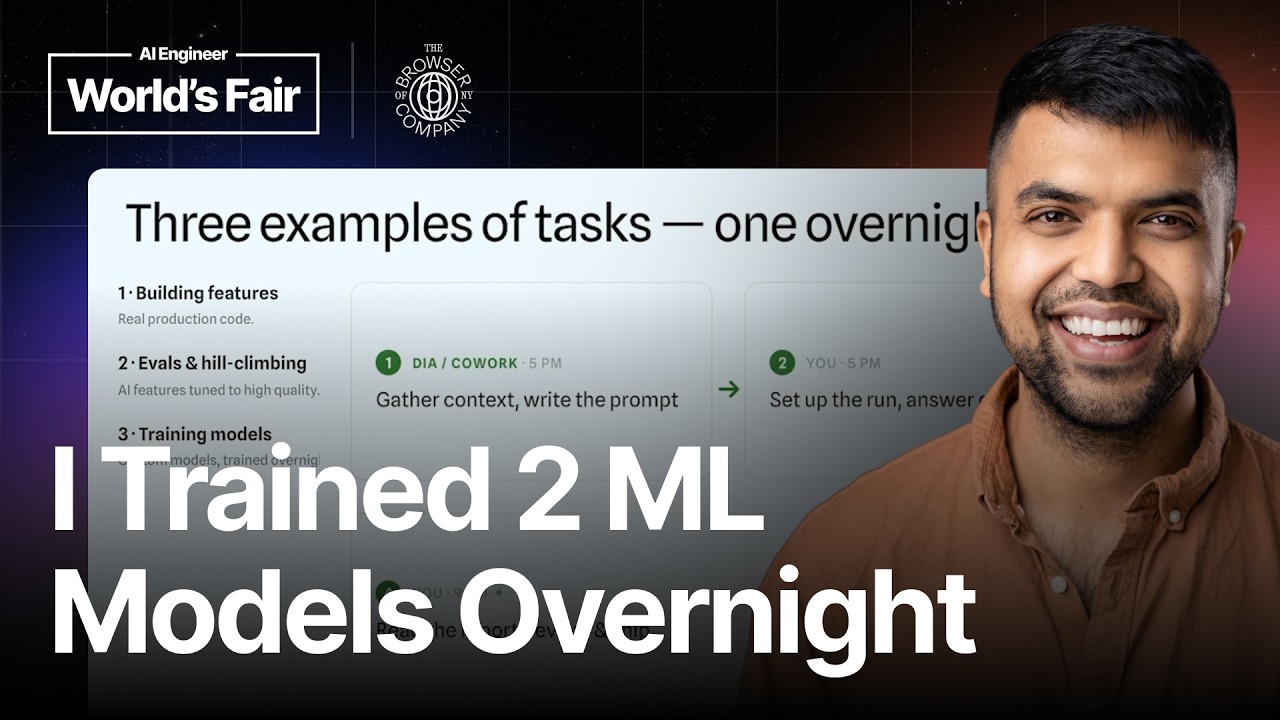
Hursh Agrawal, CTO and co-founder of The Browser Company, argues AI coding agents let leaders keep building: despite 15+ meetings, 7 direct reports, and a toddler, he ships 2–10 PRs/week. He says frontier models turn over every three months, so hands-on building is the only way to judge them and show engineers working prototypes. His method is an overnight loop: a coworker agent gathers Slack/Jira/Notion context into a prompt at 5pm, coding agent runs for hours, and a morning hour reviews tests, CI, and AI code review. He details three overnight uses: building features, hill-climbing evals from feedback JSONs, and training custom models like a PII classifier on AWS. He warns leaders to avoid critical path work and to rely on trustworthy CI, feature flags, a prototype branch, and readable PRs.
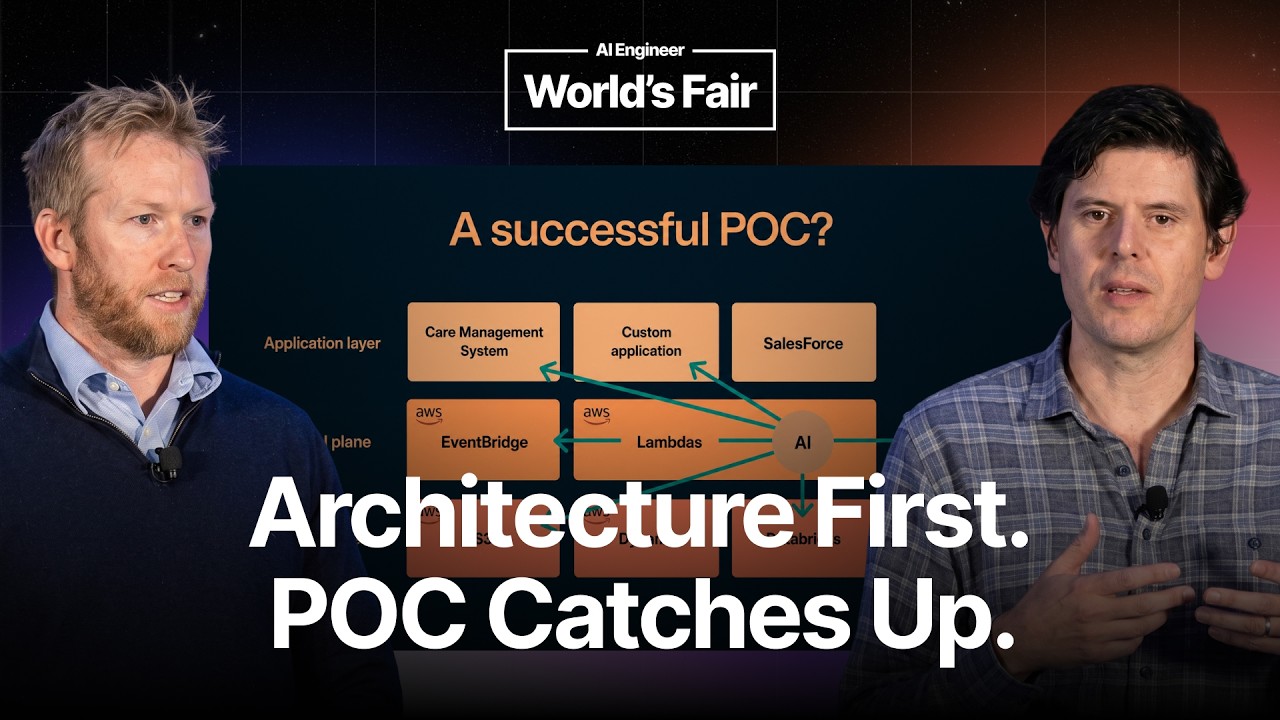
Why Your Enterprise Tech Stack Isn’t Ready for AI Agents — Christopher Lovejoy & Saul Howard
Aug 19, 2026 · 19:15
Christopher Lovejoy of Anthropic and Saul Howard of Anteria argue that enterprise stacks aren't ready for AI agents; regulated industries need primitives, not bolted-on compliance. An audit trail isn't a developer log: under HIPAA it must record every action, data access, and authorization, so they use an immutable append-only event log. Patient data lives in schema-driven object storage referenced by events, letting devs debug without PHI, enabling zero trust against prompt injection. Escalation treats humans and models as equivalent agents, enabling the same actions by either. These primitives make privacy-preserving evals a byproduct, enabling replay of production data and evaluation in customer environments without exposing data; take constraints first and rebuild toward POC accuracy.

Don’t be data poor — Anuj Iravane, Anterior
Aug 19, 2026 · 16:46
Anuj Iravane, who leads AI at Anterior, explains why the company builds synthetic medical data by reversing its inference workflow: the real faxed records it needs most are protected patient data its contracts forbid keeping. With about 70% of medical communication still moving by fax, Anterior starts from a label, samples a reasoning trace from policies modeled explicitly as decision trees, then builds a coarse-to-fine patient journey and documents, making labels correct by construction. Clinicians own the pipeline as interchangeable skills, and roughly 90% of datasets are now synthetic; in a blind review they separated synthetic from real only about 60% of the time. The payoff is creating edge cases on demand and testing workflows before deployment instead of waiting on customer data.

How to build an AI-Native Health Company — Dan Feng, Maven Clinic
Aug 19, 2026 · 17:19
Dan Feng of Maven Clinic says becoming AI-native means rewiring hiring, planning, code review, and reliability, not just adding tools. Maven hires engineers who solve ambiguous problems independently, keeps a one-year vision only directional, commits to two-to-four-week sprints, and treats three-to-six-month plans as unplannable because models change too fast. Engineers now write thousands of lines daily, so PRs are capped at 500 lines, engineers can self-certify simple changes but stay accountable, and rubber-stamp approvals are false confidence. Reliability is tiered: a scheduling failure one out of 1,000 times is tolerable because users retry, but reimbursement claims require multiple models to agree on the same receipt and integration tests to pass repeatedly.

Healthcare’s Agent Bytecode: X12 as the Harness for AI Agents — Vasant Kearney, Onlay
Aug 19, 2026 · 20:25
Vasant Kearney of Onlay argues that X12, the healthcare claims data standard, is the harness for AI agents: every step of the claim lifecycle—from eligibility (270) through acknowledgment (999) to payment (835)—has an X12 correspondence, and an agent calling a payer or driving a portal is emitting the same transaction by another route. He says phone, portal, and X12 surfaces are built by different teams and can all agree on the wrong answer, so no surface is ground truth; his system keeps a semi-correct internal X12 representation, correct only until downstream evidence says otherwise. Enterprise memory must live in a database rather than local disk, and swapping in a stronger model is not automatically better inside a system built around the old one—evals and validation must be redone. The goal is cutting insurance costs and improving patient experience, and that means being AI pilled but also AI skeptical.
AI is the World’s largest Relationship Therapist — Clay Cockrell & Tony Fabrikant, CoupleWork AI
Aug 19, 2026 · 16:43
Clay Cockrell and Tony Fabrikant, co-founders of CoupleWork AI, argue that AI is now the world's largest relationship therapist—ChatGPT's 900 million weekly users dwarf BetterHelp's 5 million—but sycophancy makes it clinically dangerous. Cockrell, a 34-year couples counselor, contrasts that with Gottman's 90% divorce-prediction accuracy and emotionally focused therapy, which CoupleWork's Maxine is built on. He warns general AI misses abuse signals and lacks data privilege. Fabrikant says start with clinicians, encode evals, and treat one failing safety test as disqualifying.

Guardrails First: Engineering Member-Facing Health AI — Rashi Agrawal, Hinge Health
Aug 19, 2026 · 21:49
Rashi Agrawal, who leads AI/ML at Hinge Health, argues most healthcare AI safety failures are architectural decisions made before a token is generated, not model failures. With 40 million people self-triaging, she cites a chatbot telling a 60-year-old to take sodium bromide, Mount Sinai finding under-triage of life-threatening emergencies half the time, and ECRI ranking chatbot misuse the top 2026 hazard. Her architecture puts PHI stripped at the pipeline boundary, irreversible decisions like 911/988 routing and identity verification in deterministic code above the prompt, and continuous judges scoring live traffic. For launch decisions, she offers five rules — worst case wins, default to the safer mistake, calibrate to revealed tolerance — and says verify the judge before changing the agent.

The Next Medium: Why Real-Time Interactive Video Changes Everything — Ahmed Ahres, Reactor
Aug 18, 2026 · 17:30
Ahmed Ahres, head of go-to-market at Reactor, argues that world models are real-time interactive video, a change of medium rather than a speedup, because video becomes programmable like software. GPS enabling Uber and viewfinders enabling Instagram and TikTok show how real time unlocks new applications. Reactor's platform serves infinite interactive video (Helios from ByteDance), controllable worlds (Lingbot from Alibaba, LongLive 2 from Nvidia), and live avatars he admits are still uncracked. Users build interactive live streams, medical and cooking simulations, and video-to-video editing. Real-time infrastructure means streaming pixels, live sessions with memory, and sub-100-millisecond latency; he offers promo code AIE2026 for $75 credits.

How to Kill the Code Review — Ankit Jain, Aviator
Aug 17, 2026 · 16:26
Aviator co-founder Ankit Jain argues code review isn't just about catching bugs: it carries knowledge sharing and mentorship, and that half must survive even as AI writes and reviews code. He says reading line by line is already over — over 30% of changes merge without review. He calls spec-driven development 1970s waterfall because intent lives in the prompts, which teams discard when the PR opens. His fix: capture agent sessions, turn decisions into acceptance criteria, pair them with an 'AI slop registry' of recurring review comments, and generate test plans a verification system runs against a live preview. Reviewers review intent and evidence, not the diff. Homework: mine your last 1,000 review comments; he pitches Aviator's new Verify pilot.
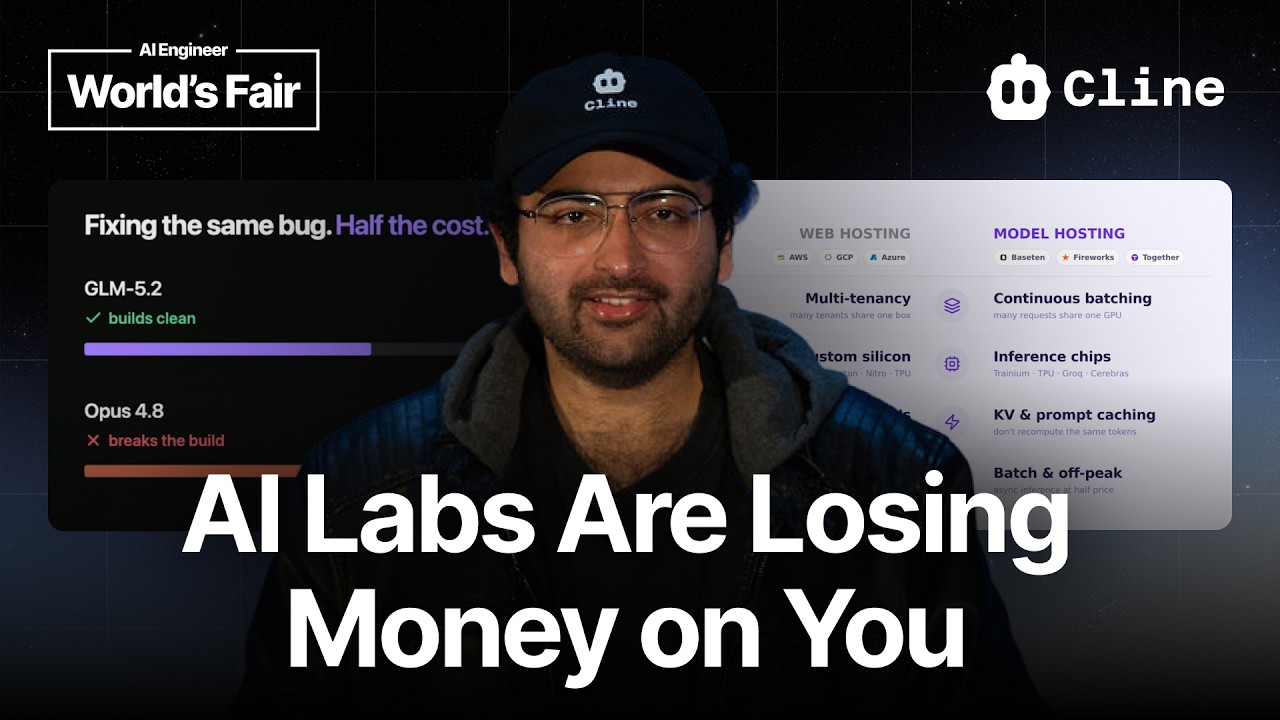
Open Source Is Dead. Long Live Open Source. — Saoud Rizwan, Cline
Aug 7, 2026 · 17:30
Saoud Rizwan, founder of Cline, argues that AI has killed the community side of open source while open weights models win on economics. He cites Zig banning AI from PRs, curl weighing shutdown of its bug bounty over AI-generated reports, and tldraw auto-closing pull requests, plus a LiteLLM compromise that stole credentials for three hours. Rizwan makes the case that closed labs' subsidized subscriptions lead to lock-in and price gouging, while open models like GLM match or beat Opus on cost and code quality — GLM used twice the tokens at half the cost and fixed a real Cline bug that Opus's faster fix left broken. He compares open weights to Facebook's Open Compute project and urges American labs to release open weights before foreign models become the standard.

Local Models: Trust, Control, Optimization — Carter Abdallah, NVIDIA
Aug 7, 2026 · 43:21
NVIDIA's Carter Abdallah, Prime Intellect's Vincent Weisser, Arcee's Lucas Atkins, and NVIDIA's Chris Alexiuk argue open-weight models are the trustworthy foundation for enterprise and local AI. Atkins separates trust from safety: when Anthropic pulled Fable, enterprises chose Chinese open models for guaranteed availability, and open models are inspectable unlike closed APIs. Arcee pretrained a 400B model in six months; Weisser cites a customer that specialized an open model for finance in a week or two, beating Opus at a fraction of Haiku's cost. Alexiuk calls open weights the fix for 'mismanaged genius' and expects capable local models on MacBooks within a year; the panel predicts Fable-level open models within a year and hopes local-model use rises from a rounding error to 10–15%.

Building Turbopuffer: Gergely Orosz (@pragmaticengineer ) × Simon Eskildsen (CEO)
Aug 3, 2026 · 56:30
Gergely Orosz talks with Turbopuffer CEO Simon Eskildsen about how napkin-math engineering took him from high-school Shopify hire to building the S3-based vector database that cut Cursor's bill by 95%. Eskildsen recounts scaling Shopify's infra to 1M RPS, building failure-injection proxy ToxyProxy, and launching Turbopuffer at $1 per million vectors on S3 with an Nginx cache. Cursor became the first customer after he helped debug Postgres/autovacuum issues; he also tells how Jensen Huang ribbed him for choosing CPUs over GPUs. He argues RL workloads are gobbling CPU capacity, making CPU SKUs scarce, and lists six reasons to raise capital, noting his first raise funded R&D and the second let employees cash out. He closes on Turbopuffer's remote culture of campfires and turbo credits for business-class flights.
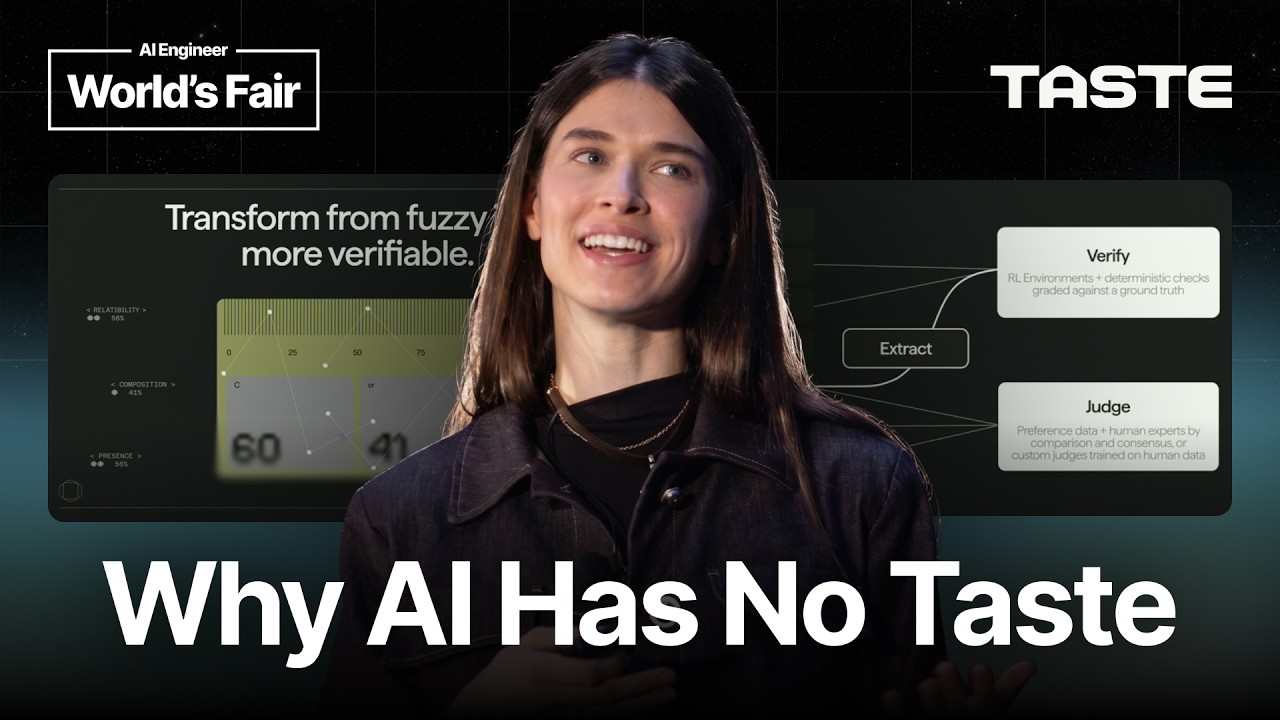
Ending AI Slop — Thais Castello Branco, Taste Labs
Jul 31, 2026 · 16:30
Thais Castello Branco, founder of Taste Labs, argues AI slop persists because subjective domains like design and writing lack the verifiability of code, and ending it requires decomposing taste into measurable components and building preference data that breaks from the mean. She sorts domains along a spectrum from things that verify and execute cleanly to pure preference with no ground truth, showing how brand adherence becomes trainable by decomposing a brand into colors, typography, motion, and textures graded against an original rather than judged whole. She warns that models predicting the most likely outcome collapse to the mean, killing the creativity good design depends on, so Taste Labs works with over 1,000 expert designers to force distribution and create preference vectors that capture pluralism. Her team pairs expert judgment with human QA tied to specific code components, distinguishing disagreement on alignment from disagreement on style, and advocates quality over quantity for subjective domains.

Build for the Memo, Not the Demo — Shawn Chan, China Resources Holdings
Jul 30, 2026 · 24:23
Shawn Chan, a veteran investor at China Resources Holdings who has sat on roughly 200 investment committees, argues that most AI finance products are built to impress for five minutes but cannot survive a room whose job is not to be impressed—the difference between a demo and a memo. He defines the memo as the real document that must survive an argument, with hundreds of pages where half the sources disagree. He recounts how one wrong sentence in a tech company's AI demo erased $100 billion in market value, how an AI invented six court cases for a lawyer's brief, and how an airline's chatbot made a fake policy that cost the airline in tribunal. He identifies six ways trust breaks: treating all sources equally, numbers that disagree, hiding contradictions, melting facts and guesses, unprovable claims, and no accountable human. His five fixes are: every claim linked to its source with trust level, facts and guesses visibly separate, automatic number reconciliation, surfaced contradictions, and a logged human approval gate. The product that wins, he says, is the one that lets a tired finance person trust its output without opening seven tabs at midnight.

Persona Engineering: A Field Guide to AI Synthetic Personas — Ishan Anand, InsightSciences.ai
Jul 29, 2026 · 21:09
Ishan Anand of InsightSciences argues that synthetic personas, powered by LLMs, can predict human survey responses with 83% alignment when normalized against human noise (humans are only 80% consistent with themselves over time). However, they fail in three critical ways: models invent confounders (e.g., price as a proxy for quality, creating an inverted U-shaped purchase curve), exhibit extreme order bias in answer choices, and predict stated attitudes far better than actual behaviors. Techniques like fine-tuning on human distributions (the subpop paper) or mapping model-generated text to human-scaled responses via semantic similarity can recover accurate distributions, not just averages. To validate, Anand recommends using correlation plus shape metrics and establishing a noise floor by splitting human data against itself. The takeaway: synthetic personas are forecasts, not ground truth, and work best as a complement to human research—extending data to unasked questions and simulating human-plus-agent ecosystems.

Why Off-the-Shelf AI Doesn't Understand Money — Udi Menkes, Intuit
Jul 29, 2026 · 19:50
Udi Menkes, principal PM at Intuit, argues that off-the-shelf frontier models deliver a 'fluent bluff' when advising on money: advice that sounds right but is dangerous because models have read about money but lack experience. He shows a rental property example where a frontier model told a landlord in negative cash flow to acquire a second property, while a model grounded in real outcomes recommended raising rent 5-10%. Intuit's head-to-head test across 100,000 businesses found frontier models gave advice that would harm businesses 40% of the time, while a mid-sized grounded model outperformed them by training on millions of state-action-outcome records from QuickBooks data. A Princeton study confirmed frontier models given $1M went bankrupt within 500 days, while a simple rule-based system beat them. Menkes says the moat belongs to whoever owns the best system of context, and advises leaders to find verified outcomes in their own data to ground AI.
How Forward Deployed Engineering is done at Factory — Eno Reyes
Jul 28, 2026 · 21:21
Factory's forward deployed engineers serve as the tip of the spear, embedding with customers to build software factories where signals flow through validation stages and ship outcomes autonomously. Co-founder and CTO Eno Reyes stresses a model-independent harness the customer owns, enabling air-gapped operation in finance, healthcare, or government. The autonomy maturity model scores codebases on agent readiness: linters, type checkers, and verifiable tasks let agents work longer without humans—enabling migrations of 30–50 million line codebases at banks. Reyes uses Disney's Epcot analogy to warn: build achievable future cities, not theme parks, or adoption stalls. Factory runs with an autonomy ratio in the upper 80%; legal Droid is fully autonomous, and the role demands business judgment, systems thinking, and communication skills as much as engineering.

AI tools for Forward Deployed Engineering — Vasuman Moza, Varick Agents
Jul 28, 2026 · 20:23
Varick Agents CEO Vasuman Moza and head of engineering JD Pruitt explain how forward deployed engineers (FDEs) design AI agents that sit on top of existing enterprise systems like SAP or NetSuite rather than requiring migrations—one customer spent $5M and five years on NetSuite, so Varick drops agents onto those systems. The bottleneck is understanding each business’s unique, undocumented workflows (e.g., when AP fails, Sarah sends to Chris, adding four days of cycle time). FDEs map these processes, re-engineer them around AI (automating four of eight steps, keeping human-in-the-loop for three, fully human for one), then deploy using Varick OS. To scale FDEs without hiring exponentially, Varick built an AI FDE agent that ingests granola notes and Slack threads, uses a Postgres-based dependency graph as a single source of truth, and post-trains open-source models (Kimi K26) to extract the right context and strip redundancy. JD outlines three stages: an engagement agent for querying documentation, a workflow agent that shadows FDEs inside the platform, and a future autonomous agent that handles client change requests (e.g., rerouting a QC report) without FDE involvement.

How Forward Deployed Engineering is done at Cognition — Jia Wu
Jul 28, 2026 · 17:38
Jia Wu, deployed engineering lead at Cognition, argues that their forward deployed engineers measure outcomes—not token usage—by embedding Devin in customer environments and delivering measurable productivity gains like an 82% reduction in delivery timelines. The job involves deeply understanding customer problem spaces, mapping Devin’s capabilities to highest-leverage work, and feeding product feedback from deployments. Wu distinguishes Cognition from single-point tools by claiming organizations achieve 10x faster output, not just individual engineers. He cites anonymized case studies: 150% headcount increase in three months, double the PRs compared to single-point tools, and one-third the timeline for an ETL migration at a bank. Wu insists that as coding becomes commoditized, deployed engineers must prioritize business and people skills, relentlessly tying into customer success and communicating back to the product roadmap.

The Dirty Secret of Forward Deployed Engineering — Natalie Meurer, Sierra
Jul 28, 2026 · 16:49
Natalie Meurer argues that forward deployed engineering (FDE) has become a meaningless label because it has stretched from DevOps at Palantir in 2008 to data integration, ontology work in Slate and Foundry, solution architecture, and enablement—but its durable core is customer accountability and outcome-based pricing. Tracing FDE's history at Palantir, she shows how the role evolved from keeping the platform stable (2008) to data integration (2012), custom dashboarding in Slate (2016), and finally customer enablement in Foundry (2020). As coding agents make software cheap, she contends the lasting value lies in integrating data, understanding customers, and owning outcomes. Pricing tells the story: seat-based assumes a tool, while usage or outcome pricing puts the provider on the hook—exactly what FDEs have always done. She concludes agent engineering is FDE reborn, and that product, infra, and AI engineering are all trending toward the same customer-accountable model.
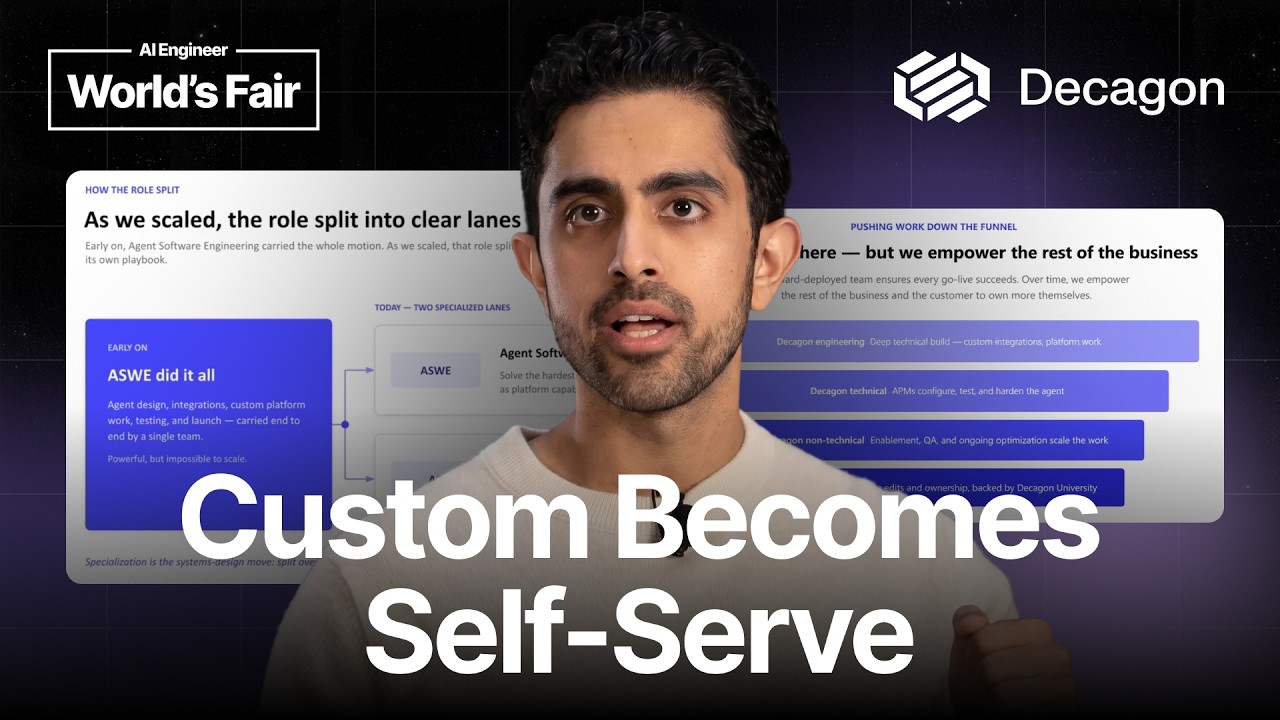
How Forward Deployed Engineering is done at Decagon — Sunny Rekhi
Jul 28, 2026 · 18:09
Sunny Rekhi, CTO of Forward Deployed Engineering at Decagon, explains that forward deployed engineering is identical to product engineering, with two kinds of work: configuring the AI agent's brain (instructions and handoff rules) and solving customer asks in a way that scales to all customers. Decagon, which builds 24/7 AI customer service agents, grew from 50 to 500 people in a year, breaking the original role into specialized lanes: agent builders who configure within the UI, and agent software engineers who productize customer requests. Rekhi stresses restraint—avoiding one-off patches—and proving value fast in the first weeks of a partnership. A key ethos is that custom work never stays custom: every integration built for one customer gets upstreamed into the platform, becoming self-serve for the next. Forward deployed engineers also act as advisors, using their cross-customer knowledge to guide enterprises on where they will see the highest ROI based on historical data.

How Forward Deployed Engineering is done at Kepler — Vinoo Ganesh
Jul 28, 2026 · 22:20
Vinoo Ganesh, a former Palantir engineer who built the Frontline rotation program, argues that Forward Deployed Engineering is a product strategy, not a go-to-market motion, and shows how Kepler applies this philosophy. He illustrates with stories from Palantir: solving a shipping customer's 47-page requirements with a four-hour Slack alert, building a Parquet viewer after watching a data quality engineer manually spot-check CSVs, and the Groovy script that became a product supporting 100,000 people. Ganesh emphasizes detecting real problems by observing users' actions—any repeated task hints at a missing feature, and pulling out a phone mid-workflow is a bug report you'll never find in documentation. He also explains defining ontology: when different teams call the same entity 'clients,' 'billing,' or 'accounts,' the FDE must canonicalize terms to become the linguistic foundation. The hardest skill is discarding—ship everything as if it will run 18 months, because every hack goes into production. Ganesh concludes that FDEs drive product leverage by solving small problems on-site, then generalizing solutions into the core product.

Forward Deployed Engineering 101 — Kevin Bai, Anthropic, ex Palantir & Rippling Founding FDE
Jul 28, 2026 · 17:48
Kevin Bai of Anthropic, formerly at Palantir and Rippling, argues that Forward Deployed Engineering (FDE) is the go-to-market motion for selling highly technical platforms to non-technical buyers, as Palantir did with its Foundry platform. The key is not building bespoke solutions from scratch but assembling outcomes on a reusable platform of shared primitives; otherwise it becomes a dev shop. FDE targets a specific quadrant: complex product + non-technical buyer, exemplified by Palantir's $4M average contract value vs. ServiceNow's $1.2M and Workday's $600K. Two questions determine need: is your product complex enough to require hand-holding, and do you have engineers who can carry that? AI has made building easy and nearly everything agentic, pushing FDE toward the center of software sales.

Notion's Token Town — Sarah Sachs, Notion
Jul 23, 2026 · 23:55
Sarah Sachs, Notion's AI engineering lead and contract negotiator, argues that AI companies must stop competing on token economics and instead build model-agnostic products that win on data flywheels, orchestration, and security. She advises treating every model supplier as a competitor, because frontier labs charge a markup on a markup for tokens they sell for first-party use. Notion's auto model routes 75% of traffic through a Switzerland-like system that swaps providers underneath, avoiding vendor lock-in. Sachs advocates routing by cost per capability per second, using open weight models for the moderate middle, and reaching for CPUs over GPUs (e.g., no LLM needed to turn a CSV into a PDF). She highlights the 'lethal trifecta' of private data, untrusted content, and external communication as the next security challenge, and demos Notion agents scoping a task, tagging teammates, and opening a PR. Her core message: optionality is leverage, and the product must transcend tokens.
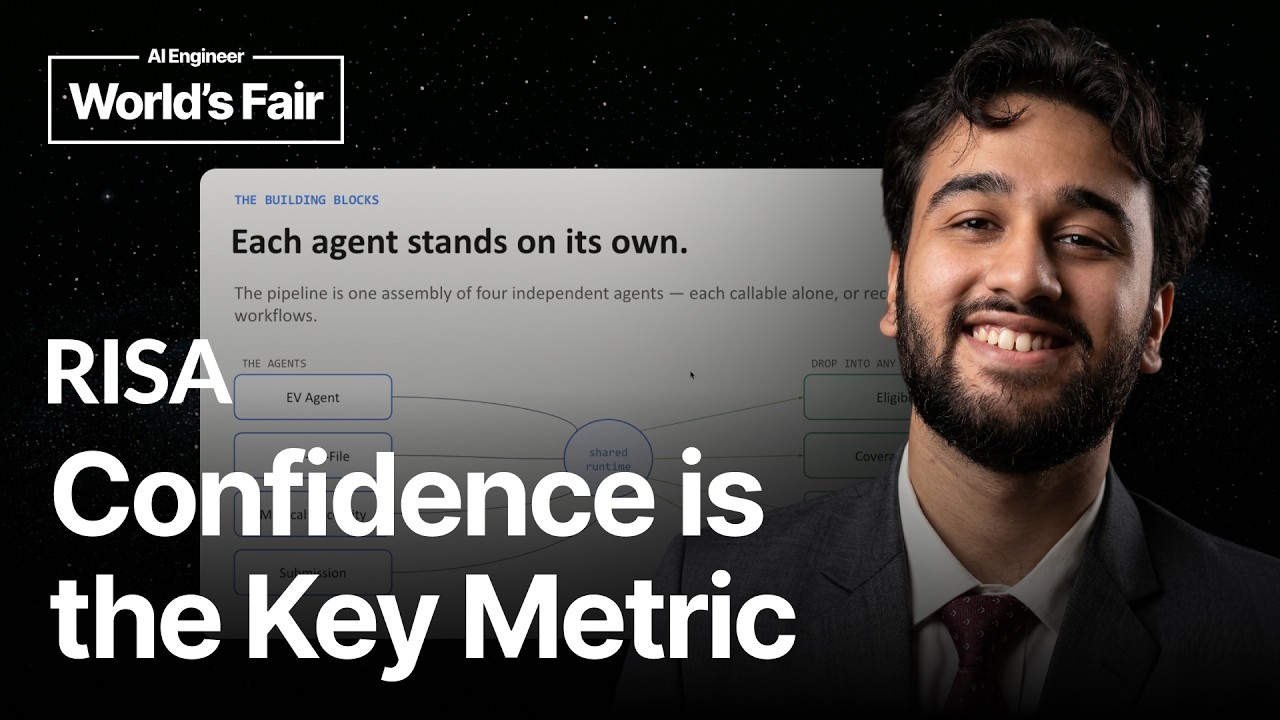
Can Oncology Workflows Run Without Human Touch? - Anant Shankhdhar, Risa Labs
Jul 20, 2026 · 16:41
Anant Shankhdhar, an AI engineer at Risa, explains how his team automates oncology workflows end-to-end using four AI agents—EV, Auth, Necessity, and Submission—to eliminate human touch in prior authorization processes. The EV Agent handles eligibility and benefits verification via a unified service that connects to payer APIs and RPA portals, using LLM-driven config generation and self-healing loops to scale. The Auth Agent determines drug authorization status by reconciling evidence from patient notes, authorization letters, and a payer rule knowledge base, enabling no-touch handling for drugs that are already authorized or don't require authorization. The Medical Necessity Agent answers clinical questions per patient, attaching confidence scores and escalating only cases needing human review. The Submission Agent submits orders to payers using customized integrations. Risa's agents are deployed across 20+ hospitals, supporting care for over 100,000 patients, and the no-touch share…
The UX of AI: Making AI-Powered Apps Your Users Don't Hate - Kathryn Grayson Nanz, Progress Software
Jul 18, 2026 · 35:59
Kathryn Grayson Nanz, Senior Design and Developer Advocate at Progress Software, argues that the success of AI-powered applications now depends on user experience rather than model performance. She identifies five pillars—trust, clarity, control, transparency, and meaningful benefit—and provides concrete patterns: citing sources to build trust, streaming text for clarity, allowing undo and version history for control, requesting granular permissions for transparency, and offering templates and next-step actions to ensure meaningful benefit. She emphasizes that developers must design these patterns themselves because AI can only remix existing interfaces, and that users need gradual introduction to AI features to avoid disengagement. The talk stresses that without addressing these UX challenges, users will abandon AI tools after a few failed attempts.
Stop Renting Your Cognitive Infrastructure - Thiyagarajan Maruthavanan, Kalmantic Labs
Jul 18, 2026 · 7:52
Thiyagarajan Maruthavanan of Kalmantic Labs argues that AI teams should stop renting inference from providers like Anthropic and build their own infrastructure, coining "rent to learn, own to earn." He recounts his app UltraSuno costing hundreds of thousands of dollars in inference, a stolen key hitting $10,000, and moving to his own DGX Sparks hardware. Three enterprises—a fund, hospital, and tax practice—each hit walls with renting: control, audit redlining, and reproducibility. He open-sourced JustTokenMax (benchmarked better than Netflix's Headroom) and wrote the book "Peak Inference" on building your own inference infra. He notes the market's conflicting pitches (Jensen's token factory, Nadella's unmetered, NeoClouds' endpoints) but concludes owning is essential post-PMF.

Imagination Engineering: "Live in the future and then build what's missing."
Jul 16, 2026 · 16:04
Eve Bouffard, Head of Design at Y Combinator, introduces 'Imagination Engineering' as the art of stretching the mind to invent what seems impossible, arguing that idea generation is the new bottleneck as AI models become incredibly capable. She shares her experiment in 'thinking in public' with a Slack channel called 'Eve Thoughts,' where she dumps her stream of consciousness, and then used Opus 4.8 to build a personalized website (EveBouffard.com) that aggregates and visualizes those thoughts. The site dynamically surfaces her projects, quotes, tools, and books, and even applies shaders and translations. She also built 'Shape of Minds'—a tool that analyzes commonalities across history's greatest minds, revealing patterns like taking naps and barely eating. Bouffard demonstrates how to spin up agents on demand for learning and productivity, emphasizing that anyone can now create software on the fly from their stream of consciousness.
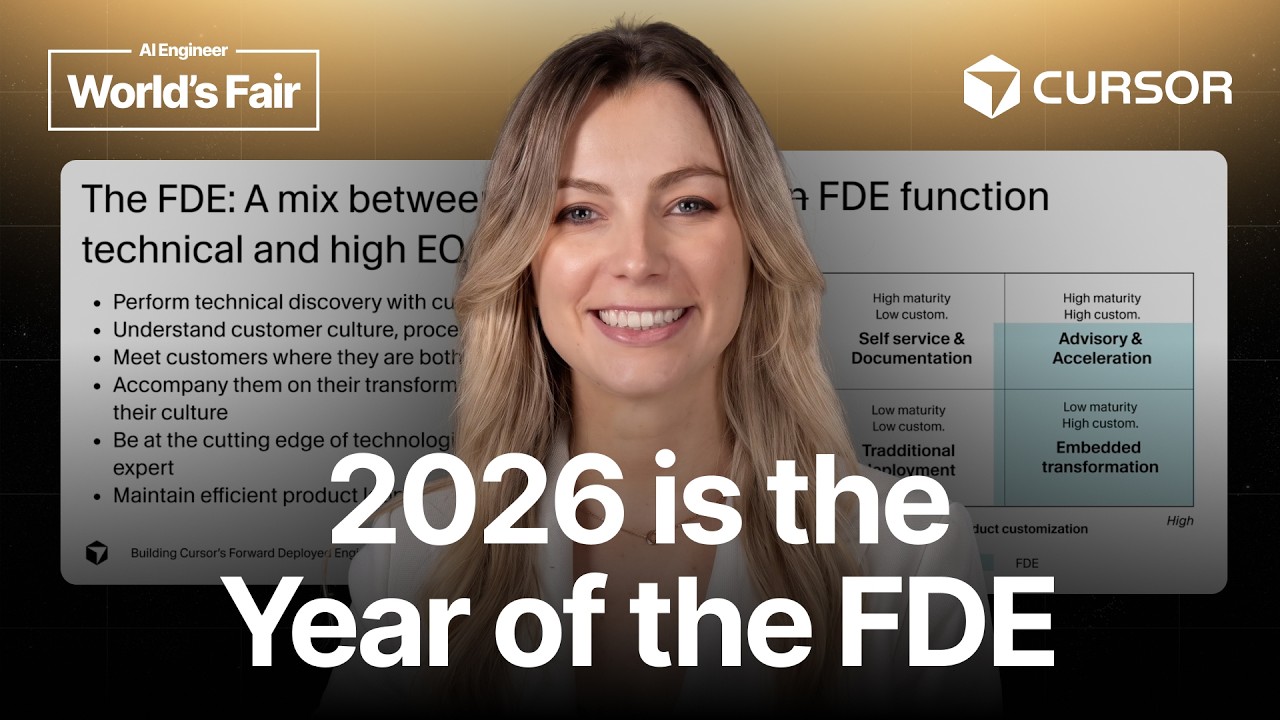
Forward Deployed Engineering at Cursor — Pauline Brunet
Jul 14, 2026 · 20:47
Pauline Brunet, VP of Forward Deployed Engineering at Cursor, explains how to build an effective FDE team by mapping customer digital maturity and product customization to the right engagement model—self-service, traditional SaaS deployment, advisory, or embedded transformation. She defines the ideal FDE as a highly technical engineer with strong customer-facing skills, capable of scoping impactful projects, co-developing with customer teams, and feeding insights back to product. Cursor’s FDE team uses a project-based approach, hires experienced unicorns (5+ year software engineers), and structures around geographies, industries, and product SMEs. Best practices include solving the right problem, defining success metrics upfront, keeping scope directional, involving customers at every step, measuring ROI (revenue, cost, risk), and leaving documentation behind. Brunet advises learning fast, pivoting, partnering with system integrators, and not being afraid to say no to mismatched use cases.
Chat and citations won't save your vertical AI - Atul Ramachandran, Filed Inc
Jul 11, 2026 · 15:12
Atul Ramachandran, CTO and co-founder at Filed, argues that chat interfaces and citation trails fail vertical AI because they shift the verification burden back to users, making every error catastrophic. Drawing from Filed's work building AI data entry for tax firms—where they hit 80%+ accuracy against a 50-60% baseline yet still faced complaints—he explains that the real fix is to design for delegation, not participation. He proposes treating the product as a conveyor belt where users are supervisors, using long-running background agents, automatic skills that capture user quirks, monitoring via traces, and control mechanisms like plan approval before irreversible actions. Ramachandran advocates measuring weekly active sessions instead of weekly active users, aiming for sessions to rise while direct user interaction falls. The episode covers these four pillars and the shift in metrics needed to build successful vertical AI products.

Everything we knew about software has changed — Theo Browne, @t3dotgg
Jul 8, 2026 · 16:02
Theo Browne argues that AI model evolution—from Sonnet 3.5’s tool-calling to Opus 4.5's long-running tasks and Mythos's orchestration—requires engineers to think bigger and wider. He compares current developer habits to skeuomorphism in iOS 7, urging rejection of legacy constraints like Git's inability to commit environment files and terminal-centric workflows. Browne introduces a shifted tier system: what was a startup is now a side project; a Markdown file running on a cron job can replace a company's product. His own PR triage service became a Markdown file updated daily via cron. He advocates building breadth over depth—architecting products so users can extend features, enabling small teams to compete with AWS or Salesforce. 'If your idea doesn't feel stupid, it's because your idea is not big enough,' he concludes.

GTM Is You - Victoria Melnikova, Evil Martians
Jul 7, 2026 · 12:35
Victoria Melnikova argues that a founder's personal brand is the most underrated competitive advantage for developer tool startups in 2026, citing interviews with Sam Lambert (Planet Scale), Zeno Rocha, and David Cramer. She presents the Product-Market Fit Compass, a framework from Evil Martians that analyzed 37 successful DevTools, finding that 9 out of 10 times product signal is stronger than revenue, making distribution the bottleneck. Key tactics include moving to San Francisco for network effects, using banners and billboards to signal credibility (as TypeCents did with hundreds of billboards), hosting events like Supabase's user conference, and embracing failures (Zeno Rocha walked away from 300k ARR to start over). Melnikova emphasizes being unapologetically yourself, as AI can amplify but not replace unique personal brands, and notes that founder-led sales builds trust in early-stage startups.
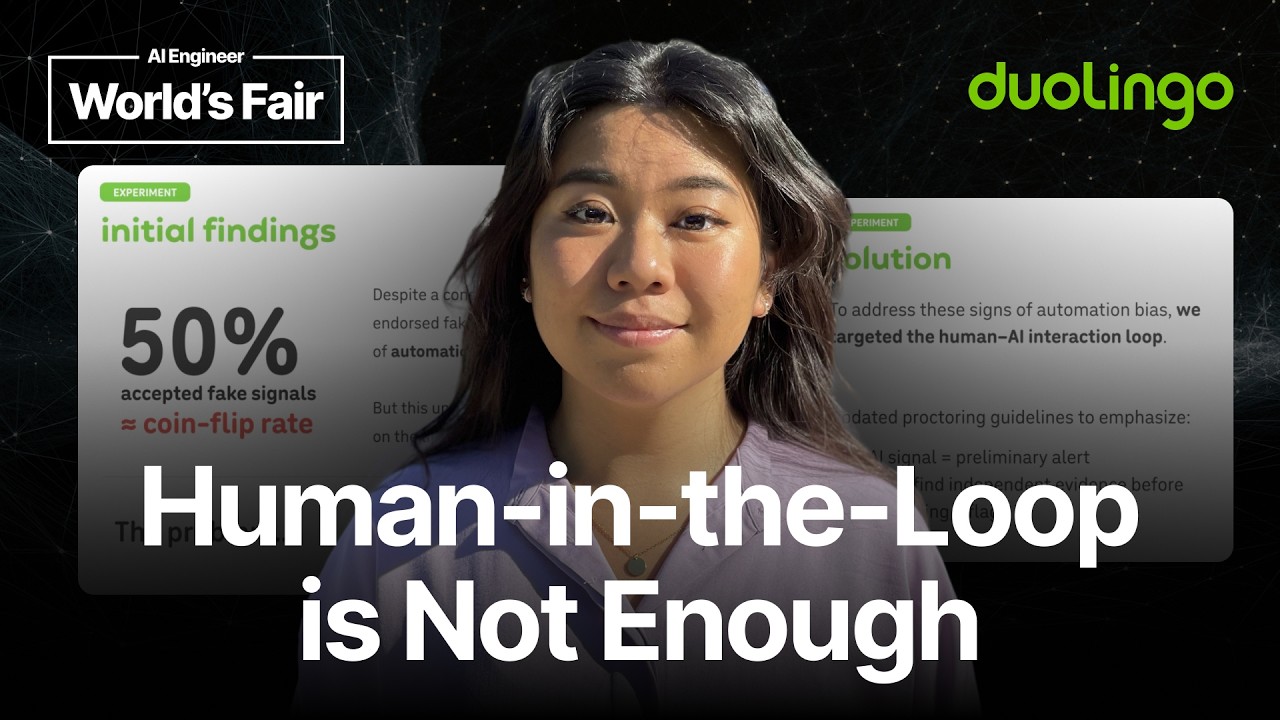
Build AI Systems for Discernment, Not Approval - Angel Ortmann Lee, Duolingo
Jul 7, 2026 · 25:53
Angel Ortmann Lee, a Software Engineer at the Duolingo English Test, argues that human-in-the-loop AI systems often fail because humans cognitively surrender—adopting AI output with minimal scrutiny, as seen in a Wharton study where 80% accepted wrong AI answers. At Duolingo, an experiment with fake AI cheating alerts showed skilled proctors flagged legitimate sessions 50% of the time due to automation bias. A simple guideline change emphasizing independent evidence boosted accurate rejections by 21%, proving the fix lies in engineering the interaction, not better models or oversight. Lee outlines design principles: engineer reasoning patterns (e.g., frame humans as investigators), match friction to stakes (add review gates for high-stakes decisions), treat every interaction as a label (capture diffs when humans override AI), and proactively define success metrics to structure interactions that yield high-quality data. The flywheel of intentional design yields a virtuous cycle of better data, models, and human judgment.
Your AI Product Will Fail Unless You Can Explain It - Veronica Hylak, Hey AI
Jul 5, 2026 · 6:02
Veronica Hylak, an AI product leader with explainers reaching 8 million views, argues that AI products fail because founders cannot explain them clearly, and offers a 3-part fix: identify the wound (the customer’s biggest pain point), make the product click by tying it to a viral story like McDonald's AI drive-thru disaster, and show the transformation from before to after using the product. She demonstrates by contrasting bad pitches like 'agentic orchestration platform' with a wound-first approach: security teams overwhelmed by disconnected tools, then the solution unifies everything. Hylak insists on banning abstract words and instead using mental images like 'smoke alarm for AI behavior.' The episode delivers a concrete framework for turning complex AI into a story people instantly understand and buy, warning that great tech dies quietly if nobody gets it.

The Prompt Is Still a Punch Card - Ted Johnson, JoinIn AI
Jul 2, 2026 · 20:13
Ted Johnson argues that AI interfaces still use the batch protocol of punch cards, forcing humans to adapt to machines rather than the reverse. He introduces three concepts—channel, expression, protocol—to show how expression exploded with LLMs but the protocol remained static. Examples include voice mode misinterpreting a side conversation, PersonaPlex's turn-taking, and a meeting AI that follows group dynamics without prompts. Johnson calls for designing interfaces where AI understands timing, ambiguity, and shared context, moving from prompting to genuine communication.

AI-Driven Multi-Document Correlation for Financial Compliance - Varsha Shah, Independent
Jun 28, 2026 · 19:00
Varsha Shah presents an AI-driven framework combining graph-based entity correlation, adaptive probabilistic risk modeling, and cross-jurisdictional normalization to detect hidden compliance risks across payroll, tax, procurement, and financial records. Evaluated on approximately 3 million anonymized records across four jurisdictions, the framework achieved 91% precision, 87% recall, and an F1 score of 0.89, while reducing false positives by 76% and manual audit effort by 40%. Shah argues that many sophisticated fraud patterns exist between documents rather than within them, and that traditional rule-based systems analyzing documents in isolation fail to capture these cross-document risks. The framework enables continuous learning from audit outcomes, shifting compliance from reactive validation to predictive, intelligence-driven governance. Key to deployment are seamless integration with existing enterprise systems, jurisdiction-specific configuration, alignment with audit frameworks, and scalability to process millions of records.

OpenClaw in Your Hand: Building a Physical AI Terminal - Lech Kalinowski, Callstack
Jun 28, 2026 · 24:36
Lech Kalinowski presents Vault, a dual-display handheld AI terminal built on an ESP32-S3 that runs a local LLM and OpenClaw agents without cloud reliance. The device pairs a fast OLED live surface with a bistable e-paper content display, offering four modes — shell, assist, control, and an LLM-native RPG — all powered by a single lithium-polymer cell. The backend serves GPT-oss 120b via NVIDIA TensorRT-LLM, keeping inference off the microcontroller. Kalinowski shares engineering war stories: blown OLEDs from unstable power supplies, software I2C issues, and noisy encoders. The RPG mode generates four worlds with NPCs and narrative state tracked by the LLM, not dice or HP. Built in three months with 130 commits, the terminal is intentionally distraction-free, targeting quiet spaces where users want text-first AI interaction.

AI System Design: From Idea to Production - Apoorva Joshi, MongoDB
Jun 28, 2026 · 28:53
Apoorva Joshi presents a structured framework for designing AI systems from idea to production, arguing that thorough product specification and evaluation are now more critical than coding itself. Using a health insurance claims review system for MDB Health as an example, she walks through four phases: defining business problems with measurable success metrics (e.g., reducing urgent claim processing from 2 days to 1 hour within 90 days), designing data strategy and architecture using patterns like RAG, control flow, and human-in-the-loop, establishing guardrails and evaluation metrics such as faithfulness and cost per recommendation, and optimizing for accuracy, cost, latency, and reliability before shipping. She emphasizes building evaluation in from the start and iterating from the simplest system.

Stop Writing Tone Instructions. Layer Them. - Isadora Martin-Dye, Isadora & Co
Jun 26, 2026 · 20:57
Isadora Martin-Dye, founder of Isadora & Co and builder of AI for a wedding venue, a personal companion, and a missing persons tool, argues brand voice requires a four-layer architecture instead of a single system prompt. The layers are immutable identity (hard rules like never claiming a body), situational mode (adjusting to user's context like grief), example-anchored voice (tone guide), and a post-generation veto (deterministic check catching errors like offering a booked date). Instructions are probabilistic; the veto is deterministic. A prompt will eventually fail; the only question is whether it's caught before reaching a customer. Examples include a wedding AI that must disclose it is AI and not say "I'd love to show you around," and a missing persons tool that must never use "confirmed" or "matched." She notes that multi-tenant voice leaks require identity to never have a default. The veto layer is the cheapest and most critical safeguard.

Why Can't Anyone Answer Questions About the Business? — Garrett Galow, WorkOS
Jun 11, 2026 · 19:06
Garrett Galow from WorkOS built Studio, an internal workspace where anyone can ask natural language questions against Snowflake, Linear, and Notion, and get reusable widgets instead of filing a request. The LLM generates declarative JavaScript widgets that call data sources directly, making subsequent runs deterministic and cheap. Three techniques made it reliable: preflight sequencing injects schema context only when a tool is invoked, a layering rule tells the model to distrust its own knowledge about WorkOS and use primary sources, and query validation catches valid SQL that returns zero rows before hardcoding it into a widget.

Sovereign Escape Velocity: Ownership w Open Models — Gus Martins, & Ian Ballantyne, Google DeepMind
Jun 10, 2026 · 20:52
Gus Martins and Ian Ballantyne of Google DeepMind introduce Gemma 4, a family of open-weight models that deliver high quality per parameter, enabling deployment on a single GPU or even a phone. They argue that the models' efficiency — a 31B model rivals those twenty times larger — and the shift to Apache 2.0 licensing remove barriers for sovereign institutions like those in Ukraine, Bulgaria, and Brazil. Ian demonstrates multi-agent translation running locally on an M4 Mac, showcasing ownership and control over agentic workloads.

20 days of compute vs 7 hours: rethinking what state-of-the-art means — Bertrand Charpentier, Pruna
Jun 1, 2026 · 19:36
Bertrand Charpentier, cofounder and chief scientist at Pruna AI, argues that state-of-the-art is not a single model but multiple on a Pareto front that balances quality and efficiency. He highlights that public leaderboards disagree—Hunyuan ranks 10th on Artificial Analysis but 5th on Arena—and most models lose 40% of head-to-head battles, meaning the top-ranked model is wrong for nearly half of use cases. Evaluating a large model like ChatGPT image on Design Arena (26k battles, 62 seconds each) costs $5,000 and 20 days of compute, consuming energy equivalent to 400 marathons, while a fast compressed model completes the same evaluation in 7 hours for $265. Charpentier advocates plotting quality against latency or cost to find the frontier, which often surfaces small specialized models instead of large foundation models, with 20x efficiency differences at similar quality scores.

Most Enterprise Agentic Projects Are Doomed, Here's Why — Jess Grogan-Avignon & Jack Wang, Accenture
May 28, 2026 · 20:35
Jess Grogan-Avignon and Jack Wang, Accenture, argue that most enterprise agentic projects fail not because of bad code but because organizational scaffolding designed for human pace chokes machine-speed AI delivery. They built an agentic application in two weeks, then spent twelve months aligning infrastructure, security, AI gateway, data governance, and application teams before it shipped—a pattern they say will worsen as GitHub's 275 million weekly commits flood approval infrastructure built for humans. They name five predictive tensions: human approval chains must become executable code, not longer meetings; finance should back a portfolio of AI bets like a VC, not demand committed returns from each project; delivery should run on hypothesis-driven loops building statistical confidence, not fixed milestones; trust is built through progressive autonomy—shadow, advisory, controlled autonomy—gated by outcome evidence, not plan completion; and the real moat is living memory from real customer signals, not static CRM or ERP data. Their prescription: bet like a VC, upgrade governance for machine speed, and engineer for trust with feedback loops from day one.

Does GenAI "belong" to data scientists? — Phil Hetzel, Braintrust
May 25, 2026 · 18:54
Phil Hetzel of Braintrust argues that generative AI development should not be isolated to data scientists or ML engineers, but instead requires a diverse team including product engineers, systems engineers, and non-technical domain experts. Because models are already built by OpenAI and Anthropic, the remaining work is prompt and context engineering, distributed systems, human annotation, and functional evaluation—not traditional training pipelines. Data scientists add value through rigorous testing and LLM-as-judge evaluation, but must move beyond precision/recall toward broader functional metrics. Traditional enterprises often mistakenly hand GenAI to ML platform teams, while AI natives use small cross-functional groups with closer problem proximity. The ideal mix combines technical roles for implementation and system design with non-technical experts for prompt engineering and human annotation, keeping the agent relevant through continuous feedback.
Bounded Autonomy: Between Free Will and Determinism — Angus J. McLean, Oliver
May 25, 2026 · 16:52
Angus J. McLean, AI Director at Oliver, argues that developers should intentionally constrain large language models rather than maximizing their capabilities, because models naturally tend toward complexity and verbosity. He shares how Oliver generates 4,000 creative assets daily for 200+ brands using agents, but warns that context windows will never be sufficient as world knowledge doubles every 12 hours. McLean advises replacing internet access with curated documentation, asking how little context can be used to complete a task, and never automating a job you cannot do yourself. He illustrates this with his own experience building a complex agent application for his CV that was outperformed 100x by a simple HTML page. The talk frames AI as fundamentally a translation process between representations—text to image, image to audio, etc.—and recommends using multiple representation structures like Markdown, graphs, and folders. McLean's core message is that abundance stops scrappiness, so self-imposed constraints drive creativity and better results.
Rewiring the State — Eoin Mulgrew, No. 10 (Downing Street)
May 18, 2026 · 28:18
Eoin Mulgrew, from the Number 10 Data Science team, details how a small insurgent unit at the center of UK government bypasses bureaucracy to rapidly deploy AI. The team recruits exclusively outsiders (0.7% acceptance rate), pays market rates, and ships tools in weeks. Examples include an engineer who saved £1.5M by building a statute-book analysis tool in two weeks, a policy simulation platform for Universal Credit, a delivery red-teaming PMO, and a public service that went from idea to live in two months. The team also placed fellows in the AI Safety Institute, the Incubator for AI (co-creating Xtract with DeepMind to digitize planning applications), and Justice AI, which embeds engineers in prisons. Mulgrew closes with Will, a Y Combinator founder and Harvard dropout, standing outside HMP Wormwood Scrubs with the keys two weeks into the job, urging talented technologists to 'join us, and we'll give you the keys to the state.'
How to Leverage Domain Expertise — Chris Lovejoy, Notius Labs
May 16, 2026 · 24:45
Chris Lovejoy argues that winning in vertical AI is an organizational problem solved by domain experts acting as Oracle (directly improving AI), Evaluator (defining metrics for engineers), or Architect (building self-improving systems). Granola's first employee, a writer, reviews meeting notes and tweaks prompts as an Oracle because there is no objectively perfect note. Tandem used decentralized Oracles—doctors per specialty and country—to handle variation in medical scribe outputs. Anteria progressed from Oracle to Evaluator to Architect as prior authorization required measurable correctness and automated learning from usage variation. Lovejoy advises hiring a principal domain expert early, giving them ownership, and hiring for breadth (domain expertise plus adjacent skills like data science or engineering) to avoid slow progress and turnover.

Mastering AI Pricing — Mayank Pant, Stripe
May 1, 2026 · 24:19
Mayank Pant from Stripe explains that AI companies, growing 3x faster than traditional SaaS, face margin risk from power users and unpredictable compute costs, making hybrid pricing (base fee + usage fee) essential—56% of AI leaders now use it. He presents a five-step framework: define customer-perceived value (e.g., automation, augmentation, enhanced service, improved results), choose a charge metric (consumption, workflow, or outcome-based), adopt hybrid pricing with guardrails like usage caps and automated notifications, and iterate pricing frequently—84% agree fast adaptation is a competitive advantage. Pant illustrates with examples: Gamma charges per deck (not API calls), Intercom prices per resolved ticket. To keep customer-facing prices stable while changing features, he advises abstracting value with credits (e.g., 100 credits/month) that can be internally revalued. Stripe's billing infrastructure supports this iteration, with 78% of AI companies building on Stripe using its subscription, usage, and hybrid billing, plus Metronome for enterprise contracts.
Taste & Craft: A Conversation with Tuomas Artman, CTO Linear & Gergely Orosz, @pragmaticengineer
Apr 21, 2026 · 29:17
Tuomas Artman, CTO of Linear, warns that AI's ability to instantly ship features risks creating convoluted, low-quality software, arguing that taste and design must guide development. He explains Linear's culture of deliberate product decisions, including a 'zero bug policy' where bugs are fixed within hours, and 'Quality Wednesdays' where engineers find and fix one minute detail each week—resulting in over 2,500 quality fixes. Artman notes that AI lacks human 'taste' and cannot feel user experience nuances like animation timing. He predicts all software engineers will become product engineers, needing to focus on customer needs and UX, and advises aspiring product engineers to build for themselves, talk to customers, and study Apple's Human Interface Guidelines.
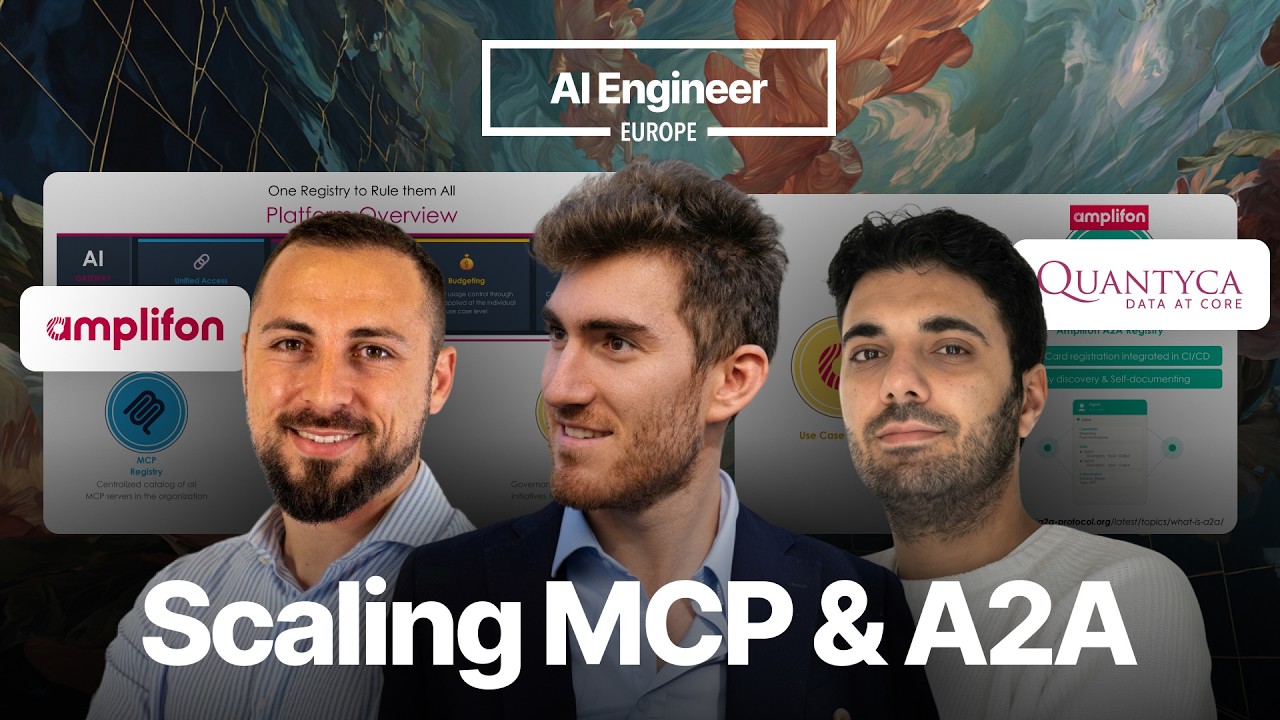
One Registry to Rule them All - Sonny Merla, Mauro Luchetti, & Mattia Redaelli, Quantyca
Apr 10, 2026 · 22:47
Amplifon's AI transformation led to the Amplify program, for which Quantyca built an enterprise-grade registry system for MCP servers and A2A agents. Sonny Merla, Mauro Luchetti, and Mattia Redaelli explain how three registries—MCP, A2A, and use case—are linked via a catalog to provide full lineage, including ownership, environment, authentication, cost attribution, and use case linkage. The solution uses an AI gateway for unified LLM access with Entra ID authentication and budgeting, and provides template repositories on GitHub with CI/CD pipelines that automatically publish agent cards and server metadata to the registries. This enables discovery, governance, and impact analysis across 26 countries and multiple teams, letting developers focus on business logic while avoiding reinventing security and deployment infrastructure.

Contact Center Voice AI: Low-Latency Intelligence Extraction from Messy Audio Streams — Dippu Singh
Apr 8, 2026 · 22:56
Dippu Singh of Fujitsu North America presents an architecture for real-time voice intelligence in contact centers that reduces post-call work by 50% through structured intent extraction from messy audio streams. The pipeline comprises four stages: voice capture with stereo channel splitting and PII masking, speech-to-text with domain-specific dictionaries, a generative AI core that uses system prompts to output separate JSON bullet points for customer intent and operator actions, and a customer data sync layer that maps LLM output to CRM fields via REST APIs. Key results show after-call work (ACW) dropped from 6.3 to 3.1 minutes, while data entry quality became standardized. Current constraints include STT accuracy for heavy accents, API token costs for long transcripts, and security compliance overhead. The roadmap targets explainable AI for agent coaching, predictive staffing from categorized intent data, and real-time abusive-call detection to protect operators.

Shipping AI That Works: An Evaluation Framework for PMs – Aman Khan, Arize
Dec 26, 2025 · 1:26:16
Aman Khan, AI PM at Arize, presents a framework for product managers to evaluate LLM-powered products beyond gut-feel 'vibe checks.' He demonstrates building an AI trip planner with multi-agent LangGraph, then using Arize's tracing and prompt playground to iterate on prompts. Khan shows how to create datasets from production traces, run A/B experiments on prompts, and use LLM-as-a-judge evals for friendliness and discount offers, comparing against human labels to refine evaluators. He argues evals are the new requirements docs, enabling PMs to own the product experience by writing acceptance criteria as eval datasets. The talk covers building eval teams, handling variance with temperature settings, and continuously improving golden datasets with hard examples, citing real-world analogies from self-driving cars at Cruise.
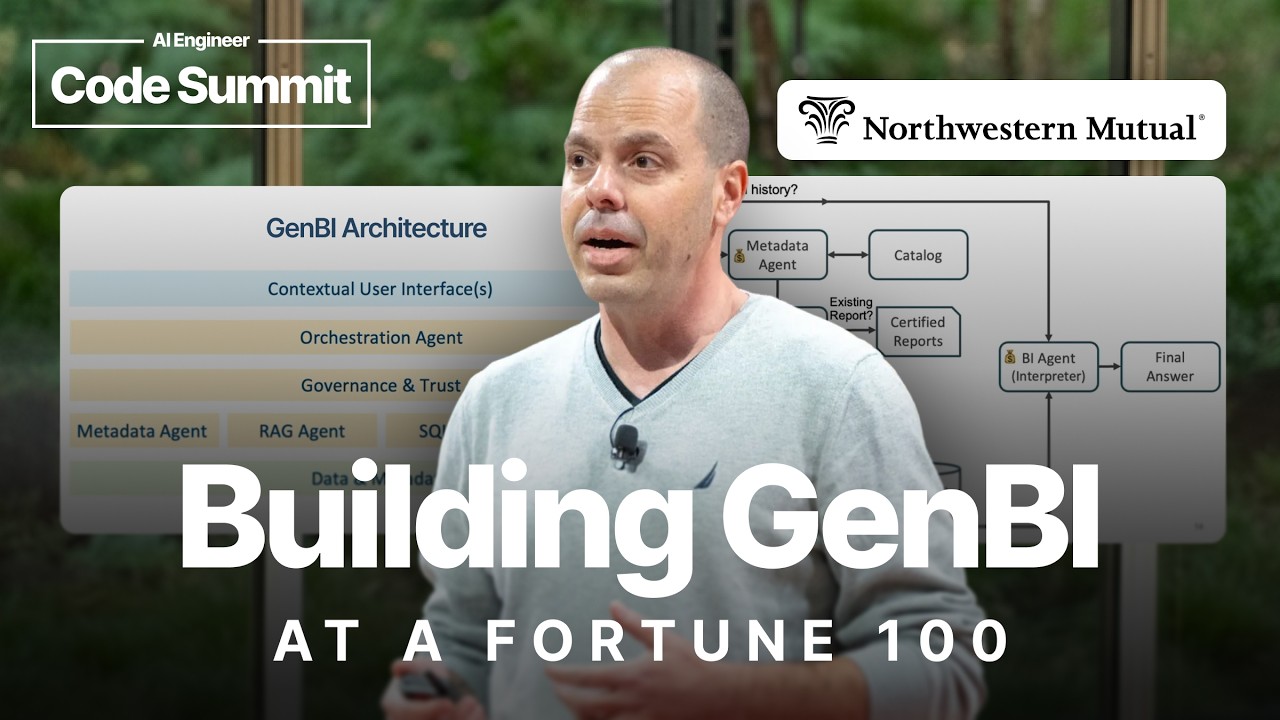
Small Bets, Big Impact Building GenBI at a Fortune 100 – Asaf Bord, Northwestern Mutual
Dec 23, 2025 · 22:50
Asaf Bord, AI Product Lead at Northwestern Mutual, shares how his team built GenBI, an LLM-powered analytics copilot, by flipping the logic from a single big bet to an incremental roadmap of small, fundable projects. Using real, messy data from the 160-year-old company, they deployed a modular architecture with metadata, RAG, SQL, and BI agents, each productizable independently. The RAG agent alone automated 80% of the 20% of BI team capacity spent on finding and sharing reports, saving roughly two full-time employees. Bord explains how a crawl-walk-run release strategy built trust with both users and leadership, starting with BI experts before expanding to business managers, and how each six-week sprint delivered tangible business value—like proving the ROI of enriched metadata through A/B tests against a semantic layer initiative. He also explores the future of SaaS pricing in the GenAI era, questioning whether per-seat models still make sense when individuals become 10x more effective.
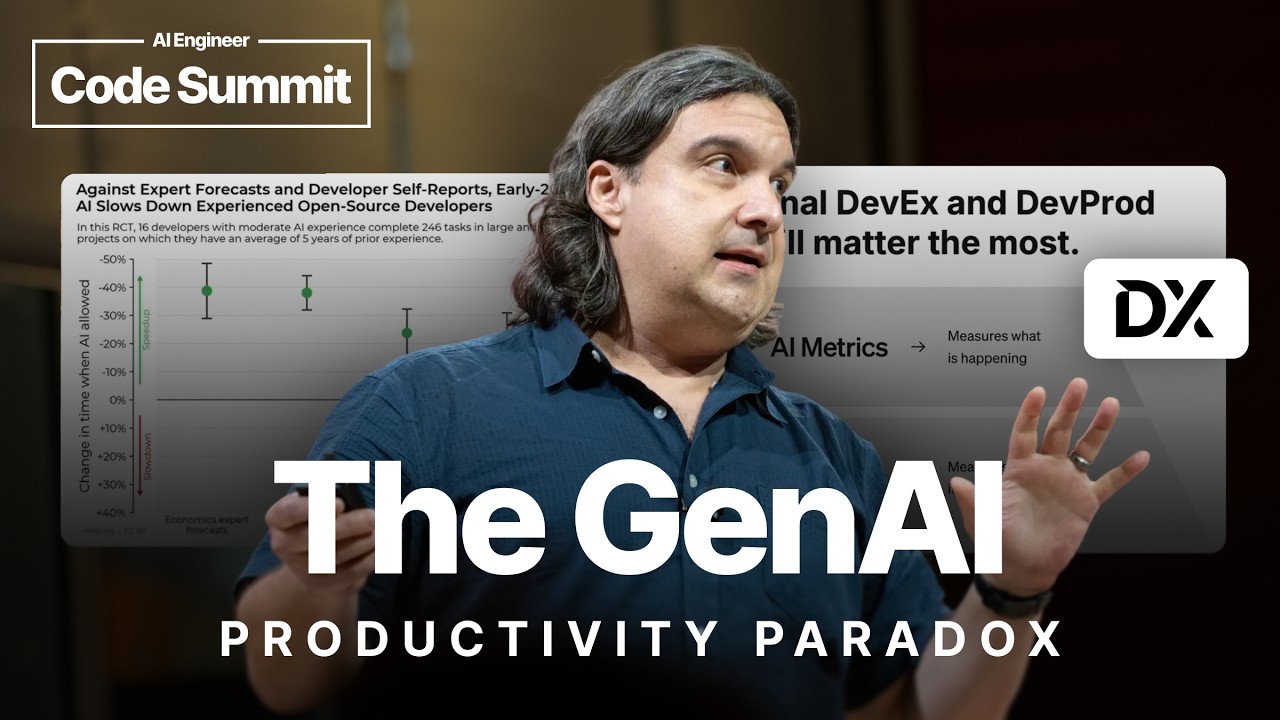
Leadership in AI Assisted Engineering – Justin Reock, DX (acq. Atlassian)
Dec 19, 2025 · 18:11
Justin Reock, Deputy CTO at DX (acquired by Atlassian), argues that AI's impact on engineering productivity varies wildly and that leaders must move beyond top-down mandates to focus on psychological safety, measurement of actual outcomes, and targeted integration across the SDLC. He presents data showing a 2.6% average increase in change confidence but extreme variability across companies, with some seeing 20% drops. Emphasizes that writing code is rarely the bottleneck; instead, leaders should identify and fix bottlenecks like context switching, citing Morgan Stanley's DevGenAI saving 300,000 hours annually by converting legacy code specs and Zapier reducing engineer onboarding to two weeks via AI agents. Introduces DX's AI Measurement Framework covering utilization, impact, and cost, and stresses trust-building through system prompt feedback loops and temperature settings. The episode delivers actionable guidance on measuring AI's true impact and enabling engineers through education, time to learn, and creative unblocking of usage.

AI Consulting in Practice – NLW, Superintelligent, @AIDailyBrief
Dec 18, 2025 · 18:18
NLW, host of the AI Daily Brief and CEO of Superintelligent, presents findings from an ROI survey of enterprise AI adoption, revealing that 44.3% of organizations report modest ROI and 37.6% report high ROI, with 67% expecting high growth next year. Agent adoption jumped from 11% to 42% in 2024, yet only 7% of organizations are fully at scale, and most remain in pilot phases. Time savings accounts for 35% of use cases, but automation and agentic use cases significantly outperform others in self-reported ROI. Risk reduction use cases, though only 3.4% of submissions, are most likely to yield transformational impact at 25%. Larger organizations and those using AI across multiple functions see greater benefits, while coding and software-related use cases show above-average ROI.

Moving away from Agile: What's Next – Martin Harrysson & Natasha Maniar, McKinsey & Company
Dec 12, 2025 · 21:55
McKinsey's Martin Harrysson and Natasha Maniar argue that enterprises must overhaul their people and operating models—moving beyond Agile to AI-native workflows—to capture the full potential of AI in software development. They identify bottlenecks like work allocation, manual code review, and tech debt that limit gains to 5-15% despite promising individual productivity stories. To scale, they advocate AI-native workflows (spec-driven development, continuous planning) and AI-native roles (smaller pods of 3-5 with consolidated roles). In a client study with a bank, interventions led to 60x increase in agent consumption, 51% increase in code mergers, and faster delivery tied to business priorities. They emphasize change management: 70% of companies haven't changed roles, and top performers invest in hands-on upskilling, measurement systems that track outcomes beyond adoption, and incentives to drive adoption.

Can you prove AI ROI in Software Eng? (Stanford 120k Devs Study) – Yegor Denisov-Blanch, Stanford
Dec 11, 2025 · 16:40
Stanford researcher Yegor Denisov-Blanch presents research based on 120,000+ developers across 600+ companies, arguing that AI ROI in software engineering is often negative despite apparent productivity gains. The study finds a median 10% productivity lift from AI, but a widening gap between top and bottom performers. Key drivers include codebase hygiene (environment cleanliness index with R² 0.40) and AI usage quality over volume. A company case study shows pull requests increased 14% but code quality dropped 9% and rework rose 2.5x, yielding no net effective output gain. Denisov-Blanch proposes a measurement framework using a primary metric (engineering output via ML model) paired with guardrail metrics, and emphasizes that companies can retroactively measure impact via git history without waiting for experiments.

AI changes *Nothing* — Dax Raad, OpenCode
Nov 23, 2025 · 16:39
Dax Raad, core contributor to SST and creator of OpenCode, argues that AI changes nothing when building a winning product. In this contrarian talk, he breaks down the three unchanging fundamentals: marketing requires creating things so cool people share them, which AI cannot do because it is too corny; the aha moment demands ruthlessly eliminating friction to get users to that singular moment of understanding, requiring deep taste not algorithmic optimization; retention hinges on building deep primitives first to support power users without sacrificing simplicity for newcomers, a design challenge AI cannot hallucinate. Raad uses examples from ChatGPT's instant aha moment—any input box that responds like a human—and Facebook's poke as a deniable flirting aha moment. He concludes that AI amplifies capabilities but does not save anyone from the hard, creative work of product success.

Form factors for your new AI coworkers — Craig Wattrus, Flatfile
Aug 22, 2025 · 15:35
Craig Wattrus, AI design engineer at Flatfile, argues that designing AI interactions requires treating AI as a new coworker with distinct form factors — invisible, ambient, inline, and conversational — rather than traditional UI. He demonstrates how feeling the material by building tools like a 'chat tuner' to tune AI character shifts from helicopter-parenting to character coaching. Finding the grain involves designing tool UX where AI communicates visually, checks alignment, and hands back control. Courting emergence yields unexpected results: an agent combined two files without being asked and suggested the user contact HR for missing employee IDs. Looking forward, Wattrus explores auto-complete for data transformations, using LLMs to suggest fixes alongside human oversight.

Designing AI-Intensive Applications - swyx
Aug 9, 2025 · 13:02
In this conference talk, swyx (host) proposes the search for a 'Standard Model' in AI engineering, analogous to physics' Standard Model, to guide practitioners. He examines candidate models: LMOS (LLM Operating System), LMSDLC (AI Software Development Lifecycle), and Anthropic's 'building effective agents' framework. Swyx introduces his own SPADE model (Sync, Plan, Analyze, Deliver, Evaluate), derived from building AI News, a daily tool that scrapes Discord, Reddit, and Twitter with thousands of LLM calls. He argues that the ratio of human input to AI output—ranging from 1:1 in ChatGPT to 0:n in ambient agents—is more useful than debating 'workflow versus agent.' The talk emphasizes that early SDLC stages (LLMs, monitoring, RAG) are becoming commodity, while real value comes from evals, security orchestration, and hard engineering. Swyx encourages attendees to identify and refine their own Standard Models to build products people want.

State of Startups and AI 2025 - Sarah Guo, Conviction
Aug 2, 2025 · 23:52
Sarah Guo of Conviction argues that AI's value creation is massive and early, with companies like Cursor reaching $100M ARR in 12 months and Harvey exceeding $70M ARR. She predicts that by end of 2026, AI agents will ship code directly to production, voice AI will replace text for most business communication, and inference costs will drop below a cent per million tokens. Reasoning is a new scaling vector unlocking higher-stakes use cases, and agent startups have increased 50% in the last year. Multimodal models from HeyGen and Eleven are already rocketing past $50M ARR. The model market is more competitive than ever, with GPT-4 costs falling from $30 to $2 per million tokens in 18 months and open-source like DeepSeek competing. Guo advises builders to focus on thick wrappers around LLMs, leveraging domain and workflow knowledge, and warns against generic text boxes: 'The prompt is a bug, not a feature.' Execution, not first-mover advantage, is the moat.

Shipping something to someone always wins — Kenneth Auchenberg (ex. Stripe, VSCode)
Jul 28, 2025 · 16:17
Kenneth Auchenberg, former VSCode and Stripe developer platform lead, argues that great AI products come from rapid iterative loops — shipping continuously viable 'skateboards' to real users rather than aiming for a perfect final product. He advocates for writing launch blog posts before building, working intimately with a few real customers (even texting them), and ignoring constraints like legal initially to design the best product. APIs are harder to change than UI, so early user feedback is critical. In AI, the fundamentals haven't changed: customer knowledge and iteration velocity matter more than ever, even as AI tools accelerate building. The goal should be to run a product feedback loop in under a day.

Why your product needs an AI product manager, and why it should be you — James Lowe, i.AI
Jul 28, 2025 · 18:37
James Lowe, Head of AI Engineering at the UK Government's Incubator for AI, argues that technical expertise makes AI engineers ideal candidates for the critical role of AI Product Manager, which balances business viability, technological feasibility, user desirability, and the core question of possibility. He shares three hard-won lessons from building products like CONSULT, Minute, and Redbox: resolve AI uncertainties early with evaluations and real-user tests (achieving 1,000x faster and 400x cheaper consultation analysis), experiment widely with features then cut back (streamlining a transcription tool from overwhelming options to a focused Justice Transcribe used for Prime Ministerial meetings), and pivot harder than ever as the landscape shifts (Redbox evolved from digitizing ministerial red boxes to a secure LLM chat client, then to an MCP-based tool provider when Microsoft Copilot Chat went free). The episode emphasizes that AI product management is a mindset, not just a title, and that engineers should step into this leadership gap to build impactful AI products.

Everything is ugly, so go build something that isn't — Raiza Martin, Huxe (ex NotebookLM)
Jul 28, 2025 · 25:15
Raiza Martin, former lead of Google's NotebookLM and founder of Huxe, argues that the current chaotic phase of AI product design is a once-in-a-career opportunity to rebuild from first principles, calling everything we use 'the ugliest that it will ever be.' Drawing from her experience forcing NotebookLM into existence against skepticism, she emphasizes that personal clarity of vision fuels product building, and purpose must be relentlessly focused on a single outcome—for NotebookLM, enabling users to upload 50 files and interact with them. She stresses earning trust by nailing deterministic behavior first, noting that 90% of first queries were summarization and failures drove users away forever, then layering on delightful probabilistic features like podcast generation. Finally, she warns against the 'kitchen sink' approach, citing her own Huxe app that did everything but users only used one feature, advocating restraint as an innovation multiplier and focus on one excellent outcome to avoid building ugly products.
The AI Engineer’s Guide to Raising VC — Dani Grant (Jam), Chelcie Taylor (Notable)
Jul 27, 2025 · 34:17
Dani Grant (CEO of Jam) and Chelcie Taylor (Notable Capital) give AI engineers a tactical playbook for raising venture capital, arguing that you don't need revenue, a product, or even to leave your full-time job to raise a pre-seed or seed round. They explain that VCs bet on founders' vision and unique insights, not perfect technology or traction, and share real cold emails that led to investments—including one that simply referenced a blog post and another that didn't mention the startup at all. In pitch meetings, they advise focusing on 'why you, why now' over tech deep dives, making the conversation bidirectional, and ending by asking about next steps. Common mistakes include over-engineering the demo, failing to acknowledge competitors, and not having a prepared pitch deck to send afterward. Grant's original Jam pitch deck is still live at deck.jam.dev. Taylor's contact is ctaylor@notablecap.com.
Building AI Products That Actually Work — Ben Hylak (Raindrop), Sid Bendre (Oleve)
Jul 24, 2025 · 18:42
Ben Hylak (Raindrop) and Sid Bendre (Oleve) argue that building reliable AI products requires iterative real-world signals over traditional evals. Ben debunks eval myths—evals don't measure product quality, LLM-as-judge fails, and production evals are costly—and stresses tracking explicit signals (thumbs up/down, copy rate) and implicit signals (refusals, frustration) to identify issues. Sid introduces Trellis, a framework for scaling viral AI apps that uses discretization—breaking infinite output into intent buckets—prioritization by volume times negative sentiment times achievable delta, and recursive refinement. Starting with an MVP, teams classify user intents, convert them into semi-deterministic workflows, then repeatedly drill into sub-intents to engineer repeatable, attributable magic. Oleve's approach, powered by Raindrop, has scaled six viral products to $6M ARR profitably with four people.
Rise of the AI Architect — Clay Bavor, Cofounder, Sierra w/ Alessio Fanelli
Jul 24, 2025 · 18:55
Clay Bavor, cofounder of Sierra, and Alessio Fanelli discuss the rise of the AI Architect—a new role combining technology, brand, and business outcomes to build customer-facing AI agents. Sierra serves hundreds of millions of consumers this year. Bavor defines the AI Architect as wearing three hats: understanding AI capabilities, defining the agent's voice (e.g., Chubbies' irreverent Duncan Smothers), and driving business outcomes. Successful AI Architects embrace risk, start with narrow problems like processing a single return, and re-architect teams to coach the AI. On build vs. buy, Bavor warns of the "agent iceberg"—hundreds of hidden complexities like regression testing and model migration. He advises tracking model improvement in a Google Doc and anticipating future capabilities, predicting glasses as the ultimate interface for trusted personal AI.

AI That Pays: Lessons from Revenue Cycle — Nathan Wan, Ensemble Health
Jul 24, 2025 · 18:19
Nathan Wan, head of AI at Ensemble Health Partners, argues that Revenue Cycle Management (RCM) is a critical yet overlooked domain for AI disruption in healthcare, where 40% of hospitals operate at negative margins due to broken manual financial processes. He explains that RCM's vast structured and unstructured data, rule-based workflows, and direct financial impact make it ripe for AI, contrasting it with more publicized clinical AI applications. Wan details how Ensemble uses AI to predict and prevent claim denials—often caused by technical errors like missing data—and to accelerate clinical denial appeals via GenAI, achieving a 40% reduction in processing time and improved overturn rates. He emphasizes that Ensemble's end-to-end view of the revenue cycle, supported by their EIQ data platform, enables longitudinal error correction and agent-driven automation, turning upstream fixes into measurable ROI for providers facing increasing payer denial rates.
Structuring a modern AI team — Denys Linkov, Wisedocs
Jul 24, 2025 · 17:40
Denys Linkov, who leads ML at Wisedocs, argues that building a modern AI team hinges on identifying your company's bottleneck—shipping features, acquiring users, or scalability—rather than reflexively hiring AI researchers. He introduces Ampere's Wager: trading your entire domain-savvy team for five top-lab researchers is usually a losing bet. For early-stage AI strategy, generalists who blend model training, serving, and business acumen outperform specialists; Linkov lived this in 2021 building a custom MLOps platform for a conversational AI startup and again in 2024 using advanced open-source tools for medical record processing. He stresses reskilling existing teams through weekly learning cadences and moving domain experts from giving feedback to writing evaluations. Hiring should hold context and act on it, verifying trends like 'don't hire juniors' against YC's AI school drawing 2,000 young people.

The Rise of Open Models in the Enterprise — Amir Haghighat, Baseten
Jul 24, 2025 · 16:50
Amir Haghighat, CTO of Baseten, argues that enterprises are increasingly moving from closed frontier models like OpenAI and Anthropic toward open source models, driven by four specific cracks in the assumption that closed models will work indefinitely: quality for specialized tasks (e.g., medical document extraction), latency requirements (especially for voice), unit economics ballooning from agentic use cases where a single user action triggers 50 inference calls, and the desire for competitive differentiation. Drawing on conversations with over 100 enterprises, he explains that while most started with dedicated deployments on Azure/AWS for toying around in 2023, by 2024 about 40-50 had production use cases, and in 2025 the shift accelerated. However, adopting open models forces enterprises to build inference infrastructure, facing challenges like speculative decoding, prefix caching, guaranteeing four-nines reliability with hardware failures and VLM crashes, and scaling replicas—with one Fortune 50 soft drink company reporting an eight-minute spin-up time. Haghighat concludes by contrasting the simple API-call world with the complexities of mission-critical inference, where…
Monetizing AI — Alvaro Morales, Orb
Jul 23, 2025 · 18:18
Alvaro Morales, CEO of Orb, argues that traditional subscription-based SaaS pricing fails for AI products due to rapid cost fluctuations, margin pressures, and customer demand for clear ROI. He presents three frameworks: decide between direct monetization (add-on, bundled) or indirect (free to drive upsells) using examples like GitHub Copilot, Notion AI, and Expedia; select a value metric from resource-based tokens (Vercel's v0) to task-based (Zapier) to outcome-based pricing (Intercom's Fin at $0.99 per resolved ticket); and embrace continual experimentation, as AI pricing cycles shrink from years to months. To reduce pricing guesswork, Orb built Simulations, a tool that lets companies backtest alternate pricing strategies on real usage data from closed betas before launch, helping teams like Replit and Perplexity optimize revenue without risking customer trust.
How agents will unlock the $500B promise of AI - Donald Hruska, Retool
Jul 23, 2025 · 16:22
Donald Hruska, engineering lead for Retool's Agents product, argues that AI agents will unlock the $500B promise of AI by moving enterprises beyond toy chatbots into production-grade systems. He explains that building a basic agent is easy (e.g., 100 lines of code using React) but getting it into production requires solving security, cost overruns, observability, and compliance. Hruska outlines four options—build from scratch, use a framework like LangGraph, a managed platform like Retool Agents, or verticalized agents—and advises building for core differentiators and buying for commodity workflows. He cites Retool customers like ClickUp saving over $200,000 in vendor costs and Descript saving hundreds of hours weekly, while noting inference costs dropped 99.7% from 2022-2024. Retool charges $3 per hour for its cheapest agent and supports on-prem deployment.

From Hype to Habit: How We’re Building an AI-First SaaS Company—While Still Shipping the Roadmap
Jul 23, 2025 · 19:29
Rossella Blatt Vital and Deepsha, AI leaders at Sprout Social, share a candid, real-time look at transforming a SaaS company into an AI-first organization, arguing that the journey is messy, non-linear, and requires evolving across strategy, ways of working, and people. They explain that being AI-first means shifting from adding AI to existing features to reimagining entirely new experiences, while managing the innovator's dilemma of balancing current customer needs with future investments. Key shifts include adopting ritualized discovery—making experimentation a repeatable process—and embracing 'smart velocity' (speed with purpose) over chaotic fast shipping. On the people side, they advocate for T-shaped talent (deep expertise plus broad vision) and building org-wide AI fluency so every team feels empowered to use AI. Despite the disruption, they emphasize that fundamentals like solving real customer problems, user experience, and trust remain non-negotiable. The talk provides a practical framework but no simple playbook, encouraging leaders to start with the right questions and the conviction to evolve.

Machines of Buying and Selling Grace - Adam Behrens, New Generation
Jul 23, 2025 · 19:37
Adam Behrens, CEO of New Gen, argues that AI will transform commerce from static websites to agentic interactions where buyer and seller agents negotiate via intent infrastructure. He traces the evolution from clerk-assisted stores to e-commerce, now to AI-natives where ChatGPT and Claude act as shopping interfaces. Behrens details three challenges: payment delegation (solved via Viza's delegated authentication), product discovery (a unified API akin to Plaid for merchants), and preference representation (two-sided, dynamic, with market-design solutions). He cites Samsung's adoption of an MCP server for chat clients and notes that AI-sourced users convert at higher rates. Behrens predicts revenue sharing via affiliate models and that agents may bypass credit cards for stablecoins, while merchants retain control by embedding transportable data into model providers' surfaces.

POC to PROD: Hard Lessons from 200+ Enterprise GenAI Deployments - Randall Hunt, Caylent
Jul 23, 2025 · 19:16
Randall Hunt from Caylent shares hard lessons from over 200 enterprise GenAI deployments, arguing that evals, embeddings, and prompt engineering matter far more than fine-tuning. He emphasizes that speed and UX are critical; a slow inference kills adoption, while techniques like generative UI and caching can mitigate latency. Hunt details real-world examples: using audio amplitude spectrographs for sports highlight reels, pooling multimodal embeddings for nature footage search, and noting that nurses prefer chat over voice bots in noisy hospitals. He reports zero regressions moving from Claude 3.7 to 4, and advises optimizing context and economics, such as leveraging Amazon Bedrock batch for 50% cost reduction. The talk underscores that knowing your end customer and minimizing irrelevant context are key to production success.

Build Dynamic Products, and Stop the AI Sideshow — Eliza Cabrera (Workday) + Jeremy Silva (Freeplay)
Jul 23, 2025 · 18:10
Eliza Cabrera (Principal AI Product Manager at Workday) and Jeremy Silva (Product Lead at Freeplay) argue that companies must stop treating AI as a separate 'sideshow' and instead deeply integrate it into product strategy using a crawl-walk-run approach to build dynamic, differentiated experiences. They explain that bolt-on AI products result from centralized AI strategies quarantined from core product, leading to features like chatbots that demonstrate capability but don't solve real customer problems. Workday's example shows starting with Gen AI content generation and translations for knowledge bases (crawl), then a contextually aware assistant that processes PII (walk), and finally agentic capabilities that autonomously act on policy changes (run). The north star is AI products that feel like natural, cohesive parts of the experience, not bolt-on enhancements.
The Billable Hour is Dead; Long Live the Billable Hour — Kevin Madura + Mo Bhasin, Alix Partners
Jul 23, 2025 · 17:04
Kevin Madura and Mo Bhasin from AlixPartners argue that AI is reshaping knowledge work by compressing upfront data ingestion from 50% to 10-20% human effort, enabling analysis of 100% of data rather than the top 20%. They detail three use cases: categorization via structured outputs achieving 95% accuracy on 10,000 vendors in minutes; enterprise-scale RAG that democratizes access to siloed data by teaching LLMs to call APIs; and structured extraction from documents using schemas and log-prob-based confidence scoring. They caution that AI investments face a paradox—89% of CEOs plan agentic AI but NBER finds no earnings impact—and stress that success requires people skills, demos, and a focus on NPS and ROI over chasing shiny new tools. The episode concludes that once Excel-powered LLMs work reliably, AGI will be here.

How to Hire AI Engineers when EVERYONE is cheating with AI — Beth Glenfield, DevDay
Jul 22, 2025 · 6:45
Beth Glenfield, from DevDay, argues that AI has broken technical hiring because candidates cheat with AI tools, making LeetCode puzzles obsolete, and small companies are crushed in the talent war with big tech. She cites the AI cheating service CLUI, which raised $5.3M and is heading toward $1M ARR, and notes 93% LeetCode wizard success rates for Google/Meta interviews, with 1 in 3 interviews now using AI assistants. Instead of puzzles, she proposes real-world workplace simulations where candidates collaborate with AI agents (perfectionist, pragmatist, etc.) to measure skills like handling ambiguity, mentoring, and business judgment. She highlights that big tech can brute-force hiring (100 candidates for 5 hires), but startups cannot afford bad hires costing $20k-$60k. Referencing Mark Zuckerberg's prediction that AI will handle mid-level engineering and Marc Benioff's announcement that Salesforce won't hire software engineers due to a 30% productivity boost from AI, Glenfield argues engineering jobs now require creativity, collaboration, and working with AI rather than being replaced by it.

Books reimagined: AI to create new experiences for things you know — Lukasz Gandecki, TheBrain.pro
Jul 22, 2025 · 9:44
Łukasz Gandecki of TheBrain.pro presents Books Reimagined, an AI-powered reading companion that adds music, graphics, and conversational AI to books like '1984' and 'The Snow Queen', arguing that AI can create magical experiences by hiding itself behind a polished user interface. He started by vibe-coding a companion for a Trump reelection book to track characters, then iterated into a full multimedia reader. He demonstrates features including 100-millisecond voice response, natural language search via embeddings, and deep research that scans the entire book. Gandecki emphasizes that human curation of AI-generated music and graphics is essential for quality, and he is open-sourcing the player at bookgenius.net.

Critical AI Inference your CIO can Trust — Sahil Yadav, Hariharan Ganesan, Telemetrak
Jul 22, 2025 · 19:04
Sahil Yadav and Hariharan Ganesan of Telemetrak present a three-pillar framework—explainability, adaptive guardrails, and human-in-the-loop on a foundation of traceability—to operationalize trust in enterprise AI inferences, arguing that without these, silent failures can cost millions. They introduce XTOPS as an integrated upgrade to MLOps, with trust-specific dashboards and dynamic guardrails. A case study of GuardHat, a worker safety platform, shows how GPS drift caused 70% false positives; applying XTOPS reduced resolution time from eight months to seven days. They propose metrics MTTRE (mean time to resolve explainable errors) and trust-adjusted risk in dollars, and demonstrate convincing CIOs by quantifying savings, e.g., $500K per site per year in fines avoided.

Excalidraw: AI and Human Whiteboarding Partnership - Christopher Chedeau
Jul 21, 2025 · 16:59
Christopher Chedeau, creator of Excalidraw, explains how to integrate AI into whiteboarding by focusing on turning prompts into editable diagrams rather than static images. He argues that just adding any AI model harms the product, citing a failed attempt to generate realistic images because users don't draw realistically. The successful integration uses Mermaid.js to output Excalidraw files, letting humans modify the AI-generated diagram. He envisions a future of iterative human-AI collaboration, and demonstrates other practical features like auto-naming files, generating illustrations (coming soon), and challenges AI engineers to build a browser-based logo background remover. He concludes that the industry is in a physical-to-virtual transition for AI, and that LLMs work best when targeting a structured domain-specific language.

The Bitter Layout or: How I Learned to Love the Model Picker — Maximillian Piras, Yutori
Jul 21, 2025 · 14:24
In this talk, Maximillian Piras argues that conversational interfaces remain dominant in AI apps not because they are natural, but because they are 'conformable' — able to absorb the next model's capabilities without redesign. He calls this pattern 'The Bitter Layout': an input field, turn-by-turn flow, and a model picker, which prioritizes flexibility over usability. Applying Clayton Christensen's theory of commoditization, Piras claims that as long as scaling laws keep models from commoditizing, the interface itself is the commodity, and designers must conform to the next model. He traces the debate over chat UX from Linus Lee (2022) to Julian Lear (2024), and criticizes the model picker as a 'mode selector' that creates usability issues. Looking ahead, Piras suggests designers shift from procedural thinking to setting goals and constraints, and speculates that future AI UX will be 'grown' like a garden rather than built.

Good design hasn’t changed with AI — John Pham, SF Compute
Jul 21, 2025 · 20:25
John Pham of SF Compute argues that good design principles—speed, trust, accessibility, and delight—remain unchanged even with AI. He demonstrates these through SF Compute's onboarding, which loads in under 300ms using server-side rendering and a 14KB fog image animated with stacked transparent layers and no third-party JavaScript, respecting reduced motion preferences. Trust is built by setting clear expectations (e.g., '3 steps, under a minute'), auto-filling forms via browser autocomplete, and avoiding layout shifts. Delight comes from color psychology to slow users, peak-end bias (ending with a beautiful San Francisco scene), and the GPU habitat: a live video feed of GPUs implemented as stacked divs and a looping video, with a prediction cone that smooths nested menu interactions. Accessibility includes semantic HTML, screen reader testing, and pausing animations for reduced motion. These techniques turn users into super fans while growing total addressable market.

Shipping an Enterprise Voice AI Agent in 100 Days - Peter Bar, Intercom Fin
Jul 18, 2025 · 17:10
Peter Bar, Product Lead at Intercom, details the 100-day build of Fin Voice, an AI voice agent for enterprise phone support. The agent handles knowledge-based queries using a stack of speech-to-text, LLM, text-to-speech, RAG, and telephony, achieving ~1 second latency for simple queries and using filler phrases for longer ones. Key product decisions included focusing on out-of-office hours as an initial wedge, designing conversations for voice differences like answer chunking, and prioritizing integration with human support workflows over model improvements. The team measured success via resolution rate (user confirming resolution or not calling back within 24 hours) and used an LLM-as-judge for quality analysis. Bar argues that voice AI is the next frontier in customer service, citing cost reduction from $7–12 per human-handled call to 3–20 cents per minute with AI.

Teaching Gemini to Speak YouTube: Adapting LLMs for Video Recommendations to 2B+DAU - Devansh Tandon
Jul 16, 2025 · 22:51
Devansh Tandon, a Product Manager at Google leading YouTube's discovery system, details how YouTube adapted Gemini LLMs to power its recommendation engine for billions of daily active users. The team built SemanticID, a tokenization system that compresses video features into semantically meaningful tokens, creating a new language for YouTube content. They then continued pre-training Gemini on sequences of user watches to make the model bilingual in English and this video language. For generative retrieval, they prompt the adapted model with user demographics and watch history to output video recommendations as SemanticIDs, achieving 95%+ cost savings to serve at scale. Challenges include serving billions of users with low latency and handling video freshness—Taylor Swift's new music video must be recommendable within minutes. Tandon argues LLM-led recommendations are a bigger consumer application than search and hints at future interactive, steerable recommendations and even personalized content creation.

Rethinking Team Building: how a 30-person Startup serves 50 Million Users — Grant Lee, Gamma
Jul 15, 2025 · 18:06
Grant Lee, CEO of Gamma, explains how his 30-person team serves 50 million users by ditching blitzscaling for lean teams of generalists and player coaches. He argues that hiring generalists—like his head of design who codes, researches UX, and mentors—enables rapid adaptation. Player coaches, such as engineering leads who still write code, make fast technical trade-offs without top-down mandates. Scaling with brand and culture, Gamma invests in a living culture deck and three weekly all-hands meetings to maintain tribal knowledge. In Q&A, Lee advises doing the job yourself before hiring for non-engineering roles, probing for high agency by asking candidates to drill into problem layers, and using work trials (five successes, high failure rate without) to avoid mismatches. He also wishes they had prioritized infrastructure for experimentation earlier given AI's speed.

Building a 10 person unicorn - Max Brodeur-Urbas, Gumloop
Jul 15, 2025 · 12:03
Max Brodeur-Urbas, founder of Gumloop, explains how his company scaled to millions in ARR as a team of two that raised a Series A and grew to only nine people, by being super picky in hiring, using product-led hiring where customers like those from Instacart and Webflow join the team, and requiring work trials such as hacking together in Airbnbs. They eliminate almost all meetings to give engineers deep focus time and automate every internal process with Gumloop itself, from customer research reports to chatbot monitoring. Culture-wise, they balance intense 45-minute shipping challenges with fun retreats and a public company handbook. Brodeur-Urbas argues that every hire must be a no-brainer, and small teams can outpace larger ones by avoiding meetings and leveraging AI tools.

Bolt.new: How we scaled $0-20m ARR in 60 days, with 15 people — Eric Simons, Bolt
Jul 15, 2025 · 17:33
Eric Simons, CEO of Bolt.new, explains how his team of less than 20 people scaled the company from $0 to $20M ARR in just 60 days, achieving the second fastest product growth in history by staying lean and focusing on high-impact decisions. He describes building a remote team with high context and agency, resisting pressure to hire more during the 2021 boom. They relied on 'things that don't scale' like weekly office hours to build user love, and leveraged AI support tools like PeraHelp to handle 90% of tickets. Community initiatives such as a Guinness World Record hackathon (over 80,000 participants) further amplified growth without adding headcount. Simons emphasizes taking consistent shots on goal and making independent bets rather than following VC trends.

Survive the AI Knife Fight: Building Products That Win — Brian Balfour, Reforge
Jul 14, 2025 · 14:10
Brian Balfour, CEO of Reforge, argues that winning in today's AI knife-fight requires answering 'What do I build and why will it win?' by focusing on proprietary data, unique functionality, and unmet customer needs rather than building custom AI. He illustrates with Granola, which entered a crowded AI note-taker market by understanding users wanted help taking better notes, not full automation, and assembled off-the-shelf AI (DeepGram, Anthropic, OpenAI) with unique data (user notes plus transcription) and functionality (Mac app, calendar integration) to create a competitive edge. Balfour warns competitive advantages now last only 2-3 weeks, so teams must sequence smaller moats continuously, each buying time to execute faster. The talk emphasizes treating AI as Lego blocks—assembling pre-trained models, data, and product superpowers into a system that spins a data flywheel.

A year of Gemini progress + what comes next — Logan Kilpatrick, Google DeepMind
Jul 10, 2025 · 11:58
Logan Kilpatrick, head of product for Google AI Studio at DeepMind, announces the final update to Gemini 2.5 Pro, which achieves state-of-the-art results on Aider and HLE benchmarks. He details Google's 50x increase in AI inference over the past year, driven by merging research and product teams into DeepMind. The episode outlines Gemini's evolution toward a universal assistant that unifies Google products, with upcoming features including proactivity, native audio and video capabilities (Veo), and smaller models. Kilpatrick also previews developer-focused updates: a SOTA embeddings model, a deep research API, and Veo 3 and Imagine 4 in the API, alongside repositioning AI Studio as a dedicated developer platform.
The Build-Operate Divide: Bridging Product Vision and AI Operational Reality
Jul 2, 2025 · 12:50
Jeremy Silva (Freeplay) and Chris Hernandez (Chime) argue that the biggest challenge in generative AI isn't building prototypes but crossing the 'quality chasm' from v1 to reliable v2 through operational iteration. They explain how the lower barrier to entry and faster iteration speed in Gen AI accentuate the need for high-quality ops, where product quality becomes a direct function of how fast teams move through monitoring, experimentation, and evaluation loops. Chris emphasizes that human-in-the-loop isn't just a safeguard but a feedback engine, and that existing QA and CX teams in operations are already equipped to become 'model shapers'—labeling data, testing prompts, and defining what good looks like. Jeremy introduces the emerging role of the 'AI quality lead,' a systems thinker who can run experiments and evaluations without writing production code. They conclude that scaling Gen AI is an operational and people challenge, not just a technical one, and that embedding quality and human feedback early is the key to building faster and better.

The New Lean Startup — Sid Bendre, Oleve
Jul 1, 2025 · 13:26
Sid Bendre, co-founder of Oleve, explains how his tiny team of four scaled a profitable, multi-product portfolio to $6M ARR by embracing a 'new lean startup' philosophy centered on AI tooling, operating principles, and organizational structure. Oleve's two products hit the top 10 in the App Store Education charts, competing with Duolingo and Photomath, with one reaching #4 in 2024 and #5 in 2025. Bendre details three pillars: operating principles like hiring only 10x generists, a profit-first mentality, and continuous process refinement; organizational structure modeled after Palantir's Harvester-Cultivator split, where Harvesters own product metrics and Cultivators build an agentic operating system; and AI tooling augmentation that turns 10x engineers into 100x. He shares how they repurpose tools like LaunchDarkly for load balancing and on-the-fly infrastructure changes, and invest in blueprints—reusable code templates and shared infrastructure—that enabled a third product to launch in three weeks and become profitable immediately. The episode culminates in Oleve's vision of one-person billion-dollar companies, where a single strategic leader commands clusters of autonomous…
Building agent fleet architectures your CISO doesn't hate — Lou Bichard, Gitpod
Jun 27, 2025 · 13:52
Lou Bichard explains how Gitpod evolved from a managed SaaS to a 'bring your own cloud' architecture that satisfies CISOs in regulated industries by running secure dev environments—and now agent fleets—on customer infrastructure via a simple runner (a single ECS task) instead of complex Kubernetes. The platform, used by banks and healthcare firms for 37 hours per week per developer, reduces operational overhead through a cloud-formation-based setup that takes three minutes. For agents, the same infrastructure provides source code access and audit logging, ensuring privacy and compliance. Bichard argues that vendors should simplify architectures to lower customers' day-two costs, and advises buyers to prioritize security and ownership models when selecting AI tools.

Revenue Engineering: How to Price (and Reprice) Your AI Product — Kshitij Grover, Orb
Jun 27, 2025 · 15:39
Kshitij Grover, CTO of Orb, argues that AI-native pricing treats monetization as a first-class engineering concern, with pricing acting as a form of friction that must balance value delivery, audience, and rapidly changing margins. He walks through examples like Replit’s multi-tier transparent pricing with a free tier to prove value before charging, Unify’s higher price point and credit-based model to signal enterprise readiness, and Cloudflare’s charging for CPU milliseconds rather than wall time to pass on architectural advantages. Grover explains that margins are not fixed; companies should protect against degenerate workloads with guardrails rather than linear scaling, as Jasper did by going unlimited after switching models seamlessly. He emphasizes flexibility, noting Orb customers make price changes two to three times a month, and advises simulating pricing impacts on different usage cohorts. Predictions include price wars, convergence toward effectively unlimited plans with caps, more real outcome-based pricing with clear SLA definitions, and real-time spend visibility with agent prompts estimating credit usage.

Are MCPs Overhyped? A Rant about MCPs — Henry Mao, Smithery
Jun 3, 2025 · 7:29
Henry Mao, founder of Smithery and MCP steering committee member, argues that despite MCPs standardizing AI agent-service connections, the ecosystem faces fragmentation, high-friction installation, security, and monetization problems. Users struggle with unreliable MCP servers and complex five-step installs, while developers face hosting challenges, lacking tooling, distribution hurdles, and unclear monetization. Smithery aims to solve these as an AI gateway, demoing an agent that finds GitHub issues and creates Linear tickets using curated MCPs. Mao envisions a future dominated by tool calls where agent experience trumps user experience.

The Agent Native Company — Rick Blalock, Agentuity
Jun 3, 2025 · 20:58
Rick Blalock of Agentuity argues that an agent-native company, built from the ground up with AI agents at the core of product, operations, and culture, is fundamentally different from an AI-enhanced one that merely uses AI as a tool. He contrasts the two: removing agents from an agent-native company would halt productivity, while an AI-enhanced business would just become less efficient. Blalock describes the agent-native workday, where humans oversee agents that handle routine tasks, and notes the rise of roles like 'Agent Manager' and the importance of AI fluency in hiring. He shares how his 7-person team built an entire agentic cloud infrastructure in weeks using agents like Devin, arguing that this paradigm shift requires founders to rethink org charts, roles, and skills. The episode concludes that businesses must decide whether they are just using AI or ready to be built around it.
Agentic Enterprise - What your CEO must know about AI - Hubert Misztela
Jun 3, 2025 · 28:04
Hubert Misztela, an AI research lead at Novartis, argues that organizations may be run by AI agents within three years and must pivot from traditional roles to persona-based workflows to harness agentic automation. He explains that AI agents glue multiple cognitive steps, automating workflows where only humans could operate. Understanding deep context around each workflow is crucial, as this knowledge is often undocumented. Misztela introduces five employee personas (silent achiever, individual contributor, connector, multiplier, knowledge hub) to project how agents merge tasks, magnify impact, and replace roles. He warns that intelligence and domain knowledge become cheap commodities, so companies need multidisciplinary or deeper specialization, and new roles like workflow miner will emerge. Employees must build their own agents using no-code tools, and ethical questions around value alignment remain.

From PM at Stripe to Building an AI startup, a recent founder's journey - Mounir Mouawad
Jun 3, 2025 · 11:59
Mounir Mouawad, CEO and co-founder of Porsche AI, explains how building an AI startup differs from product roles at Stripe, Google, and Amazon, using video game analogies. He argues user problems are an 'emergent property' requiring hypothesis-driven iteration rather than conventional roadmaps. Product development is gratifying with releases in hours or days, but velocity is a 'stable stick' as opportunities like MCP come and go quickly. The hardest part is outreach without big brand support—like playing Crash Bandicoot without boosters—so he finds people followers, advocates, and partnerships (e.g., with Browserbase) essential. He asks listeners to star Porsche AI's GitHub repo.

My AI Thinks I'm Eating My Feelings (and Other Nutritional Insights) - Rami Alhamad
Jun 3, 2025 · 9:59
Rami Alhamad, founder of Alma, presents the AI nutrition companion that simplifies food tracking through voice, text, and photo inputs, using LLMs broken into sequential steps to deliver near-instant feedback. AlmaScore, developed with Harvard’s Dr. Eric Krim, rates meals out of 100 based on nutritional quality. The system learns user preferences continuously via a knowledge dataset and proactively surfaces insights like pairing blueberries with dark chocolate to boost vitamin C absorption. Rami emphasizes that real-time user feedback (a 'How did Alma do?' prompt) outperforms evaluation benchmarks, and that brand design, trusted partnerships, and community-generated data are key differentiators as foundation models commoditize code.
Invisible Users, Invisible Interfaces: Accelerating Design Iteration with AI Simulation - Alex Liss
Jun 3, 2025 · 12:37
Alex Liss, VP of Data Science and AI at Huge, argues that AI should be used as a tool for design itself rather than as a feature, proposing Intelligent Twins—AI simulations of user personas—to accelerate needfinding and interface testing. Citing a trust gap where only 32% of US adults trust AI, he advocates for repairing it by designing better interfaces, not adding chatbots. He demonstrates a global audit of sports websites (NBA, Olympics, Premier League) where Intelligent Twins simulated casual and super fans across 72 tasks, revealing strong navigation but declining performance in information architecture and engagement. The methodology uses computer use agents for visual evaluation and human-in-the-loop review to generate focused design briefs. Limitations include reproducibility and the need for test-and-control validation, with future potential in integrating MCP protocol for turning Figma components into code. Liss concludes that AI simulation can help teams gather insights faster and create simpler, trustworthy interfaces.
Stop Ordering AI Takeout A Cookbook for Winning When You Build In House - Jan Siml
Jun 3, 2025 · 10:45
Jan Siml argues that small in-house teams can generate millions in revenue by focusing on one job-to-be-done, tracking dollar outcomes, and pushing proactive insights instead of chasing multi-agent systems and expensive models. Over 10 sprint weeks with two developers, his team built a sales alert system driving several million dollars ARR. He shares five lessons: go deep on one value event, trace everything to revenue (offline evals never sign contracts), push insights proactively (daily digests had 20-point higher NPS than chat UI), convert time saved into guided action, and invest in data and UX over bigger models (changing models only affected costs and evals, not user outcomes). Owning data and tight feedback loops create a revenue flywheel.

Unlocking Africa's Potential with AI — Thabang Ledwaba
Jun 3, 2025 · 26:17
Thabang Ledwaba argues that Africa, often seen as a latecomer to AI, actually has immense potential to lead in AI-driven innovation by leveraging its unique challenges and creativity. He points to Kenya's third-highest daily ChatGPT usage and fintech successes like M-Pesa as evidence of immersion in technology. Criticizing over-engineered solutions, he contrasts ticket systems for home office queues with his idea to auto-initiate ID applications at age of eligibility. He highlights Africa's 30% of earth minerals, noting the irony of exporting raw materials only to import finished goods, and calls for a mindset shift akin to China's 'serve yourself first' strategy. Ledwaba showcases African innovations like Nigerian pharma wings and Moroccan Project Cumulus, urging Africans to see themselves as producers, not just consumers, and to harness AI for sustainable development.

ChatGPT is poorly designed. So I fixed it
Jun 3, 2025 · 5:21
Ben Holmes critiques ChatGPT's confusing design, calling it a case of 'shipping the org chart' where voice and text features feel like separate apps. He demonstrates a fix by building FixGPT, an app that allows simultaneous voice and text interaction and smartly routes requests to the right model via tool calls. Using off-the-shelf APIs like 4.0 real-time and simple prompts, Holmes shows how a 'send chat message' tool enables detailed text responses alongside voice, while a reasoning model tool handles complex queries. The source code is available on GitHub, showcasing how to avoid OpenAI's science fair of options.

Designing AI To Scale Human Thought — Jun Yu Tan, Tusk
Jun 3, 2025 · 12:24
Jun Yu Tan, founding engineer at Tusk, argues that AI should augment human thinking rather than automate tasks, introducing three interaction patterns — blind spot detection, cognitive partnership, and proactive guidance — to help users reveal blind spots, spark creativity, and amplify decision-making. At Tusk, this approach caught verified bugs in 43% of pull requests and added nearly 1,000 tests in two months by systematically surfacing edge cases and assumptions. Tan emphasizes progressive, contextual, and bidirectional trust, and advocates for product metrics that track user skill growth, not just engagement. The episode concludes that the most profound technologies make us more thoughtful, not just productive, and that AI should act as a mirror for our minds, showing us blind spots we habitually miss.

Creating Agents that Co-Create — Karina Nguyen, OpenAI
Apr 30, 2025 · 24:22
Karina Nguyen, an AI researcher at OpenAI and former Anthropic researcher, discusses two major AI scaling paradigms—next-token prediction (pretraining) and reinforcement learning on chain of thought—that shift AI from narrow tools to collaborative agents that co-create. Pretraining builds world understanding by predicting the next token, but hard tasks like math and creative writing require chain of thought reasoning, scaled with OpenAI’s O1 model. Post-training via RLHF and synthetic data enables rapid iteration, and the next stage is co-innovators: agents with reasoning, tool use, long context, and creativity. Nguyen shares product lessons from developing ChatGPT and Claude: 100K context via file uploads, ChatGPT Tasks for scheduled reminders that scale with model capabilities, and Canvas as a flexible interface for co-writing, coding, and research that can morph into an IDE, a tutor, or a data scientist. She envisions a future of invisible software creation where AI generates personalized, multimodal outputs on the fly, reducing reliance on clicking links, and the interface becomes a blank canvas that adapts to user intent.

The missing pieces of workflow automation — Shirsha Chaudhuri, Thomson Reuters Labs
Apr 23, 2025 · 14:37
Shirsha Chaudhuri, head of co-innovation at Thomson Reuters Labs, identifies eight missing pieces preventing true AI workflow automation in the enterprise. She argues that while 71% of Fortune 500 companies still run mainframes and 68% of IT production workloads remain on mainframe, current agentic efforts lack connectors to bridge legacy systems, standardized agent architectures, and reliable ROI metrics. She highlights the need for domain experts to reimagine processes alongside AI practitioners, collaborative UX design, and AI governance that translates ethics into agent architecture. Control balance between deterministic and agent-driven steps remains unresolved, and the fast-evolving agent lifecycle lacks a clear update strategy. Drawing from Thomson Reuters' own journey—from a 2023 open AI arena through RAG and prompt engineering to 2024's agentic experiments—she calls for a reimagined workflow design rather than just task-level automation.

Insights on Building AI Teams — Heath Black, SignalFire
Apr 15, 2025 · 20:30
Heath Black, Managing Director of Product at SignalFire, uses Beacon platform data to guide AI team building, arguing that credentialism is declining—only 7% of AI engineers had PhDs in 2023 versus 16% in 2015—and that work experience now outweighs education. He shows AI talent concentrates in San Francisco (35% of AI engineers), Seattle (22%), and New York (10%), and that tracking retention rates (e.g., Anthropic at 66% four-year retention vs. Perplexity at 43%) helps time outreach. Black advises hiring based on a candidate's body of work, removing academic requirements from postings, and understanding generational job-hopping (27% of Gen Z left jobs in 2023). He warns against relying solely on salary and equity, as AI engineers command 5% salary and 10–20% equity premiums, and recommends narratives centered on mission, speed, and collaborative teams. The talk emphasizes using data to filter, locate, time, and close hires effectively.

How to Fail at AI Strategy: Hamel Husain & Greg Ceccarelli
Apr 13, 2025 · 17:03
Greg Ceccarelli and Hamel Husain argue that the most reliable path to AI failure is to follow a set of inverted worst practices, including cultivating disconnect between executives and builders, promising unrealistic AI capabilities, drowning communication in jargon, and avoiding data analysis. They describe how to divide your company by incentivizing secrecy and using jargon like 'agents' to exclude domain experts, ensuring that AI projects are disconnected from real needs. The speakers advocate faking strategy by highlighting random paragraphs from last year's report, announcing vague goals like 'become the global AI leader in everything,' and creating a massive backlog with no timeline. They recommend throwing tools at problems—buying expensive vector databases or switching frameworks—without understanding root causes, and blindly trusting off-the-shelf evaluation metrics like BLEU and ROUGE. Crucially, they insist on never looking at data, using complex systems inaccessible to domain experts, and trusting gut feelings over evidence. This inverted guide guarantees wasted resources, alienated teams, and spectacular failure.

Anthropic in the Enterprise — Alexander Bricken & Joe Bayley
Apr 13, 2025 · 20:55
Alexander Bricken and Joe Bayley from Anthropic's Applied AI team argue that enterprise AI implementation often fails due to overengineering, poor data infrastructure, or lack of testing—but industry leaders achieve transformative results with Claude. They detail Anthropic's deployment models (API, cloud partnerships, enterprise solutions) and real-world case studies like Intercom's Fin agent, which solved 86% of support volume using Claude. Best practices include building evals early as intellectual property, identifying intelligence/cost/latency trade-offs based on use-case stakes, and avoiding premature fine-tuning by trying prompt caching, contextual retrieval, and agentic architectures first. They also highlight interpretability research and the Model Context Protocol for reliable AI deployments.

OpenAI for VP's of AI + Advice for Building Agents
Mar 5, 2025 · 16:52
OpenAI's Toki Sherbakov and Prashant Mital explain how enterprises adopt AI through a three-phase journey: building an AI-enabled workforce with ChatGPT, automating operations with APIs, and infusing AI into end products. They detail a Morgan Stanley case study where retrieval methods improved an internal knowledge assistant's accuracy from 45% to 98%. The pair define agents as models with instructions, tools, and self-terminating execution loops, then share four field lessons: build with primitives before frameworks, start with a single purpose-built agent, graduate to a network of specialized agents with handoffs for complex tasks, and keep prompt instructions simple while running guardrails in parallel using fast models like GPT-4o mini for safety and reliability.
Don't just slap on a chatbot: building AI that works before you ask
Feb 22, 2025 · 5:46
Arthur Objartel of Evil Martians argues that slapping chatbots on products is misguided, advocating instead for proactive AI that assists users before they ask. Drawing from his work on Tegon, an AI-powered issue tracker, he demonstrates three interaction modes—suggestion, action, and question+action—that operate within the natural workflow without chat interfaces. The AI triggers contextually relevant questions and actions, such as splitting issues or suggesting subtasks, all reversible with one click. He proposes three rules: AI supplements user agency, offers recommendations not force, and integrates without breaking flow. Examples extend to code editors catching pitfalls and design tools promoting accessibility. The talk challenges the status quo, urging experimentation beyond reactive chat interfaces.
The Price of Intelligence - AI Agent Pricing in 2025
Feb 22, 2025 · 20:38
Shitej, co-founder and CTO of Orbe, argues AI agent pricing must continuously evolve, citing Intercom's 99 cent per resolution outcome model, Clay's prospecting credits, and Cursor's tiered usage limits. He stresses aligning pricing with target audience—SMB vs. enterprise—and maintaining simplicity and predictability. Cost structure is key: Character.AI optimized inference to support 100M DAUs, while Jasper leveraged a model decision engine to offer unlimited credits. Shitej emphasizes flexibility, noting OpenAI's price drops force repricing, and predicts 2025 will see more unlimited plans, outcome-based pricing with SLAs, and greater investment in pricing R&D for usage visibility.

WTF do people use Open Models for??
Feb 22, 2025 · 28:01
Eugene Cheah of Featherless.ai breaks down how individuals and enterprises actually use open-source AI models, based on platform data. DeepSeek R1 dominates individual usage, but Mistral Nemo 8B remains the top enterprise model due to production stickiness and Apache 2.0 licensing. Creative writing and roleplay account for 30–40% of all traffic, with over 60% of users in that segment being women; coding copilots and agents make up 20–30%, driven by 'vibe coding' and token-hungry workflows like Kline. RAG and ChatGPT clones represent 20%, while agentic workflows (10–20%) succeed with human-in-the-loop designs. Cheah advises enterprises to aim for 80% automation with escape hatches, and warns against chasing 100% reliability. He concludes by introducing Quirky, a post-transformer hybrid built for $100k.
Privacy First Enterprise AI: Building AI Agents that Never Leave Your Security Boundary
Feb 22, 2025 · 7:10
Steven Moon, founder of Aech AI, argues that enterprise AI agents should be deployed within existing security boundaries by treating them like human employees—using existing identity management, compliance frameworks, and audit tools rather than building parallel systems. He explains that IT departments will evolve into HR departments for AI agents, provisioning them through active directory and applying standard security policies. Moon highlights email as a powerful medium for agent-to-agent communication, where every interaction is logged and auditable through existing systems. He advocates for enhancing current enterprise platforms like Microsoft 365 and Azure with AI agents instead of creating new interfaces, noting that the era of mandatory translation layers between humans and machines is ending.

Reverse Conway's law and GenAI: How agents will take over the organisation - Patrick Debois
Feb 22, 2025 · 28:12
Patrick Debois argues that generative AI will reverse Conway's law, reshaping organizations around agents instead of human teams. He traces a progression from AI as a copilot to a team member, then a peer, and eventually a manager, with each stage unbundling human tasks and shrinking team sizes. Debois cites Amazon's AI pricing glitch as a reminder that humans remain needed for failure cleanup, and notes that LLMs mimic human collaboration behaviors, as shown in a multi-agent simulation. He warns of agent toxic behavior and the need for guardrails akin to human codes of conduct, while speculating that companies may replace SaaS with internally built AI services, making performance reviews and ROI calculations for agents inevitable. Debois advises engineers to focus on building the AI that builds their current work, not the work itself.
Your AI Agent Isn't an Engineer: The Art of Thoughtful Anthropomorphism
Feb 22, 2025 · 20:20
Rizel Scarlet, a staff developer advocate at Block, argues that marketing AI agents as "software engineers" creates unrealistic expectations and alienates developers. She explains that such anthropomorphism—attributing human traits to AI—stems from lazy marketing to executives, but it backfires by making developers feel threatened and discrediting products when AI fails to meet human-level performance. Citing a Wired article, she notes 52% of game companies have adopted generative AI, yet 30% of surveyed developers expressed negative sentiment. To build trust, she proposes a framework: understand how AI works (e.g., the agentic loop), use non-human names like "copilot" (pioneered by GitHub), focus on augmentation over replacement, be transparent, give developers control, show real demos (including live troubleshooting), provide clear documentation, and foster open collaboration (e.g., Cursor.Directory). The episode reframes AI as a tool to work in parallel, not a replacement.

Where AI is superhuman: The right jobs to automate with LLMs
Feb 22, 2025 · 11:53
Andy Treadman, partner at Theory Ventures, argues that LLMs are already superhuman in high-volume, low-complexity jobs, making them the prime targets for full automation. He breaks down LLM capabilities into transformation, synthesis, and reasoning, and maps jobs on a spectrum of volume and complexity. At the high-volume end, he says LLMs can be 10x better than humans because scale is the challenge, not reliability. He highlights two portfolio companies: Dropzone AI automates security alert investigations, performing better than rules-based systems and covering 24/7, while Amp personalizes customer engagement at scale, discovering new cohorts like late-night snackers. Treadman predicts that organizations will shrink and invert from pyramids to diamonds, with fewer entry-level roles. He advises founders to consider technology-problem fit and other factors when building AI workflow automation.

Personality Driven Development: Exploring the Frontier of Agents with Attitude
Feb 17, 2025 · 18:00
Ben, from Perpetual, argues that anthropomorphizing AI agents—giving them personalities, forms, and preferences—transforms user adoption and engagement, despite significant challenges. He presents examples like Tech Lead, an artichoke recruiter, and hamster teams, showing how form factors create instant understanding and enable price anchoring (e.g., 1/20th the cost of a junior employee). Benefits include easy problem decomposition (specialized agents outperform generalized), branding, and fun. However, downsides include reinforcing stereotypes (100% of generated software engineers appear male), raised performance expectations, difficulty rebranding, distraction from core value, and stark reminders of job replacement—illustrated by a CEO introducing an IC as the one who 'knows what they're doing.' Ben highlights personality-driven development where every instance is bespoke, with prompt-driven preferences (e.g., 'I like Ivy League schools'), making debugging uniquely challenging.

Accelerate your AI journey with Azure AI model catalog: Sharmila Chokalingam
Feb 6, 2025 · 23:14
Shubhi and Sharmila present the Azure AI model catalog as a platform offering over 1,600 models including GPT-4, Mistral, Llama, Cohere, and Phi3, with a standardized inference API enabling easy model swapping. They demonstrate deployment via serverless API (pay-per-token) and managed compute, emphasizing that customer prompts and completions are not shared with model providers or used for training. The platform includes model benchmarks, playground for RAG, and Prompt Flow for building generative AI apps with evaluation and variant comparison. Customer success stories include EY's EYQ chat adopted by 275,000 employees, CMA CGM's reduced response latency using Mistral, and Bridgestone's 30% reduction in forecasting errors with Nixtla's TimeGen.

Cohere for VPs of AI: Vivek Muppalla
Feb 5, 2025 · 16:11
Vivek Muppalla, Director of Engineering at Cohere, details the company's enterprise AI strategy centered on security, customization, and deployment flexibility. He presents Cohere's product line: Command R and R+ for generation, plus advanced retrieval models like embeddings and the ReRanker, which reduces RAG costs by narrowing context. Key claims include a focus on enterprise-specific eval suites (health, HR, finance), out-of-the-box citations, and multilingual performance. Partnerships with Accenture and McKinsey bridge the last-mile gap, while wins often stem from private cloud deployment and data control. In Q&A, he recommends purpose-built classifiers for high-throughput production and notes current 128k context windows.
Cooking with fire without burning down the kitchen: Dominik Kundel
Dec 31, 2024 · 20:35
Dominik Kundel, who leads product and design for Twilio's Emerging Tech & Innovation team, explains how the company balances disruptive AI innovation with its existing communications and customer data platform businesses. He distinguishes sustaining innovation (e.g., Apple's AI features) from disruptive innovation (e.g., agents not yet enterprise-ready due to quality and cost), arguing that ignoring disruptive AI is increasingly dangerous because quality improves daily. Kundel shares three key lessons from Twilio's AI journey: first, ship early and often—even rough prototypes—to gather real feedback, which led to the Twilio Alpha sub-brand for setting expectations; second, build a curious, problem-owning team rather than requiring existing AI expertise; third, share learnings internally and externally to avoid operating in a silo and to help customers be thought leaders. He recounts how an initial AI personalization engine was too disruptive for mainstream R&D, so the team iterated on an AI Assistance agent builder, using internal hackathons and dogfooding with low-risk use cases like IT helpdesk to improve quality before broader release.

Hiring & Building an AI Engineering Team: Dr. Bryan Bischof
Dec 31, 2024 · 29:07
Dr. Bryan Bischof, Head of AI at Hex, argues that building an AI engineering team requires hiring based on product stage—starting with full-stack engineers and data profiles, then adding designers and later MLEs—while avoiding the 'mythical man month' trap in early AI products. He advocates for data intuition over LeetCode in interviews, using a take-home data exercise to assess candidates' ability to extract meaning from data and give feedback. Key attributes he looks for are curiosity, urgency, and product-mindedness, noting that enthusiasm alone is insufficient. Bischof also recommends working directly with domain experts to model AI behavior and suggests a centralized AI platform team to support multiple product teams, rather than having each team build AI infrastructure independently.
AI Platform Engineering: Patrick Debois
Dec 31, 2024 · 28:18
Patrick Debois, who coined DevOps in 2009, argues scaling GenAI requires an AI platform team, mirroring the cloud and DevOps pattern. He lists shared infrastructure: model access, vector databases, RAG connectors, version control, proxy, observability, monitoring, caching, feedback services, and stresses enablement through prototyping and frameworks. He warns of pitfalls like chasing GenAI without use case, overfocus on fine-tuning, and cost obsession. Citing the Ironies of GenAI Automation, he notes that as engineers shift from producing to reviewing code—copying co-pilot suggestions more on weekends—they risk losing situational awareness. For governance, he advises awareness programs, opt-out training, license checks, and layered guardrails: central rules plus team-specific overlays. He recommends combining cloudops, secops, devx, data platform, and AI platform teams for collaboration.
Real ROI: Lessons from Enterprises that have already succeeded with LLMs at Scale: Raza Habib
Dec 31, 2024 · 20:01
Raza Habib, CEO of Humanloop, shares lessons from enterprises like Duolingo, Filevine, and Ironclad that have achieved real ROI with LLMs at scale. He argues that success hinges on centering domain experts (e.g., Duolingo's linguists do all prompt engineering), needing less ML expertise than expected, and breaking down evaluation into small, testable components rather than chasing a single metric. Habib emphasizes collecting end-user feedback (acceptance rates, edits, thumbs up/down) and building tooling for logging, regression testing, and team collaboration. Filevine doubled revenue by launching six LLM-powered products; Ironclad's open-source Rivet logging tool enabled agents to auto-negotiate 50% of contracts. The talk covers how to optimize the four-component chain (base model, prompt, data selection, function calling) and why simpler systems will win as models improve.

Decoding Mistral AI's Large Language Models: Devendra Chaplot
Nov 21, 2024 · 18:16
Devendra Singh Chaplot of Mistral AI details the company's open-source large language models, including Mistral 7B, Mixtral 8x7B, Mixtral 8x22B, and CodeStral 22B, arguing that open models complement rather than compete with profit by serving as branding tools and driving customer acquisition for proprietary upgrades. He explains the three-stage LLM training process—pre-training on trillions of tokens, instruction tuning with prompt-response pairs, and learning from human feedback via preference optimization—emphasizing that more data does not guarantee better performance due to noise. The episode highlights Mistral's focus on optimizing the performance-to-cost ratio, with CodeStral 22B outperforming larger models like Code LLaMA 70B while being smaller and multilingual across 80+ programming languages. Practical guidance is given: prototype with high-end commercial models, then fine-tune open models for specific tasks to balance performance and cost.

The AI emperor has no DAUs why most devs still don't use code AI: Quinn Slack
Nov 20, 2024 · 18:45
Quinn Slack, CEO and cofounder of Sourcegraph, argues that despite massive hype, only about 5% of professional developers actually use Code AI tools, with total recurring revenue from Code AI sitting at roughly $300 million ARR—a fraction of Salesforce's $36 billion. He cites GitHub's 1.3 million paid Copilot subscribers and just 935,000 yearly active users receiving suggestions, revealing the gap between perception and reality. Slack warns that the entire AI ecosystem—foundation models, infra, and applications—risks collapse if usage doesn't grow, and most revenue in AI flows to NVIDIA and chip makers, not software. From building Cody, the number two Code AI product, he shares lessons: hype fools everyone, autocomplete is a freakishly good feature that spoils expectations, while chat and agents are harder to vet and adopt. He advises builders to use their own product daily, ignore customer demands for buzzwords like fine-tuning, and manually build explicit interactions before adding magic. Slack concludes that the industry must collectively dehype and focus on real daily active users to turn the potential into sustained enterprise revenue.

Second Order Effects of AI: Cheng Lou
Oct 28, 2024 · 21:46
Cheng Lou explores how to anticipate second-order effects of AI by examining who is learning, widening information bandwidth, and extrapolating quantity to extremes. He uses chess and Go as examples where AI initially seemed to end human play but actually improved it, likening this to Conway's Game of Life's emergent behavior. He argues AI can aid human learning in drawing through stroke auto-completions and in music via indirect manipulation of spectrograms, shifting focus from automation to personal skill development. He envisions personalized AR language translation to replace one-size-fits-all text, and critiques current UI designs by proposing machine-learned gesture interpretation that considers full context. Finally, he extrapolates generating thousands of AI-curated UI layouts at design time, then using classification at runtime to deliver dynamic, context-aware interfaces, moving beyond static media queries.

The era of unbounded products: Designing for Multimodal IO: Ben Hylak
Sep 25, 2024 · 20:32
Ben Hylak, founder of Dawn and former Apple Vision Pro designer, argues that the key to building intuitive AI products in the era of unbounded interfaces is adding structure—highlighting what matters, establishing hierarchy, and leveraging familiarity—lessons from designing VisionOS. He shows how successful AI apps like Dot, Perplexity, and Claude use structure (e.g., Claude pulling code into artifacts) while the Vercel chatbot's inline dynamic UI is an anti-pattern because it disrupts conversation flow. For agents, spreadsheets (like Clay) make unfamiliar multi-step tasks familiar. Looking ahead, Hylak predicts less prompt engineering via sparse autoencoders for millions of ranked, personalized presets, shifting product evaluation from evals to user analytics as apps become increasingly personalized.

Build enterprise generative AI apps using Llama 3 at 1,000 tokens/s on the SambaNova AI platform
Sep 11, 2024 · 54:34
SambaNova’s Michelle Matern and Petro Milan present their full-stack AI platform, demonstrating how the SN40L RDU chip enables Llama 3 inference at 1,000 tokens per second. They introduce Samba-1, a composition of 92 expert models behind a single endpoint, and benchmark it against GPT-3.5 and GPT-4 on enterprise tasks like information extraction and text-to-SQL. The workshop then builds a RAG-based Q&A system using LangChain, Unstructured, E5-large-v2 embeddings, ChromaDB, and Llama-3-8B-Instruct at 1,000 tokens per second. Attendees set up the environment, load documents, and run inference with real-time metrics showing time to first token of 0.09 seconds and total inference time of 0.65 seconds.

Lessons From A Year Building With LLMs
Jul 19, 2024 · 35:21
The six authors of the O'Reilly article "Lessons From A Year Building With LLMs" — Bryan Bischof, Jason Liu, Hamel Husain, Eugene Yan, Shreya Shankar, and Swix — argue that the model itself is not a moat and that success comes from continuous improvement centered on evals and data. They stress that AI engineers should treat models as SaaS, quickly swapping for better ones, and focus on product and user interactions. The talk warns against toxic practices like prematurely hiring ML engineers without data or blindly adopting tools, advocating instead for deliberate eval practice and data literacy. On tactics, they compare LLM-as-judge (quick to prototype) vs fine-tuned evaluators (more precise and faster), and emphasize looking at real user data regularly with automated guardrails. Ultimately, they conclude that going from demo to production requires sustained investment in infrastructure and evaluation, echoing MLOps lessons from a decade ago.

Open Questions for AI Engineering: Simon Willison
Nov 25, 2023 · 24:33
Simon Willison recaps the AI industry's past year—from ChatGPT's breakthrough to open-source local models—and poses key open questions for AI engineering. He argues that ChatGPT's chat interface, while popular, is a poor fit for advanced use, urging better UIs like his command-line tool LLM. He celebrates Meta's Llama release as a 'stable diffusion moment' for language models and highlights the rise of small, locally-run models such as Replit's 3B model, asking how small models can remain useful. On security, he warns that prompt injection remains unsolved after 13 months, limiting what can safely be built. He champions ChatGPT's Code Interpreter (which he dubs 'Coding Intern') as the most exciting tool, able to write and compile C code on a phone, and argues that LLMs flatten the learning curve, making programming accessible to more people. He concludes by urging the community to build tools that enable anyone to automate tedious tasks.

The AI Evolution: Mario Rodriguez, GitHub
Nov 7, 2023 · 19:32
Mario Rodriguez, VP of Product at GitHub, recounts the history and future of GitHub Copilot, the first at-scale AI programmer. Copilot now serves over 20,000 organizations and 1 million-plus developers, generating over $100M in ARR, with 46% of code written via completions. He shares insider lessons: ghost text, low latency under 100 milliseconds, and prompt engineering were key to success. He warns that 'syntax is not software' and that global presence and offline/online scorecards are essential at scale. Looking ahead, Rodriguez envisions moving from procedures to goals and constraints, enabling AI to reason on code, and designing immersive UIs for human-AI collaboration. He concludes that GitHub has evolved from a version control system into an end-to-end platform infused with AI.

The AI Pivot: With Chris White of Prefect & Bryan Bischof of Hex
Nov 7, 2023 · 35:16
Chris White (CTO of Prefect) and Bryan Bischof (Head of AI at Hex) detail how their non-AI startups successfully pivoted to integrate AI, arguing that ruthless prioritization and deep product integration are key. White explains Prefect built the open-source Marvin project to learn from LLM experimenters, while adding AI features like error summaries to its core orchestration product, but had to restrain over-enthusiasm from engineers. Bischof describes Hex's Magic feature as an augmentation, not a separate product, and explains they built their own evaluation system but chose not to build a vector database, and killed a promising feature called Crystal Ball to avoid splitting the product experience. They both emphasize machine-to-machine interfaces and typed outputs, and caution that the work is often tedious data engineering. Their hot takes: White says stop building chat interfaces, AI is a tool; Bischof warns that the journey is boring but worth it.

Climbing the Ladder of Abstraction: Amelia Wattenberger
Nov 3, 2023 · 16:47
Amelia Wattenberger, a designer at Adept, argues that AI can augment knowledge work by enabling users to 'zoom out' on information across different levels of abstraction, much like Google Maps hides detail at higher zoom levels. She reframes augmentation as composed of smaller automations, using the example of spreadsheets automating calculations so accountants can focus on analyzing numbers. Wattenberger demonstrates a prototype that uses LLMs to summarize paragraphs of Peter Pan into single sentences at higher zoom levels, and sketches how Adept's AI could extract key factors like Wi-Fi speed and walking distance from Airbnb and hotel listings, presenting them in customizable views and even a scatter plot for comparing 50 listings at once. The talk emphasizes that structured interfaces around AI models—not just chatbots—will transform how we work, and that Adept is building AI to automate tedious tasks while keeping users in control.

The Intelligent Interface: Sam Whitmore & Jason Yuan of New Computer
Nov 2, 2023 · 18:56
Sam Whitmore and Jason Yuan of New Computer advocate for AI interfaces that adapt to human context by using implicit signals like proximity, gesture, and tone, rather than forcing users to adapt to rigid input modes. They demonstrate a pose-detection system that switches between keyboard and voice input based on user distance from the screen. They explore social gestures for rejecting calls and propose new physics metaphors like blending images by shaking an iPad. They argue that probabilistic materials like generative AI require familiar metaphors from nature and human behavior, and that mixing input and output modalities in real time yields more natural experiences. The demos, all speculative fictions, point toward future hardware where context-aware reasoning becomes the norm.
The 1,000x AI Engineer: Swyx
Oct 23, 2023 · 9:27
Swyx argues that AI engineers are just in time for a 1,000x opportunity, drawing on historical tech cycles and compute scaling laws. He cites Carlota Perez's tech revolution cycles, placing the AI revolution's start at AlexNet in 2012. With compute growing 600x by decade's end, GPT-3 took one person-year of compute, GPT-4 took 100, and GPT-10 will exceed all human compute ever. He defines three AI engineer types: AI Enhanced (Copilot-like), AI Product (Midjourney), and AI Agent (Auto-GPT). To achieve 1,000x, he advises scaling knowledge from O(n) (attending talks) to O(n²) (teaching others) to O(2^n) (building networks).
Powered by PodHood