
Developer Productivity
Episodes from AI Engineer about Developer Productivity.
68 episodes

From Tokenmaxxing to Trusted Throughput — Mingsheng Hong, Ironclad
Aug 29, 2026 · 23:04
Mingsheng Hong, VP of Engineering focused on AI at Ironclad, argues token dashboards are smoke detectors, not leaderboards, and the goal is trusted throughput—merged, customer-validated PRs weighted by complexity—not token minimization. Don't cut cost before measuring value; Ironclad's metric evolved from lines of code to open PRs to merged PRs to merges weighted by an LLM-assigned complexity score, because a ten-line concurrency fix beats boilerplate. He identifies review and CI as new bottlenecks, where slow pipelines encourage giant batched PRs; he recommends AI as first-pass reviewer, killing flaky tests, capping agent retry loops, and measuring ready-to-merged time. He advises prompt caching, context pruning, and buying infrastructure while building context-specific playbooks in-house.
How to Get Your Org to Adopt Coding Agents (Without Shipping Garbage) — Eyal Blum, Figma
Aug 28, 2026 · 17:43
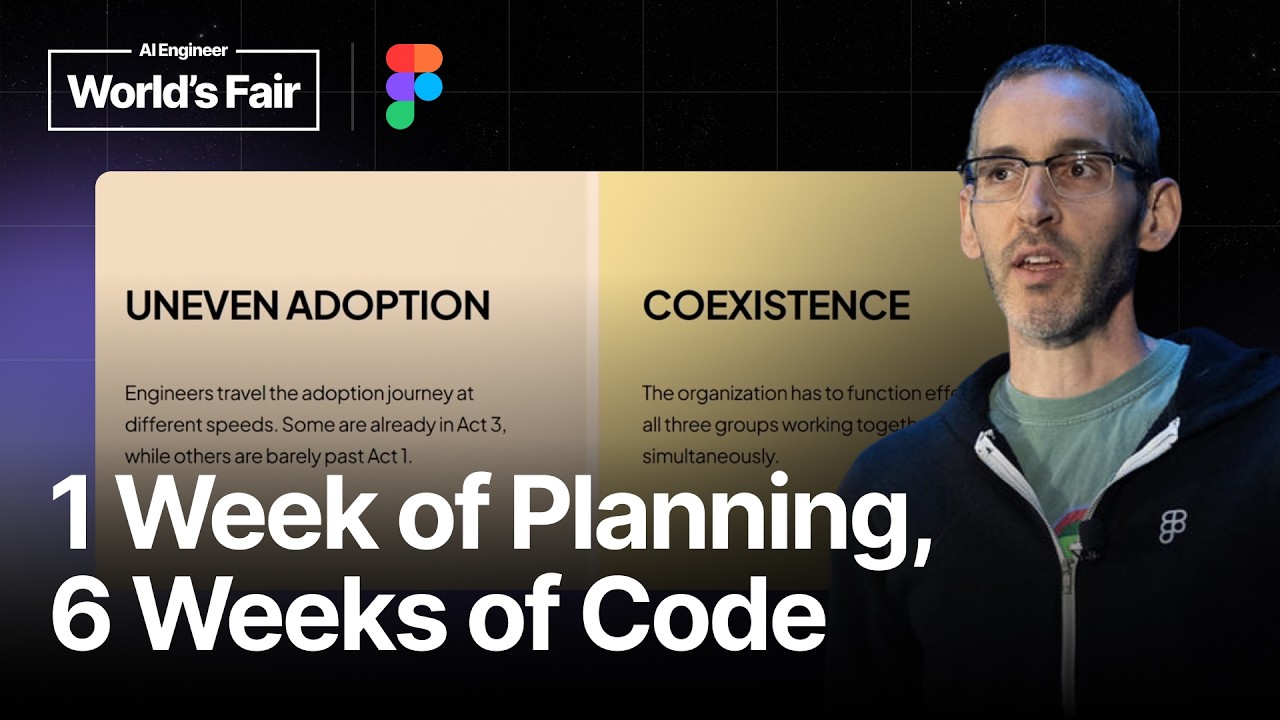
Eyal Blum, a software engineer at Figma, explains why the engineers slowest to adopt coding agents are often the best ones, and how his org is making agent adoption safe without shipping garbage. He outlines a three-act adoption process and notes adoption is uneven, forcing AI-forward and skeptical teams to coexist. Blum argues the highest-value investment is verification — using Playwright MCP, moving deterministic checks down the testing pyramid, and having agents write tests first in TDD style. He advocates detailed planning over prompting: a week-long plan yields 20 small PRs, turning six weeks of coding into one week (a 5x speedup). He also addresses reduced developer agency, says AI-written communication needs explicit labeling because human attention is scarce, and advises treating skeptics' complaints as the roadmap to make agents safer.
From AI-Assisted to AI-Native: Building a Frontier Development Team — Clare Liguori, AWS
Aug 28, 2026 · 20:57
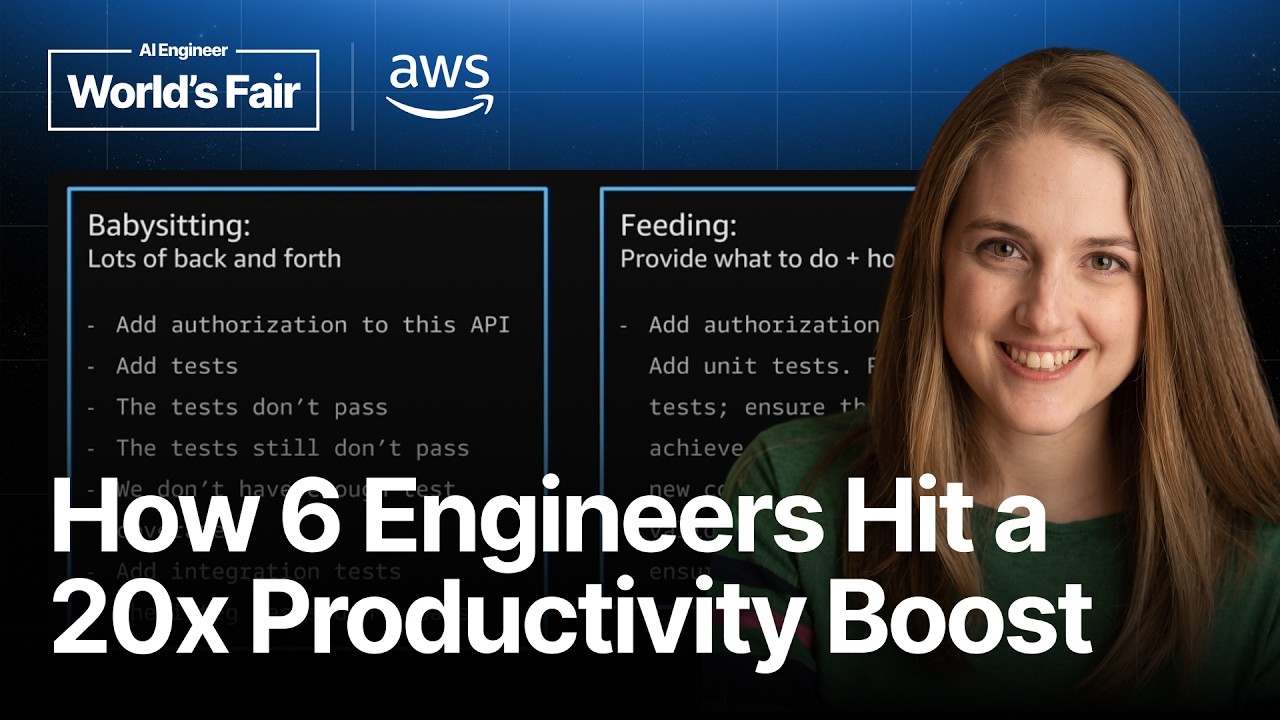
Clare Liguori, Senior Principal Engineer at AWS, says Amazon's frontier development teams achieved step-function productivity gains by deliberately changing how they work with Kiro, its agentic coding assistant. In a 50-team pilot, half improved under 3x in deployment velocity and the other half hit a median 4.5x; the difference was habits, not tools. She defines frontier developers as writing 1-2% of their code, letting agents run for hours, and running multiple agents in parallel. The five habits: invest in agent context, slow down to speed up by refactoring brownfield codebases, feed agents specifications instead of babysitting them, make intent explicit, and shift testing left with deterministic mocks. She also warns that new bottlenecks emerge, like decision speed and burnout.

How to avoid disaster when vibe-coding a billing engine — Andrew Garvin, Stripe
Aug 28, 2026 · 17:49
Andrew Garvin, co-founder of Metronome, the usage-billing platform Stripe acquired this year in its largest deal ever, argues that billing engines carry deep business logic, so a coding agent should build a test environment while a human stays in the loop — demonstrated by a Stripe Projects workflow replicating Lovable's pricing model. He demonstrates a billing sandbox that provisions a customer, metered usage, scoped credit pools for builds, plan mode, cloud and gateway calls, and a draft invoice, using portable skills files and verbose errors so the agent can self-correct. He separates agent as product, buyer, and user, pointing to HubSpot's move from seats to credits as one agent does the work of many logins. Stripe's CLI use by coding agents has risen exponentially.

How Anthropic Builds: Lessons from Labs — Mike Krieger, Anthropic
Aug 27, 2026 · 26:11
Instagram co-founder Mike Krieger, now an individual contributor at Anthropic's Labs, argues for being 'unreasonable' with Claude—he had it port a few hundred thousand lines of Python to TypeScript over a weekend. He attributes timid asks to first-gen AI's boxed tools; cites Instagram-era habits (pre-measure everything, knobs); and explains tagging Claude in Slack as multiplayer delegation. Labs runs two-week 'persevere or pivot' reviews, bet leads manage nobody, and code review is bottlenecked by comprehension, so 2,000-line PRs travel with artifacts explaining intent and tradeoffs. He also sketches Claude Design's future, urges unship of product complexity, and advises startups to bet on verticals like finance. On burnout: no job is so important you cannot be offline for two days.

The Death of Developer Advocates — Stephanie Jarmak, Sourcegraph
Aug 26, 2026 · 18:16
Stephanie Jarmak, agent advocate at Sourcegraph, says developer advocacy isn't dead—the audience is now AI agents that read docs, call APIs, hit errors, and recommend tools. After going from zero commits to 12,000 in a year, Jarmak built CodeScaleBench, ran agents with and without Sourcegraph's code navigation MCP tool, and found failures like a model burning a turn on a guessed parameter. Her GEO experiments recommended Sourcegraph 65% of the time for shopping prompts but zero for the actual pain of breaking downstream services when changing shared libraries, which got a wiki-page suggestion. Her advice: enter MCP registries, keep content fresh, reduce adoption friction, and treat agent advocacy as a curb cut that clears the path for humans too.

How AI Agents Let GTM Teams Scale — Justin Joyce, Cloudflare
Aug 26, 2026 · 19:15
Cloudflare principal sales operations manager Justin Joyce argues traditional go-to-market does not scale, so his team built a three-pillar agentic system on Cloudflare Workers and Durable Objects. To scale analysis, role-specific skill files let non-SQL users query data, cutting two-hour analyses to five minutes. To scale insight, weekly summaries are drafted by one agent, verified by a second, and toned by a third, tested on every run for two to three months. For self-service, Cloudflare OS gives reps forecast briefs, QBR decks, account plans and renewal prep with centrally curated expert skills. The result is 2X efficiency, with harder problems ahead in quoting, approvals and CRM writes.

The Agent Behind the Curtain: Building the Oz Cloud Agent Platform — Safia Abdalla, Warp
Aug 22, 2026 · 20:51
Safia Abdalla, an engineer at Warp, explains how her team built the Oz cloud agent platform on the principle that platforms should absorb complexity before the user sees it. Agents run in managed or self-hosted sandboxes; the platform supports multiple harnesses consistently. Users can orchestrate sub-agents by prompt or via an API exposed across the stack, and non-engineers used the SDK to build Slack bots for triaging social mentions. Abdalla recounts open-sourcing Warp: stars grew from about 20,000 to over 60,000, with thousands of PRs; agents triage issues and review every PR, so humans only see high-signal ones. She rejects 'software factory' as losing the people in it, offering a potter's workshop: stations, sourcing, verification, and an observable, improvable, cost-effective system.

Coding Agents Don't Scale Themselves. Neither Do Your Teams. — Patrick Debois, Tessl
Aug 22, 2026 · 22:06
Patrick Debois of Tessl argues that the 'dark factory' of autonomous coding agents won't work in most organizations because teams and platforms aren't set up for it, not because the technology fails. Developers who rebelled at 'writing better prompts' re-engaged once tooling opened a technical path; skeptics are ideal for context authoring, and retros target repeated agent failures, not code. Planning splits into well-scoped agent tasks and conversational human work; Debois tracks two metrics: human touches per result (down) and shared fixes that help everyone, not one 10x person. Platform teams must own paved roads, registries, eval systems, and spend visibility; that's the shift from solo developer to multiplayer system, and hiring tests AI leverage, engineering taste, and collaboration.

The Missing Layer: Design Taste in AI Agents — Hassan El Mghari, Together AI
Aug 21, 2026 · 14:10
Hassan El Mghari, developer experience lead at Together AI, argues design taste, not model capability, decides whether AI apps reach millions or read as vibe-coded slop. He ships about 10 apps a year — a few with millions of users — and credits design for that reach. His design skill Hallmark, launched six weeks ago to 10,000+ users, turns AI slop tells like purple gradients and italic headers into gates and supplies themes, since strong inspiration produces better work. He starts in Codex or Claude Code and iterates with cheaper open-source GLM 5.2, whose landing page was nearly indistinguishable from Opus 4.8. He advises saving screenshots as references, using longer prompts from voice notes, one or two features per prompt, and a skill file or AGENTS.md — but agent output is only a base.

Building Blocks for Uber’s Software Factory— Uday Kiran Medisetty & Adam Huda, Uber
Aug 21, 2026 · 18:26
Uber's Uday Kiran Medisetty and Adam Huda explain the six building blocks of their agentic software factory, which now generates more than 70% of pull requests and has doubled lines of code per engineer year over year. A model gateway handles 100 million requests a day across 800 projects with redaction of 20+ PII types and safety models under 100 milliseconds; an MCP gateway cuts token use over 40%, a skills marketplace runs 20,000 executions daily across 2,500 skills, and a context graph of 40 million entries replaces 20-30 systems. Adam shows one feature end-to-end, from Slack idea to draft PR that stops before CI, validating via simulator screenshots against Figma in an inner loop. The bottleneck, they argue, has moved to deciding whether a thing should be built at all.

How I automate my own job at Hugging Face using agents — Niels Rogge, Hugging Face
Aug 20, 2026 · 20:37
Niels Rogge, machine learning engineer on Hugging Face's community science team, explains how he automated his own job: agents ask researchers to publish paper artifacts on the Hub instead of Google Drive, Dropbox, or Zenodo. The outreach is a deterministic nightly workflow on GitHub Actions cron jobs with LangFuse tracing; follow-ups run as a fully autonomous Claude Agents SDK loop, with each GitHub issue in its own Modal container using Bash and one Hugging Face CLI skill. Thousands of issues have drawn only two negative replies, and he doesn't disclose the bot because recipients reply to the same messages he used to send. He argues open models like GLM 5.2 can replace closed ones, and cites his Daily Papers X account (90,000 followers) and a Papers with Code revival at paperswithcode.co.

The Era of Compound Engineering — Kieran Klaassen, Every/Cora
Aug 20, 2026 · 20:38
Kieran Klaassen of Every describes compound engineering, the system behind his AI email client Cora, built alone without writing a single line of code this year. He moved through bottlenecks—code, plans, judgment—then built memory so the next feature is easier. His rule: spend 50% building the feature and 50% teaching the system what it got wrong; stored solutions are more token-efficient than corrections and research. The loop is a human-AI sandwich—brain on to decide problems, autonomous middle overnight, brain on to raise the bar. His open-source Compound Engineering Plugin, used by hundreds of thousands daily, turns backlogs into argued ideas and automates work via /LFG. The bet: implementation gets cheaper, judgment does not.
Prototyping as Leadership: How a CTO Ships with AI Agents — Hursh Agrawal, The Browser Company
Aug 20, 2026 · 18:18
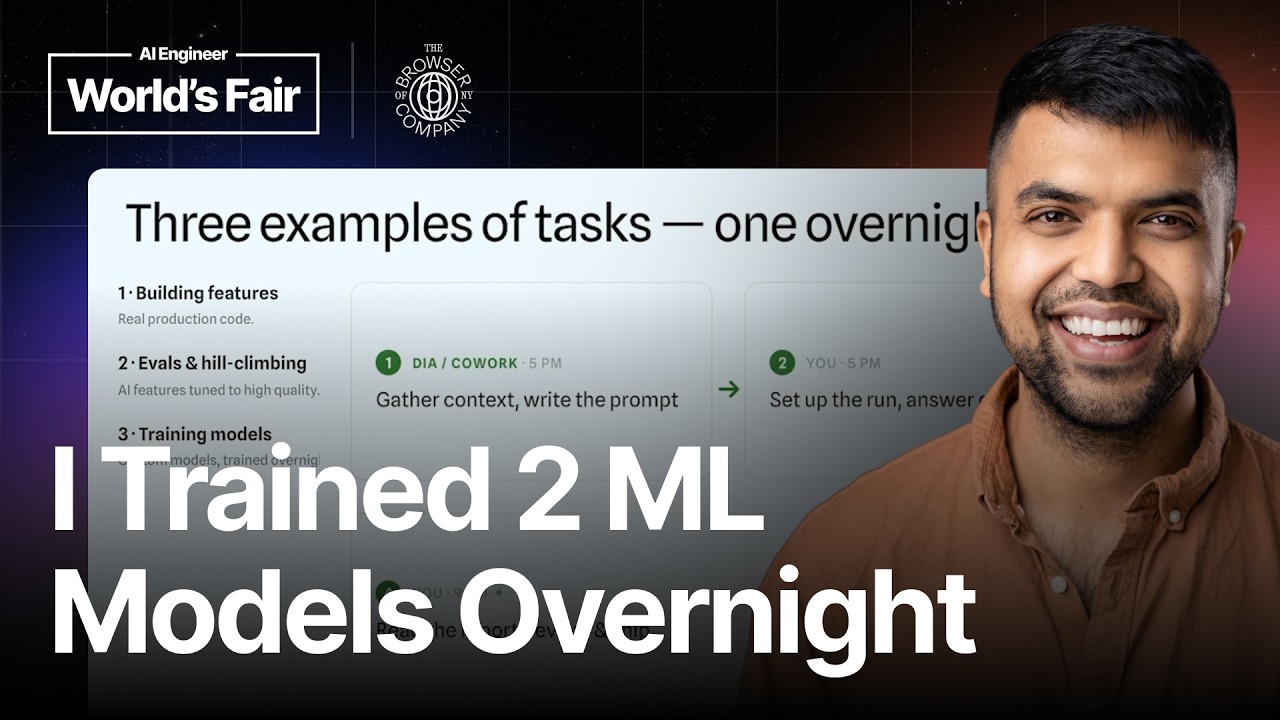
Hursh Agrawal, CTO and co-founder of The Browser Company, argues AI coding agents let leaders keep building: despite 15+ meetings, 7 direct reports, and a toddler, he ships 2–10 PRs/week. He says frontier models turn over every three months, so hands-on building is the only way to judge them and show engineers working prototypes. His method is an overnight loop: a coworker agent gathers Slack/Jira/Notion context into a prompt at 5pm, coding agent runs for hours, and a morning hour reviews tests, CI, and AI code review. He details three overnight uses: building features, hill-climbing evals from feedback JSONs, and training custom models like a PII classifier on AWS. He warns leaders to avoid critical path work and to rely on trustworthy CI, feature flags, a prototype branch, and readable PRs.

The Last Human Code Review: Building Trust in AI-Generated Code — Itamar Friedman, Qodo
Aug 20, 2026 · 18:54
Itamar Friedman, CEO and co-founder of Qodo, argues the bottleneck in AI-generated code is now context, not models; teams shipping code faster than humans can review are already inside the problem. He splits leaders into two camps — trust every line vs. ship bugs and fix fast — and says code-review benchmarks barely moved, proving context, not reasoning, matters. Qodo's answer is a context engine that codifies tribal knowledge — instruction files, Slack threads, and senior developers' heads — into interfaces humans can audit and agents can consume, shifting review from a single PR to a graph of PRs and contracts. Qodo targets 2027 with zero critical bugs in production, moving from artificial intelligence to artificial wisdom.

How to build an AI-Native Health Company — Dan Feng, Maven Clinic
Aug 19, 2026 · 17:19
Dan Feng of Maven Clinic says becoming AI-native means rewiring hiring, planning, code review, and reliability, not just adding tools. Maven hires engineers who solve ambiguous problems independently, keeps a one-year vision only directional, commits to two-to-four-week sprints, and treats three-to-six-month plans as unplannable because models change too fast. Engineers now write thousands of lines daily, so PRs are capped at 500 lines, engineers can self-certify simple changes but stay accountable, and rubber-stamp approvals are false confidence. Reliability is tiered: a scheduling failure one out of 1,000 times is tolerable because users retry, but reimbursement claims require multiple models to agree on the same receipt and integration tests to pass repeatedly.

How to Kill the Code Review — Ankit Jain, Aviator
Aug 17, 2026 · 16:26
Aviator co-founder Ankit Jain argues code review isn't just about catching bugs: it carries knowledge sharing and mentorship, and that half must survive even as AI writes and reviews code. He says reading line by line is already over — over 30% of changes merge without review. He calls spec-driven development 1970s waterfall because intent lives in the prompts, which teams discard when the PR opens. His fix: capture agent sessions, turn decisions into acceptance criteria, pair them with an 'AI slop registry' of recurring review comments, and generate test plans a verification system runs against a live preview. Reviewers review intent and evidence, not the diff. Homework: mine your last 1,000 review comments; he pitches Aviator's new Verify pilot.
LLM Knowledge Bases: a practical guide — Ben Holmes, Warp
Aug 12, 2026 · 21:17
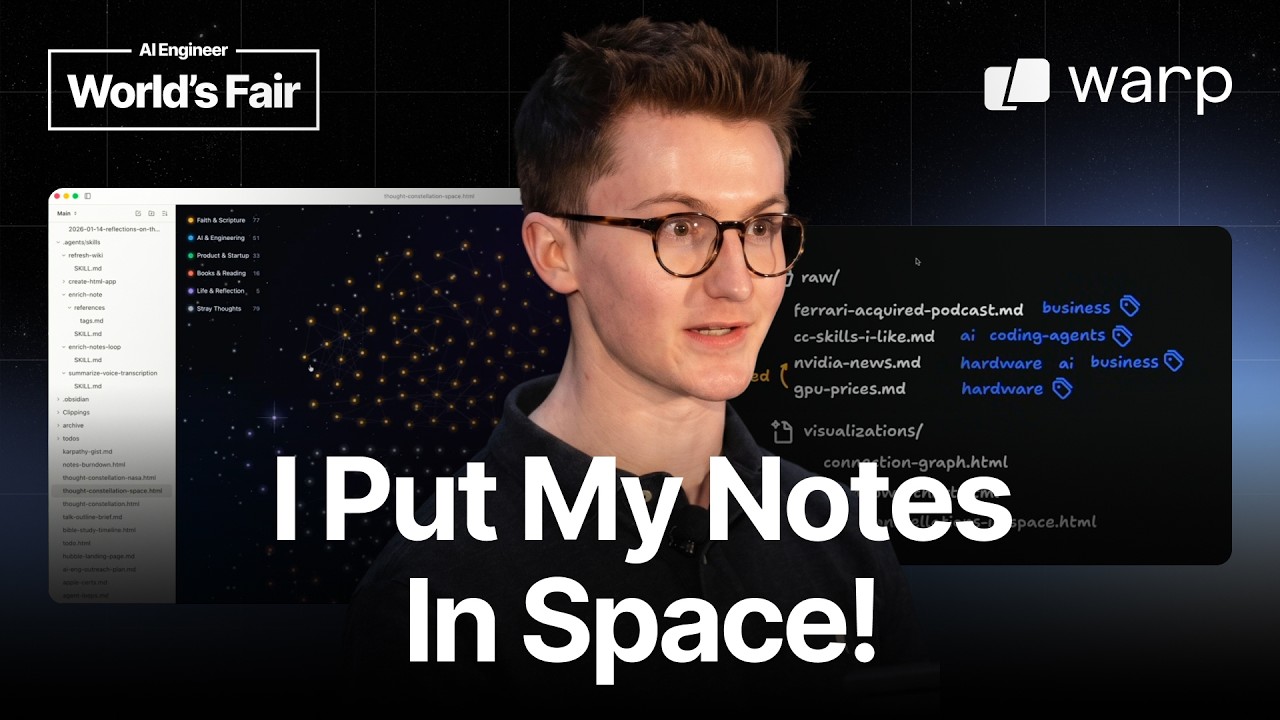
Ben Holmes, Developer Relations Lead at Warp, demonstrates how to turn a disorganized folder of voice-dictated notes into a browsable, interconnected knowledge base using LLM agents. He argues that voice dictation at 200 words per minute is the fastest capture method, recommending local tools like Handy and Voice Ink to avoid subscriptions. Holmes explains his 'enrich note' skill, which timestamps files, assigns tags from a fixed list to prevent Claude from inventing new ones, researches sources via web search, and adds backlinks through key term search. He then shows how to generate wikis from a Karpathy gist, grouping people, concepts, and organizations, and automates the entire pipeline on a daily schedule using Obsidian's headless CLI in a cloud sandbox via Oz.dev. Finally, he demonstrates asking an agent to build an HTML and Tailwind graph view of all notes, revealing clusters of interests and gaps in thinking.
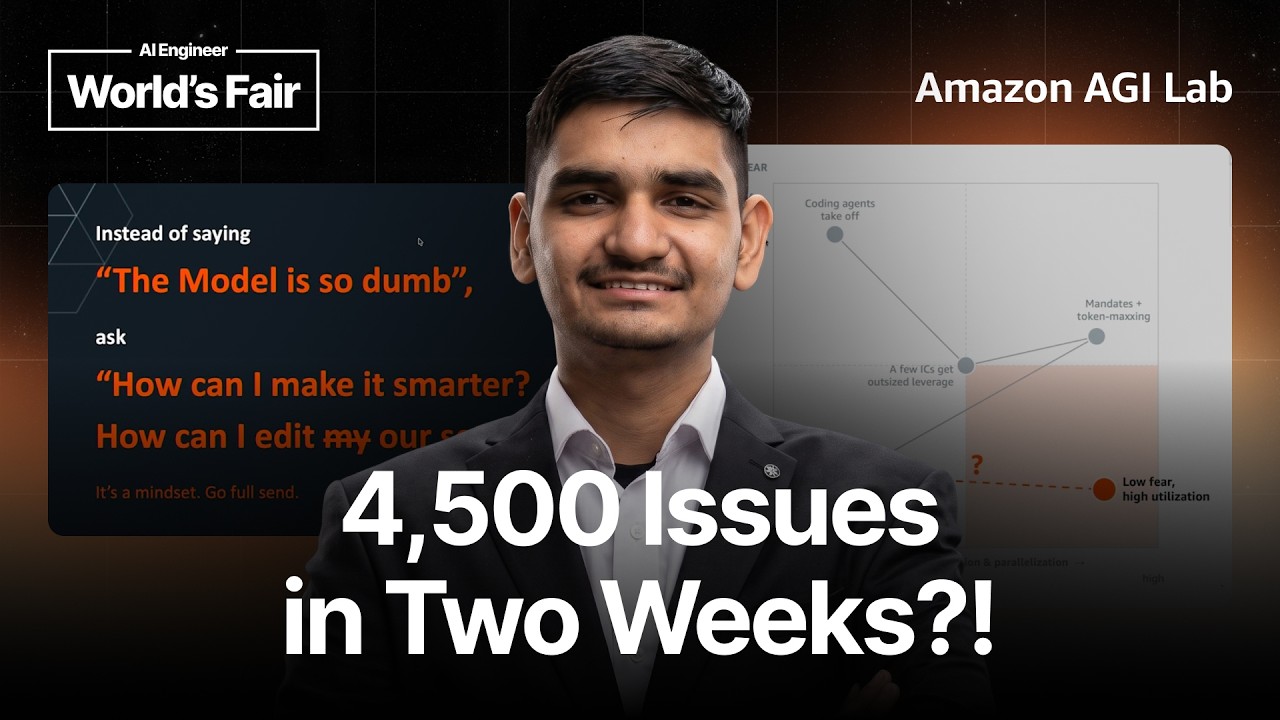
Agents, codebases, and teams — Aditya Khandelwal, Amazon AGI Lab
Aug 11, 2026 · 16:57
Aditya Khandelwal, from Amazon AGI Lab, argues that making agents work on a team is a leadership problem, not an IC one, because the fixes that work—restructuring a codebase for progressive disclosure and converging on a shared setup—require team buy-in. He describes symptoms of a bad setup: engineers babysitting runs, burning 500k context on simple tasks, and blaming the model when the harness changed. His team's solution centered on one high-value skill called 'ship it' that carries a change from code done to PR ready, handling descriptions, review comments, and CI failures, often running over an hour. They wired issues and boards into the repo, added agentic reviews, and a nightly code gardener, but agents filing against each other blew the repo to roughly 4,500 open issues in a couple of weeks. In Q&A, he sets a hard limit near 100 lines in a skill file and says first-prompt context burn is the test of whether progressive disclosure works.

Velocity Sickness: What Happens When Your Whole Team Gets 10x Faster — Matt Dailey, Ref.
Aug 9, 2026 · 20:37
Matt Dailey, CEO of Ref, argues teams get 'velocity sickness' when AI makes everyone 10x faster, shipping output without impact: too many PRs, too many directions, 'agent bankruptcy,' and critical decisions made by agents—ceding ownership of code and product. His fix is separating the decision layer from the implementation layer, making durable shared docs the state while agents are stateless action-takers; a newsletter writer published 'basically a book every week' that readers didn't read. The tell it is working is people writing plans they never implement, shifting from code velocity to idea velocity. To start: notice which gear you are in (planning vs polish), treat the plan as a portal into the system rather than a prompt, and share a plan with a teammate before giving it to an agent.

Realtime multiplayer, automation, and you! — Idan Gazit, GitHub
Aug 8, 2026 · 21:41
Idan Gazit of GitHub Next presents two prototypes for the future of software development: agentic workflows, which turn plain-English instructions into automated, guardrailed maintenance tasks, and ACE, a cloud-based platform for real-time multiplayer coding. He shows how an agentic workflow upgraded his site from Astro 5 to Astro 7, reading changelogs, fixing breaking changes, verifying the build, and opening exactly one pull request, with permissions, tools, networks, and safe outputs declared in YAML front matter rather than prompts, since prompts can be prompt-injected and are not real guardrails. Secrets stay outside the agent's jail, and agents may "do nothing" to avoid noise. ACE runs sessions in cloud microVMs, looks like Slack, and lets teams edit a shared plan document together before telling the AI to "make the document true." He closes with a study of about 100 developers over thousands of hours showing typing is only about 5% of the job, so AI must help with the other 95%.
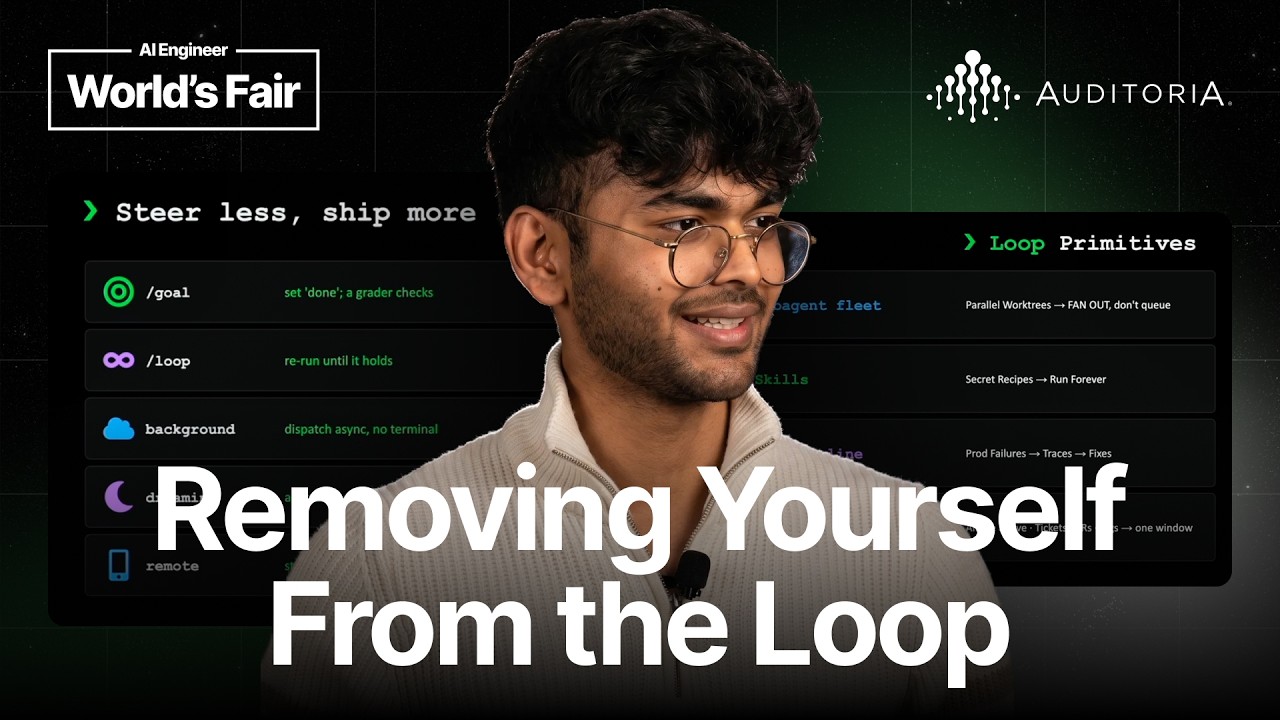
Your Finance Agent's Bottleneck Is You — Ramana Siddanth Emani, Auditoria AI
Jul 30, 2026 · 13:42
Ramana Siddanth Emani, data scientist at Auditoria AI, argues that the bottleneck in shipping production finance agents is the developer in the loop, not the model or GPUs. He presents harnessing coding agents across parallel git worktrees (50 with 48GB RAM) to automate bug fixes from QA and Jira tickets, with sub agents pulling traces, logs, running tests, and creating PRs, needing human input only at task assignment and final verification. In the finance sector, regulation demands human oversight, so agents handle the grind while developers focus on verification. Emani advocates for recursive self-improvement where agents analyze bottlenecks and upgrade loops; after a month, a developer can simply type 'fix this bug' and the agent handles everything, allowing developers to step out of the loop while remaining final verifiers.
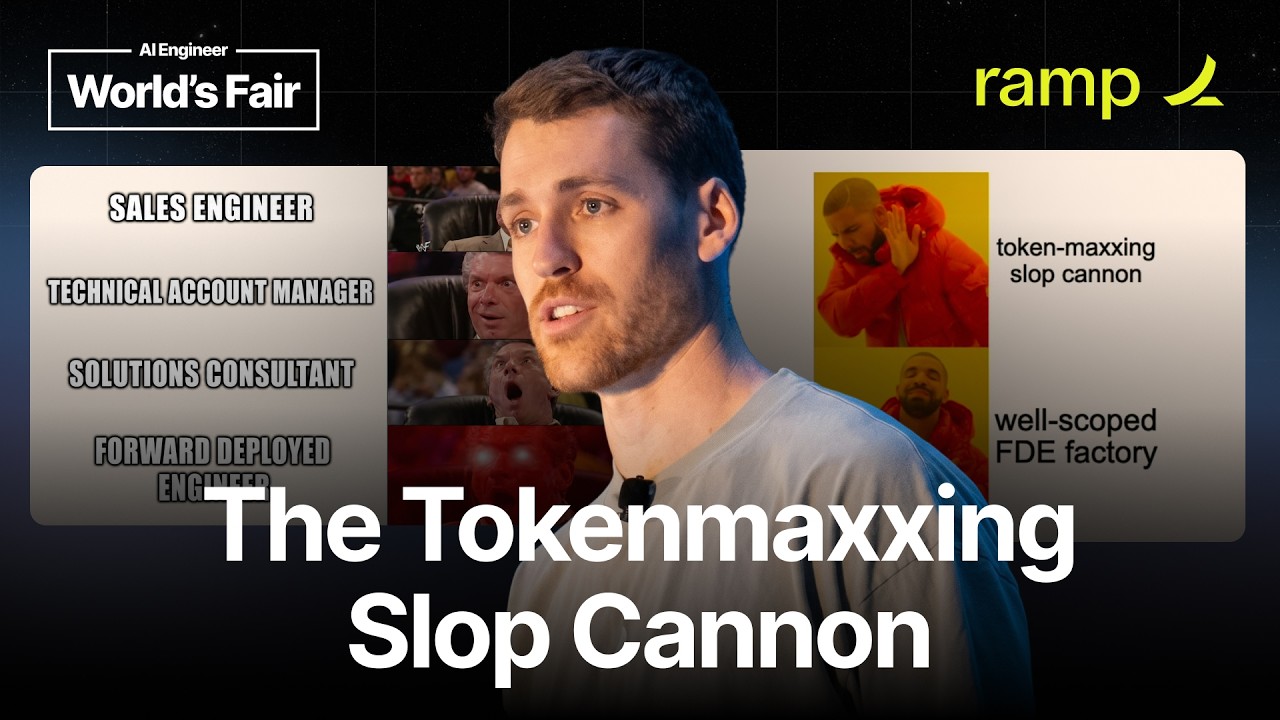
How Forward Deployed Engineering is done at Ramp — Leo Mehr
Jul 28, 2026 · 14:05
Leo Mehr, Director of Engineering at Ramp, lays out two principles for Forward Deployed Engineering: always be scoping and scale with tokens. He illustrates scoping with a Friday night SAP S4 HANA integration request that required pausing to validate urgency, and a painful lesson where his team built an Android reimbursement feature only to learn the customer mandated iOS devices. For scaling with tokens, Ramp automated the request intake stage with a Notion agent that saved about 20% of scoping time by asking iterative questions and generating specs. Mehr warns that without proper scoping, agents become a 'token maxing slop cannon,' while without agent automation, competitors will overtake you. He concludes that the future of FDE requires both human judgment for scoping and agents for volume.

AI Agents for Performance: Ship Faster, Pay Less — Rajat Shah, Netflix
Jul 28, 2026 · 33:39
Rajat Shah from Netflix explains how an AI agent can replace the manual performance engineering loop by reading profiling data, identifying inefficient code patterns like an O(N²) tensor merge method, and producing a validated fix — all within five minutes. The agent traced a call stack to the exact source line, proposed an optimized implementation, and ran a canary deployment to confirm CPU savings without regression. Shah emphasizes building a shared catalog of anti-patterns (starting as markdown files in a Git repo) so future agents can catch similar issues earlier, even during code authoring. He advocates shifting left from reactive profiling to proactive prevention, using unit tests, canary automation, and human approval as guardrails. The playbook aims to help teams adopt the same loop to reduce infrastructure cost and ship faster.

From Blind Spots to Merged PRs: Continuous Agentic Performance Optimization - May Walter, Hud
Jul 19, 2026 · 22:46
May Walter, CTO of Hud, presents a case study on using coding agents with runtime intelligence to automate continuous performance optimization in production. The system analyzes real production traces, queries, and latencies to surface high-ROI fixes like N+1 queries and missing indexes, scoring them by complexity and impact. It runs weekly via GitHub Actions and Claude Code, generating reports with verified fixes and evidence of impact, such as P90 latency improvements after deployment. Key challenges included 'plausible unverified' fixes, complex ClickHouse queries, and lazy fixes that only mask exceptions rather than root causes. Walter emphasizes the need for prod-to-code context mapping, scoring guardrails, and human review to achieve reliable automation. The talk concludes that context over cleverness works, and agents can automate the investigation phase that teams rarely do proactively, turning dormant performance debt into actionable merged PRs.

The Great Loops Debate — Dex Horthy, Geoff Huntley, Ian Livingstone, Greg Pstrucha, @insecure-agents
Jul 17, 2026 · 1:00:16
In the 'Great Loops Debate' hosted by Ali Howe, Geoff Huntley, Ian Livingstone, Dex Horthy, and Greg Pstrucha argue whether there is a delta between the hype behind loops in AI-assisted development and what works in practice. Team No Delta (Ian, Geoff) contends loops are inevitable and already cost-effective at $10.42/hour, with models surpassing average coders. Team Delta (Dex, Greg) counters that hype outruns discipline: loops work only for deterministic tasks, quality remains low, and token spend scales unsustainably. The debate covers loop history, anatomy (verification, context windows), and the feasibility of fully autonomous software factories, concluding that while loops boost productivity 2-3x, the vision of lights-off factories is premature.

Claude Fable, Claude Tag, and Anthropic's Culture — Cat Wu & Thariq Shihipar ft Simon Willison
Jul 15, 2026 · 51:30
This episode features Anthropic's Cat Wu and Thariq Shihipar discussing Claude Code, Claude Tag, and Claude Fable, arguing that these tools have shifted engineering from slow spec-driven processes to rapid, ambitious building. Thariq notes that with each model generation, delegation increased, and Claude Fable now enables one-shot features. Cat says engineers now need product taste over execution, as timelines shrink from six months to a week. Claude Tag, a proactive multiplayer agent, lands 65% of product engineering PRs internally by monitoring channels and remembering preferences. The team reduced Claude Code's system prompt by 80% for frontier models by removing examples and hard constraints, relying on model judgment. Auto mode, used internally since January, mitigates prompt injection through thousands of evals and Sonnet classifiers. Cultural hacks include default-public channels and a 'don't negotiate against ourselves' mindset, leading to ambitious builds like Thariq's Claude-powered video editing and a Street Fighter game.

ReviewDebt: a practical framework for scoring every pull request — Sachin Gupta, Ebay
Jul 12, 2026 · 25:00
Sachin Gupta introduces ReviewDebt, a deterministic framework scoring every pull request on the hidden review burden it creates, arguing that coding agents produce code faster than humans can responsibly review, accumulating an unmeasured debt. He defines 5 signal families—diff size and coupling, test evidence gap, directory and ownership spread, AI authorship indicators, and evidence and rational gaps—with 10 deterministic checks computable from PR data without LLMs, to produce a 0–100 score. Real PR examples show a clean human PR scoring 0, a high-debt AI PR scoring 60 with 86 estimated review minutes, and a well-shaped AI PR scoring 7. A cross-repo scan of 524 PRs over 27–90 days found 228 senior reviewer hours accumulated, with 5–20% of PRs weekly firing AI indicators but none of those landing in the high-burden band—complexity, not authorship, drives burden. Gupta advises teams to backfill the scorer on last 200 PRs, set a threshold (e.g., 50), surface scores as PR comments, aggregate weekly per team, and bring the number to retrospectives, turning vibe into measurement for 2027's governance conversation.

Understanding is the new bottleneck — Geoffrey Litt, Notion
Jul 10, 2026 · 19:33
Geoffrey Litt from Notion argues that understanding code written by AI agents is crucial for creative participation, not just correctness checking. He presents three techniques: explanations via his 'explain diff' skill, which generates HTML or Notion documents with background, intuition, interactive figures, and literate code diffs, capped by a five-question quiz to ensure understanding before sharing code; micro-worlds, like a step-by-step debugger for a Prolog interpreter or a 'video game' that walks through migrating a website; and shared spaces in Notion where humans and agents can collaborate in multiplayer chat threads and comment on documents. Litt emphasizes that agents can build ephemeral UIs and simulations to help humans understand better, leveraging education principles to stay deeply in the loop.

The Pipeline Is Dead - Iris ten Teije, Sky Valley Ambient Computing
Jul 7, 2026 · 19:50
Iris ten Teije, co-founder of Differ, argues that the traditional software pipeline—built on one frozen artifact for everyone—is dying because producing code changes has become nearly free. This shift enables per-user adaptive software: instead of one codebase shipped to all, a canonical stem plus bounded, isolated, and reversible divergences adapt live per user. She explains how this dissolves the line between development and distribution, using examples like a CRM that learns an investor’s intro paths and skips unused fields. Key challenges include provenance (every divergence must be attributable and inspectable), correctness testing at scale, desirability measurement, and coordination—not merging code but merging intent and outcome. The hard part isn’t AI-generated code; it’s the observability, validation, and isolation that make per-user versions safe rather than terrifying.
Field Guide to Fable — Thariq Shihipar, Anthropic
Jul 6, 2026 · 19:28
Thariq Shihipar of Anthropic discusses Fable and argues models improve in "spiky" ways: a chat model fails to list Pokémon ending in "aw" (Croconaw and Dreadnaw), but Claude Code fetches and filters the list in seconds – a gap he calls "capability overhang." He explains that to unlock Fable, Claude Code cut 80% of its system prompt because heavy instructions now constrain a more imaginative model, and the "ask user question" tool evolved from barely working under Opus 4 to generating embedded HTML questionnaires. He shares techniques like blind-spot passes and interviews to surface unknown unknowns, and reflects on the grief of moving from hand-coded programming to agentic workflows. Shihipar urges engineers to reject trade-offs – "good, fast, cheap: pick three" – and instead demand all three, citing a four-hour keynote deck built with Fable as proof that agents can deliver ambitious work faster.

Research to Reality: Bringing Frontier ML Research to Production - Vaidas Razgaitis, Higharc
Jun 28, 2026 · 14:57
Vaidas Razgaitis, Senior Research Engineer at Higharc, presents three tactical focus areas to accelerate the handoff of frontier ML research into production features. First, he advocates for a Research Prototype Taxonomy Document—a technical design document tailored for ML that maps domain context, business goals, type safety, persistence, and system architecture. Second, he details Higharc's monorepo of cleanly isolated microservices with a layered API/business logic/data structure, enabling researchers to own individual services. Third, he explains using Graphite for stack diffs to decompose monolithic prototypes into small, reviewable PRs that tap subject matter experts asynchronously. The talk offers diagnostic questions to assess team velocity across these three levers.

GPU Cloud Deployment Without Leaving Your IDE — Audry Hsu, RunPod
Jun 9, 2026 · 20:19
Audry Hsu of RunPod introduces Flash, a Python SDK that deploys GPU cloud functions from a developer's IDE with a single decorator, eliminating the slow iteration cycle of commits, Docker builds, and server allocation. She demonstrates hot reload, swapping Stable Diffusion XL Turbo for DreamShaper instantly, and a pipeline that chains Qwen 3 for prompt generation, DreamShaper for image rendering, and Nano Banana 2 for photo composition. RunPod's serverless H100 pricing is $0.00116 per second, charged only during active inference. Hsu recommends starting with pods for experimentation and switching to serverless when scaling to hundreds of workers across data centers.

Benchmarking semantic code retrieval on Claude Code — Kuba Rogut, Turbopuffer
Jun 3, 2026 · 16:08
Kuba Rogut from Turbopuffer benchmarks semantic code retrieval on Claude Code, finding that raw Claude Code wastes one in every three file reads (65% precision), windowed grep drops that to one in five, and adding semantic search cuts it to one in eight (87% precision). Semantic search wins on behavior-adjacent tasks where files share no keywords; grep wins on import tracing. Cursor's production numbers show a 24% relative improvement in answer accuracy from semantic retrieval plus a 2.6% increase in code retention in large codebases. Rogut explains Cursor's model knows when and why to call semantic search, while Claude Code treats it as just another tool, limiting gains.
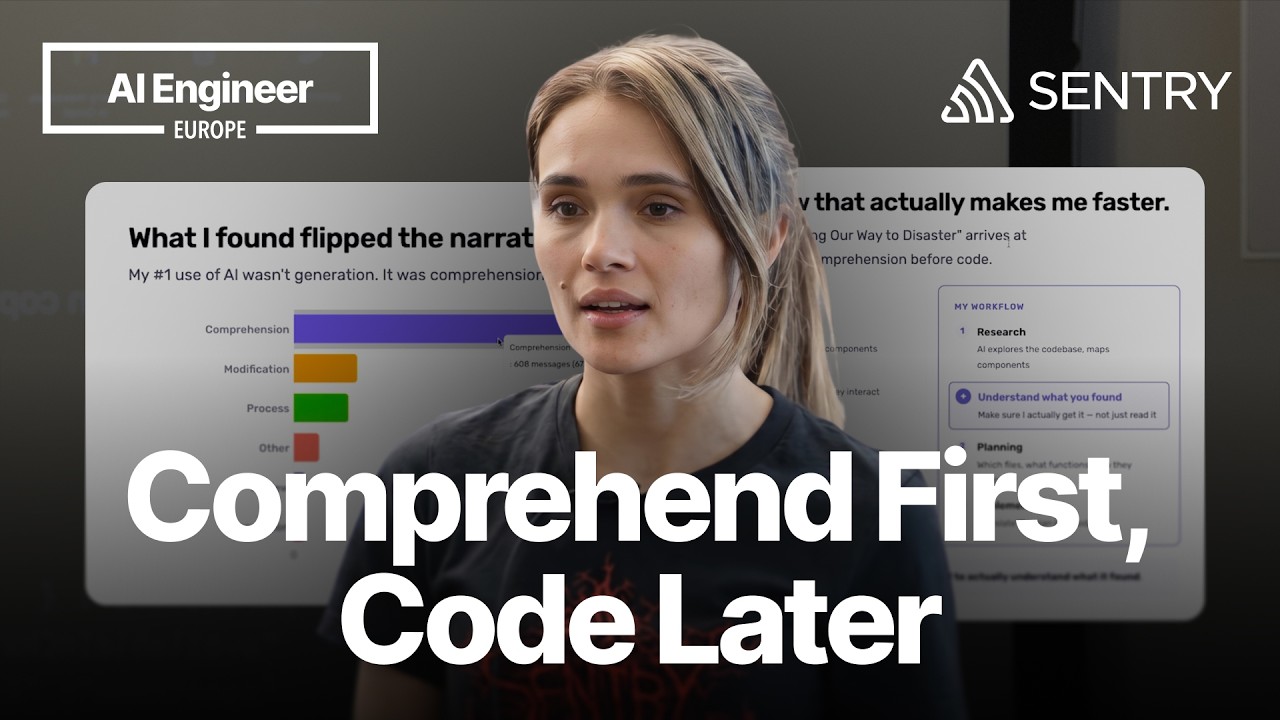
The AI Skill I Rely On Daily — Priscila Andre de Oliveira, Sentry
May 27, 2026 · 17:05
Priscila Andre de Oliveira, a senior software engineer at Sentry, reveals that 67% of her AI usage is for comprehension and only 2% for code generation, based on analyzing 116 of her own Claude sessions. Working in Sentry's 15-year-old codebase with 100 PRs merged daily and 100,000 organizations depending on it, she built a personal skill called 'Catch Me Up' with six exploration modes (architecture, conventions, feature traces, syntax, testing, history). She argues that understanding what the agent found before letting it plan and implement prevents misaligned mental models that produce slop code. The episode emphasizes that in large, complex codebases, AI's biggest unlock is comprehension, not generation, and advises developers to align their mental models before prompting.
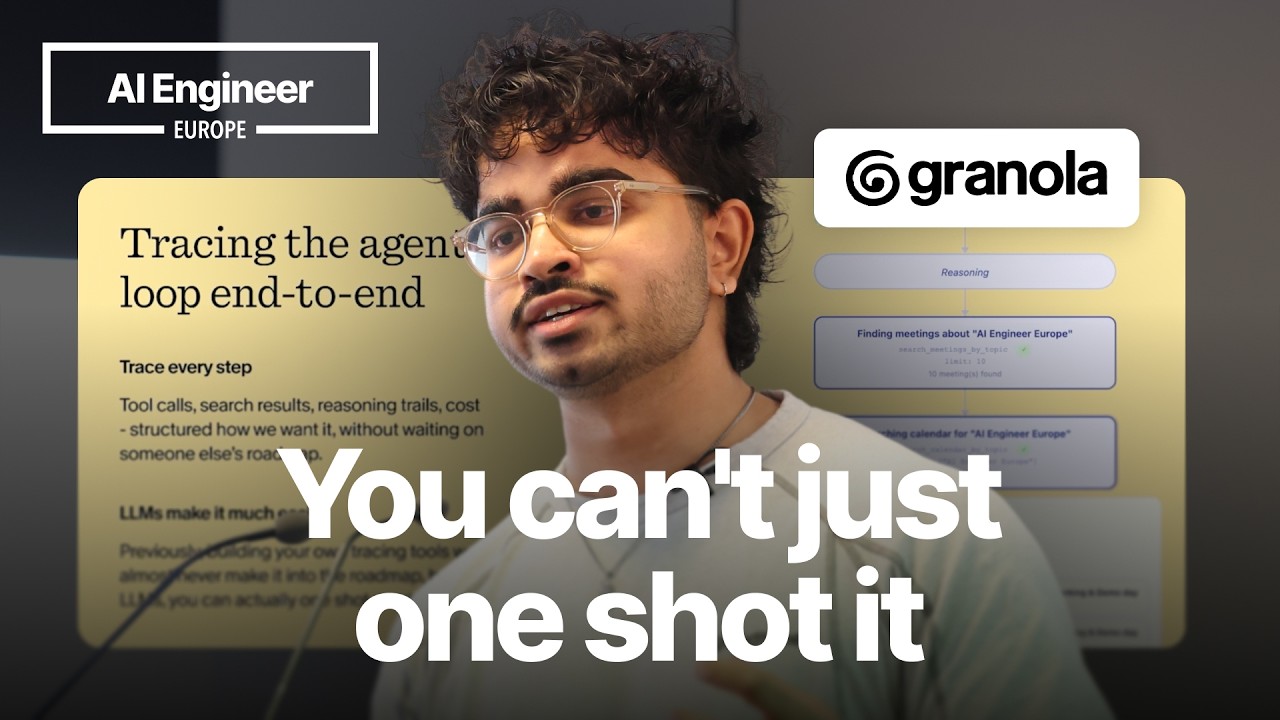
Feedback Loops are All You Need — Mehedi Hassan, Granola
May 10, 2026 · 10:11
Mehedi Hassan, a product engineer at Granola, argues that shipping AI features into production requires building feedback loops rather than one-shotting better prompts. Granola's chat feature for meeting notes revealed problems with web search — token costs ballooning to 10p per chat, overnight provider updates silently degrading results — and with prompt personalization, as a single prompt cannot serve salespeople, engineers, and HR managers equally. To close the gap, Granola built custom internal tracing exposing tool calls, search trails, reasoning, and cost in a UI accessible to non-engineers, not just CloudWatch queries. They also refactored their Electron app's renderer to run as a web app, enabling preview links on every PR and allowing Cursor to automatically test changes and upload screenshots. The result is faster iteration and confidence that shipped features actually work for customers.

"Software Fundamentals Matter More Than Ever" — Matt Pocock
Apr 23, 2026 · 18:26
Matt Pocock argues that software fundamentals matter more than ever in the AI era, directly countering the 'specs-to-code' movement that treats code as cheap. He shares practical skills like 'Grill Me' to reach a shared design concept with AI, a ubiquitous language from domain-driven design to align terminology, and test-driven development to force small, deliberate steps. Drawing on John Ousterhout's 'deep modules' and Frederick Brooks's 'design concept,' he advocates structuring codebases with simple interfaces behind which AI can implement freely. He warns that bad code is the most expensive it's ever been, as it blocks the productivity gains AI can offer. His reusable skills are available in the GitHub repo MattPocock/skills.

Developer Experience in the Age of AI Coding Agents – Max Kanat-Alexander, Capital One
Dec 23, 2025 · 18:20
Max Kanat-Alexander, Capital One executive distinguished engineer, argues that developer experience teams should invest in a 'No Regrets' framework to prepare for an agentic future, regardless of unpredictable AI advancements. He identifies six key inputs that benefit both humans and AI agents: standardized development environments using industry-standard tools, native CLIs and APIs instead of browser automation, deterministic validation with clear error messages, refactoring legacy codebases for testability and reasoning, documenting external context and intentions, and improving code review velocity and quality through assignment and apprenticeship. Without these, bad codebases lead to rubber-stamped PRs and a vicious cycle of decreasing agent productivity; with them, a virtuous cycle accelerates software engineering velocity. Kanat-Alexander emphasizes that what's good for humans is good for AI, and these investments will help developers no matter what the future holds.

Paying Engineers like Salespeople – Arman Hezarkhani, Tenex
Dec 19, 2025 · 14:53
Arman Hezarkhani, CTO of Tenex, describes his company's outcome-based compensation model where engineers are paid per story point completed, tying incentives directly to shipped value. He argues that hourly billing and salary with equity fail to motivate engineers to use AI tools effectively, leading to misaligned incentives. Tenex's system involves strategists scoping tickets and engineers receiving a flat base plus quarterly story-point bonuses. Risks like inflated story points, quality drops, and sharp elbows are mitigated by strategist counterbalance, multi-round QA, and a rigorous hiring process. He cites examples: a billboard company's image moderation AI built in two weeks at 96% accuracy, and a retail heat-mapping project with five parallel models. Arman asserts that AI amplifies existing talent, and current compensation must change to unlock potential.

Moving away from Agile: What's Next – Martin Harrysson & Natasha Maniar, McKinsey & Company
Dec 12, 2025 · 21:55
McKinsey's Martin Harrysson and Natasha Maniar argue that enterprises must overhaul their people and operating models—moving beyond Agile to AI-native workflows—to capture the full potential of AI in software development. They identify bottlenecks like work allocation, manual code review, and tech debt that limit gains to 5-15% despite promising individual productivity stories. To scale, they advocate AI-native workflows (spec-driven development, continuous planning) and AI-native roles (smaller pods of 3-5 with consolidated roles). In a client study with a bank, interventions led to 60x increase in agent consumption, 51% increase in code mergers, and faster delivery tied to business priorities. They emphasize change management: 70% of companies haven't changed roles, and top performers invest in hands-on upskilling, measurement systems that track outcomes beyond adoption, and incentives to drive adoption.

The State of AI Code Quality: Hype vs Reality — Itamar Friedman, Qodo
Dec 11, 2025 · 21:15
Itamar Friedman, CEO of Qodo, argues that while AI code generation boosts productivity, it has a glass ceiling unless organizations invest in agentic quality workflows and context. Drawing on reports from Qodo, Sonar, and Pharos, he reveals that 60% of developers say a quarter of their code is AI-generated, yet 67% have serious quality concerns, leading to 42% more time fixing bugs and 35% project delays. He notes that AI code review tools double trust and quality gains, and that better context—including standards and best practices—is the top request from developers. Friedman recommends automated quality gateways, intelligent code review, and testing, warning that without dynamic quality processes, the promised 2x productivity remains elusive.

Can you prove AI ROI in Software Eng? (Stanford 120k Devs Study) – Yegor Denisov-Blanch, Stanford
Dec 11, 2025 · 16:40
Stanford researcher Yegor Denisov-Blanch presents research based on 120,000+ developers across 600+ companies, arguing that AI ROI in software engineering is often negative despite apparent productivity gains. The study finds a median 10% productivity lift from AI, but a widening gap between top and bottom performers. Key drivers include codebase hygiene (environment cleanliness index with R² 0.40) and AI usage quality over volume. A company case study shows pull requests increased 14% but code quality dropped 9% and rework rose 2.5x, yielding no net effective output gain. Denisov-Blanch proposes a measurement framework using a primary metric (engineering output via ML model) paired with guardrail metrics, and emphasizes that companies can retroactively measure impact via git history without waiting for experiments.

What Data from 20m Pull Requests Reveal About AI Transformation — Nick Arcolano, Jellyfish
Nov 24, 2025 · 17:57
Nick Arcolano, head of research at Jellyfish, presents data from 20 million pull requests across 200,000 engineers at 1,000 companies to reveal what AI transformation actually looks like. Median AI adoption of interactive coding tools (Copilot, Cursor, Claude Code) jumped from 22% in June 2024 to nearly 90% today, driving a 2x increase in PR throughput and 24% faster cycle times on average. Autonomous agents like Devin and Codex remain negligible—only 44% of companies have tried them, contributing less than 0.2% of PRs. PRs grow 18% larger with AI, but bug rates and reverts show no significant quality impact. Crucially, code architecture determines success: centralized and balanced repos see 4x throughput gains, while highly distributed architectures (many repos per engineer) show no correlation with AI adoption, likely due to cross-repo context limitations. Arcolano advises focusing on adoption first, then addressing architectural barriers to unlock productivity.

Does AI Actually Boost Developer Productivity? (100k Devs Study) - Yegor Denisov-Blanch, Stanford
Jul 23, 2025 · 18:12
Yegor Denisov-Blanch from Stanford presents findings from a study of nearly 100,000 developers across 600+ companies, showing AI boosts developer productivity by an average of 15-20%, but the effect varies widely. The study measures functionality delivered, not commits, and reveals that AI introduces significant rework—bug fixes from AI-generated code. Productivity gains depend on task complexity, codebase maturity (Greenfield vs. Brownfield), language popularity, and codebase size: low-complexity Greenfield tasks see 30-40% gains, while high-complexity Brownfield tasks see only 0-10%. AI can even decrease productivity for low-popularity languages like COBOL or Haskell, and context window limitations reduce performance on larger codebases. The study provides data-driven guidance for when AI helps or hinders, with a matrix showing 20% gains for low-complexity common languages and minimal gains for complex niche ones.

AI powered entomology: Lessons from millions of AI code reviews — Tomas Reimers, Graphite
Jul 22, 2025 · 10:21
Tomas Reimers, co-founder of Graphite, discusses the company's AI-powered code reviewer Diamond, arguing that while LLMs can effectively find bugs, they must be carefully prompted to avoid frustrating developers. After analyzing 10,000 comments from codebases, Graphite classified bugs into a quadrant based on what LLMs can catch versus what humans want to receive, identifying bugs, accidentally committed code, performance and security concerns, and documentation mismatches as high-value targets. Code cleanliness and best practice comments, though technically correct, are often unwelcome from AI. Graphite measures success via emoji reactions (less than 4% downvote rate) and the percentage of comments that lead to code changes, reaching 52% actionability in March—matching human-level effectiveness. The talk emphasizes continuous monitoring to ensure LLM comments stay within the desirable quadrant.

Building a 10 person unicorn - Max Brodeur-Urbas, Gumloop
Jul 15, 2025 · 12:03
Max Brodeur-Urbas, founder of Gumloop, explains how his company scaled to millions in ARR as a team of two that raised a Series A and grew to only nine people, by being super picky in hiring, using product-led hiring where customers like those from Instacart and Webflow join the team, and requiring work trials such as hacking together in Airbnbs. They eliminate almost all meetings to give engineers deep focus time and automate every internal process with Gumloop itself, from customer research reports to chatbot monitoring. Culture-wise, they balance intense 45-minute shipping challenges with fun retreats and a public company handbook. Brodeur-Urbas argues that every hire must be a no-brainer, and small teams can outpace larger ones by avoiding meetings and leveraging AI tools.

To the moon! Navigating deep context in legacy code with Augment Agent — Forrest Brazeal, Matt Ball
Jun 27, 2025 · 15:24
Forrest Brazeal and Matt Ball demonstrate how Augment Agent helps developers navigate and modernize legacy codebases using the Apollo 11 guidance computer as an example. They show that Augment's chat mode can instantly explain the 1202 program alarm—indicating the computer was overloaded but could continue—by reading assembly code and web context. Then, using agent mode, they prompt the tool to write a Python implementation of the P65 vertical descent algorithm from the original assembly, run a simulator, and land the lunar module within expected parameters. The episode argues a three-step strategy for any legacy codebase: use chat to understand, write tests via agent, and then modernize modularly—proving AI agents can turn toil like Java 8-to-17 migrations into automated tasks.

Don’t get one-shotted: Use AI to test, review, merge, and deploy code — Tomas Reimers, Graphite
Jun 27, 2025 · 5:45
Tomas Reimers, CPO and co-founder of Graphite, argues that AI-generated code accelerates the inner loop (development) but bottlenecks the outer loop (review, test, merge, deploy), necessitating AI-native tooling across the entire workflow. He presents Graphite's AI code reviewer, Diamond, which achieves a 52% acceptance rate on its comments—exceeding the 45–50% rate for human comments—while only 4% of its comments are dismissed. Reimers emphasizes that AI tools must deeply understand the codebase, integrate with CI/testing pipelines, and provide high-signal, low-noise feedback to handle the increasing volume of AI-assisted code. He cites that 46% of GitHub code is now written by Copilot, and predicts the outer loop will break without AI-driven prioritization, review automation, and optimized deployment. The talk advocates for self-driving code review that lets developers focus on product features rather than manual processes.

Mastering Engineering Flow with Windsurf - Eashan Sinha, Windsurf
Jun 27, 2025 · 15:20
Eashan Sinha, a Deployed Engineer at Windsurf, explains how engineering teams can master agentic IDEs using Windsurf's Cascade agent. He argues that developers should treat AI as a teammate rather than a tool to abuse, emphasizing Windsurf's flow awareness—tracking user actions, edits, and terminal commands to infer intent. Sinha details Windsurf's evolution from copilots to agents, combining collaborative chat with autonomous tool calling, and introduces features like state-of-the-art context engine, workflows for deterministic steps, rules, memories, and simultaneous Cascades. He provides a practical four-step framework—explore, plan, build, test—for maximizing agentic flow, including using planning files, checkboxes, and automated test generation. The episode delivers a concrete guide to integrating AI into development without sacrificing quality, recorded at the AI Engineer World's Fair in San Francisco.

Supercharging developer workflow with Amazon Q Developer - Vikash Agrawal
Jun 10, 2025 · 13:22
Vikash Agrawal and Linda show how Amazon Q Developer can drive every stage of the software development lifecycle. They build a 2048 game with FastAPI and Poetry using Q's /dev command in the CLI, then add unit tests with /test, generate documentation with /doc, and integrate with GitHub for automated pull requests. After deploying to AWS, they use Q in CloudWatch to debug a runtime import error by analyzing logs and resource topology. The episode emphasizes that planning infrastructure and prompts upfront, along with security scans, are critical for production-ready AI-assisted development.

The Many Ends of Programming - Ray Myers
Jun 10, 2025 · 27:12
Ray Myers, Chief Architect at All Hands AI, argues that the future of software engineering is not predetermined and we have a say, categorizing competing visions into six distinct endgames: extreme completion, dev apocalypse (innovator's paradise), abstraction leap, uncharted waters, review economy, and infinite pile of garbage. He illustrates extreme completion with a real example where an AI agent generated a 48-file pull request from a Slack message, and abstraction leap via domain-specific languages (DSLs) shown in the Parcel paper’s 61 prompts producing a 220-line Lisbon interpreter. Myers warns that dev apocalypse is desirable but not yet feasible, while the review economy is a pit stop where manual review bottlenecks must be managed using Theory of Constraints. He cites contradictory studies: UpLevel found developers with coding assistants had higher bug rates, while GitHub Copilot claimed improved quality; he notes 2024 was the first year copy-pasted code exceeded refactored code, a red flag for tech debt. Ultimately, Myers urges deliberate choices: whether we want no programmers or everyone to be a programmer, and whether we prioritize quality over quantity.

Building AI Agents with Real ROI in the Enterprise SDLC: Bruno (Booking.com) & Beyang (Sourcegraph)
Apr 8, 2025 · 20:56
Beyang Liu, CTO of Sourcegraph, and Bruno Passos, Group PM at Booking.com, explain how their partnership built AI coding agents that deliver measurable ROI in enterprise software development. Booking.com, with 3,000 developers handling 250,000 merge requests and 2.5 million CI jobs yearly, used Sourcegraph's Cody and custom agents to automate code migration and review, cutting cycle times. They report that daily Cody users ship 30% more pull requests and are 30% faster, with lighter MRs. Agents like a GraphQL generator for a million-token schema and a code review tool with customizable rules emerged from joint hackathons. Bruno emphasizes education as critical: training turned skeptical developers into daily users, driving adoption and productivity gains. The goal is to shift-left compliance and reduce tech debt, making the SDLC self-healing.

How Windsurf writes 90% of your code with an Agentic IDE - Kevin Hou, Windsurf
Mar 11, 2025 · 20:50
Kevin Hou, head of product engineering at Codeium, introduces Windsurf as the first AI agent-powered editor, arguing that agents are the future of software development. The editor is built on three principles: trajectories, a unified timeline that lets the agent read the user's mind and execute commands like 'continue my work'; meta-learning, which auto-generates memories of user preferences and codebase context; and scaling with intelligence, removing legacy features like chat and @-mentions as models improve. Windsurf launched three months ago and has already generated 4.5 billion lines of code, with 90% of code now written via its Cascade agent. Hou emphasizes that the agent reduces human-in-the-loop effort by inferring context, running terminal commands in the user's environment, and dynamically retrieving documentation—allowing developers to contribute less input while getting more production-ready output.

GitHub Next Explorations: Rahul Pandita
Feb 8, 2025 · 18:18
Rahul Pandita, a researcher at GitHub Next, presents two explorations: Copilot Next Edit Suggestions and Copilot Workspace. Next Edit Suggestions extends GhostX by suggesting multi-location edits beyond the cursor, such as updating method definitions and documentation when a parameter is added. Copilot Workspace addresses developers' pain points of getting started on tasks, trusting AI output, and retaining control by offering a one-click proposal, built-in runtime verification, and an iterative, collaborative environment. Pandita demonstrates updating a MonoSpace website to add Rust syntax highlighting via a GitHub issue, showing specification generation, planning, and terminal command synthesis. He emphasizes that GitHub Next explores uncertain futures rapidly, learning from experiments like Copilot (which started as a Next project) to shape AI-augmented software engineering without waiting decades.

GitHub Copilot: The World's Most Widely Adopted AI Developer Tool
Feb 6, 2025 · 29:49
GitHub Senior DevOps Advocate Dave Bernason demonstrates how GitHub Copilot has evolved from an AI code generator to a comprehensive developer assistant with chat, enterprise knowledge bases, pull request summaries, and third-party extensions, emphasizing that Copilot keeps developers in flow and requires human oversight. He shows Copilot Chat explaining code, refactoring, debugging, and generating unit tests. Copilot Enterprise adds Bing search, knowledge bases from Markdown files, and repo indexing for accurate answers, exemplified by updating a hard-coded sales tax function to use the Avalara API. Copilot Extensions integrate third-party tools like Octopus Deploy for deployment dashboards within chat. Bernason also covers prompt engineering tips—specificity improves suggestions—and highlights Copilot's support for any language, even COBOL, for modernization.

The Rise of the AI Software Engineer: Jesse Han
Feb 5, 2025 · 3:48
Jesse Han, CEO of Morph Labs, announces the Morph Code Index and RiffCoder 7B model as milestones toward the personal AI software engineer. The Code Index is a neurosymbolic code database that enables semantic search over codebases, makes entire Git history visible to coding assistants, and transmutes code into training data. It uses static analysis, vector embeddings, and graph algorithms for state-of-the-art code search, with a query language guaranteeing precise results. RiffCoder 7B, trained on data from the Code Index, is the only open-source code editing model that runs on laptops and IDEs. Morph Labs is building a platform for managing personal AI software engineers, available via waitlist. The future of software should belong to everyone, and the tools are open-source and free.

The ROI of AI: Why you need Eval Framework - Beyang Liu
Dec 31, 2024 · 25:28
Beyang Liu, CTO of Sourcegraph, presents six evaluation frameworks for measuring the ROI of AI coding tools, arguing that no single metric suffices because AI ROI reduces to the intractable problem of developer productivity. He dismisses the 'roles eliminated' framework as irrelevant for engineering, noting that backlogs are never fully addressed. Instead, he highlights customer examples: A/B testing velocity at Palo Alto Networks showed 20-30% acceleration with Cody; time saved as a function of engagement lower-bounds gains (e.g., each code search saves ~2 minutes); and LITOS tracked value-add zones (building features, writing tests, reviewing code) instead of lines of code. For key initiatives like code migrations, ROI is measured by how many months the migration is pulled forward. Liu also advocates developer surveys bounded by a 5-25% productivity tool budget, and warns against the Mythical Man Month fallacy: preferring one 100x human developer over 100 mediocre AI agents.

The AI emperor has no DAUs why most devs still don't use code AI: Quinn Slack
Nov 20, 2024 · 18:45
Quinn Slack, CEO and cofounder of Sourcegraph, argues that despite massive hype, only about 5% of professional developers actually use Code AI tools, with total recurring revenue from Code AI sitting at roughly $300 million ARR—a fraction of Salesforce's $36 billion. He cites GitHub's 1.3 million paid Copilot subscribers and just 935,000 yearly active users receiving suggestions, revealing the gap between perception and reality. Slack warns that the entire AI ecosystem—foundation models, infra, and applications—risks collapse if usage doesn't grow, and most revenue in AI flows to NVIDIA and chip makers, not software. From building Cody, the number two Code AI product, he shares lessons: hype fools everyone, autocomplete is a freakishly good feature that spoils expectations, while chat and agents are harder to vet and adopt. He advises builders to use their own product daily, ignore customer demands for buzzwords like fine-tuning, and manually build explicit interactions before adding magic. Slack concludes that the industry must collectively dehype and focus on real daily active users to turn the potential into sustained enterprise revenue.

Code Generation and Maintenance at Scale: Morgante Pell
Oct 17, 2024 · 18:54
Morgante Pell, founder of Grit, argues that AI agents for code generation must be built for modifying large existing codebases rather than generating new apps, and that combining static analysis with AI enables reliable migrations at scale. Grit has merged more PRs than any other company by focusing on supercharging top engineers, using GritQL to precisely find code via syntactic and semantic queries, and relying on compilers like TSC to catch errors that LLMs miss. They overcome slow enterprise builds (10 minutes for type checking) by precomputing in-memory indexes and using Firecracker to snapshot and fork environments for parallel agent execution, achieving PRs with only a few iterations. For editing, they developed a custom 'loose search and replace' format to avoid expensive full-file generation and LLM laziness. This approach allowed one customer to complete a multi-year OpenTelemetry migration in a week with under 100 developer hours. Morgante envisions future UIs that let engineers manage entire codebases like SimCity.
We accidentally made an AI platform: Jamie Turner
Oct 8, 2024 · 5:36
Jamie Turner, co-founder of Convex, explains how his company's backend platform accidentally became an AI platform because its reactive data flow paradigm—extending React's state reactivity to the server with subscribable queries and mutations—perfectly suits generative AI workflows. He describes Convex's architecture as seamlessly syncing state between backend steps and the application, enabling concurrent chains of tasks like automatic speech recognition, summarization, embedding generation, and finding related notes. Turner notes that post-ChatGPT, over 90% of Convex projects are generative AI. To support this shift, Convex added native vector indexes for schema fields and launched a startups program with discounts and exclusive forums. Upcoming high-level components will encapsulate state machines for sophisticated workflows. Turner presents Convex as a way for generative AI engineers to ship quickly and confidently.

Git push get an AI API: Ryan Fox-Tyler
Aug 23, 2024 · 45:01
Ryan Fox-Tyler and Matt Johnson Pint from Hypermode present a hands-on workshop demonstrating how to build and iteratively improve AI features using their platform, focusing on a GitHub issue triage app. They first illustrate the process with a multiplayer game (Hypercategories) that uses AI for classification and scoring. Then they build a trend summary function using OpenAI GPT-4 to summarize repository issues, and a classify issue function with a Hugging Face DistilBERT model for labeling issues as bug, feature, or question. Finally, they add natural language search for similar issues by creating an embeddings model (MiniLM) and a Hypermode collection, enabling vector search without external databases. The workshop emphasizes incremental iteration, mixing AI models with traditional code, and using Hypermode's automatic GraphQL generation and observability to speed development.

Hypermode Launch: Kevin Van Gundy
Aug 23, 2024 · 5:03
Kevin Van Gundy, founder of Hypermode, argues that iteration velocity is the compound interest of software and key to succeeding with AI, and presents Hypermode as a runtime that makes AI approachable by integrating models and data into AI functions with minimal friction. Drawing from his experience at Vercel, he explains how rapid iteration helped them win against competitors, and applies the same philosophy to AI development. Hypermode removes common pain points: it offers one-request RAG with in-memory embedding and search, model comparison and fine-tuning export, and strong defaults that work with existing stacks. The platform de-risks getting it wrong by making model switching and prompt changes frictionless. Kevin invites listeners to a workshop to build a demo and offers $1000 in Hypermode credits to get started.

10x Development: LLMs For the working Programmer - Manuel Odendahl
Aug 21, 2024 · 1:14:46
Manuel Odendahl presents a workshop on using LLMs as a translation engine to achieve 10x development productivity, arguing that treating models as cultural rather than purely technological artifacts enables novel techniques like world simulation for code reviews and domain-specific language creation. He demonstrates concrete methods: regenerating responses, editing model outputs, clearing context frequently, and summarizing transcripts into actionable formats. Odendahl introduces his tool Prompto for managing code fragments and emphasizes that fundamental programming knowledge remains essential while API-specific details become less critical. The episode focuses on decomposing problems into language translation steps, using examples such as transforming meeting transcripts into GitHub issues and building applications by instructing the LLM to simulate itself as the app. Odendahl advocates for divergent thinking and human-centered output, noting that all generated artifacts should ultimately serve human understanding.

What's new from Anthropic and what's next: Alex Albert
Aug 5, 2024 · 13:38
Alex Albert, Head of Developer Relations at Anthropic, argues the industry is in a 'magic star icon phase'—tacking AI onto existing products—and urges rebuilding from the ground up. He announces Claude 3.5 Sonnet, which scores 64% on pull request evals (vs 38% for 3 Opus), with 200k context, vision improvements, and pricing at $3/M input and $15/M output tokens. New features include Artifacts for collaborative creation of code and React components from screenshots, Projects for team knowledge grounding, and an enhanced ToolUse API supporting hundreds of tools and structured JSON output. Future models (3.5 Haiku/Opus) will be smarter, cheaper, and faster; a steering API for interpretability allows clamping feature values to control outputs.

Unlocking Developer Productivity across CPU and GPU with MAX: Chris Lattner
Jul 25, 2024 · 18:33
Chris Lattner, CEO of Modular, presents MAX, a unified AI framework that accelerates Gen AI inference by combining CPU and GPU programming into a single Pythonic model, and Mojo, a new programming language that extends Python to systems programming with 100–1000x speedups. Lattner argues that current fragmentation across PyTorch, ONNX, TensorRT, and hardware-specific libraries slows innovation, and MAX replaces the entire stack—including cuDNN and Intel MKL—with a consistent, compiler-driven approach. He demonstrates that MAX's Int4/Int6 quantization achieves 5x faster performance than llama.cpp on cloud CPUs, and that its GPU matrix multiplication beats NVIDIA's cuBLAS by up to 30%. Mojo enables developers to write for loops and tokenizers (e.g., for LLaMA 3) in Python-like syntax without dropping to C++ or Rust. MAX is free and available now for CPU inference; GPU support launches in September with early access via Discord.

The Making of Devin by Cognition AI: Scott Wu
Jul 11, 2024 · 20:04
Scott Wu, co-founder and CEO of Cognition AI, demonstrates Devin, a fully autonomous AI software engineer that builds and deploys working applications from plain English instructions, sharing the early lessons and vision behind the product. Devin built a name game website for the AI Engineer World's Fair in minutes, iterating on feedback to hide names, add a streak counter, and deploy the final version. Cognition uses Devin internally for features like a search bar and dashboards; Wu notes that engineers typically spend 80–90% of time on implementation, but Devin frees them to focus on architecture and problem-solving, making them 5–10x more productive while increasing overall demand for software. He also highlights the UX challenges of agents, which require new interactions beyond text completion, and notes that access to Devin is expanding via a waitlist.

Open Questions for AI Engineering: Simon Willison
Nov 25, 2023 · 24:33
Simon Willison recaps the AI industry's past year—from ChatGPT's breakthrough to open-source local models—and poses key open questions for AI engineering. He argues that ChatGPT's chat interface, while popular, is a poor fit for advanced use, urging better UIs like his command-line tool LLM. He celebrates Meta's Llama release as a 'stable diffusion moment' for language models and highlights the rise of small, locally-run models such as Replit's 3B model, asking how small models can remain useful. On security, he warns that prompt injection remains unsolved after 13 months, limiting what can safely be built. He champions ChatGPT's Code Interpreter (which he dubs 'Coding Intern') as the most exciting tool, able to write and compile C code on a phone, and argues that LLMs flatten the learning curve, making programming accessible to more people. He concludes by urging the community to build tools that enable anyone to automate tedious tasks.

Move Fast Break Nothing: Dedy Kredo
Nov 8, 2023 · 13:01
Dedy Kredo, co-founder and CPO of CodiumAI, argues that code generation needs a GAN-like architecture with a separate code integrity critic, and that behavior coverage is a more useful metric than code coverage. He demonstrates CodiumAI's IDE extensions (200,000 installs) on the open-source AutoScraper project (5,000 GitHub stars with no tests), automatically mapping behaviors, generating tests for happy paths and edge cases, and using reflection to auto-fix failures. The tool then enhances code with deep improvements (performance, security) and, via a PR assistant, catches a forgotten API key vulnerability. Kredo closes with a personal note about the Hamas attack on Israel, showing his co-founder on reserve duty while CodiumAI usage continues to rise.
Powered by PodHood