
Agent Memory
Episodes from AI Engineer about Agent Memory.
21 episodes

Your company brain will leak secrets: how we stopped it for big banks — Tanmai Gopal, PromptQL
Sep 3, 2026 · 26:25
Tanmai Gopal explains how to build a company brain: a single shared wiki of markdown files holding all context, with per-file read/write scopes. The agent proposes facts and scopes; a human accepts or rejects each change, with their name attached so leaks have an owner. Two use cases: personal recall (security questionnaire) and multiplayer debugging. Credentials are injected per user at the HTTP and SQL layers, never stored in the sandbox. Keep the summary between 500 and 800 characters — over that, it's rejected outright.

Building Agents Is Trivial Now, Context Is the Next Frontier — Jeff Ng, Unblocked
Aug 21, 2026 · 13:22
Jeff Ng, founding engineer at Unblocked, argues building agents is trivial but missing context makes them confidently wrong. Cloud primitives and frameworks have removed plumbing that six months ago took a team a quarter. In a demo, an agent enriching a Linear ticket recommended re-enabling async dispatch, missing that a support engineer had disabled it after an outage; it lacked the Slack thread and postmortem. Background agents fail silently when no human supplies that context. Ng's context engine connects docs, code, tickets, and conversations, reconciles conflicts, and returns a synthesized understanding scoped to permissions. MCP provides access, not understanding; rerunning the same agent grounded in the engine flips its recommendation from repeating the outage to preventing it.

Lessons from Studying Every Memory System — Shlok Khemani, Independent
Aug 12, 2026 · 19:31
Shlok Khemani, an independent researcher, reverse-engineered the memory systems of ChatGPT and Claude to show how consumer AI personalization evolved from user-managed fact lists to background-updated running profiles. He details that ChatGPT's v2 profile is ~4,000 tokens of dense keyword clues, updated every few days, while Claude's is 1,000 tokens of full sentences, refreshed daily and visible in settings, arguing memory is a function of compute with trade-offs between serving and update costs. He highlights a false memory where ChatGPT claimed he visited Turkey in 2025 (he went to Thailand), blaming a product problem—no system notices conflicts or reasons over email and calendar—rather than a technology limitation. He concludes that memory cannot be outsourced, continual learning already happens outside model weights, and the real bottleneck is context gathering across fragmented products.

Memory Harnesses for Long-Running Research Agents — Stefania Druga, Sakana.ai
Aug 12, 2026 · 13:04
Stefania Druga, a research scientist at Sakana AI in Tokyo, presents experiments on memory harnesses for long-running research agents running on local models like Qwen 27B and DeepSeek V4 Flash on an M3 Ultra. She frames memory as a write-manage-read control loop, not a database, and tests a recall ladder—no recall, vector RAG, a ranked decisions ledger, and an oracle—across 68 xbench questions. The ranked ledger performed best, beating even gating on whether memory is needed, while the oracle didn't hit max because giving the right memory doesn't force its use. When tasks fit in context, memory only added cost with no accuracy gain, but for long-horizon tasks where answers sit far outside the window, good recall policy became essential and cheaper. She urges treating recall policy as a first-class metric and highlights the broader memory technique landscape, including over 30 runnable cookbooks from Diamond, while noting local models run serially, which is why her Tokyo machine…

Always-on agents run production without the on-call tax — Justin Smith, Resolve AI
Aug 9, 2026 · 24:56
Justin Smith, founding product engineer at Resolve AI, says roughly 70% of an engineer's time is spent running code, not writing it, and coding agents raise that burden by pushing more changes into production. Resolve's background agents are defined by schedule, event stream, or Slack triggers; a cloud sandbox; and a learning system holding production context. A demo shows an agent watching GitHub release tags: for a release replacing a currency service, it builds a custom check plan on checkout latency, error rates, and the Kafka pipeline, with no hardcoded timing — it may wait an hour or return in three days. Another agent watches Slack, stays silent without confidence, and DMs Smith before replying. His sharpest point: execution is the easy half; deciding a metric smells off is production context.

Let's integrate AI Agents in Event-Sourced Systems — Divakar Kumar, FlyersSoft
Jul 30, 2026 · 21:37
Divakar Kumar explains how to layer AI agents onto event-sourced systems to resolve ambiguous fraud cases that rule-based engines and ML models cannot score. In his architecture, bounded contexts (transaction, device, account) feed events through change feeds into a semantic layer that agents read asynchronously via a message broker in a saga-style loop. A risk analyzer agent and a behavior analyzer agent fan out, each using tools to query the semantic layer, then a third verdict agent synthesizes their outputs to decide whether to approve or block a transaction. Kumar emphasizes keeping memory short and guarding against infinite loops to meet sub-500ms SLAs. The key takeaway: event sourcing already carries the state and history an agent needs, so the cleanest way to add judgment is to layer agents onto the events you already emit.
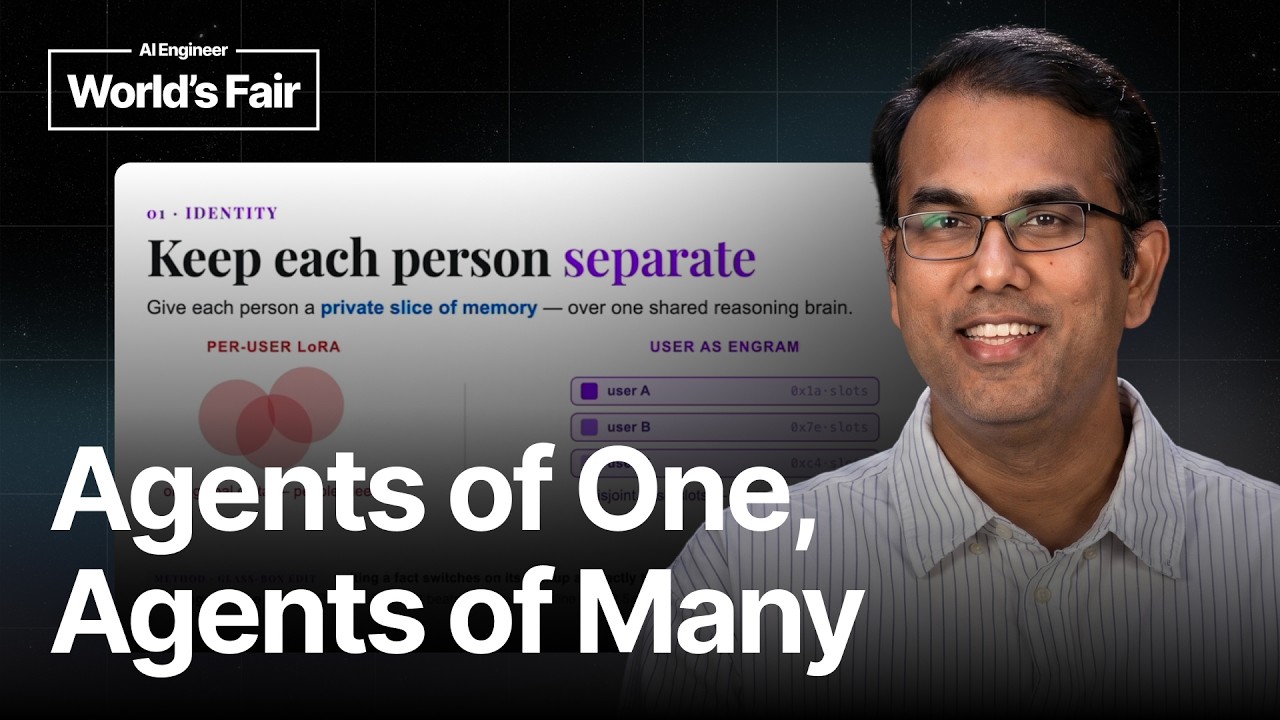
Wearing the Agent: From Group Chats to Glasses — Sai Krishna Rallabandi
Jul 29, 2026 · 19:09
Sai Krishna Rallabandi argues that group and wearable settings force agents to be redesigned around shared memory and security, as single-user assumptions break in multi-user contexts. He shares eight months of deploying Jodith among friends and family, highlighting two core challenges: guarding and memory. On security, two individually safe skills—OCR and reporting—can collide at runtime, leaking PII 90% of the time; his defense is a deterministic guard at the action surface and a LoRA fine-tuned SLM that catches prompt injection even when characters are obfuscated with dots. For memory, he proposes a continuously adapting relevance scorer to compact context and graph-based retrieval for evolving group conversations. Finally, he advocates per-user LoRA adapters on a shared memory layer to bake in privacy permissions instead of code-based access control.
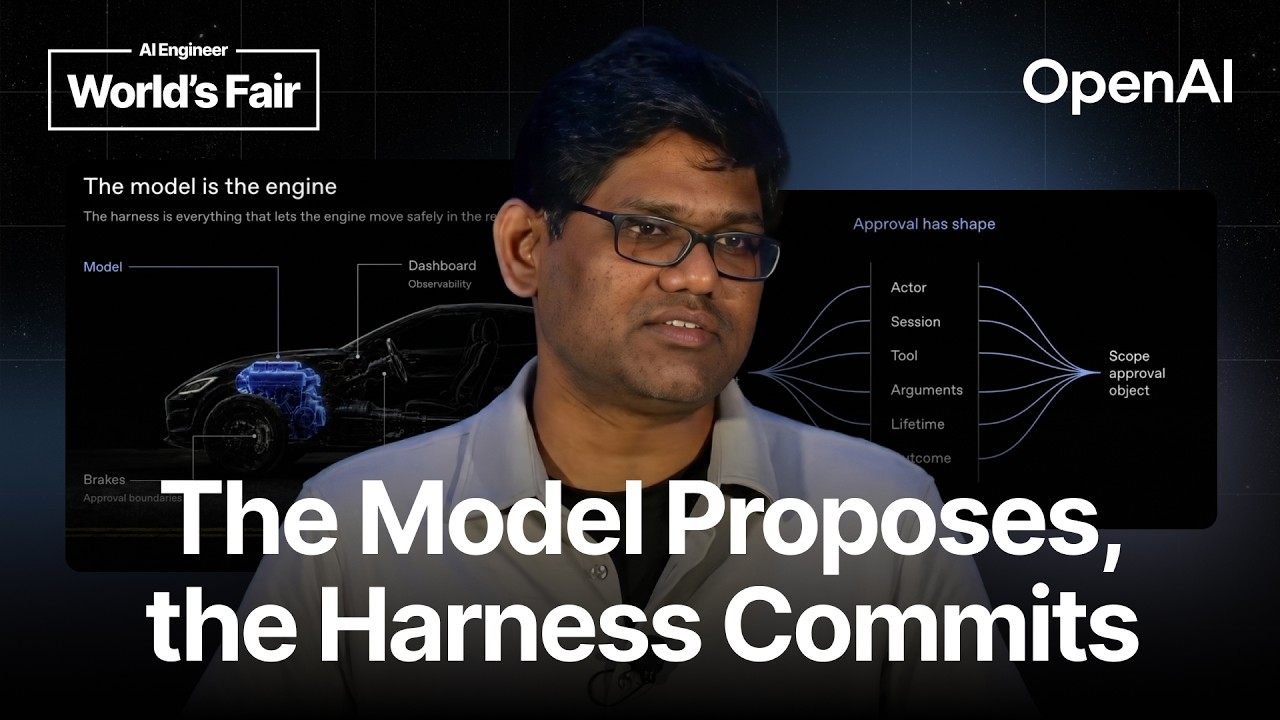
The Model Was Right. The Harness Failed. — Vinoth Govindarajan, OpenAI
Jul 29, 2026 · 18:26
Vinoth Govindarajan of OpenAI argues that most agent failures are harness failures, not model failures. Using OpenClaw as a case study, he details five failure shapes: state hole (delivered but not remembered), overlapping writers (last write silently erases previous), dangling tool call (run waits for an event that never arrives), approval drift (expired approval blocks later work), and missing edge proof (internal success but user didn't see result). The through line: a model proposes, the harness commits, and the receipt proves it. He prescribes three invariants—own the state, order the mutation, prove the action—and a five-question run receipt audit: what woke it up, what state did it inherit, what authority did it use, what executed, and what evidence survived.

Full Workshop: Setting Yourself Up for Success —Jason Liu, OpenAI Codex
Jul 24, 2026 · 1:15:02
Jason Liu walks through how to set up OpenAI's Codex for maximum productivity, using voice dictation, app shots, computer use, and a personal memory vault to delegate and automate almost every task. He demonstrates creating skills and plugins from past work, using compaction to keep threads running for weeks with hundreds of sub-agents, and setting up automations with heartbeats and goals. Specific examples include auto-checking flights, editing iMovies via computer use, and having a chief-of-staff thread that monitors Slack and updates task lists. He also covers security permissions (auto-review vs full auto), tips for new users to start with low thinking mode to save tokens, and how to build skills that self-improve by editing their own files. The workshop emphasizes that threads can now communicate with each other, enabling manager-like orchestration and long-running work streams.
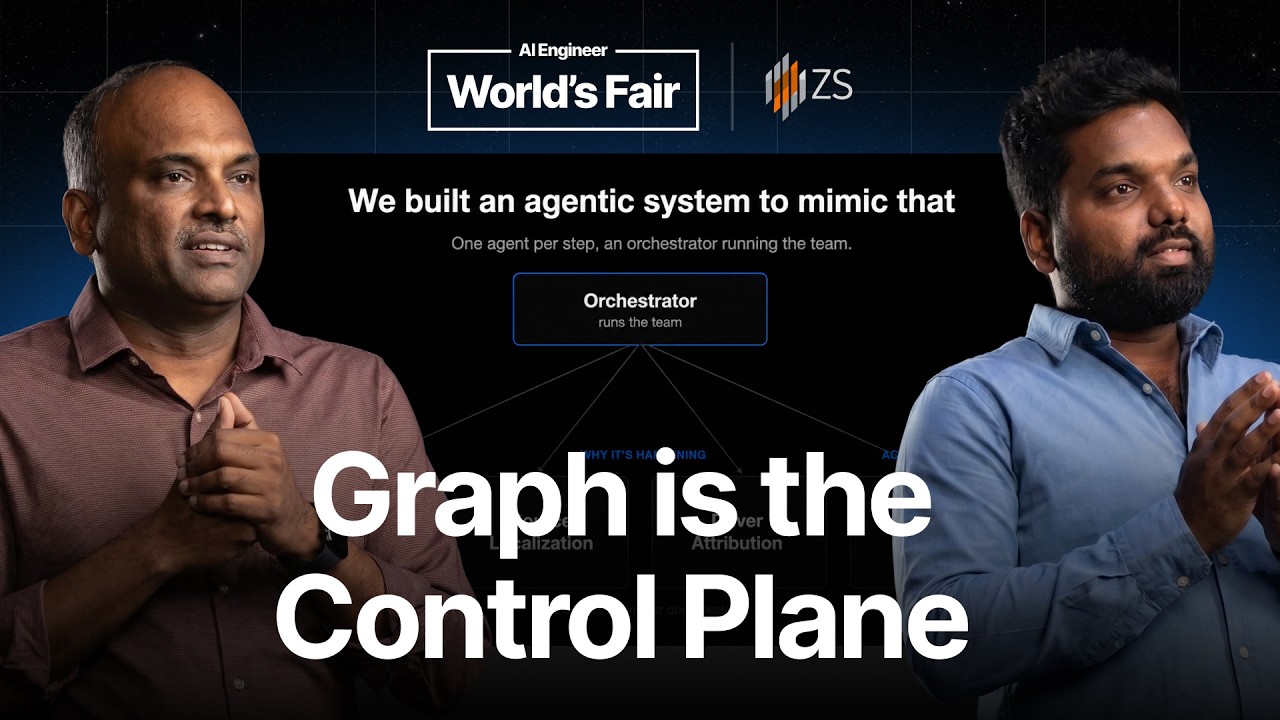
Why We Killed Our Multi-Agent Pipeline — Subbiah Sethuraman and Abhilash Asokan, ZS Associates
Jul 23, 2026 · 15:00
Subbiah Sethuraman and Abhilash Asokan of ZS Associates explain why they killed their multi-agent pipeline for pharma commercial analytics: the system produced incoherent output because no single agent owned end-to-end reasoning, domain knowledge was missing, and LLMs were used for deterministic signal detection. Observing Claude Code in an empty directory, they rebuilt with a deterministic pipeline that detects signals before the agent wakes up, consolidated to a single agent that owns reasoning and spawns sub-agents only for focused lookups, and added a knowledge graph as a control plane where every edge is a hypothesis the agent tests against data. The new system does in 20 minutes what an analyst did in a month, achieving bounded search and coherent output.
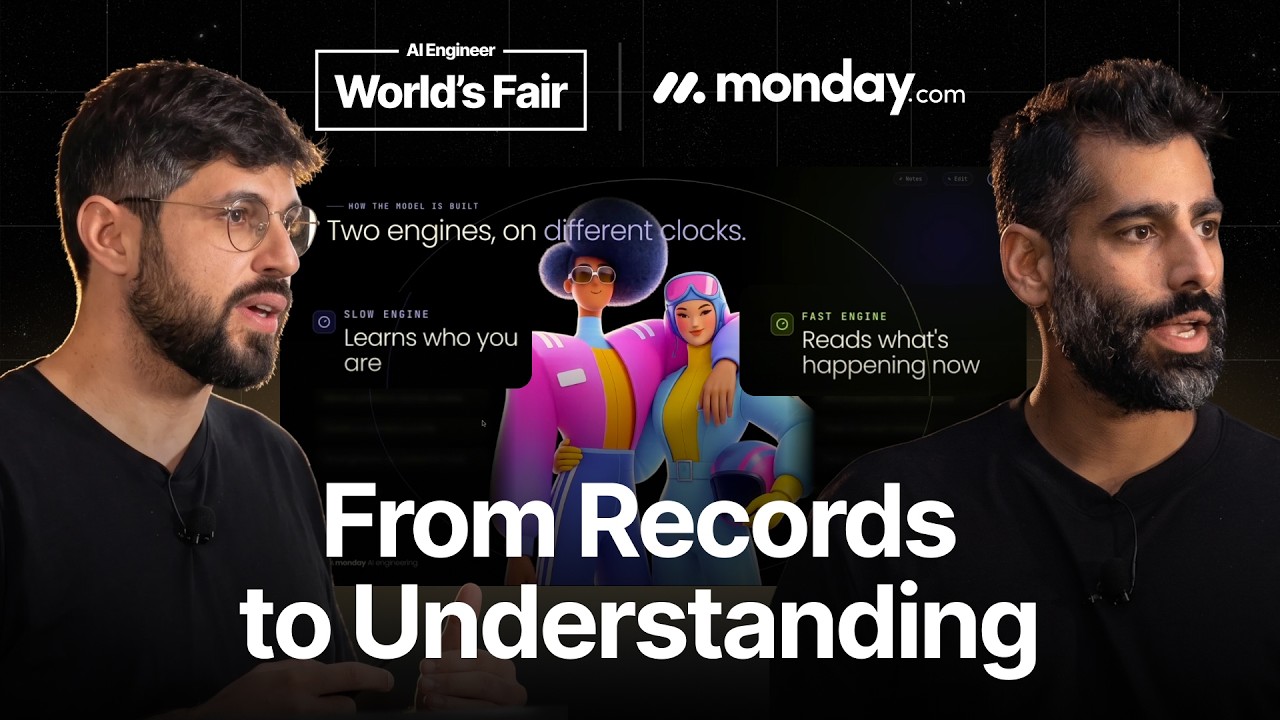
From Systems of Record to Systems of Context — Omri Bruchim & Tomer Ast, monday.com
Jul 22, 2026 · 15:58
Omri Bruchim and Tomer from monday.com argue that AI assistants fail to understand users because the bottleneck is understanding, not retrieval—so they are building a 'Monday world model' that precomputes context before the user asks. The system uses two engines: a slow engine that mines weeks of activity into a durable user profile (knows you), and a fast engine that reads recent signals for urgent items (knows your day). This split mirrors neuroscience’s hippocampus-neocortex and data architecture’s lambda architecture. The context is served to their Sidekick assistant, which degrades gracefully by falling back to verified context and compounds as every new day sharpens the profile. The result: Sidekick can answer 'what should I focus on right now' with understanding, not just a list of disconnected bullets.

CrabRAG: Why Automated Assistants Need Graph Memory, Not More Tokens — Stephen Chin, Neo4j
Jul 22, 2026 · 20:42
Stephen Chin of Neo4j introduces CrabRAG, a graph-based memory system that outperforms vector databases for AI agent reasoning. He demonstrates that markdown-based memory wastes over 100,000 tokens per round and that vector similarity fails at multi-hop questions. Using a home lab digital twin, he shows a graph agent correctly identifies his daughter's Minecraft server running outdated OS and exposed management ports, while the vector agent returns vague answers. Chin explains that graphs store relationships and enable precise, explainable, and auditable results, and that Claude can write Cypher queries for graph traversal. He announces his book 'GraphRAG: The Definitive Guide' and free training at Neo4j's Graph Academy.
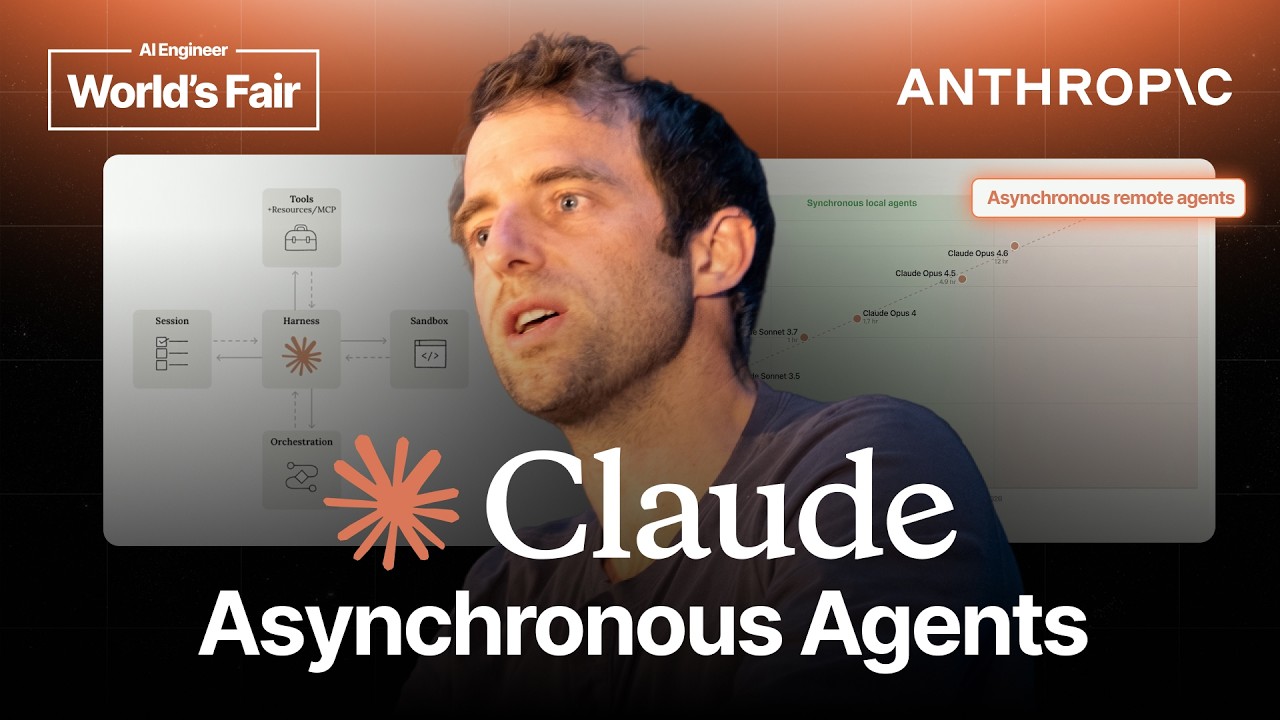
Claude for Long-Horizon Tasks — Lance Martin, Anthropic
Jul 22, 2026 · 25:19
Lance Martin from Anthropic discusses how Claude's increasing task horizon enables asynchronous agents through decoupled architecture, verifier loops, and self-improving memory systems. He explains the shift from short task horizons (10–20 minutes) to 12+ hours, necessitating decoupling the brain (harness) from hands (sandboxes) for reliability and security. Verifier loops using separate contexts allow models to self-correct, demonstrated on the Parameter Golf benchmark with Opus 4.7. Memory systems inspired by human dreaming correct errors in-band, as shown in a Pokémon example where dreaming prevented repeated failures. Finally, org-level harnesses like Claude Tag provide shared identity and context for multiplayer proactive agents.
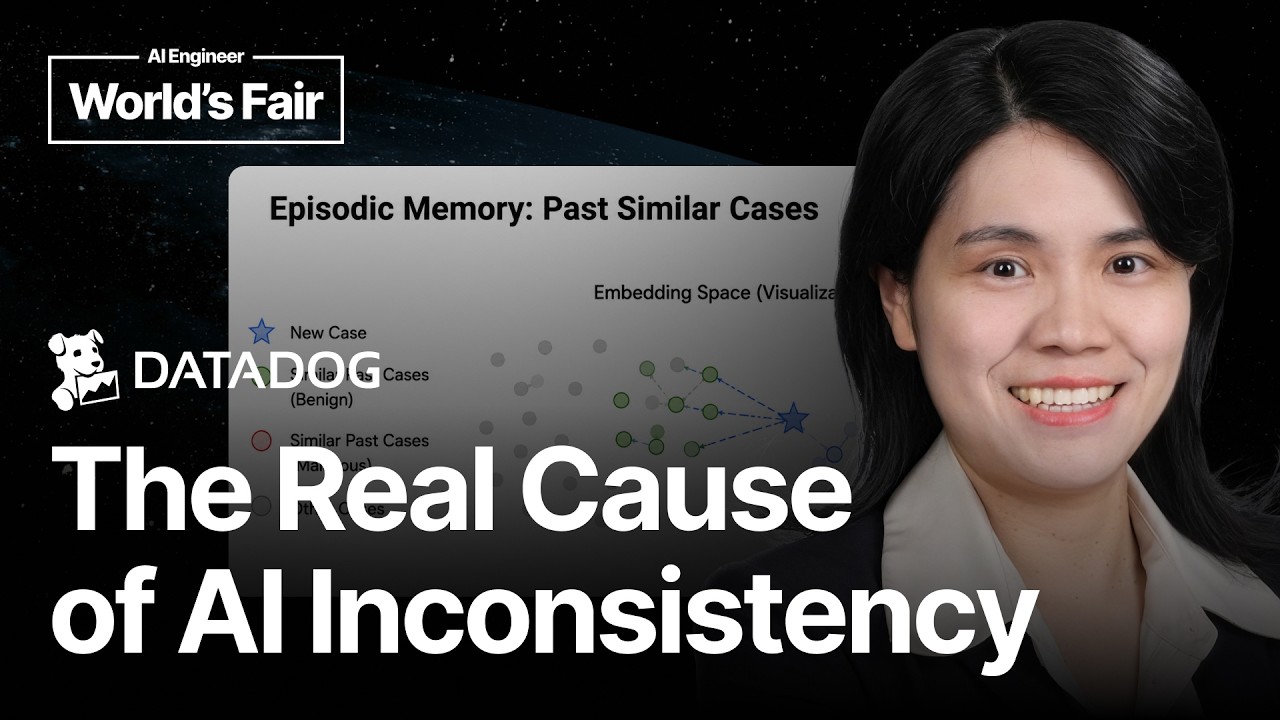
Why Your Agent Disagrees With Itself (And What To Do About It) - Diane Lin, Datadog
Jul 20, 2026 · 25:38
Diane Lin, Tech Lead at Datadog, argues that AI agent inconsistency is not a model failure but a signal of ambiguous data near the decision boundary, known as the gray zone. She presents a workflow combining active learning with semantic memory (domain policies) and episodic memory (past similar cases) to automatically identify flip-flopping outputs, focus human review, and continuously adapt agents without expensive fine-tuning. In a real experiment with 93 cybersecurity alerts, 25% initially flip-flopped; episodic memory reduced that to 10%, with the remainder resolved via human review and policy clarification. Lin emphasizes treating each disagreement as an opportunity to clarify labels and policies, building trustworthy, customer-adaptive agents.

Every company should have a Brain — Garry Tan, Y Combinator
Jul 17, 2026 · 21:08
Y Combinator CEO Garry Tan argues founders must build AI-native companies that treat AI as a workforce, not auto-complete, to achieve 400x productivity. He details how skill files (Markdown documents) act as employees, a resolver table as an org chart, and a company brain (like his open-source GBrain) as the memory layer that selects the right context for each task. Tan cites YC's Winter '25 batch where 25% of companies had 95% AI-generated code, and portfolio companies Emergence and Retail reaching $15M ARR with 15 people and $60M with 40 respectively. His core message: never do one-off work—always "skillify" completed tasks into reusable skills, so the organization compounds knowledge daily rather than waking up with amnesia.

The Factory That Dreams: 39 AI Agents, No Framework - Rushabh Doshi, Machinecraft
Jul 11, 2026 · 9:58
Rushabh Doshi, CEO of Machinecraft, explains how his 100-person factory built Ira, a 36-agent AI OS running its go-to-market and memory without a framework. The system uses 36 specialist agents, each with one job, orchestrated by Athena, handling outbound emails, quoting, leads, and replies from one Cursor tab. Built for $30,000 versus $230,000 agency quote, it runs on a few thousand monthly with no training. Doshi says the secret is well-organized memory, vectors, graphs, and biological-inspired architecture including senses, digestion, memory layers, a nightly dream cycle, and immune system for fact-checking. The system is grounded in a SOUL.md constitution based on Jain philosophy, and ForkMyBrain.org helps others build their own forkable brain by mapping their business from the inside.

A Genius With Amnesia - Victor Savkin, Nx
Jun 26, 2026 · 20:00
Victor Savkin, creator of Nx and Polygraph, argues that current coding agents are like a genius with amnesia – they see only a tiny portion of the codebase and forget everything between sessions – and introduces Polygraph, a meta-harness that gives agents full organizational context and perfect memory. He explains that agents are repo-bound and lack episodic memory, forcing humans to re-explain changes (e.g., seven explanations for one UI change across four repos). Polygraph builds a unified dependency graph by analyzing thousands of repos without code changes, lets agents work across multiple repos in a single session, and captures all traces so sessions can be resumed by any agent (Claude or Codex) on any machine. It also enables context-aware queries like 'find every repo that depends on version X of this library' and allows referencing past sessions for best practices. The result is an agent that sees the entire organization's code and remembers every decision, effectively creating a hive mind.

Build Systems, Not Code - Angie Jones, Agentic AI Foundation
Jun 25, 2026 · 19:39
Angie Jones (Agentic AI Foundation) argues that engineering discipline remains essential when building agentic systems, moving the joy of building from writing code to designing system architecture. Using her Relocation Scout house-hunting agent as an example, she walks through applying skills like systems thinking, workflow design, decomposition, separation of concerns, modularity, and algorithmic thinking. She advises using code for deterministic tasks like commute calculation, agents for judgment on listings, and humans for authority to approve tours. Jones stresses defining structured contracts between components, designing for idempotency with memory logging, and threat modeling to treat all external input as untrusted. She advocates baking maintainability into the system with self-documenting workflows so that any agent or human can orient themselves without reverse-engineering prompts.

Viktor: AI Coworker That Lives in Slack — Fryderyk Wiatrowski
May 11, 2026 · 19:30
Fryderyk Wiatrowski, co-founder of Viktor, explains how his AI employee lives in Slack—no web UI—participating in channels and threads like a teammate, inheriting integrations from whoever connected them first, and handling tasks that take ten minutes. He details the challenges of scaling a personal agent to a company agent: memory management across hundreds of users, managing Slack's complex input surface (threads, DMs, edits, emoji reactions), and preventing context leakage between channels. He shares that swapping the underlying model from Opus to GPT-5.4 caused user backlash due to personality differences, and describes the need to earn proactivity trust to avoid security alarms. Viktor's advantage is shared context—only one person needs to connect an integration for the whole team—but warns against giving it personal email access, as illustrated by a customer story. The episode argues that a great AI coworker requires helping get work done, knowing the company context, and being friendly.
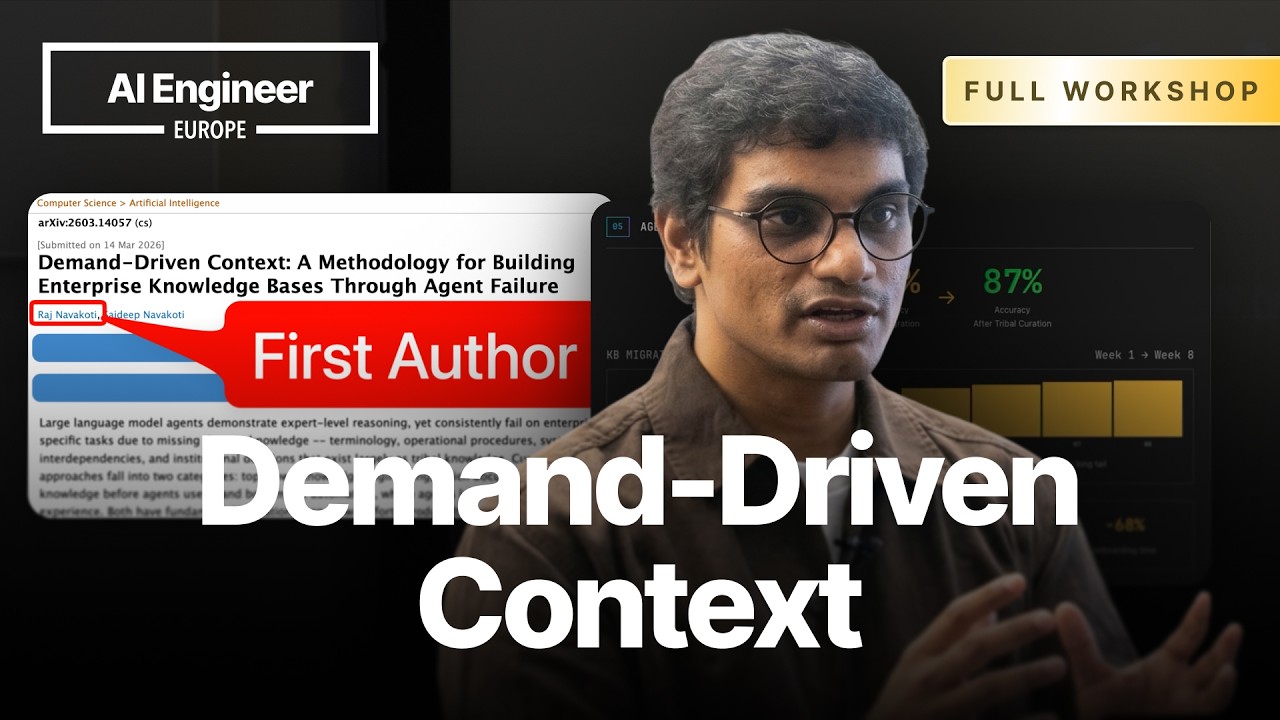
Demand-Driven Context: A Methodology for Coherent Knowledge Bases Through Agent Failure
May 5, 2026 · 1:08:15
Raj Navakoti, a staff software engineer at IKEA, presents a demand-driven context methodology for building coherent knowledge bases by letting AI agents fail on real problems and surfacing missing institutional knowledge. He argues that enterprises should shift from pushing monolithic documentation to a pull approach where agents reveal undocumented tribal knowledge through repeated failures on incidents and Jira tickets. Using a framework with skills, rules, and hooks, he demonstrates how agents can gradually improve confidence scores (from 1.4 to 4.4 over 14 incidents) by documenting discovered context blocks. Navakoti introduces a context gap scanner that automatically analyzes work items against existing documentation to identify critical gaps, outdated information, and duplications. He advocates storing curated knowledge in GitHub for version control and PR-based collaboration, and emphasizes that this approach helps teams know the unknown, enabling agents to manage knowledge rather than just consume it.

"Data readiness" is a Myth: Reliable AI with an Agentic Semantic Layer — Anushrut Gupta, PromptQL
Jun 27, 2025 · 17:02
Anushrut Gupta of PromptQL argues that 'data readiness' is a myth — perfect, clean data is unattainable — and instead advocates for an agentic semantic layer that learns from user corrections. He contrasts traditional approaches like manual semantic layers and knowledge graphs, which break as business definitions change, with PromptQL's design: a deterministic domain-specific language (PromptQL) that lets an LLM generate a plan executed by a runtime, avoiding hallucination. The system behaves like a new hire analyst: day zero it can handle messy tables (e.g., 'Morc, Plug, Zorp'), and through human guidance it self-improves — learning 47 business terms, mapping six systems, and discovering 12 calculation variants within 30 days. Gupta demonstrates a multi-step query across databases, Zendesk, and Stripe, with explainable steps and editable 'brain'; the AI achieves 100% accuracy on complex tasks for customers like a Fortune 500 food chain and a fintech company.
Powered by PodHood