
Agent Commerce
Episodes from AI Engineer about Agent Commerce.
18 episodes

Beyond the Lethal Trifecta: Agentic Commerce on the Open Internet — David Levine, Kiduna Club
Sep 1, 2026 · 21:40
David Levine, founder of Kiduna Club, argues that the lethal trifecta — Simon Willison's term for private data, untrusted content and the ability to act — keeps true agentic commerce off the open internet. Enterprises responded by penning agents inside Slack and Salesforce, losing context. His fix is the DUNA, a decentralized nonprofit under a West Virginia law that took effect the day before his talk, registered as organization 62847. Agents gain legal standing to own assets, sign agreements and answer in court, but cannot distribute profits without memberships becoming securities. Each agent carries JWT tokens resolving to a registered organization like DNS names; governance runs on decision markets trading pass-and-fail tokens on proposed policies instead of votes.

Agent Spending Without Controls — Rodrigo Coelho & Pranav Maheshwari, Edge & Node
Sep 1, 2026 · 20:48
Rodrigo Coelho and Pranav Maheshwari of Edge & Node argue agents are only as capable as the paid tools they can access, and agentic payments scale only with a compliance layer. Coelho cites The Graph's 1.8 trillion onchain queries and Edge & Node's 2021 query micropayments citing the HTTP 402 spec before Coinbase's x402. Rails built for humans can't serve agents transacting at machine speed, so enterprises stall until a chief legal officer signs off without risking fines in the billions. Maheshwari demos the same Mastercard prompt in two Claude Cowork terminals: without Ampersand's skill file it returns only the email format; with it, the agent pays a fraction of a cent and gets the email, location and handle. A final demo rejects a sanctioned wallet once TRM screening turns on.

x402 isn’t good (yet) — Jan Curn, Apify
Sep 1, 2026 · 20:48
Jan Curn, founder and CEO of Apify, argues that x402, Coinbase's HTTP 402-based agentic payments standard, is promising but still has rough edges. Drawing on Apify's launch of 20,000 tools on x402 alongside Coinbase, he explains how the protocol works: a client signs a payment, a facilitator verifies it, and only then does the server settle on-chain. He details the double-spending window between verification and settlement, the conflict between x402's mandatory 402 response and MCP's 401, and why metered billing pushed Apify to charge fixed amounts and refund the remainder. He also explains why crypto, unlike credit cards, suits micropayments and one-way agent transactions where buyers cannot dispute payments.

Your Agent Just Authorized What?! — Jay Mok & Ben Coumes, Paypal
Sep 1, 2026 · 16:07
PayPal's Jay Mok and Ben Coumes tie agent authorization to three questions — did the human authorize it, is it allowed in scope, can you prove it later — answered by stakes and familiarity. Low stakes is the coding agent: allow/ask/deny permissions plus system logs, since actions revert. Medium stakes is money in a closed ecosystem — Evermind's shared vault plus OAuth scopes, with the amount-bound mandate and transaction logs settling disputes. High stakes: autonomous payments between strangers need a layered selective disclosure JWT per FIDO/AP2 — merchants verify checkout, processors verify the mandate. The approval token inverts the flow: users approve before an agent finds an item; PayPal returns a payload with amount, expiry and merchant, starting with Gemini.

When AI Agents Pay and Sellers Monetize: Building x402 Apps on AWS — Anil Nadiminti, AWS
Sep 1, 2026 · 20:41
Anil Nadiminti, Senior Solutions Architect at AWS, presents AgentCore Payments — a service that lets AI agents autonomously discover, authorize, and execute payments for premium content over the x402 protocol. He explains how AgentCore handles paywalls through wallet support via Coinbase, with KMS-secured secret storage keeping private keys safe. Bot detection verifies trusted agents while blocking malicious ones, and per-session budgets with spend limits keep settlement instantaneous at internet speed. Real-time traffic analysis and observability throughout the stack ensure payment connectors, MCP5 integration, and web scraping all operate without exposing credentials — no centralization required, no SDK change, and no friction for developers building agentic applications.

Why Your AI Agent Needs a Wallet: USDC and Nanopayments — Harshal Bhangale, Circle
Sep 1, 2026 · 20:52
Harshal Bhangale, an engineer on Circle's Agentic Product team, argues that paying is where AI agents actually stall, and that Circle's USDC stablecoin and x402 protocol are the fix. He demos two identical Claude Code agents planning his trip to the FIFA World Cup final: the one without a wallet could only draft an email and admitted it had no way to call, while the wallet-equipped one paid for premium data, sent the email, and phoned him on stage to explain how to reach MetLife Stadium from his hotel. Card fees near 3% cannot sit on a one-cent call, he says, because agents consume in fractional amounts at high frequency, and sellers now meter slices of data instead of selling humans subscriptions. He cites roughly 24 million dollars transacted against paid API endpoints over x402 in 30 days, 99% settled in USDC. Blockchains alone fail since gas swamps microtransactions and shared block space brings unpredictable latency, so Circle's Nanopayments keeps settlement off-chain: funds sit in a smart contract, the agent signs cryptographic authorizations, and the seller relays them for confirmation in a few hundred milliseconds, with the wallet enforcing spending caps instead of human…

Multimodal Collaborative Agents for Next-Gen Commerce — Nidhi Kaushik Vyas, Google DeepMind
Sep 1, 2026 · 21:08
Nidhi Kaushik Vyas of Google DeepMind argues shopping agents fail as wrappers around the search bar, assuming well-formed intent, when users arrive with only a vibe — closing the articulation gap is the agent's job. Her discovery-research-response loop starts by building a working state from conversation, context and reference images, separating hard constraints from soft ones an image implies, and flagging inventory as a real-time variable. Research picks the highest information-gain question — room width, since all is moot if furniture won't fit — using visual boards for subjective tastes. Response adapts format — summary for policy questions, comparison tables, imagery — and autoraters grade every stage, including counterfactual tests flipping query parts to check constraints move when they should. A Q&A covers merchant ontology and UCP.

Teaching agents to pay — Anna Spysz, Stripe
Sep 1, 2026 · 19:10
Anna Spysz of Stripe walks through how agentic commerce works in a talk based on her own experience building a shopping agent. She demonstrates how agents discover and buy products: reading structured catalog data rather than rendered pages, speaking protocols like UCP, and operating within guardrails like disclosed fees and logged decisions. Using her headphones purchase as the running example, she shows how a merchant capabilities manifest makes a store visible to agents, and how a persona config change can flip an agent from pushy to trustworthy. The episode's core claim is that agentic commerce demands deliberate design from both sides of a transaction, not just a checkout API.

The Agentic Commerce Stack — Ahnaf Prio, Best Buy
Aug 27, 2026 · 20:38
Ahnaf Prio, Senior Engineering Manager at Best Buy, argues agentic shopping now runs on standardized commerce primitives rather than browser automation, with 45% of agent sessions on ChatGPT and Gemini already touching shopping. He explains why screenshot/DOM agents failed and maps MCP, A2A, OpenAI's ACP, Google's UCP, and AP2 payment mandates. Merchants push product feeds because M merchants times N products does not scale; payments today use shared tokens or Google Pay. His live demo has his cat Jenny as a bakery agent on Cerebras at 3,000 tokens per second, showing checkout state transitions and an AP2 token with spend ceiling and revocation URL. He closes with evals for behavior, protocol compliance and latency, citing Chipotle's agent answering programming questions as a whack-a-mole caution.
Knowledge Systems: The New GTM Stack — Jeffrey Wang, Exa
Aug 26, 2026 · 18:49
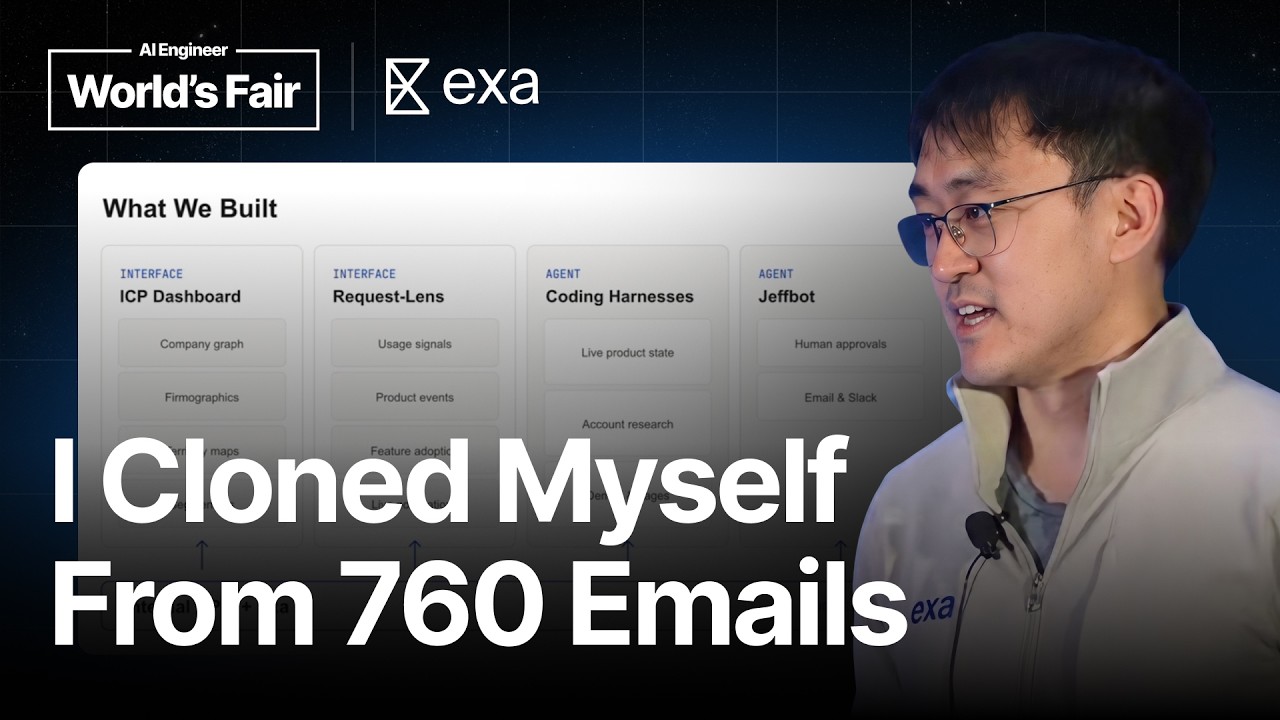
Jeffrey Wang, cofounder of Exa, argues go-to-market is an AI engineering problem and details Exa's stack: an ICP dashboard classifying nearly every company in its addressable market with anticipated spend, and Request Lens alerting on meaningful customer events. The team runs about a dozen Slack agents plus Jeffbot, an AI clone of Wang trained on 760 emails—he averages 18 words and signs 'best' not 'sincerely'—and limited to drafts when others use it. He closes on three principles: agent-first means API-first, not everything should be a chatbot, and buy-versus-build is false—Salesforce exposed as MCP is arbitrarily customizable. He also notes an eight- or nine-person FDE org runs deals and builds the sales systems.

Building GTM AI Agents: Lessons from Deploying to 6,000 Users — Sait Izmit, Snowflake
Aug 26, 2026 · 20:39
Sait Izmit of Snowflake says winning over 6,000 go-to-market users comes down to quality over coverage: he wrote 150 sales questions before testing, accepted 50% first accuracy, and chose 50 questions at 95% over 100 at 70%. The Snowflake Cowork agent, live since September, has answered over a million questions (~40,000 weekly); 60% of data arrived post-launch, and it now spans 15 semantic views, 85 tables, 3,000 columns, MCPs, and 20 skills. After pilot and a 600-user 10% beta with 70% retention, GA showed only 20% of the org tried it, so Izmit spends 60-70% of his time on demos and sales meetings. He warns the wow factor collapses quickly, so teams must move from data chat to workflow automation, build fast with today's stack, accept rearchitecture, and mine logs for feedback loops.

The Missing Layer in Agentic AI — Giedrius Šteimantas, Oxylabs
Aug 26, 2026 · 15:04
Giedrius Šteimantas of Oxylabs argues the missing layer in agentic AI is web scraping infrastructure, applying ten years of scraping rules to make agents cheaper and more reliable. His friend's shopping agent used a browser for everything, hit CAPTCHAs, and wasted tokens. Rebuilding it, he replaces discovery's browser and fixed retailer list with Oxylabs' fast search API (under 2,000 tokens, under 700 milliseconds), and the decision stage with a scraper API that returns markdown, fails loudly, runs hundreds of parallel requests, and bills only for successful results. Checkout needs a browser, so Playwright MCP connects to Oxylabs' headless browser with stealth, residential proxy, and geolocation. Cost matters: use a browser only when necessary, validate content—HTTP 200 does not mean valid.
Agents Need Receipts, Not More Tool Calls - Armanas Povilionis, Alithea Bio
Jul 18, 2026 · 19:36
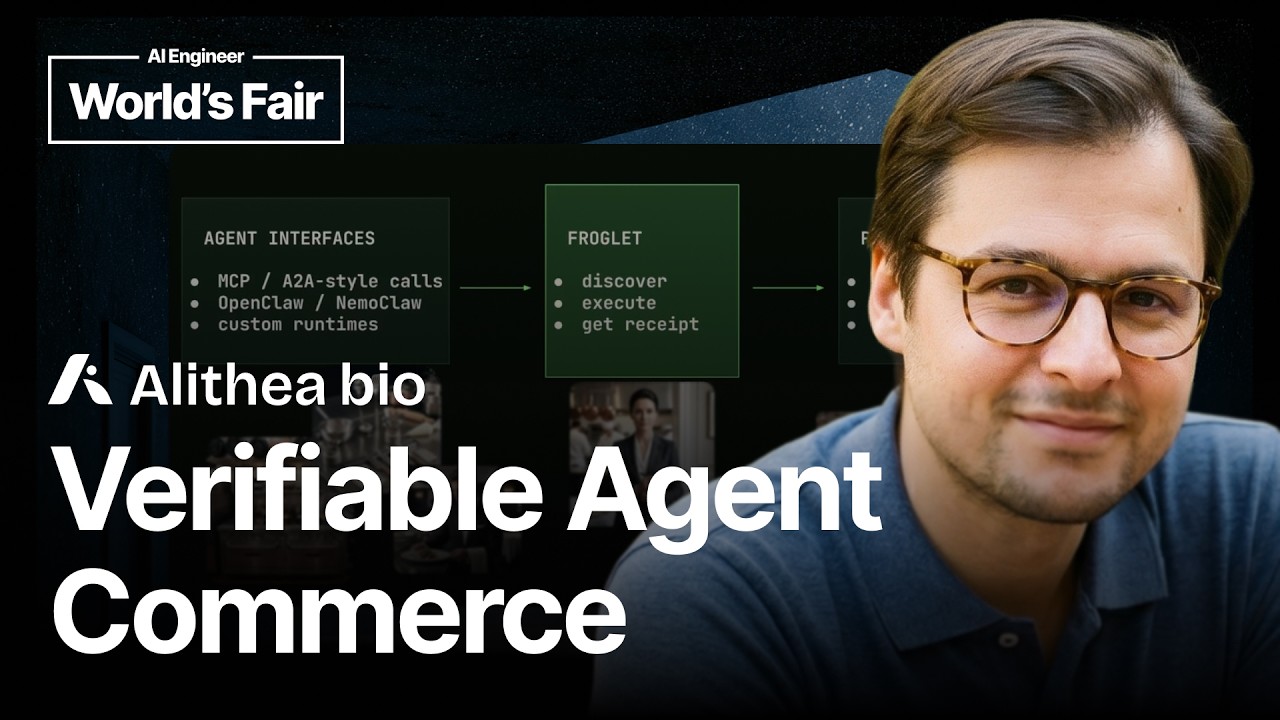
Armanas Povilionis of Alithea Bio argues that agents need verifiable receipts, not more tool calls, and introduces Froglet, an open-source protocol for agent-to-agent compute. Froglet enables agents to discover, negotiate, execute, and receive signed, tamper-proof receipts for external services, reducing setup to 2,000 tokens and minutes. The protocol integrates with MCP, OpenClaw, and NemoClaw, and supports payment rails, identity, and workload hashes. In a live demo, he shows Claude using Froglet to publish an 'add two numbers' service locally and remotely, then invoke it to get result 12, with a signed deal ID. Froglet aims to make scientific collaboration repeatable and consistent across organizational boundaries without requiring uniform software stacks.
The Agentic Web and the Bazaar Era of AI - Ramesh Raskar, MIT Media Lab
Jul 12, 2026 · 12:11
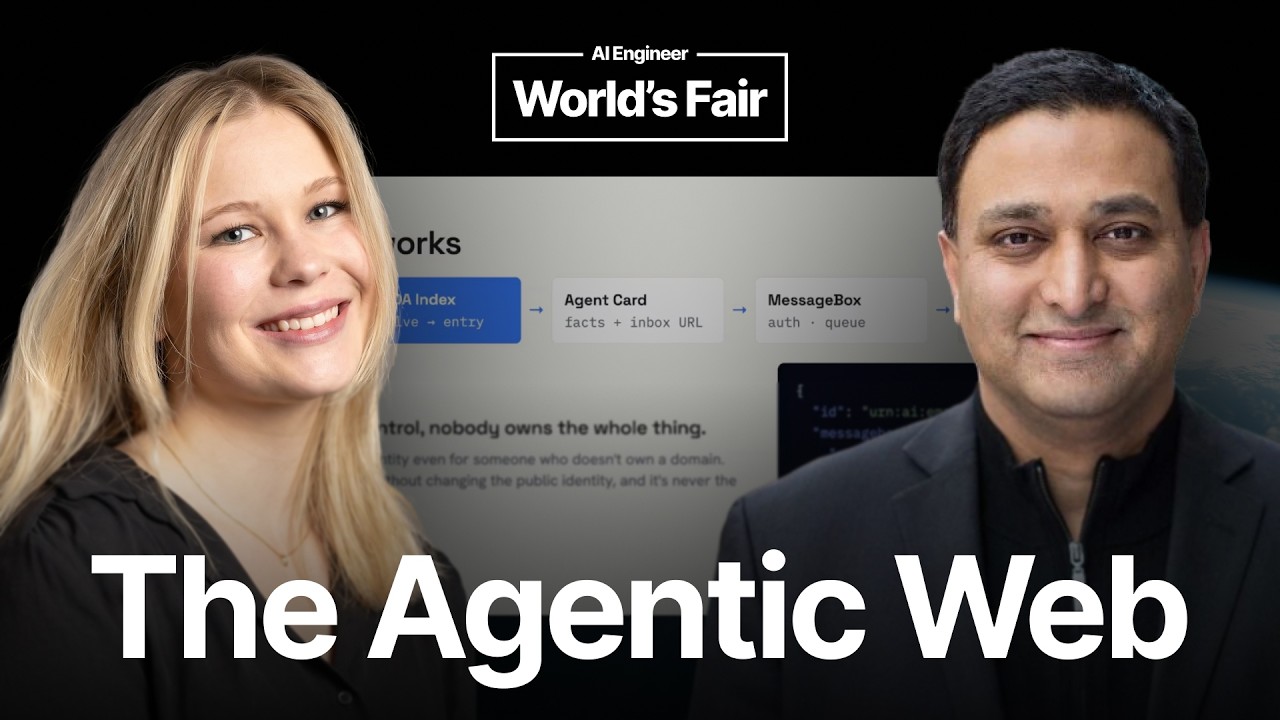
Ramesh Raskar and Maria from MIT's Project Nanda argue that the emerging web of AI agents requires an open infrastructure for discovery, commerce, and coordination, moving beyond today's walled-garden platforms. They outline three layers: the Discovery Layer (Nanda index for agent identity, trust, and adaptive resolution), the Commerce Layer (knowledge pricing markets for intelligence), and the Bazaar Layer (machine co-learning). The Nanda index enables agents to find each other across vendors via signed agent facts and adaptive routing, while Nanda town simulates the entire agent economy to test protocols at scale. The goal is a permissionless web where any agent can discover, transact, and learn across organizational boundaries, analogous to the transition from AOL to the open web.

The Factory That Dreams: 39 AI Agents, No Framework - Rushabh Doshi, Machinecraft
Jul 11, 2026 · 9:58
Rushabh Doshi, CEO of Machinecraft, explains how his 100-person factory built Ira, a 36-agent AI OS running its go-to-market and memory without a framework. The system uses 36 specialist agents, each with one job, orchestrated by Athena, handling outbound emails, quoting, leads, and replies from one Cursor tab. Built for $30,000 versus $230,000 agency quote, it runs on a few thousand monthly with no training. Doshi says the secret is well-organized memory, vectors, graphs, and biological-inspired architecture including senses, digestion, memory layers, a nightly dream cycle, and immune system for fact-checking. The system is grounded in a SOUL.md constitution based on Jain philosophy, and ForkMyBrain.org helps others build their own forkable brain by mapping their business from the inside.
Building safe Payment Infrastructure for the autonomous economy — Steve Kaliski, Stripe
Jun 6, 2026 · 18:46
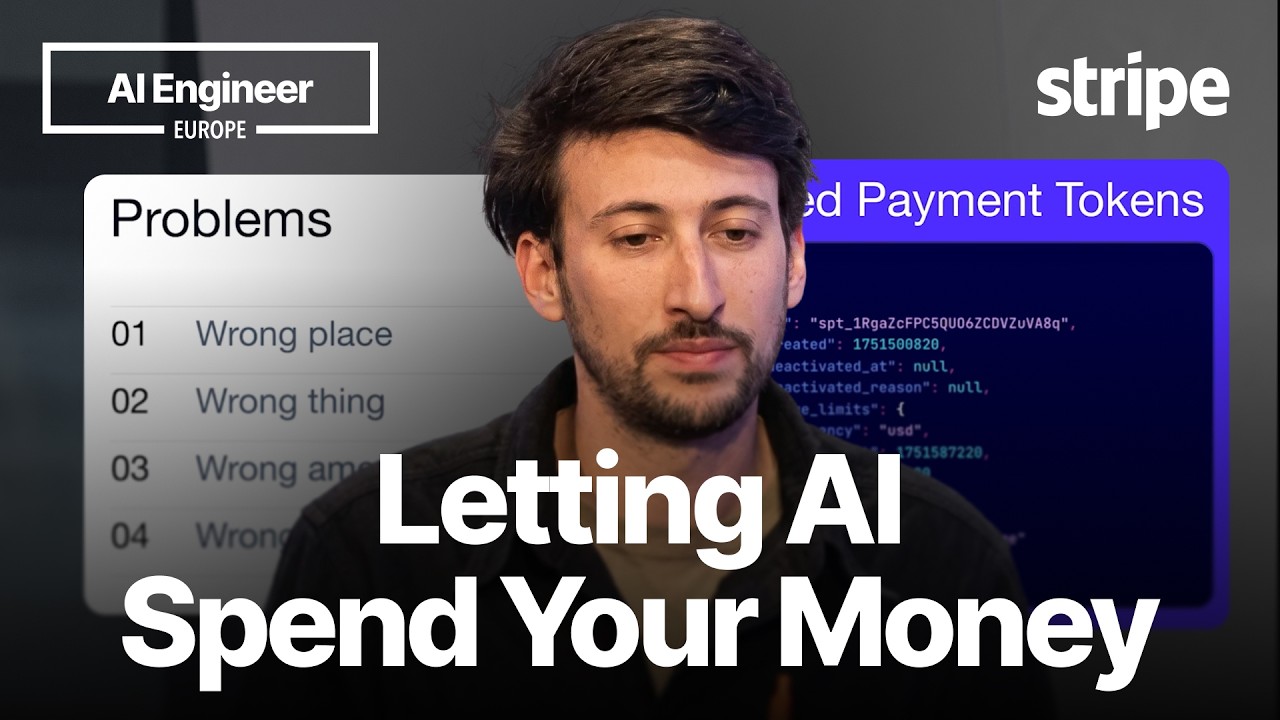
Steve Kaliski, Principal Software Engineer at Stripe, explains how to build safe payment infrastructure for the autonomous economy, focusing on enabling AI agents to spend money without catastrophic risk. He argues that discovery benefits from non-determinism (e.g., LLMs), but payments and credentials require determinism. Stripe's solutions include shared payment tokens that enforce spend limits per seller, amount, currency, and time; the machine payments protocol with Tempo for paying for API calls via HTTP status codes; and the agent e-commerce protocol with OpenAI for structured checkout flows. Kaliski also demonstrates how Stripe projects wraps these primitives. The goal is to minimize blast radius through verifiable identities, spend policies, and API-driven interactions.
Automating Escrow with USDC and AI - Corey Cooper, Circle
Jul 14, 2025 · 58:18
Corey Cooper, Head of DevRel at Circle, demonstrates how USDC stablecoins and AI agents can automate escrow by combining smart contracts with LLM-based task verification. He explains that USDC's programmability enables near-instant settlement, chargeback-free transactions, and always-on payments ideal for agent-to-agent payments. The demo shows an escrow agent app that uses OpenAI to parse PDF contracts, deploys Solidity escrow contracts via Circle APIs on Base Sepolia, and allows an AI agent to verify deliverables (e.g., image quality) and trigger payout from a locked smart contract. Cooper discusses human-in-the-loop safeguards, cross-chain deposits via Circle's Cross-Chain Transfer Protocol, and future possibilities like multi-sig agent verification. He highlights that while full autonomy is not yet reliable, combining USDC with AI can streamline payment operations.

Ionic Launch: Opening the economy to AI agents
Feb 6, 2025 · 5:30
Justin, CEO and co-founder of Ionic Commerce, presents his company's mission to enable AI agents to participate in the economy, starting with ecommerce. He argues that the current web is built for ads, not actions, leaving agents unable to access dynamic product data like stock or shipping. Ionic solves this by partnering with hundreds of merchants, enriching their product feeds via an agentic workflow, and exposing the data through an API that agents can query in their preferred format (relational, vector, graph). The platform also adds a transaction layer so agents can complete purchases in one step using payment tokens. Justin emphasizes that merchants will pay for this service because it provides better attribution and customer relationships than Amazon's cut. Ionic's catalog already includes millions of AI-native SKUs, and developers can start today at docs.ioniccommerce.com.
Powered by PodHood