
Zep
ProductA product discussed on AI Engineer.
3 episodes
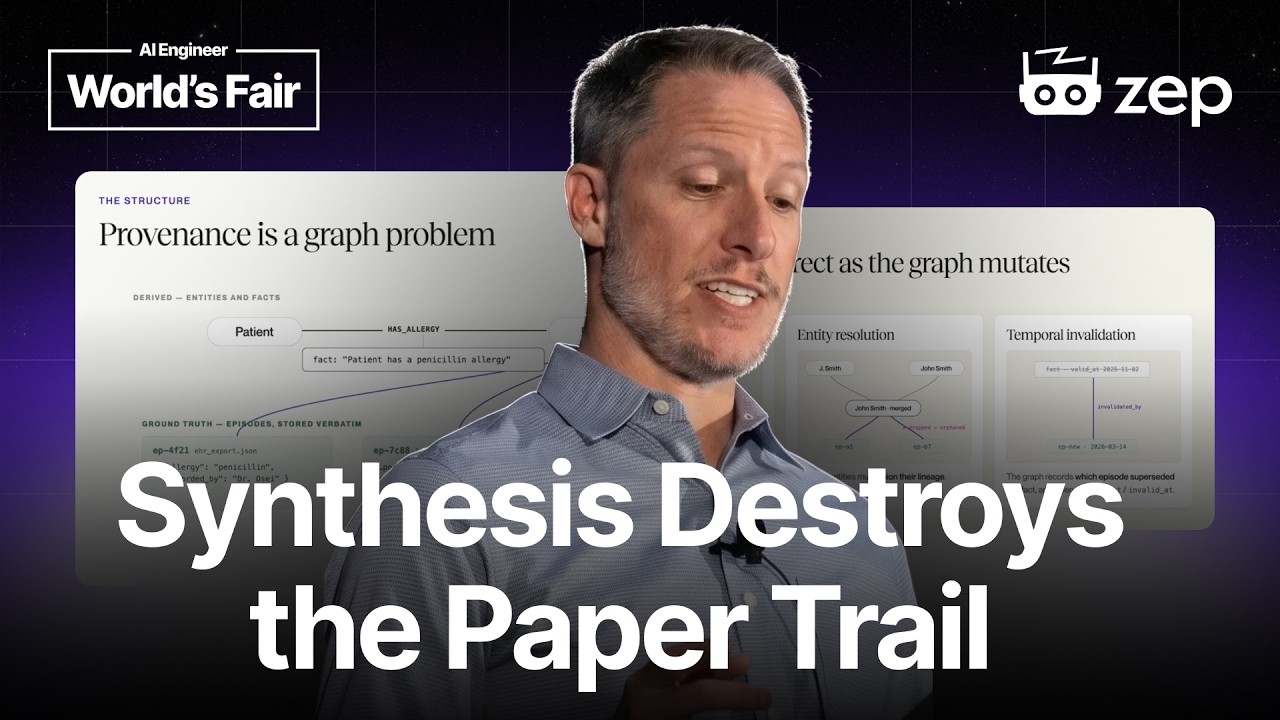
Citation Needed: Provenance for LLM-Built Knowledge Graphs — Daniel Chalef, Zep AI
Jul 23, 2026 · 20:54
Daniel Chalef argues that provenance for knowledge graphs built by LLMs must itself be a graph, not a simple source ID, because LLM synthesis destroys the paper trail. In Graphiti, the open-source temporal graph framework behind Zep, sources become episodes and derived facts link back to them, enabling a graph walk to trace any fact. This handles merges (merged entities keep all source links), invalidation (invalid-at dates on mutated edges), and metadata projection (tags on episodes inherit to derived facts). Deletion follows the same edges: a fact survives GDPR erasure only if other supporting episodes remain. Benefits include compliance, veracity evaluation, and debuggability for agentic systems.

Agentic GraphRAG: AI’s Logical Edge — Stephen Chin, Neo4j
Jul 21, 2025 · 15:27
Stephen Chin of Neo4j argues that Agentic GraphRAG — combining graph databases with retrieval-augmented generation — overcomes LLM hallucinations and biases by providing structured, relational context. He demonstrates how LLMs fail on reasoning tasks like calculating classroom capacity due to inaccurate anchoring on irrelevant data, and proposes an architecture where vector search first identifies relevant nodes, then graph traversal retrieves related context for the LLM. Chin highlights Neo4j’s MCP server for cypher query generation and memory modules, and cites Klarna’s success: 250K employee questions answered in the first year, 2,000 daily queries, and 85% adoption, replacing their entire SaaS stack. He recommends the Neo4j Certified Developer Program and the Nodes Conference for further learning.

Architecting Agent Memory: Principles, Patterns, and Best Practices — Richmond Alake, MongoDB
Jun 27, 2025 · 17:37
Richmond Alake from MongoDB presents memory management as the key pillar for building believable, capable, and reliable AI agents, arguing that agentic systems require structured memory types—persona, toolbox, conversational, workflow, episodic, and entity—to achieve statefulness and reduce reliance on prompt engineering. He introduces MemoRiz, an open-source library implementing these memory design patterns, and positions MongoDB as a flexible memory provider with its document model and hybrid retrieval capabilities (vector, text, graph). Alake details practical patterns: storing tool schemas for scalable tool use, persisting conversation history with timestamps and recall signals, leveraging workflow memory to learn from failures, and using MongoDB's upcoming integration of Voyage AI embedding models to simplify chunking and retrieval. He connects these advances to neuroscience, citing how feline visual cortex research inspired CNNs and noting recent collaborations with neuroscientists to further agent memory research.
Powered by PodHood