
Windows
ProductA product discussed on AI Engineer.
4 episodes
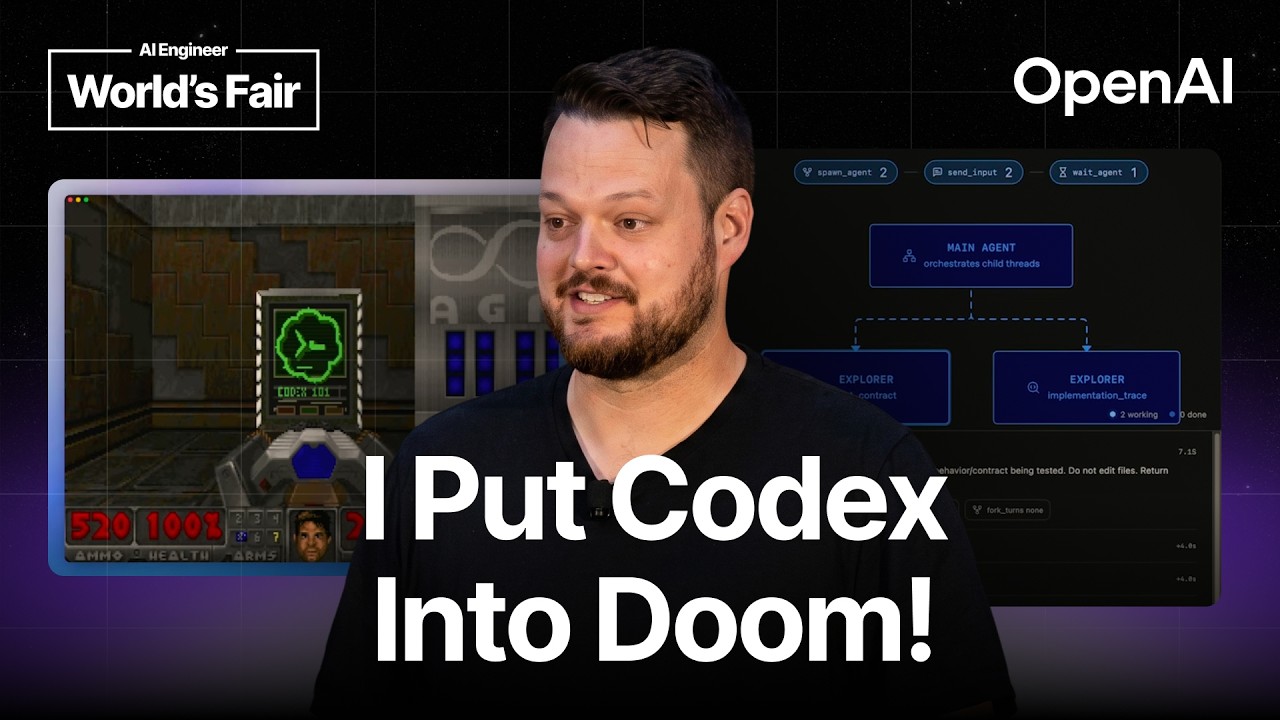
How Codex Works — Dominik Kundel, OpenAI
Aug 10, 2026 · 20:55
Dominik Kundel, an OpenAI engineer, explains the internals of the Codex agent harness, which is open source under Apache 2 and written in Rust. He details how context construction caps available skills at 2% of the context window and uses deferred tools with tool search to manage size and cost. For actions, Codex relies on an apply patch tool for file edits, a shell tool with ripgrep, and sandboxes: seatbelt on macOS, bubblewrap on Linux, and a custom open-source Windows sandbox. To reduce approval fatigue, an auto-review subagent with read-only permissions judges actions against user authorization and risk taxonomies. Speed improvements come from websocket mode in the responses API, which sends only changed items instead of full state, crucial when GPT 5.3 Codex Spark hit 1,000 tokens per second on Cerebras. Long-horizon goals work via a continuation prompt until the model calls an update goal tool, favoring concrete verifiable objectives, and auto compaction maintains performance…

The New Primitives: Building AI Native Software — Kwindla Kramer, Daily
Aug 7, 2026 · 21:14
Kwindla Hultman Kramer (Daily, Pipecat) argues that agents are the web pages of 1995—a primitive, not a destination—and the next target is AI-native software. He grounds this in 80 years of computing: Vannevar Bush's 1945 As We May Think predicted OCR, speech to text, and hypertext; the 1950s brought programming languages, the 1960s interactivity, the 1970s databases, then the personal computer. VisiCalc, he says, didn't eliminate accountants; it multiplied accounting work and created new roles, a counter to AI unemployment fears. He cites Apple's 1987 Knowledge Navigator and Tavas's real reimagining as prototypes. He closes with Gradient Bang, a multiplayer game he built with LLMs at the core of every interaction, showing asynchronous non-blocking context compression, long-running subagents, progressive skills loading, dynamic UI generation, and conversational voice.
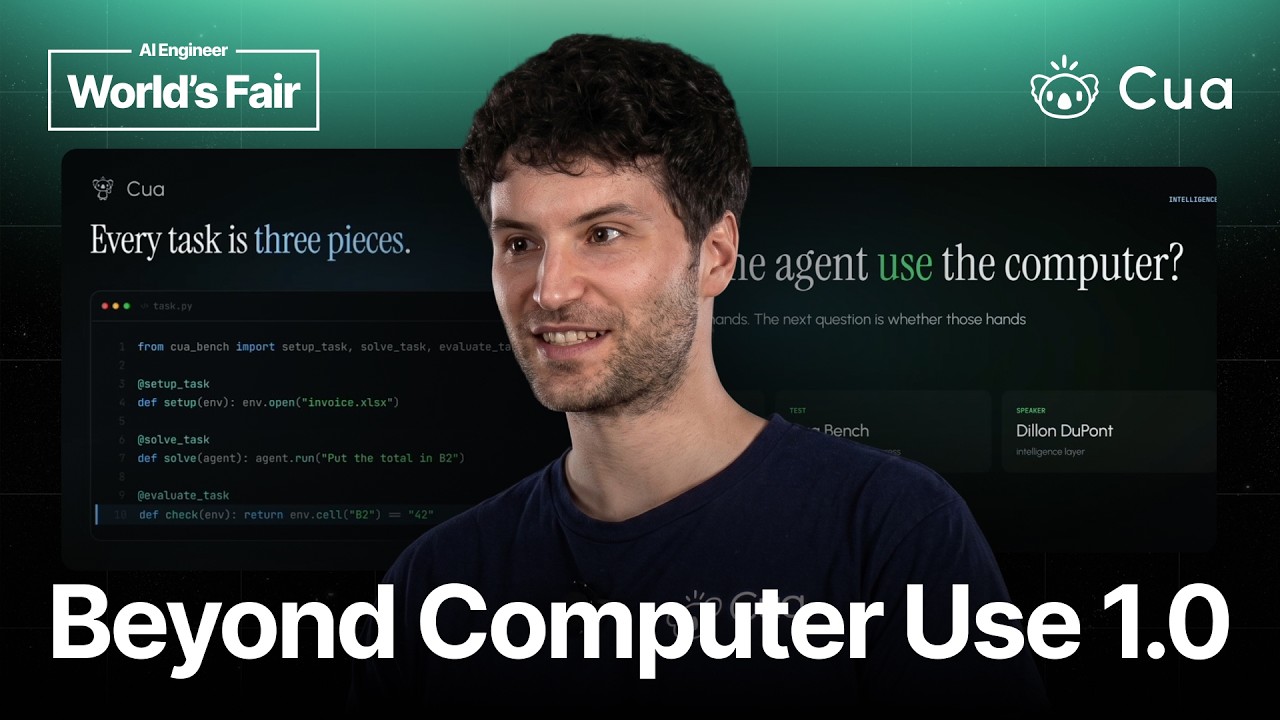
Computer-Use 2.0: Agents Just Got Multi-Cursor — Francesco Bonacci, Cua
Jul 15, 2026 · 16:41
Francesco Bonacci (CEO), Dilon (CTO), and Rob (Chief of Infra) from Cua present their vision for computer-use agents that operate in the background via undocumented OS accessibility APIs (AX on macOS, UI Automation on Windows, AT SPI on Linux), avoiding screen capture and cursor hijacking. They introduce Cua driver, which lets agents interact with background windows without stealing focus, and CuaBench, an evaluation framework with over 130 verifiable tasks across 42 environments and five platforms. Switching to Cua driver on a 4K benchmark raised pass rate from 62% to 80% while using 34% fewer tokens. Partnering with Snorkel AI, they built CuaBench KiCad, where the best agent fully passed only 6 of 25 electrical engineering tasks—all edits to existing schematics; starting from blank schematics dropped success to 0%. Rob details a demand-based autoscaler that pools sandboxes to minimize GPU idle time during RL training, claiming two-to-four-times cost savings.

Foundry Local: Cutting-Edge AI experiences on device with ONNX Runtime/Olive — Emma Ning, Microsoft
Jun 27, 2025 · 22:52
Emma Ning, Principal PM at Microsoft, presents Foundry Local, a platform for building cross-platform on-device AI applications using ONNX Runtime and Olive. She argues local AI is essential for low-bandwidth, privacy-sensitive, cost-efficient, and real-time latency scenarios, noting that modern hardware and optimized models like Phi-4-mini and DeepSeek make it viable. Ning demonstrates Foundry Local's CLI, model benchmarking (Qwen 1.5B at 90 tok/s vs. Phi-4-mini with richer output), and a cross-platform document summarization app built with JavaScript SDK, running identically on Windows and macOS. She also previews a local agent with MCP servers (file system and OCR) that extracts receipt totals using Phi-4-mini. Customer testimonial from Sava (CEO of Pieces) highlights improved memory management and tokens-per-second, while another partner underscores ease of install and hybrid cloud-local solutions.
Powered by PodHood