
WebRTC
ProductA product discussed on AI Engineer.
2 episodes

Generative Video at the Speed of Light — Keegan McCallum, uRun
Aug 18, 2026 · 8:43
Keegan McCallum, founder of inference provider uRun, argues that generative video's interesting axis is no longer quality but efficiency and long-horizon generation. He shows Helios, a distillation of Wan 2.1 14b, generating clips in real time for ~one-hundredth the cost of a slower frontier-quality clip, and notes at least 40 real-time/long-horizon models released this year. Ten dollars buys three hours of continuous generative video, and fifty buys fifteen; this unlocks magic-mirror webcam transformations, visual mediums for people who don't think in text, and content creation where you steer a generation in under a second. The hard part is serving: global GPUs, WebRTC with ICE/TURN, and synchronized streaming pipelines; uRun is building a React component, Python runtime, and MCP/CLI.
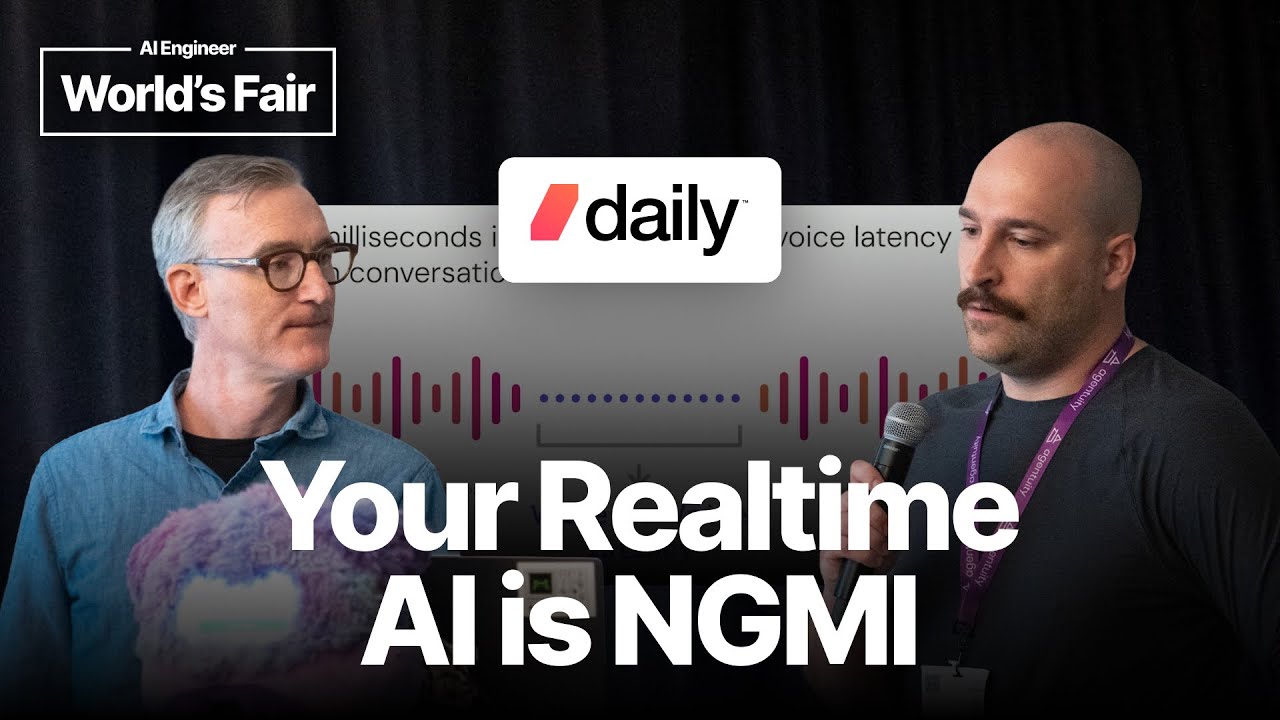
Your realtime AI is ngmi — Sean DuBois (OpenAI), Kwindla Kramer (Daily)
Jul 31, 2025 · 16:30
Sean DuBois (OpenAI, Pion) and Kwindla Kramer (Daily, Pipecat) argue that realtime AI systems must be built from the network layer up, with WebRTC essential for voice AI over WebSockets. WebSockets rely on TCP, causing glitches in 10–15% of connections, while WebRTC uses UDP for sub-second voice-to-voice latency (they demonstrate ~500ms target). Kwindla shows a latency breakdown from a Pipecat app, and Sean notes WebRTC handles packet loss, jitter, and bandwidth estimation automatically. They demo Squabbert, a Raspberry Pi stuffed animal using peer-to-peer WebRTC with MLX Whisper and Gemma 3 for local AI. Yashin, a non-technical mom, shares her bilingual learning app built with Sean's guidance, highlighting WebRTC's accessibility.
Powered by PodHood