
Security Copilot
ProductA product discussed on AI Engineer.
2 episodes

The New Primitives: Building AI Native Software — Kwindla Kramer, Daily
Aug 7, 2026 · 21:14
Kwindla Hultman Kramer (Daily, Pipecat) argues that agents are the web pages of 1995—a primitive, not a destination—and the next target is AI-native software. He grounds this in 80 years of computing: Vannevar Bush's 1945 As We May Think predicted OCR, speech to text, and hypertext; the 1950s brought programming languages, the 1960s interactivity, the 1970s databases, then the personal computer. VisiCalc, he says, didn't eliminate accountants; it multiplied accounting work and created new roles, a counter to AI unemployment fears. He cites Apple's 1987 Knowledge Navigator and Tavas's real reimagining as prototypes. He closes with Gradient Bang, a multiplayer game he built with LLMs at the core of every interaction, showing asynchronous non-blocking context compression, long-running subagents, progressive skills loading, dynamic UI generation, and conversational voice.
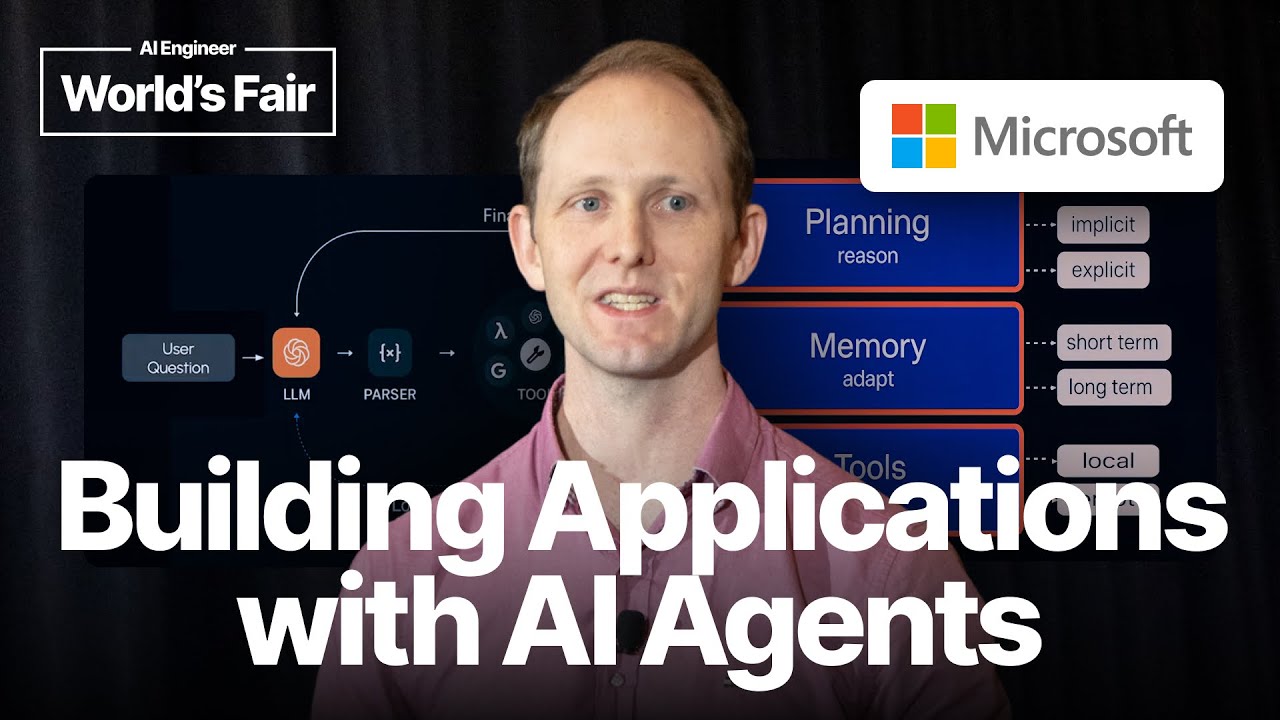
Building Applications with AI Agents — Michael Albada, Microsoft
Jul 24, 2025 · 15:50
Michael Albada, Principal Applied Scientist at Microsoft, explains how to build effective AI agent systems, defining agents as entities that reason, act, communicate, and adapt. He emphasizes that tool use requires exposing grouped, human-facing functions rather than one-to-one API mappings, noting a 254% increase in agentic Y Combinator startups. Orchestration should start simple with chains and trees before moving to fully agentic patterns, using deterministic logic for safety and external state management. For multi-agent systems, he recommends splitting tools into semantically similar groups to avoid overwhelming a single agent. Albada stresses investing in evaluation via open-source tools like Intel Agent, Pirate, Label Studio, and automatic optimization with Trace, TextGrad, and DSPY. He warns against common pitfalls: insufficient evals, poorly designed tools, excessive complexity, and lack of observability, while urging design for security with tripwires and fallback to human review.
Powered by PodHood