
Rails
ProductA product discussed on AI Engineer.
3 episodes

The Era of Compound Engineering — Kieran Klaassen, Every/Cora
Aug 20, 2026 · 20:38
Kieran Klaassen of Every describes compound engineering, the system behind his AI email client Cora, built alone without writing a single line of code this year. He moved through bottlenecks—code, plans, judgment—then built memory so the next feature is easier. His rule: spend 50% building the feature and 50% teaching the system what it got wrong; stored solutions are more token-efficient than corrections and research. The loop is a human-AI sandwich—brain on to decide problems, autonomous middle overnight, brain on to raise the bar. His open-source Compound Engineering Plugin, used by hundreds of thousands daily, turns backlogs into argued ideas and automates work via /LFG. The bet: implementation gets cheaper, judgment does not.
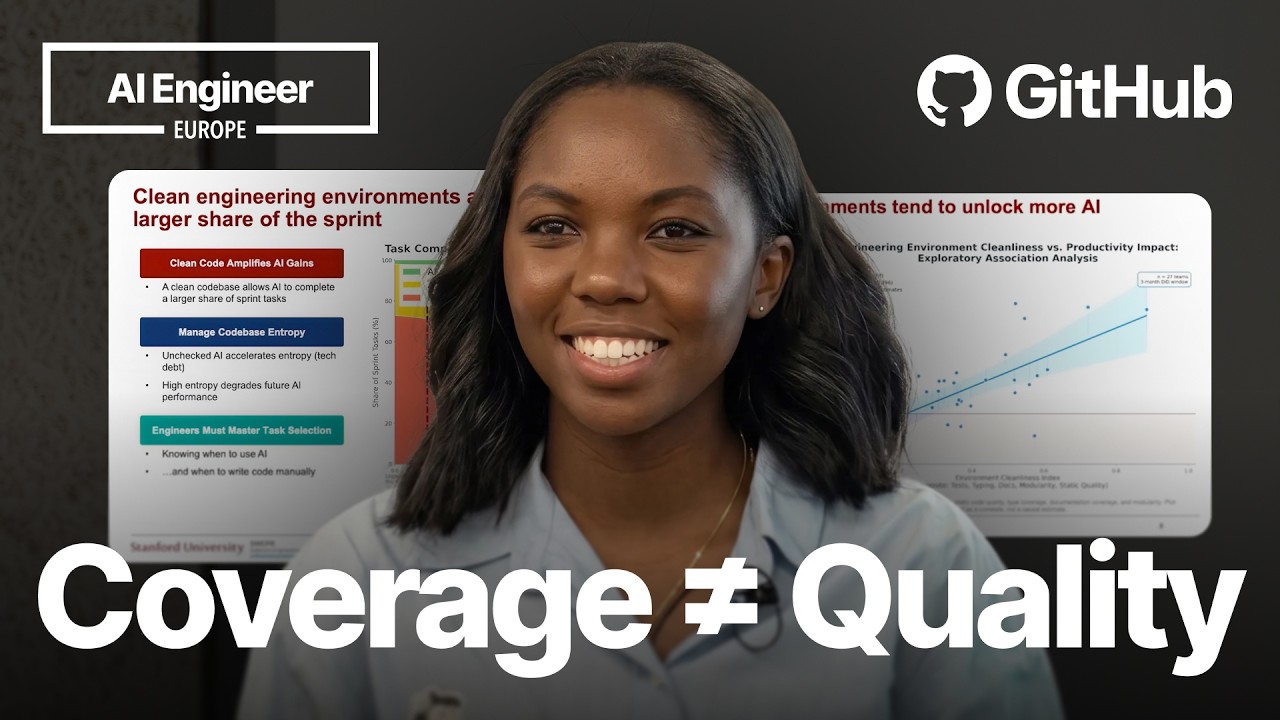
Beyond Code Coverage: Functionality Testing with Playwright MCP — Marlene Mhangami, Microsoft
May 16, 2026 · 19:45
Marlene Mhangami of Microsoft and GitHub argues that AI boosts developer productivity only when paired with clean code practices, citing a Stanford study of 120,000 developers and GitHub Octoverse data showing 275 million weekly commits in 2026 with a growing share co-authored by AI. She advocates test-driven development (TDD) with Playwright for functional testing over unit tests, as AI-generated tests often affirm code behavior rather than user experience. In a live demo, she uses GitHub Copilot CLI and Playwright MCP server to automatically write failing Playwright tests for a toy store's search and filter features, then generate code to pass them. She emphasizes testing one feature per test, capturing screenshots for PRs, and committing code before fixes to preserve context. She closes with advice on using Playwright agents for complex state management and confirming cross-screen-size support.

How Building with AI Can Double the Throughput of Your Engineering Team — Brian Scanlan, Intercom
May 15, 2026 · 21:49
Brian Scanlan of Intercom explains how treating Claude Code like a new hire—onboarding it to a 15-year-old Rails monolith, writing skills for every recurring task, and connecting it to production systems—doubled engineering PR throughput in under a year. By going all in on one platform instead of letting everyone choose their own tool, Intercom achieved a 17.6% automatic PR approval rate with SOC 2 sign-off, and its CI infrastructure collapsed under the volume. The key principle: give agents problems, not tasks. Scanlan recounts a security incident where Claude automatically pulled files, ran analysis, and handed back next steps in two minutes using a skill he didn't know existed. The talk emphasizes that all engineering work—debugging, testing, planning—should be agent-first, and that companies must invest in platform-level adoption and continuous skill improvement.
Powered by PodHood