
R1
ProductA product discussed on AI Engineer.
7 episodes

Scaling to Long Horizons — Ross Taylor & Chengxi Taylor, General Reasoning
Jul 31, 2026 · 18:07
Ross Taylor and Chengxi Taylor, co-founders of London-based RL company General Reasoning, argue that scaling to long horizons demands a mindset shift and better simulation, not just bigger context windows. Ross recounts how Galactica's 2022 thinking tokens were prescient, but its base-model demo backfired, while RLHF made LLMs products; his Meta team's PPO with verifiable rewards worked, but DeepSeek-R1 later showed better base models were key. Chengxi details long-horizon obstacles: sparse rewards, credit assignment, and 1M token limits, solved by value models that reduce variance and enable bootstrapping. Kelly Bench gave frontier models $100K to trade Premier League matches; all lost money, exposing how little current environments simulate real competition. Pipeline RL trades off off-policy staleness (8 steps okay) against GPU utilization, and they point to openreward.ai, with 350+ environments, for long-horizon RL.
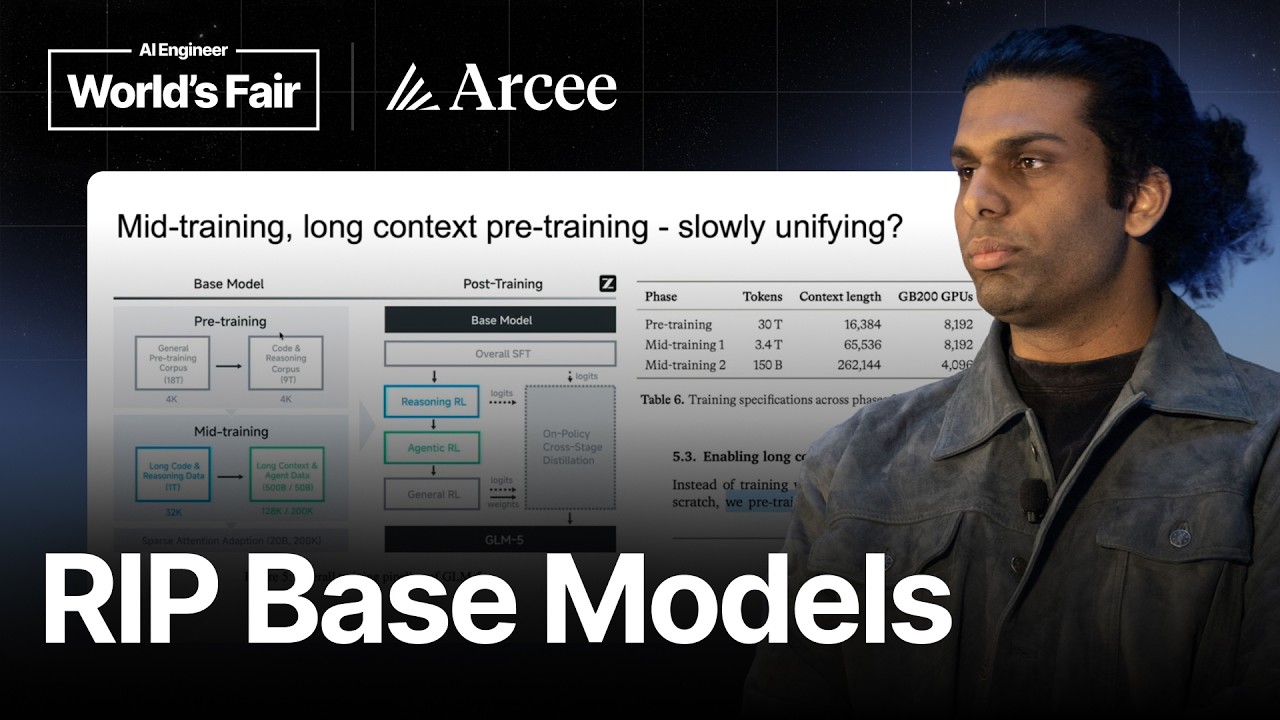
The Base Model Is Dead — Varun Singh, Arcee AI
Jul 31, 2026 · 17:45
Varun Singh, pre-training lead at Arcee AI, argues the base model is dead: it no longer just mirrors web text but must carry the prior that reinforcement learning builds on. He traces how web text fell from 85% of GPT-3's mix to 15% in MAI Thinking 1, with code and STEM dominating, and how Nemotron 3 Ultra pulls SFT-style Q&A data back into pre-training. Synthetic rephrasing, as used in Arcee's Trinity Large and Kimi K2, upsamples information to teach task shapes early. He warns that without post-training-flavored data early, MoE load balancing can break when SFT distributions differ, citing MAI's cranking of the balancing coefficient. He frames training as supervised learning vs RL, noting RL compute now rivals or exceeds pre-training, as with Compose 2.5, and argues the base model's job is to provide atomic skills for RL to compose.

The Next Unicorns: 7 Top AI startups from the HF0 Residency
Aug 21, 2025 · 22:16
Diego Rodriguez (Krea) presents an AI creative suite that generated 1M images/day for a Fox ad, while OpenHome debuts the first AI smart speaker with 10K developers and 500 free dev kits. Josh’s Coframe made $20M for a travel firm by making websites adaptive, and Eugene’s Featherless AI built QWERTY 72B without transformer attention, claiming scale is dead in favor of reliability. Jonas Bauer’s Upside uses LLMs to structure enterprise data, Lengyue’s OpenAudio introduces S1, the first instructable voice model beating ElevenLabs, and Alex Atallah’s OpenRouter provides a single API for all LLMs, growing 10–100% monthly.

Training Agentic Reasoners — Will Brown, Prime Intellect
Jul 7, 2025 · 19:17
Will Brown of Prime Intellect argues that reasoning and agents are fundamentally the same, and reinforcement learning (RL) is the key to advancing both. He explains that RL now works at scale, as shown by DeepSeek's GRPO and OpenAI's o3, and that agentic tasks like tool calling are natural RL environments. Brown warns against reward hacking and emphasizes designing evals that are harder to game than the task itself. He introduces his open-source toolkit 'verifiers' (now on pip) which lets users build trainable agent loops with a simple API, and demonstrates training a 7B Wordle agent in a few turns on just a couple GPUs.

Personal, Local, Private AI Agents: Soumith Chintala
Apr 6, 2025 · 20:32
Soumith Chintala, co-founder of PyTorch, argues that personal AI agents should run locally and privately to maintain trust and control over intimate data. He warns that cloud-based agents, lacking complete context (like access to all messaging or financial accounts), become unreliable and potentially dangerous—catastrophic actions like buying a Tesla instead of Tide Pods are possible. Key technical challenges include slow local inference, immature open-source computer-use models, and poor catastrophic action classification. He is bullish on open models surpassing closed ones through coordinated improvement, citing Linux, Llama, and DeepSeek. Chintala also plugs open reasoning data from gr.ink and PyTorch’s work on enabling local agents, urging AI engineers to tackle these gaps.
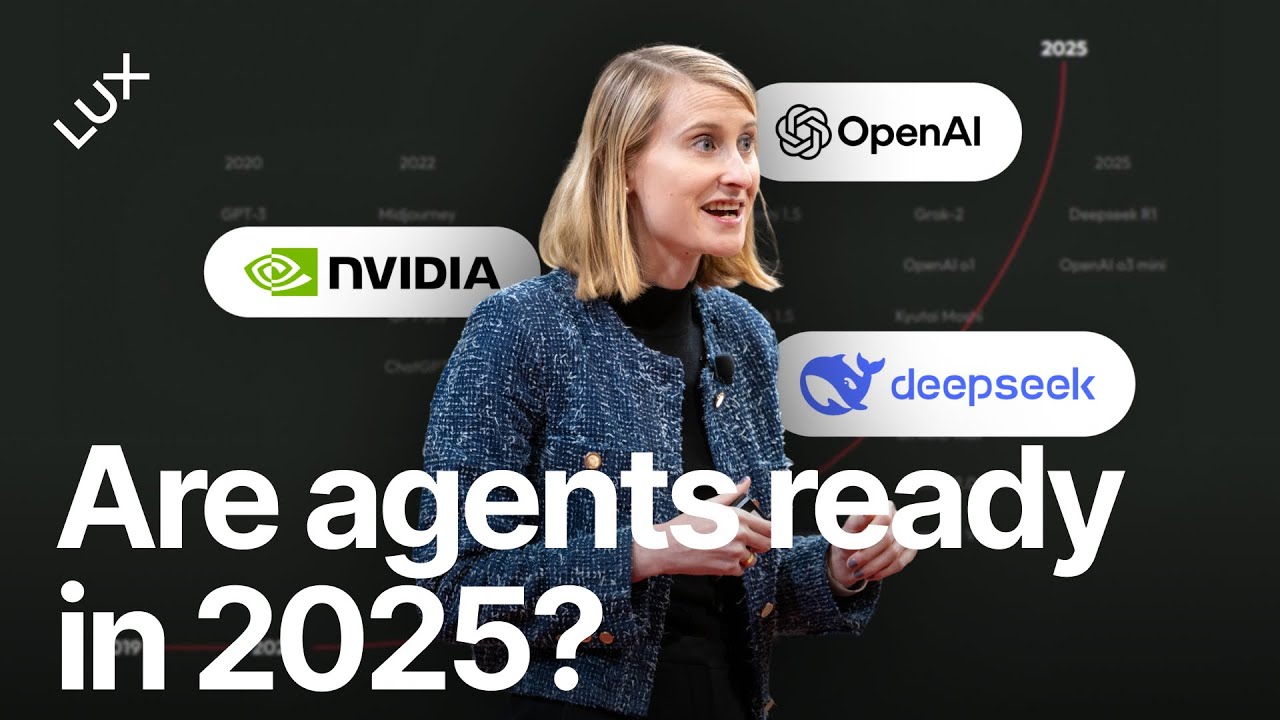
Navigating AI’s Frontier in 2025 - Grace Isford, Lux Capital
Mar 13, 2025 · 17:55
Grace Isford, partner at Lux Capital, argues that while 2025 is a 'perfect storm' for AI agents with reasoning models like O3 and R1, cheaper inference, and billions in infrastructure (e.g., Stargate, DeepSeek), agents still fail due to cumulative errors—decision, implementation, heuristic, and taste—exemplified by OpenAI Operator booking a flight incorrectly. She prescribes five strategies: curating proprietary and agent-generated data, building personalized evals for non-verifiable domains (e.g., seat preference), designing scaffolding that prevents cascading failures (citing Ramp's approach), treating UX as the moat (e.g., Codium, Harvey, TLDraw), and building multimodally with voice, smell via Osmo, and touch for embodiment. The talk, recorded at the AI Engineer Summit 2025 in NYC, closes with a call to reframe perfection through visionary product experiences.

The Model Isn’t Wrong—You’re Just Bad at Prompting
Feb 22, 2025 · 8:54
Dan from PromptHub argues that prompt engineering remains critical for improving LLM outputs, covering Chain of Thought, few-shot, and meta prompting techniques. Chain of Thought breaks problems into sub-problems and is built into reasoning models; few-shot prompting works best with just one or two diverse examples, but can degrade performance on reasoning models like O1 and R1. Meta prompting uses LLMs to write or refine prompts, with PromptHub offering model-specific enhancers. For reasoning models, Dan advises minimal prompting, encouraging more reasoning instead of few-shot, and avoiding instructing the model on how to reason. Free resources include PromptHub's templates, the AutoReason prompt, and the Prompt Engineering Substack.
Powered by PodHood