
Prime RL
ProductA product discussed on AI Engineer.
3 episodes
Local Models: Trust, Control, Optimization — Carter Abdallah, NVIDIA
Aug 7, 2026 · 43:21
NVIDIA's Carter Abdallah, Prime Intellect's Vincent Weisser, Arcee's Lucas Atkins, and NVIDIA's Chris Alexiuk argue open-weight models are the trustworthy foundation for enterprise and local AI. Atkins separates trust from safety: when Anthropic pulled Fable, enterprises chose Chinese open models for guaranteed availability, and open models are inspectable unlike closed APIs. Arcee pretrained a 400B model in six months; Weisser cites a customer that specialized an open model for finance in a week or two, beating Opus at a fraction of Haiku's cost. Alexiuk calls open weights the fix for 'mismanaged genius' and expects capable local models on MacBooks within a year; the panel predicts Fable-level open models within a year and hopes local-model use rises from a rounding error to 10–15%.

Reinforcement Learning without Verifiable Rewards — Will Brown, Prime Intellect
Jul 31, 2026 · 19:27
Will Brown of Prime Intellect argues RL can work without verifiable rewards by anchoring training in environments rather than clean ground truth. He frames RL as a model plus harness acting in a task and world with a scoring rule, citing Prime Intellect's Prime RL and LAB platform as the tooling. Verifiable rewards are easy for math and code, but messy tasks need manufactured signal: grounded Q&A pairs from documents and repos, plus a reverse direction trick that hides a bug or backdoor so the model learns to find it, calibrating difficulty. He warns reward hacking will surface, so teams should inspect traces, run small experiments, and involve experts. His goal is making RL a science with open models and shared benchmarks, where production traces become new tasks for continual learning.
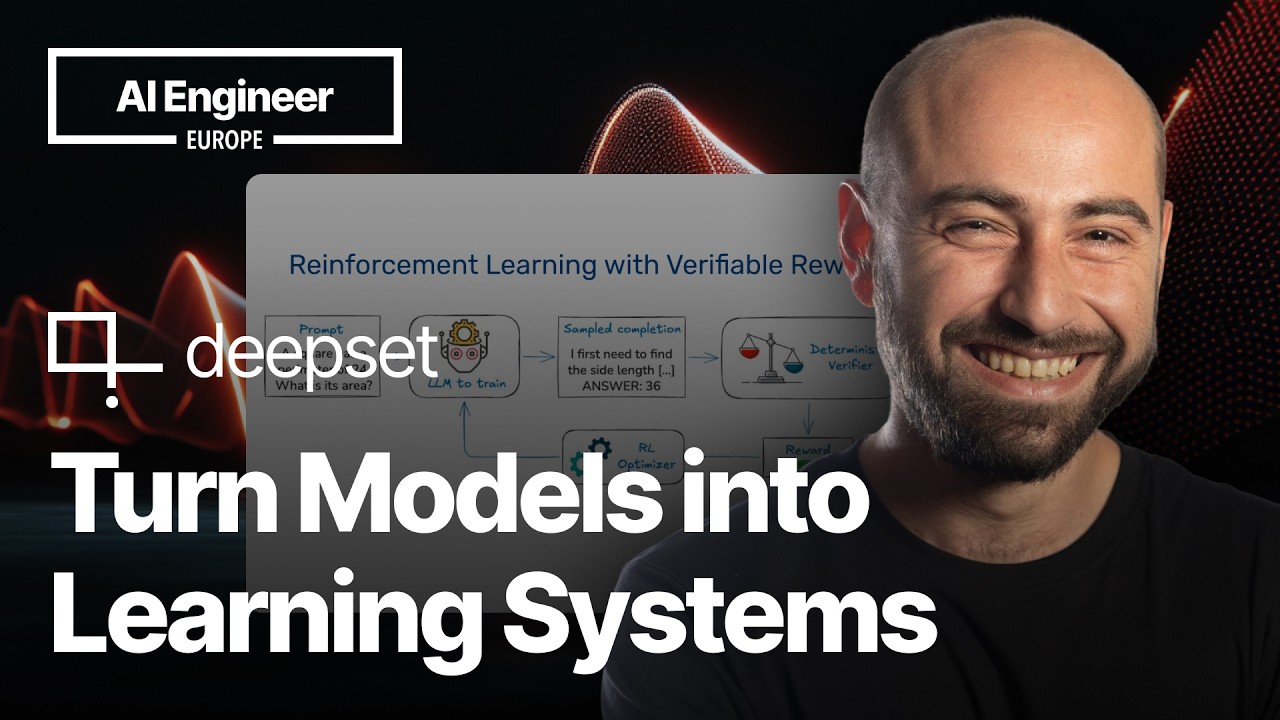
Let LLMs Wander: Engineering RL Environments — Stefano Fiorucci
Apr 8, 2026 · 40:35
Stefano Fiorucci demonstrates how to build Reinforcement Learning environments for language models using the open-source Verifiers library, arguing that training small models with verifiable rewards can surpass large closed models on specific tasks. He maps classic RL concepts to LLMs, introduces Verifiers components for single-turn, multi-turn, and tool environments, and then walks through an experiment where he takes LiquidAI's LLM 2 — a small open model — and transforms it into a tic-tac-toe master via supervised fine-tuning and GRPO-based reinforcement learning. After training, the model dominates random opponents and draws 85% of games against optimal ones, eventually outperforming GPT-5 Mini against identical optimal opponents. Fiorucci shares practical lessons: large batch sizes (≥256) ensure stable training, hidden biases in opponent algorithms can skew results, and starting from a base model (not a reasoning model) avoids truncated thinking traces. He concludes that if you can define a clear reward signal, you can build an environment and train a small specialized model to beat a large closed model at a fraction of the cost.
Powered by PodHood