
Phoenix
ProductA product discussed on AI Engineer.
8 episodes

How Forward Deployed Engineering is done at Kepler — Vinoo Ganesh
Jul 28, 2026 · 22:20
Vinoo Ganesh, a former Palantir engineer who built the Frontline rotation program, argues that Forward Deployed Engineering is a product strategy, not a go-to-market motion, and shows how Kepler applies this philosophy. He illustrates with stories from Palantir: solving a shipping customer's 47-page requirements with a four-hour Slack alert, building a Parquet viewer after watching a data quality engineer manually spot-check CSVs, and the Groovy script that became a product supporting 100,000 people. Ganesh emphasizes detecting real problems by observing users' actions—any repeated task hints at a missing feature, and pulling out a phone mid-workflow is a bug report you'll never find in documentation. He also explains defining ontology: when different teams call the same entity 'clients,' 'billing,' or 'accounts,' the FDE must canonicalize terms to become the linguistic foundation. The hardest skill is discarding—ship everything as if it will run 18 months, because every hack goes into production. Ganesh concludes that FDEs drive product leverage by solving small problems on-site, then generalizing solutions into the core product.

From Signal to PR: Anatomy of a Self-Improving Agent — Jason Lopatecki, Arize
Jul 24, 2026 · 20:36
Jason Lopatecki demonstrates how Arize's Signal agent transforms observability from human-clicked dashboards into telemetry for self-fixing systems. The key unlock is pulling production traces and logs as files into a repo—Claude Code works magically with files, not dashboards—so the agent sees the exact code path software took. Signal runs periodically or event-based in a sandbox (VPC-deployed for Uber, Booking), using composable skills to gather context, find root cause, and create a PR. Lopatecki argues you should trace and log ten times more because agents can read that smoke. For the question 'why not just point Claude Code at data?', he explains skills must be well-designed to fetch and format the right data into files. On evals, they run as LLM judges layered on production traces, pre-processing information for the agent to catch known failures and create new evaluators.
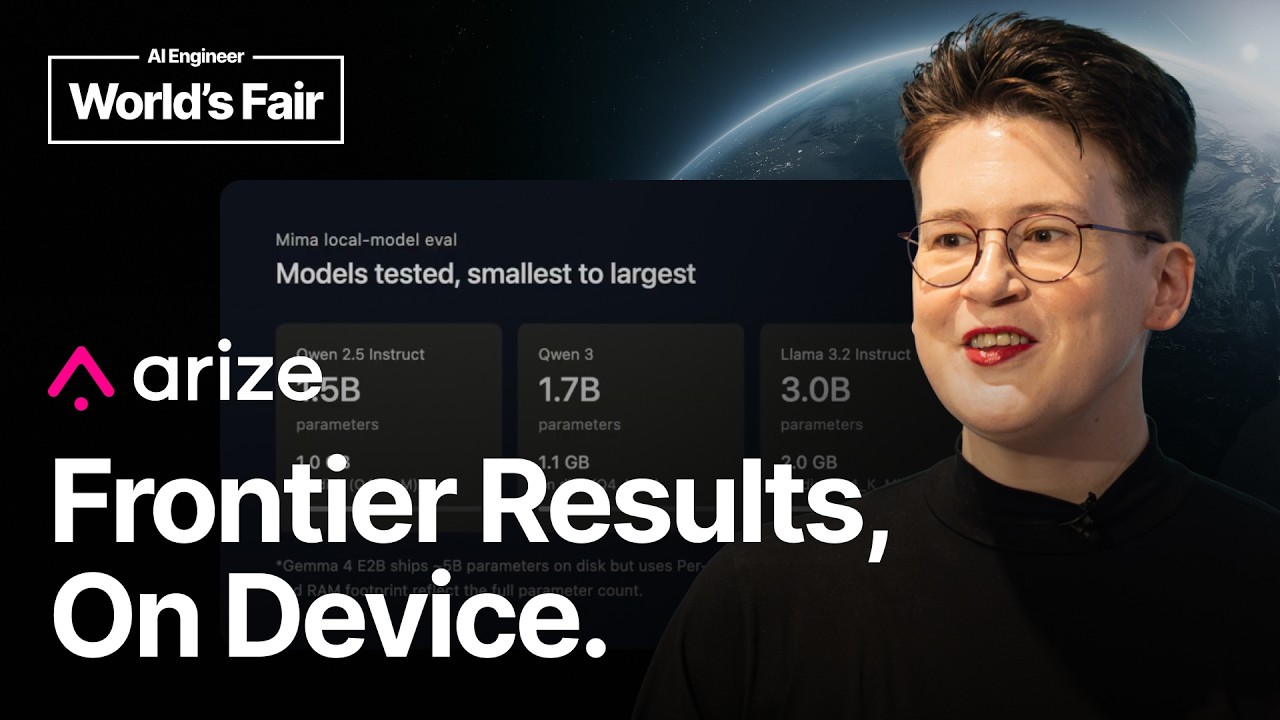
Frontier results, on device - RL Nabors, Arize
Jun 29, 2026 · 30:52
RL Nabors (Arize) argues that most frontier-model calls can be replaced by smaller, local models, saving cost, latency, and energy. She presents a four-step framework: prototype big with a foundation model, collect a golden dataset, run capability evals using Arize's open-source Phoenix, then select the 'sage' (small and good enough) model. Demonstrating with her social app Mima, she tested Qwen 2.5, Qwen 3, LLaMA 3.2, and Gemma 4 against Claude Sonnet on summary accuracy, latency, and cost. LLaMA 3.2 (3B params) won at 90% accuracy and 1-second P50 latency, versus Gemma 4's 8 seconds. Prompt engineering—specifically few-shot prompting—closed the gap further, achieving 92.9% factual consistency and 100% JSON validity. Nabors emphasizes running regression evals to prevent regressions, and notes that on-device inference eliminates data exposure and round-trip latency.
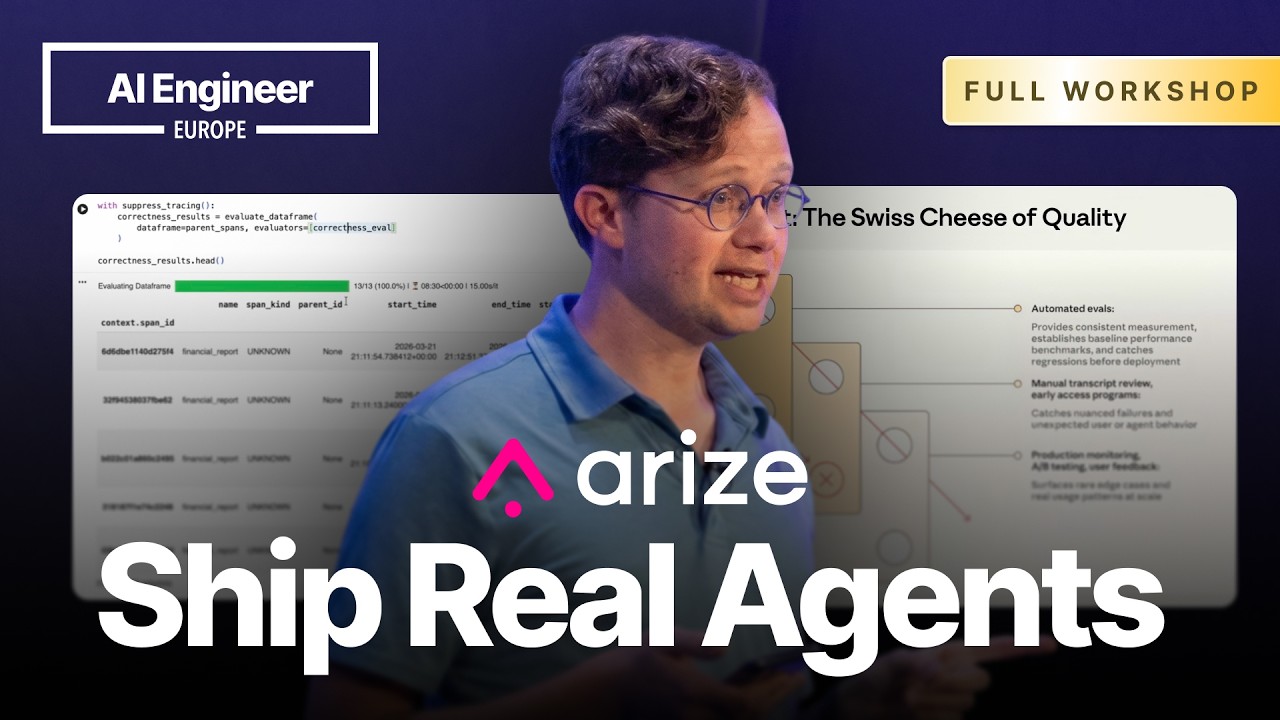
Ship Real Agents: Hands-On Evals for Agentic Applications — Laurie Voss, Arize
May 14, 2026 · 2:04:18
Laurie Voss, head of developer experience at Arize AI, delivers a hands-on workshop on evaluating agentic applications using Arize Phoenix, demonstrating that choosing the right eval matters more than tuning it: a correctness eval scored 0 out of 13 on the same financial analysis agent that a faithfulness eval scored 13 out of 13, because the model doesn't know the current year and cannot verify forward-looking data. He walks through building a complete eval pipeline from scratch—starting with tracing a Claude Haiku-based financial agent, reading and categorizing traces to identify root causes, then implementing code evals, built-in LLM-as-a-judge evals, and a custom actionability rubric with labeled examples. Voss emphasizes the importance of meta-evaluation to validate judge accuracy and introduces Phoenix experiments to prove prompt changes actually improve scores, not just vibes. Practical tips include using the impact hierarchy (data quality > prompting > model selection > hyperparameters) and the value of regression evals for safe model upgrades. The workshop closes with cost-aware evaluation, pairwise evaluation, and reliability scoring as next steps beyond the foundations…

DSPy: The End of Prompt Engineering - Kevin Madura, AlixPartners
Jan 8, 2026 · 1:13:13
Kevin Madura of AlixPartners argues that building robust enterprise AI applications requires shifting from brittle prompt engineering to programming with LLMs using DSPy, a declarative framework that treats prompts as implementation details optimized by the system. He demonstrates how typed interfaces (Signatures) and modular logic (Modules) allow developers to focus on control flow while deferring implementation to the LLM, with Adapters controlling prompt formats (e.g., JSON vs. BAML) to improve performance by 5-10%. The talk's core is Optimizers (like MIPRO and JEPA), which automatically tune prompts by learning from data, shown improving a time entry corrector from 86% to 89% accuracy. Real-world examples include routing files by type (SEC filings vs. contracts), using a 'poor man's RAG' with attachments for multimodal documents, and a boundary detector that segments legal documents from images. Madura emphasizes that DSPy enables transferability across models (e.g., GPT-4.1 to GPT-4.1 Nano) and addresses cost concerns by allowing offline optimization to reduce LLM calls.

Shipping AI That Works: An Evaluation Framework for PMs – Aman Khan, Arize
Dec 26, 2025 · 1:26:16
Aman Khan, AI PM at Arize, presents a framework for product managers to evaluate LLM-powered products beyond gut-feel 'vibe checks.' He demonstrates building an AI trip planner with multi-agent LangGraph, then using Arize's tracing and prompt playground to iterate on prompts. Khan shows how to create datasets from production traces, run A/B experiments on prompts, and use LLM-as-a-judge evals for friendliness and discount offers, comparing against human labels to refine evaluators. He argues evals are the new requirements docs, enabling PMs to own the product experience by writing acceptance criteria as eval datasets. The talk covers building eval teams, handling variance with temperature settings, and continuously improving golden datasets with hard examples, citing real-world analogies from self-driving cars at Cruise.
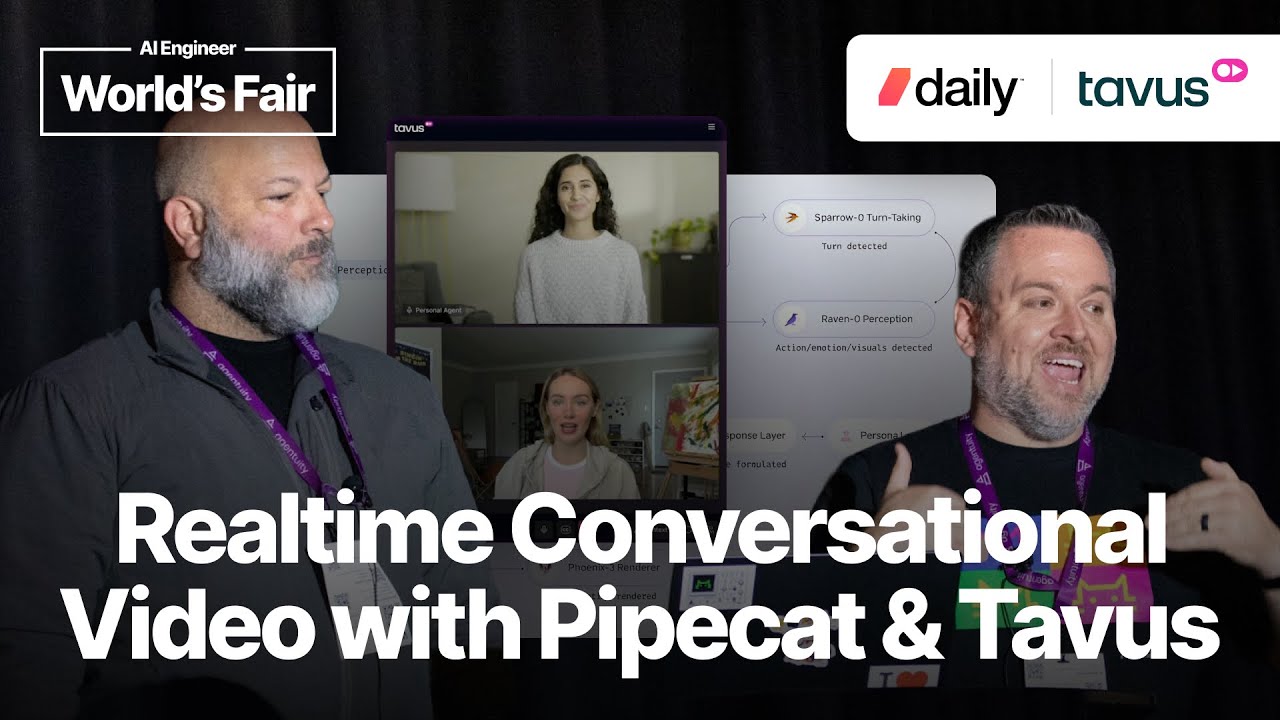
Realtime Conversational Video with Pipecat and Tavus — Chad Bailey and Brian Johnson, Daily & Tavus
Jun 27, 2025 · 18:46
Chad Bailey of Daily and Brian Johnson of Tavus explain how to build real-time conversational video bots using the Pipecat open-source framework and Tavus's avatar platform. They argue that beyond models, an orchestration layer is essential for handling input, processing, and output with low latency. Bailey details Pipecat's pipeline of frames, processors, and pipelines that manage audio/video frames, speech-to-text, LLM inference, and text-to-speech in a modular way. Johnson describes Tavus's 600-millisecond response time and proprietary models—Sparrow Zero, Raven Zero—plus future turn detection, response timing, and multimodal perception models being integrated into Pipecat. They emphasize that Pipecat solves real-world production challenges like observability, barge-in handling, and parallel pipelines for tasks like voicemail detection. Johnson admits Tavus initially built its own orchestration but now plans to adopt Pipecat internally, as its customers are already using it.

Lessons from the Trenches: Building LLM Evals That Work IRL: Aparna Dhinkaran
Feb 6, 2025 · 18:49
Aparna Dhinakaran, co-founder of Arize AI, distinguishes between model evals (e.g., Hugging Face leaderboard) and task evals for real-world LLM systems, arguing that production applications need component-level evaluations like router and parameter evals. She demonstrates a chat-to-purchase app where a router function call misidentifies user intent, showing how Phoenix open source tool traces errors and provides explanations to iterate. Dhinakaran advises using categorical over numeric LLM-as-judge scores because numeric outputs tend to be binary (0 or 10) and lack granularity. Presenting needle-in-haystack research, she notes GPT-4 struggles retrieving facts placed early in large context windows, and in retrieval-with-generation tasks, Anthropic’s Claude 2.1 outperforms GPT-4 due to verbose reasoning, a gap closed by prompting GPT-4 to explain itself first.
Powered by PodHood