
Neo4j
ProductA product discussed on AI Engineer.
11 episodes

AI on Your Lakehouse: Context Comes in Shapes, Not Queries — Zach Blumenfeld, Neo4j
Jul 23, 2026 · 1:59:10
Zach Blumenfeld of Neo4j argues that AI agents need context in shapes rather than queries, building three reusable graph shapes on lakehouse data to solve agent hallucinations and missed connections. The shapes include a connection semantic layer on top of BigQuery (or Databricks/Snowflake) that helps agents navigate join paths across hundreds of tables, a deterministic table-of-contents tree that lets agents traverse document folders and links without vector search, and a Leiden community-detection theme shape that surfaces unknown patterns and documentation gaps. Blumenfeld demonstrates with an auto-repair chain scenario, showing how these shapes enable an agent to answer specific repair questions and estate-level questions like what documentation is missing or what failure patterns exist, by treating context as navigable structure rather than a single query.
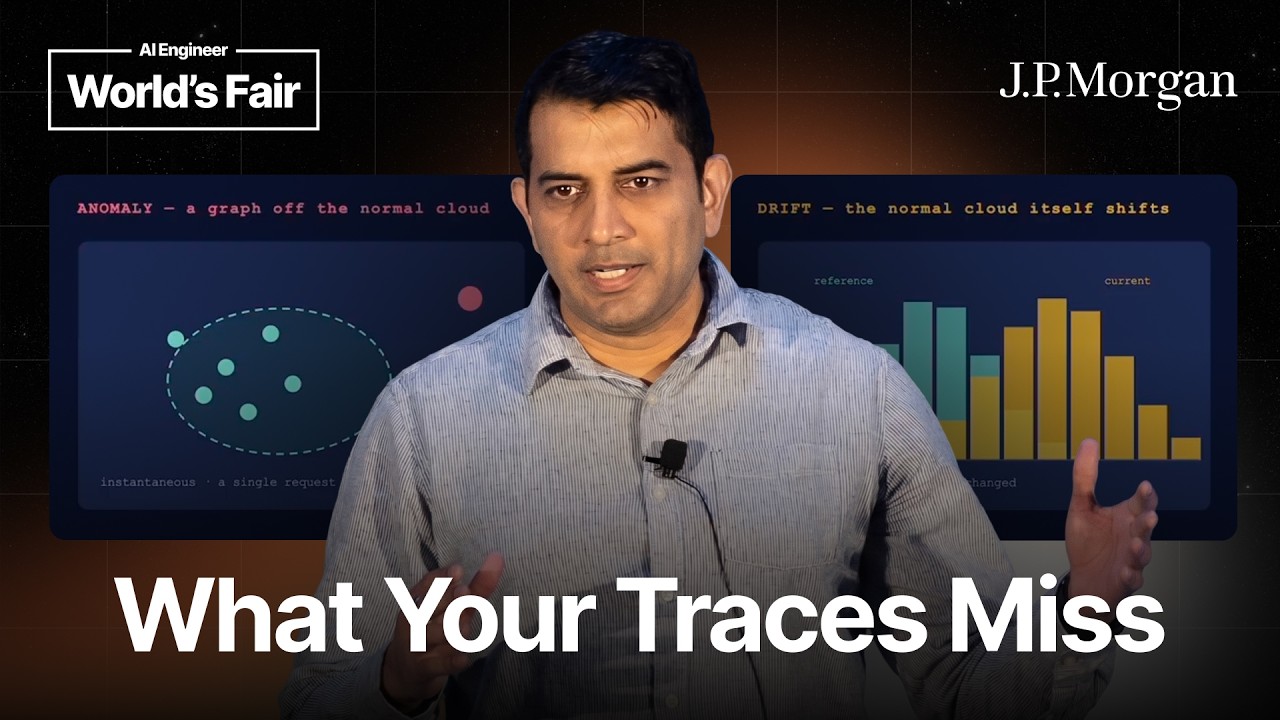
Learned Execution Graphs for Anomaly Detection & Drift in APIs — Ritvik Pandya, JP Morgan Chase
Jul 23, 2026 · 19:38
Ritvik Pandya of JP Morgan Chase presents Learned Execution Graphs, a method that models each API request as a short-lived DAG of middleware steps learned from telemetry at over 1,600 requests per second. The system detects anomalies by comparing actual execution against a learned baseline, localizing deviations to exact nodes instead of whole endpoints. In production it flagged a 41x deviation at a single node that service-level monitoring missed, cutting root cause from hours to under 30 seconds. Pandya distinguishes one-off anomalies from drift, categorizing drift into structural (added/removed steps), volume (scaling needs), and covariate (shifting request demographics), using per-client baselines and KL divergence rather than a single threshold. The approach uses tiered checks: a cheap first check only escalates when the graph signals a real change, reducing false alarms and enabling faster automated responses.

Your Moat Is Your Data Model — Mike Phipps, Gates Foundation
Jul 22, 2026 · 20:30
Mike Phipps of the Gates Foundation argues that as AI commoditizes frontends and agent frameworks, the durable moat is your data model and the tacit knowledge of how your questions are answered. At the foundation, he and his team modeled 25 years of grantmaking—$7 billion a year across 2,000 grants and 4,000 people—into a single Neo4j knowledge graph served to Claude through one MCP server. The graph is built for agents, not dashboards: hierarchies become traversable paths, and unstructured documents are chunked, tagged, and mapped to structured entities at ingestion. Phipps details the curation pipeline, engaging data owners to capture reporting conventions and safeguard constraints, and explains how the graph connects siloed systems (funding, management, org charts) with unstructured meeting documents. Retrieval evals with LLM-as-judge measure pass-at-one and stability, surfacing gaps that feed back into the data model. The talk makes the case that a small team's efforts compound in the data layer, not the layers above it, offering a practical architecture for enterprise agentic retrieval.
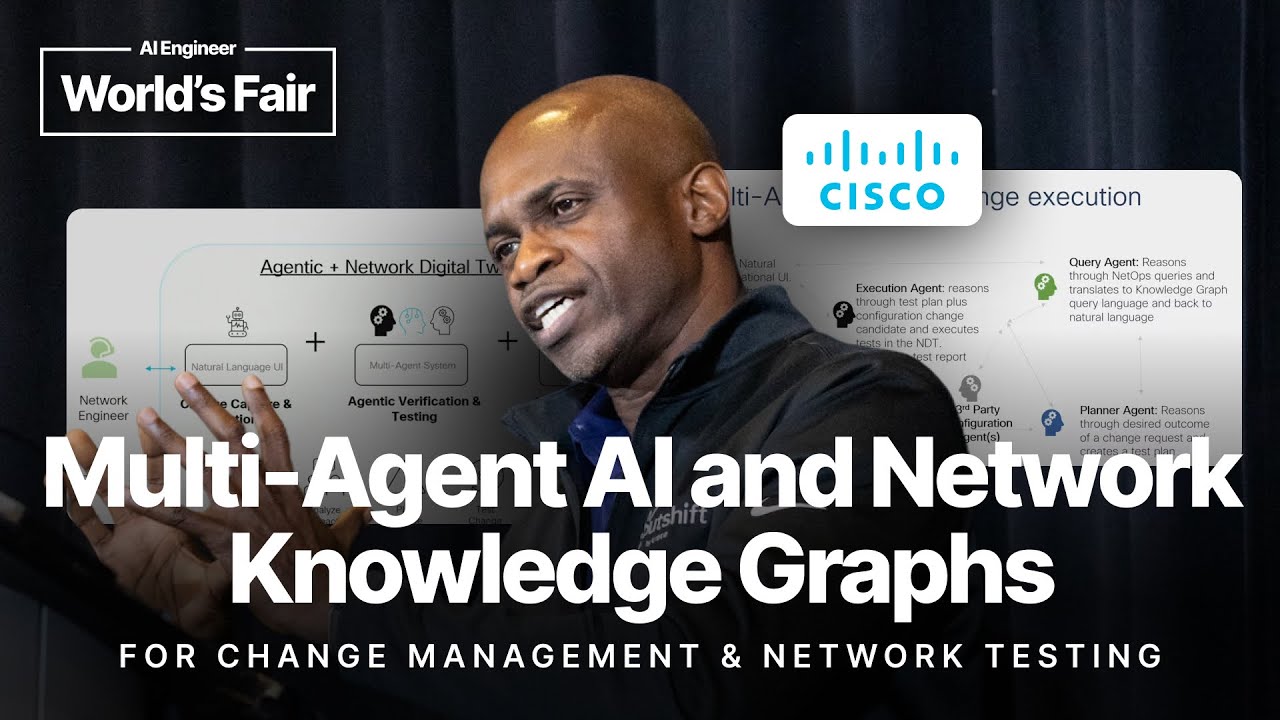
Multi Agent AI and Network Knowledge Graphs for Change — Ola Mabadeje, Cisco
Aug 22, 2025 · 18:49
Ola Mabadeje from Cisco's Outshift presents a multi-agent AI system that combines network knowledge graphs with natural language interfaces to improve change management. The solution ingests data from ITSM tools like ServiceNow, uses five specialized agents built on an open framework (agency.org) to automate impact assessment, test planning, and execution within a digital twin. A fine-tuned query agent reduces token usage and latency when querying the ArangoDB knowledge graph, layered using OpenConfig schema. The demo shows agents collaborating to assess a firewall rule change, generate test cases, and run them on a synthetic network, attaching results back to the ticket. Early evaluations focus on extrinsic metrics tied to customer outcomes, with the knowledge graph and open agent framework as key building blocks for scalable network operations.

Wisdom-Driven Knowledge Augmented Generation at Scale - Chin Keong Lam, Patho AI
Aug 22, 2025 · 18:43
Chin Keong Lam, founder and CEO of Patho.ai, argues that Wisdom-Driven Knowledge Graphs (KAG) significantly outperform traditional RAG systems for complex quantitative analysis and expert-level advice. He presents a wisdom-decision-situation feedback loop where knowledge, experience, and insight feed into wisdom, mapped to a practical competitive analysis chatbot for a marketing client. The system uses N8n and a multi-agent architecture with a supervisory Wisdom Agent overseeing insight, knowledge, and strategy agents, all updating a centralized knowledge graph. Lam cites five reasons knowledge graphs beat RAG: capturing complex relationships, improved accuracy, scalability, rich multi-hop query capability, and seamless data integration. He demonstrates how vector RAG fails on numerical reasoning (e.g., Apple revenue query) while KAG returns precise evidence-based answers. Lam recommends a hybrid graph extraction combining LLM extraction with expert pruning, and reports benchmark results of 91% accuracy, 85% flexibility, and strong traceability and scalability.

Intro to GraphRAG — Zach Blumenfeld
Jun 30, 2025 · 1:18:35
Zach Blumenfeld introduces GraphRAG using Neo4j, showing how to build knowledge graphs from employee and skill data, combine structured and unstructured data, and use graph traversal with vector search for retrieval. The workshop covers Cypher query patterns for multi-hop similarity, entity extraction from resumes via LLMs, and creating semantic similarity relationships. It demonstrates Leiden community detection for skill clustering and builds a LangGraph agent with four custom tools that balance exact skill matches with vector similarity. Blumenfeld argues that knowledge graphs provide controlled, explainable retrieval logic for agentic workflows, enabling developers to decompose data into graph models that expose domain logic for more accurate retrieval than pure vector search.

Why Your Agent’s Brain Needs a Playbook: Practical Wins from Using Ontologies - Jesús Barrasa, Neo4j
Jun 27, 2025 · 13:54
Jesús Barrasa, AI Field CTO at Neo4j, argues that ontologies are the secret weapon for building robust GraphRAG applications, providing both a formal, implementation-agnostic schema for knowledge graph creation and a dynamic data layer that drives retriever behavior. He explains how ontologies replace rigid code-orchestrated workflows and chaotic LLM-generated ones by guiding entity extraction from unstructured data and mapping structured sources into a property graph. During retrieval, storing the ontology in the graph enables dynamic Cypher queries that automatically navigate contextualizing relationships — such as "acted-in" rather than "directed" — based on annotated subproperties, without hard-coded logic. This allows developers to change retrieval behavior on the fly by modifying the ontology as a data artifact. The talk covers two practical wins: using ontologies as a shared domain model for graph construction, and leveraging them to build adaptive, schema-driven retrievers that improve result completeness and relevance.
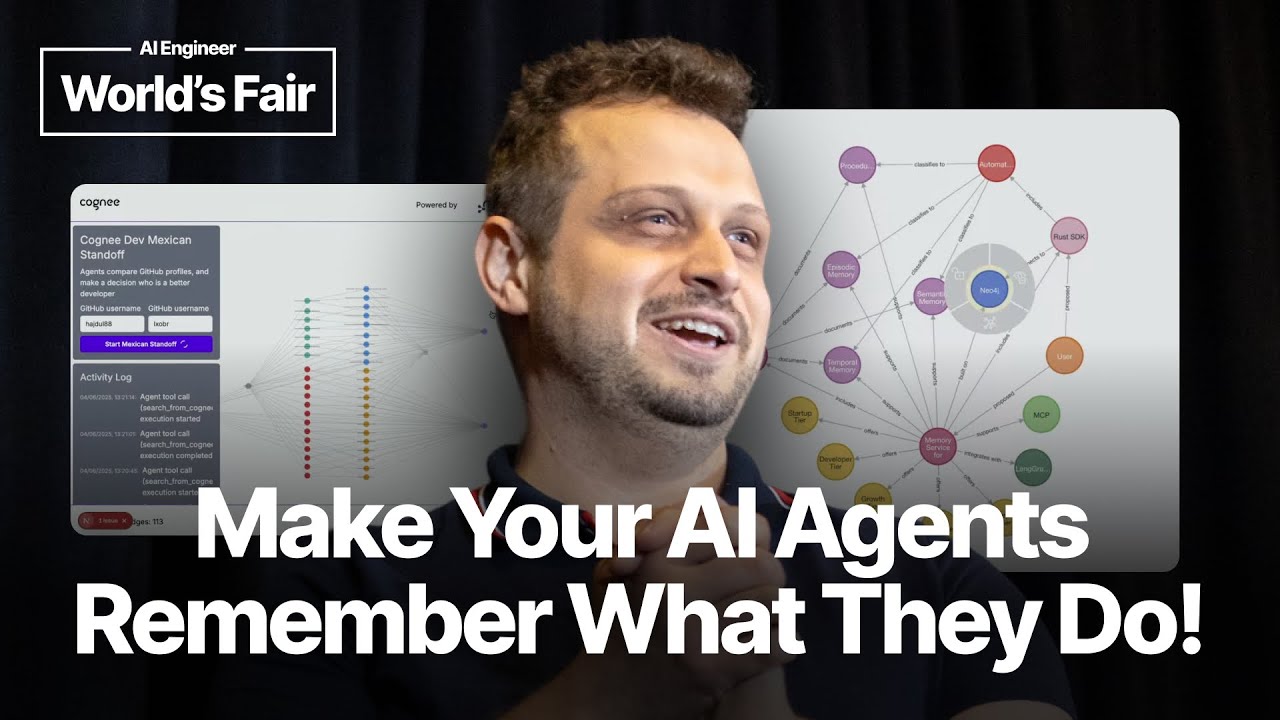
Memory Masterclass: Make Your AI Agents Remember What They Do! — Mark Bain, AIUS
Jun 27, 2025 · 51:25
Mark Bain, Vasilia Markovits, Alex Gilmore, and Daniel Chalev demonstrate that AI memory requires causal relationships and graph databases, not just vector similarity, to solve hallucinations and enable agentic workflows. Bain argues that memory is any data affecting change, and that attention, diffusion, and VAEs follow the same geometric principles as gravity and entropy. Alex shows Neo4j's MCP server storing semantic memory as entities and relationships retrieved across conversations. Vasilia demos Cognee building semantic graphs from GitHub data for agentic hiring decisions. Daniel presents Graphiti's domain-aware memory using custom Pydantic schemas to filter irrelevant facts. Bain introduces a GraphRAG chat arena that switches between memory solutions on a single Neo4j graph, testing different implementations for episodic and temporal recall.
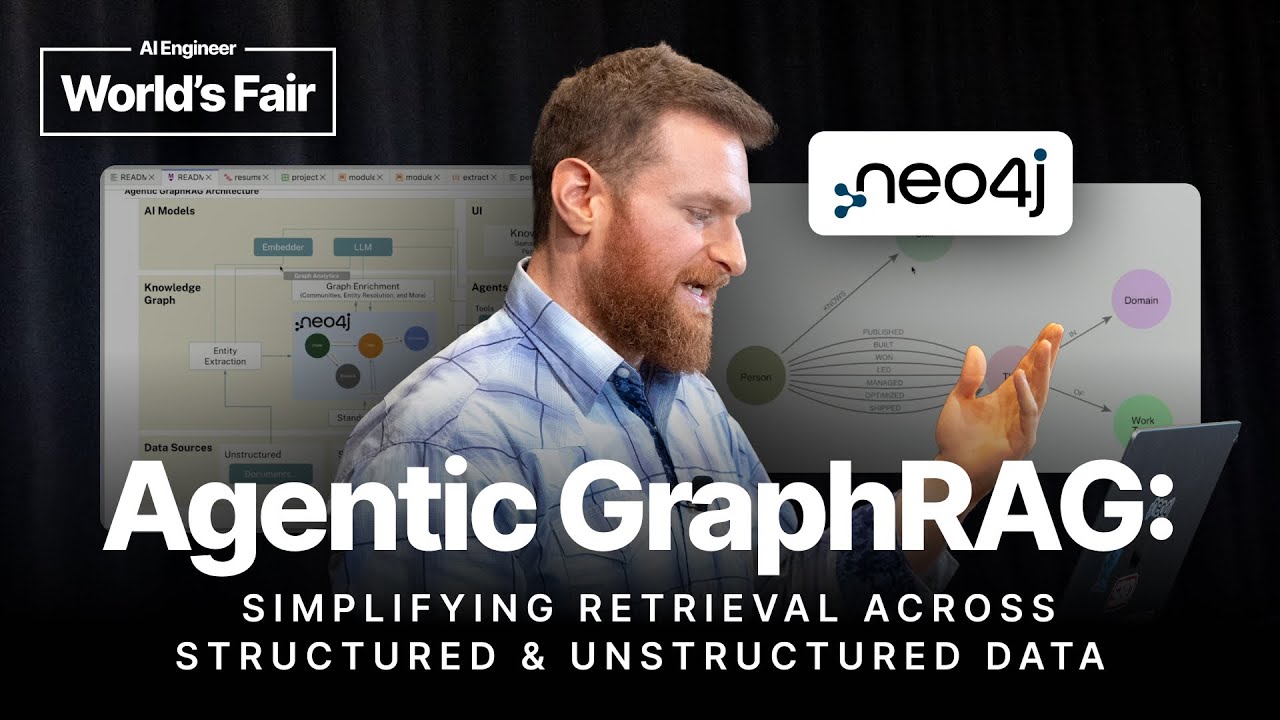
Agentic GraphRAG: Simplifying Retrieval Across Structured & Unstructured Data — Zach Blumenfeld
Jun 27, 2025 · 15:25
Zach Blumenfeld (Neo4j) demonstrates how a knowledge graph simplifies agentic retrieval across structured and unstructured data, using an employee skill graph as an example. He shows that a plain document search fails to answer questions like "how many Python developers" (returns 5 instead of 28) or "who is most similar to Lucas Martinez" — but after extracting entities into a Neo4j graph, the agent can run precise Cypher queries via an MCP server, correctly reporting 28 Python devs and identifying Sarah as the closest match via skill overlap. He also shows how to flexibly add new relationships (e.g., project collaborators from an HR system) without schema changes, enabling questions like "which individuals collaborated most on AI projects" to return exact pairings like Sarah and Amanda. The talk emphasizes accuracy, explainability, and the ability to start with a simple data model and expand as agents ingest more data.
Knowledge Graphs & GraphRAG: Techniques for Building Effective GenAI Applications: Zach Blumenthal
Nov 1, 2024 · 1:39:52
In this workshop, Zach Blumenthal of Neo4j demonstrates how to build a GraphRAG application using Neo4j, OpenAI, and LangChain on an H&M fashion dataset. He argues that combining knowledge graphs with vector search and graph embeddings improves retrieval and personalization for LLMs. The session covers creating a Neo4j sandbox, loading data, performing vector search with OpenAI embeddings, adding collaborative filtering via graph traversal patterns, using graph data science (FastRP) to generate graph embeddings for recommendations, and integrating everything into a LangChain chain that generates personalized marketing emails. Attendees build a Gradio app that, given a customer ID and season, outputs a tailored email with product recommendations, demonstrating how structured graph data enhances RAG systems beyond pure vector search.

GraphRAG: The Marriage of Knowledge Graphs and RAG: Emil Eifrem
Aug 28, 2024 · 19:15
Emil Eifrem, Neo4j co-founder and CEO, argues that GraphRAG—combining knowledge graphs with vector search—significantly improves RAG application accuracy, ease of development, and explainability. Citing studies, he reports accuracy gains of 3x (Data.org), 75-77% (LinkedIn), and Microsoft's finding that GraphRAG enables answering entirely new question types. He demonstrates Neo4j's Knowledge Graph Builder, which auto-generates graphs from PDFs, Wikipedia, and YouTube, making graph creation accessible. Eifrem frames this as the next evolution in search after PageRank and Google's knowledge graph, urging developers to adopt GraphRAG for richer context and better AI outcomes.
Powered by PodHood