
Minimax
ProductA product discussed on AI Engineer.
3 episodes
Multiplayer agentic engineering — Arjun Singh, Superconductor
Aug 9, 2026 · 18:44
Arjun Singh explains how Superconductor enables multiplayer agentic engineering by making agents model-agnostic, cloud-isolated, and reachable from Slack, desktop, and GitHub as one shared session. He argues agents should run in a configurable network sandbox for least privilege, letting non-technical staff trigger real work without dev setups; a meeting bot left in a Google Meet at their expo booth picked up a passerby's idea, opened a ticket, and added acceptance-criteria fields. He advises benchmarking agents on your own codebase because SWE-bench is Python while they are Ruby on Rails, citing one month: 10.5 billion tokens, 3,300 Claude Code runs worth about $10,000, and Codex running four times as many sessions for less money. Takeaways: sandbox your code, integrate agents into human interfaces, stay model-agnostic.

Teaching AI to Find Real Vulnerabilities — Prof. David Brumley, Bugcrowd
Aug 1, 2026 · 27:17
Carnegie Mellon professor and Bugcrowd chief AI officer David Brumley argues that teaching AI to hack mirrors human learning: a ladder from crashes to arbitrary code execution, graded by deterministic oracles rather than LLM judges. He shows why benchmarks fail when targets hold multiple vulnerabilities — models reward-hack the easiest bug — and presents his 'audit task' scoring precision and recall across all discovered bugs. Testing on Chrome's V8 with 41 real vulnerabilities, MITHOS hit 73% full code execution and GPT 68%, while Gemini and Kimi scored 0%. Several exploits were novel: MITHOS reverse-engineered Math.random to forge a pointer, found a new WASM path, and produced a real zero day. The episode grounds this in stories from picoCTF winner Fluorescence to DARPA's Cyber Grand Challenge, urging RL environments built on real bugs over benchmark-maxxing security.
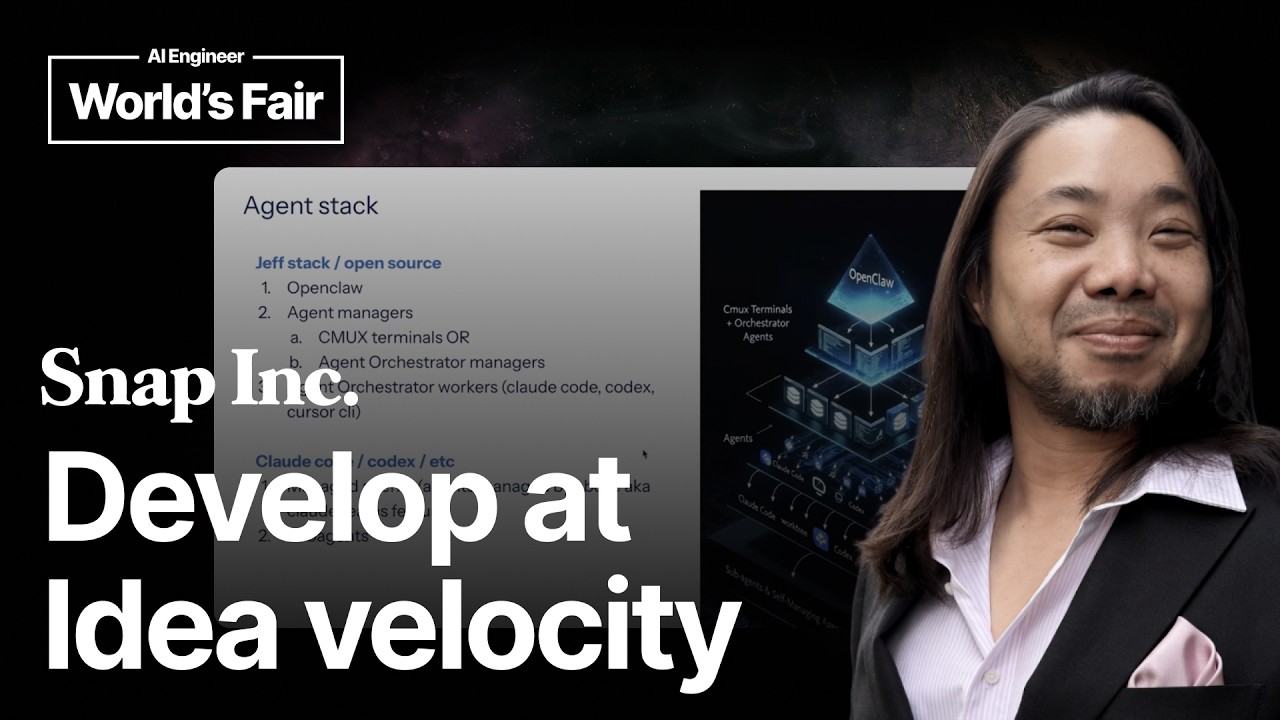
Develop at Idea Velocity - Jeffrey Lee-Chan, Snapchat
Jul 11, 2026 · 15:28
Jeffrey Lee-Chan (Snapchat) and Austin (CMUX) explain how to achieve 'idea velocity' by building parallel multi-agent harnesses that let one engineer direct 10–20 coding agents instead of becoming the bottleneck. Lee-Chan argues the key is separating 'Agent Orchestrator Managers' from specialized workers to prevent low-level implementation bias, using OpenClaw for frictionless Slack-based communication and CMUX terminals for real-time parallelization and unbiased manager oversight. He demonstrates two apps—an AI RPG with dice-roll mechanics and a multi-AI analysis tool—built with this stack, and discusses token-burn tradeoffs between models like Codex 5.3, GPT-5.4, and Minimax. The episode also covers staging environments to avoid doubling token usage, the benefit of persistent memory and contextual guardrails, and the importance of pushing human interaction to the start or end of the workflow for improved parallelization.
Powered by PodHood