
LLM gateway
ProductA product discussed on AI Engineer.
2 episodes
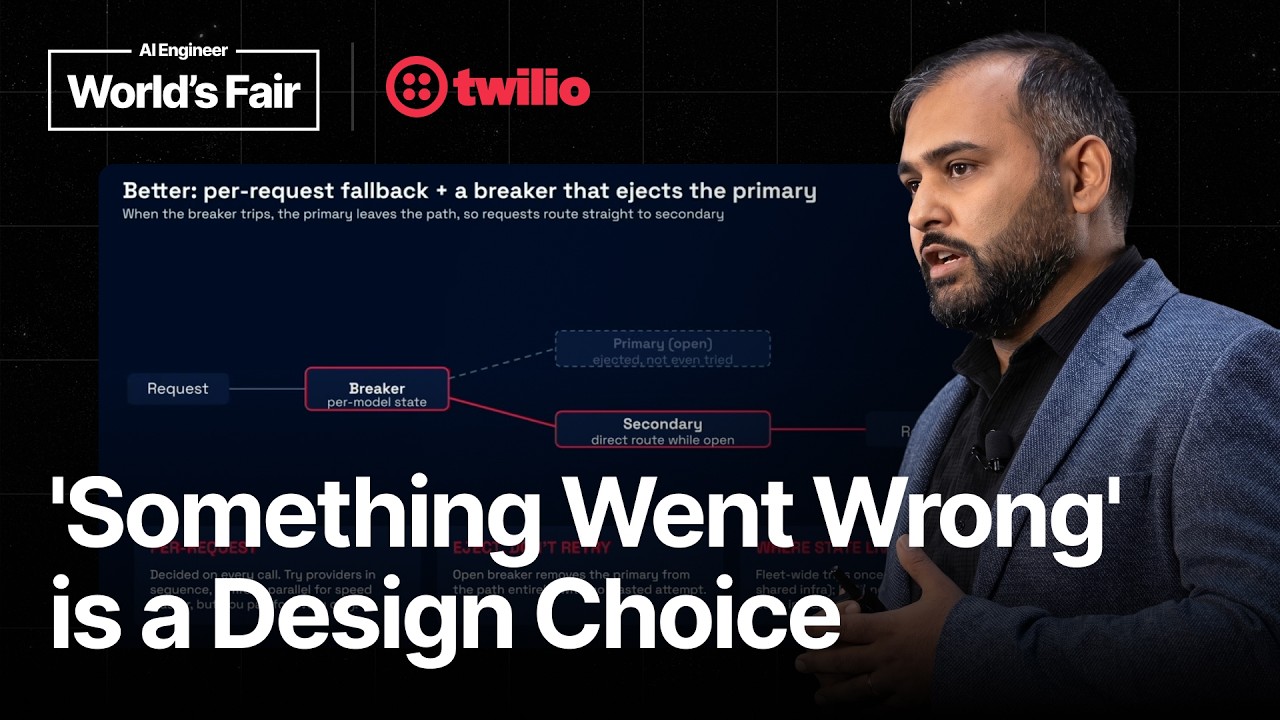
Productionizing LLM Gateways: Architecture, Tradeoffs and Hard Lessons — Kanish Manuja, Twilio
Aug 28, 2026 · 16:24
Kanish Manuja, principal engineer at Twilio, says an LLM gateway is a fight among availability, latency, guardrails, and cost, and degradation forces you to pick one. He prefers per-request fallback over retries and circuit breakers, with extra headroom for the backup provider; streaming commits you to provider A, so 'Something went wrong, please try again' is by design. Ignore gateway-wide latency—a reasoning model's normal is 2 to 60 seconds, a chat model's outage—and set timeouts per model per route. Guardrails fail too, so choose fail-open vs fail-closed, budget their time, and place them pre, parallel, or post; gateway dependencies need segregated keys and load shedding. Most teams want centralized governance, not a central gateway, so decentralize traffic and centralize governance.

AI Evals for Cross-Functional Teams — Nachiket Paranjape & Swaroop Chitlur Haridas, DoorDash
Aug 28, 2026 · 16:11
DoorDash GenAI platform team's Swaroop Chitlur Haridas and Nachiket Paranjape argue evals stopped being an engineering harness and became a cross-functional effort spanning strategy and operations, product, operations, and engineering. They describe a continuous loop — trace, sample, annotate, calibrate — and an API-first platform that lets non-engineers use Codex or Claude Code to vibe code their own annotation UIs. Judge prompts are calibrated self-serve through a UI showing original and optimized prompts side by side, using JetPa, so product managers and operators can run optimization loops without engineering. Per-annotation cost fell sharply at DoorDash scale, and variation in who owns judge prompts across teams is treated as a sign the org is still learning.
Powered by PodHood