
Kimi K2
ProductA product discussed on AI Engineer.
2 episodes
Multiplayer agentic engineering — Arjun Singh, Superconductor
Aug 9, 2026 · 18:44
Arjun Singh explains how Superconductor enables multiplayer agentic engineering by making agents model-agnostic, cloud-isolated, and reachable from Slack, desktop, and GitHub as one shared session. He argues agents should run in a configurable network sandbox for least privilege, letting non-technical staff trigger real work without dev setups; a meeting bot left in a Google Meet at their expo booth picked up a passerby's idea, opened a ticket, and added acceptance-criteria fields. He advises benchmarking agents on your own codebase because SWE-bench is Python while they are Ruby on Rails, citing one month: 10.5 billion tokens, 3,300 Claude Code runs worth about $10,000, and Codex running four times as many sessions for less money. Takeaways: sandbox your code, integrate agents into human interfaces, stay model-agnostic.
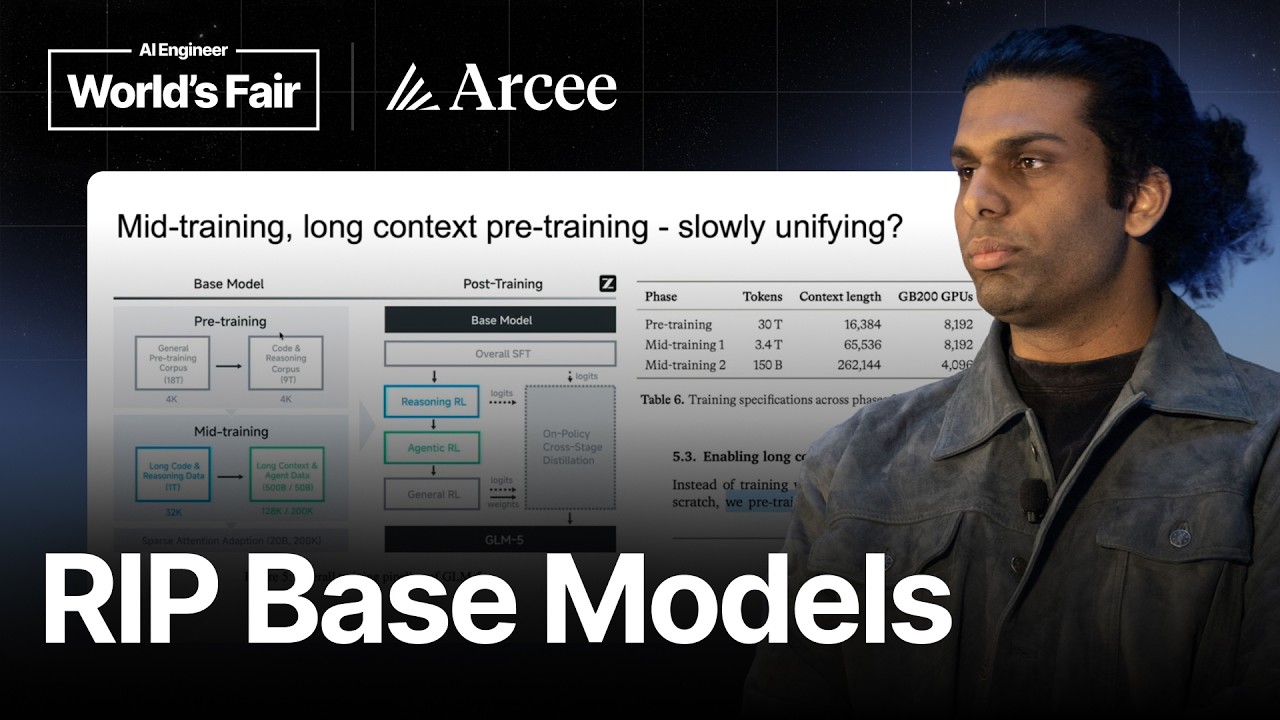
The Base Model Is Dead — Varun Singh, Arcee AI
Jul 31, 2026 · 17:45
Varun Singh, pre-training lead at Arcee AI, argues the base model is dead: it no longer just mirrors web text but must carry the prior that reinforcement learning builds on. He traces how web text fell from 85% of GPT-3's mix to 15% in MAI Thinking 1, with code and STEM dominating, and how Nemotron 3 Ultra pulls SFT-style Q&A data back into pre-training. Synthetic rephrasing, as used in Arcee's Trinity Large and Kimi K2, upsamples information to teach task shapes early. He warns that without post-training-flavored data early, MoE load balancing can break when SFT distributions differ, citing MAI's cranking of the balancing coefficient. He frames training as supervised learning vs RL, noting RL compute now rivals or exceeds pre-training, as with Compose 2.5, and argues the base model's job is to provide atomic skills for RL to compose.
Powered by PodHood