
Kafka
ProductA product discussed on AI Engineer.
4 episodes

The Building Blocks of GTM Orchestration — Arman Vaziri, Ramp
Aug 26, 2026 · 19:55
Arman Vaziri, who leads product and sales led growth engineering at Ramp, details go-to-market orchestration: an intent — offering Pro V1 golf balls to golfers at East Coast construction companies — becomes targeted outbound, paid creative, landing page and in-app nudges. He argues the bottleneck was never ideas but messy data, rep busy work, and coordination cost; Ramp's answer was an internal CDP on Kafka and Postgres, plus embedded unstructured data for search. Pre-meeting briefs for account managers map attendee emails to accounts and run as durable Temporal threads; a skill library for custom brief formats drove adoption. For smaller teams, build narrow automations first — three years ago two people used GPT-3.5 for outbound — because nobody gets a year to design a perfect architecture.

Always-on agents run production without the on-call tax — Justin Smith, Resolve AI
Aug 9, 2026 · 24:56
Justin Smith, founding product engineer at Resolve AI, says roughly 70% of an engineer's time is spent running code, not writing it, and coding agents raise that burden by pushing more changes into production. Resolve's background agents are defined by schedule, event stream, or Slack triggers; a cloud sandbox; and a learning system holding production context. A demo shows an agent watching GitHub release tags: for a release replacing a currency service, it builds a custom check plan on checkout latency, error rates, and the Kafka pipeline, with no hardcoded timing — it may wait an hour or return in three days. Another agent watches Slack, stays silent without confidence, and DMs Smith before replying. His sharpest point: execution is the easy half; deciding a metric smells off is production context.
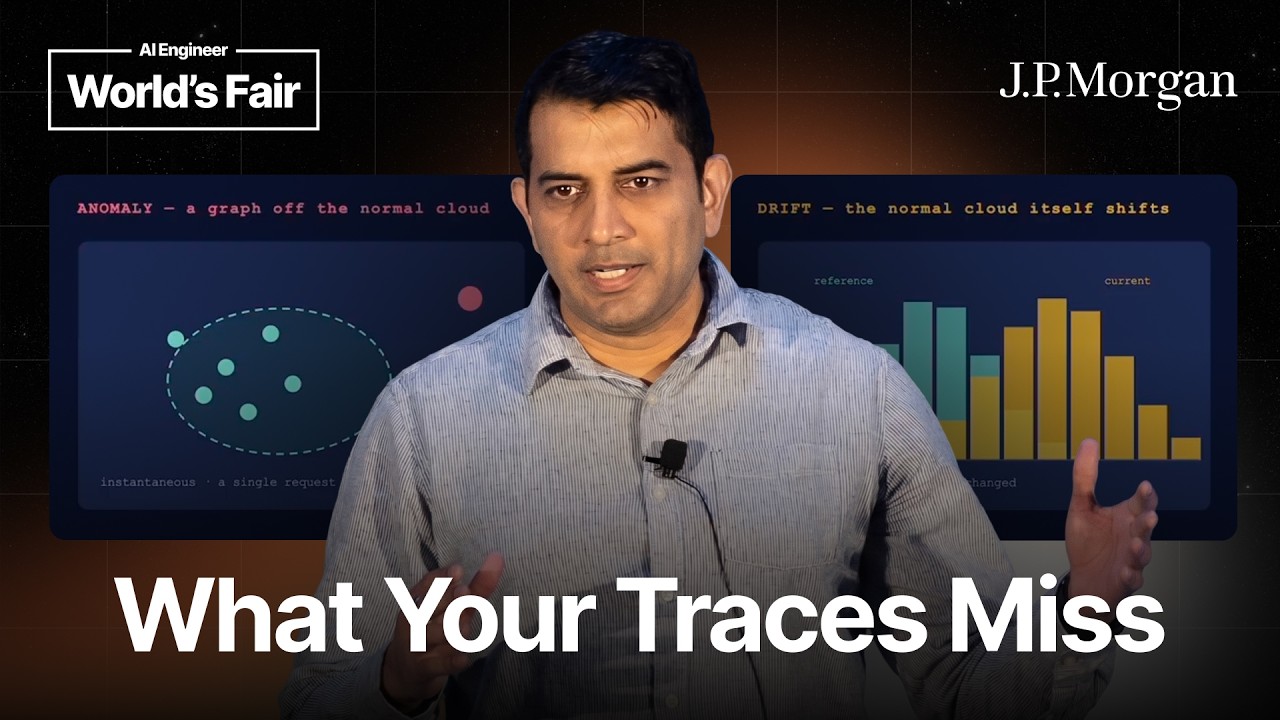
Learned Execution Graphs for Anomaly Detection & Drift in APIs — Ritvik Pandya, JP Morgan Chase
Jul 23, 2026 · 19:38
Ritvik Pandya of JP Morgan Chase presents Learned Execution Graphs, a method that models each API request as a short-lived DAG of middleware steps learned from telemetry at over 1,600 requests per second. The system detects anomalies by comparing actual execution against a learned baseline, localizing deviations to exact nodes instead of whole endpoints. In production it flagged a 41x deviation at a single node that service-level monitoring missed, cutting root cause from hours to under 30 seconds. Pandya distinguishes one-off anomalies from drift, categorizing drift into structural (added/removed steps), volume (scaling needs), and covariate (shifting request demographics), using per-client baselines and KL divergence rather than a single threshold. The approach uses tiered checks: a cheap first check only escalates when the graph signals a real change, reducing false alarms and enabling faster automated responses.

Function Calling is All You Need — Full Workshop, with Ilan Bigio of OpenAI
Apr 23, 2025 · 1:42:54
Ilan Bigio from OpenAI argues function calling is the essential primitive for building AI agents, demonstrating how to implement memory, delegation, asynchronous task execution, and even self-modifying tools—all using the same loop. Starting from a basic weather tool, he builds an agent that stores user facts in a JSON file, delegates complex requests to o1, runs multiple weather lookups in parallel with asyncio, and creates a Bootstrap agent that writes its own Python functions on the fly. He also shares practical tips from his work on Swarm and the Real-Time API, including a stay-silent function to prevent premature responses and the ability to read scripts with XML tags. The workshop emphasizes that sophisticated agent behaviors emerge from simple function calling patterns without needing heavy frameworks.
Powered by PodHood