
Java
ProductA product discussed on AI Engineer.
3 episodes
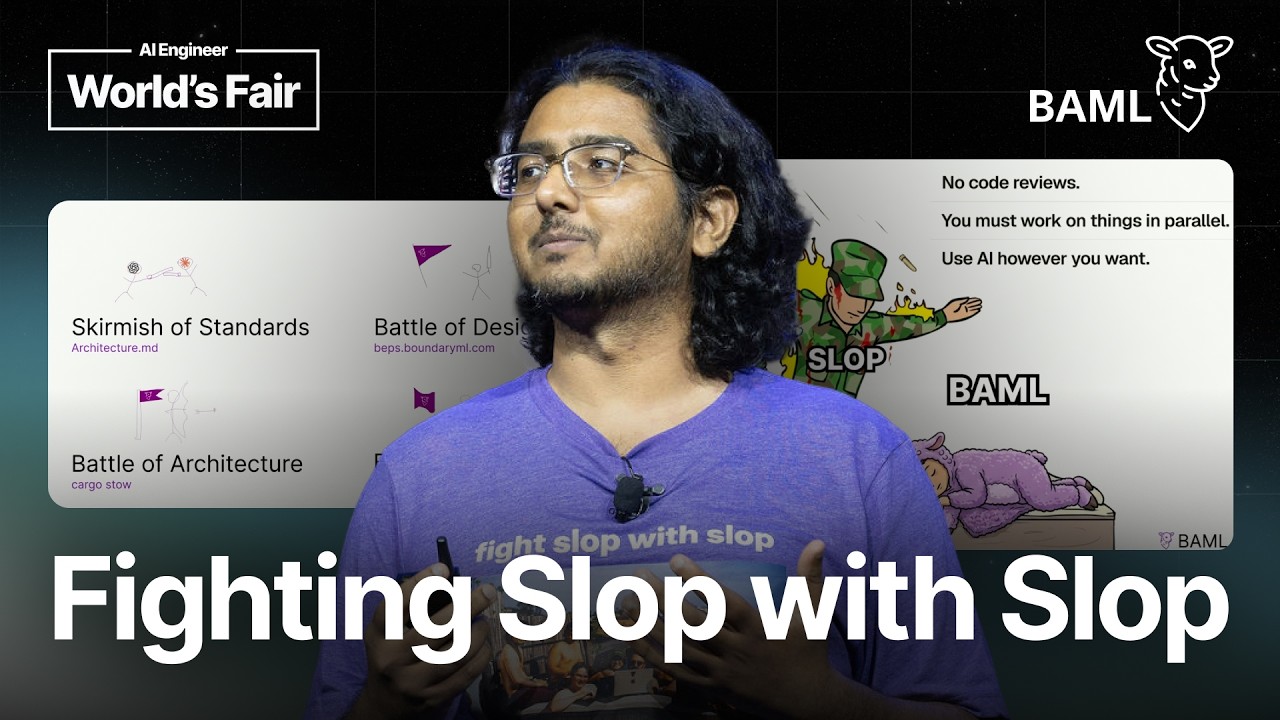
fighting slop with slop — Vaibhav Gupta, Boundary
Jul 31, 2026 · 21:32
Vaibhav Gupta of Boundary argues that AI slop can be fought with slop: instead of code reviews, his team relies on agents that read other agents' transcripts and on hard invariants like architecture.md files and CLI checks. He explains how they ship a stable programming language, BAML, without reading all code, using agents that flag hallucinations, tool-call errors, and inefficiencies from Claude transcripts, then A/B test language features by token spend and error rates. He attacks TypeScript as baking slop in—string coercion on sort, unsafe any—and designs BAML with inferred error types that prove division-by-zero is handled or the build fails. BAML works across Python, TypeScript, Rust, and more, with type-safe functions, lambdas, and generics across boundaries, plus zero-cost execution traces and generated CLI tools. His closing challenge: build these sloppy tools yourself, constrain the systems underneath, and rethink foundational layers like Git, databases, and programming languages.

The Infinite Software Crisis – Jake Nations, Netflix
Dec 20, 2025 · 18:57
Jake Nations, engineering lead at Netflix, argues that AI-generated code accelerates the software crisis by conflating easy with simple—producing tangled, incomprehensible systems. He traces the crisis from 1968 to today's infinite code generation, citing Fred Brooks' 'No Silver Bullet' and Rich Hickey's definition of simple as 'one fold, no entanglement.' Nations presents a three-phase methodology—research (compressing 5 million tokens of code into a 2,000-word spec), planning (paint-by-numbers implementation steps), and implementation (using a manual migration seed)—to maintain human understanding. He warns that without this approach, engineers lose the ability to recognize dangerous complexity, and challenges listeners: will we still understand our own systems when AI writes most of the code?
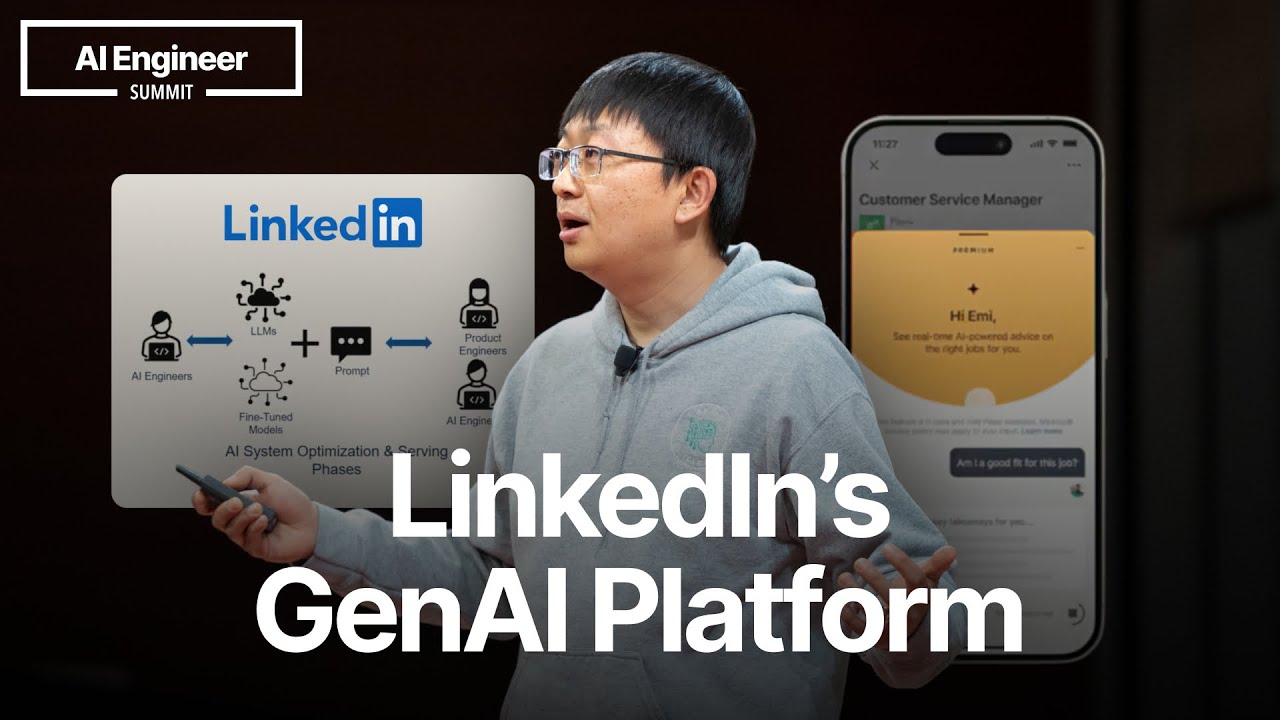
Building LinkedIn's GenAI Platform — Xiaofeng Wang
Apr 16, 2025 · 17:53
Xiaofeng Wang, manager of LinkedIn's GenAI Foundation, explains the evolution of LinkedIn's GenAI platform from simple prompt-in string-out applications to a multi-agent system for LinkedIn Hire Assistant, arguing that a unified platform is critical for bridging the gap between AI and product engineers in the era of compound AI systems. He details the platform's four-layer architecture—orchestration, prompt engineering, tools/skills invocation, and memory management—and key investments like a Python SDK, centralized skill registry, experiential memory across working, long-term, and collective layers, and observability built on OpenTelemetry. Wang discusses hiring philosophy: prioritize strong software engineers over AI expertise, hire for potential, and build diverse teams integrating full-stack engineers, data scientists, and AI engineers. He recommends solving immediate needs first, leveraging existing scalable infrastructure like messaging systems for memory, and focusing on developer experience to drive adoption.
Powered by PodHood