
Hugging Face Hub
ProductA product discussed on AI Engineer.
2 episodes

Serving 2 Million Models Without Melting: Scaling the Hugging Face Hub — Arek Borucki, Hugging Face
Jul 28, 2026 · 21:39
Arek Borucki, ML platform and database engineer at Hugging Face, explains how the Hugging Face Hub serves 14 million users and hosts 3 million public models and 1 million datasets while keeping search instant. The Hub uses MongoDB Atlas with Apache Lucene for full-text search, storing metadata separately from model artifacts in S3. Precomputed tokens and denormalized read collections optimize queries, while a seven-node MongoDB cluster distributes reads and reserves a hidden analytics node for heavy queries. Kubernetes autoscaling scales pods from 10 to 500 based on traffic, with CastAI adding nodes when capacity is exhausted, and they are migrating from HPA to KEDA for event-driven scaling on real application metrics. As the catalog grows, sharding will horizontally scale the database across multiple shards, each with its own replication.
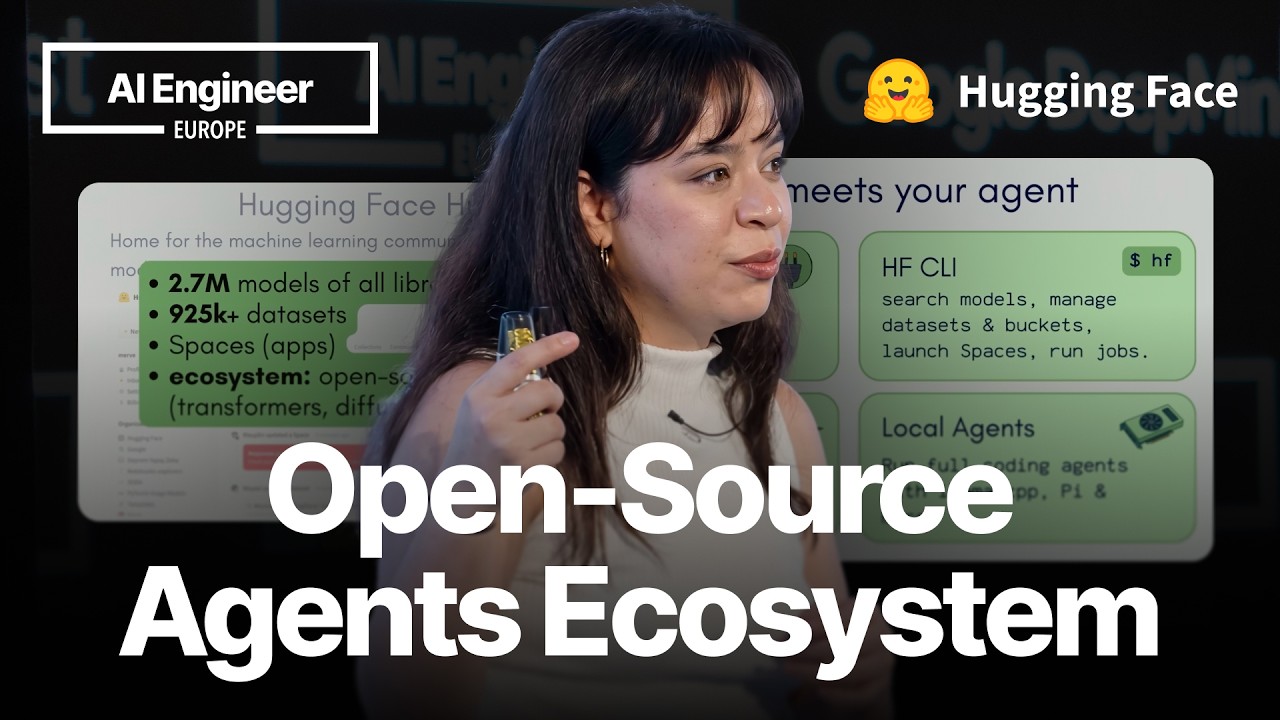
Self-Training Agents: Hermes Agent, HF Traces, Skills, MCP & Finetuning — Merve Noyan, Hugging Face
May 13, 2026 · 19:11
Merve Noyan from Hugging Face argues that open-weight and open-source models have caught up with closed models, citing GLM 5.1 topping the Artificial Analysis Intelligence index. She walks through Hugging Face’s ecosystem for agentic AI: benchmark datasets on the Hub to filter models by SWE-bench or AIME scores; inference providers that route to the cheapest or fastest option per model; a traces repository type for storing and exploring agent sessions; and skills that plug into coding agents (e.g., Claude Code) to fine-tune vision-language models on a dataset by name—calculating VRAM, selecting an instance, and launching the job. She demos an agent-driven fine-tuning of Qwen2-VL on a vision-language dataset, and a case study where an LLM agent orchestrated OCR of 30,000 AI papers using open OCR models and Hugging Face Jobs, eliminating napkin math. The MCP server also enables querying Hub models, datasets, and spaces from agents.
Powered by PodHood