
Haiku
ProductA product discussed on AI Engineer.
10 episodes
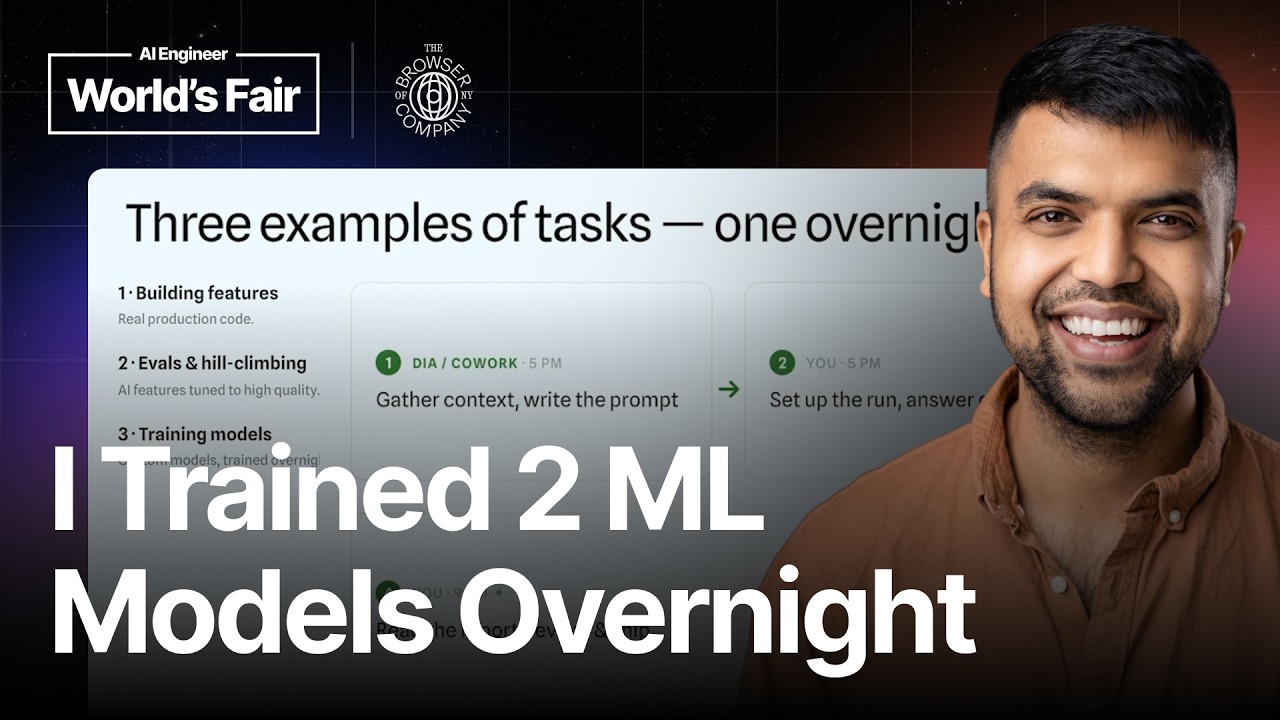
Prototyping as Leadership: How a CTO Ships with AI Agents — Hursh Agrawal, The Browser Company
Aug 20, 2026 · 18:18
Hursh Agrawal, CTO and co-founder of The Browser Company, argues AI coding agents let leaders keep building: despite 15+ meetings, 7 direct reports, and a toddler, he ships 2–10 PRs/week. He says frontier models turn over every three months, so hands-on building is the only way to judge them and show engineers working prototypes. His method is an overnight loop: a coworker agent gathers Slack/Jira/Notion context into a prompt at 5pm, coding agent runs for hours, and a morning hour reviews tests, CI, and AI code review. He details three overnight uses: building features, hill-climbing evals from feedback JSONs, and training custom models like a PII classifier on AWS. He warns leaders to avoid critical path work and to rely on trustworthy CI, feature flags, a prototype branch, and readable PRs.
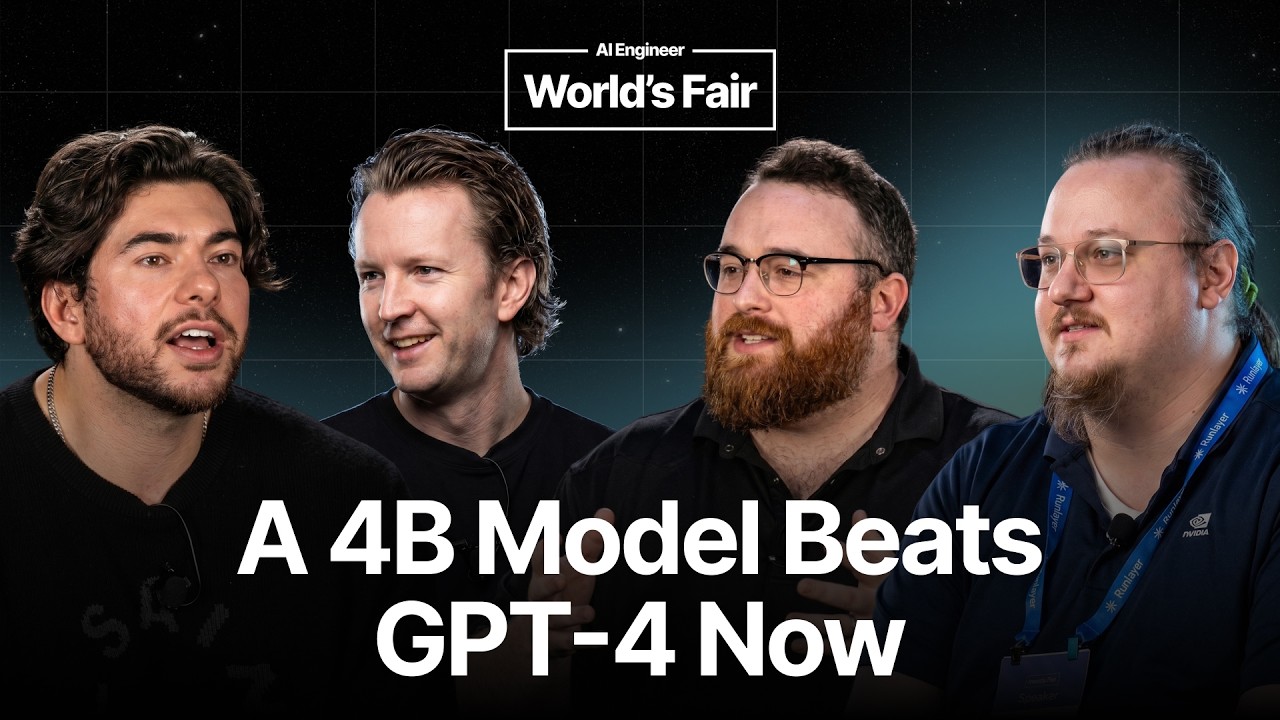
Local Models: Trust, Control, Optimization — Carter Abdallah, NVIDIA
Aug 7, 2026 · 43:21
NVIDIA's Carter Abdallah, Prime Intellect's Vincent Weisser, Arcee's Lucas Atkins, and NVIDIA's Chris Alexiuk argue open-weight models are the trustworthy foundation for enterprise and local AI. Atkins separates trust from safety: when Anthropic pulled Fable, enterprises chose Chinese open models for guaranteed availability, and open models are inspectable unlike closed APIs. Arcee pretrained a 400B model in six months; Weisser cites a customer that specialized an open model for finance in a week or two, beating Opus at a fraction of Haiku's cost. Alexiuk calls open weights the fix for 'mismanaged genius' and expects capable local models on MacBooks within a year; the panel predicts Fable-level open models within a year and hopes local-model use rises from a rounding error to 10–15%.

The State of Model Routing — NVIDIA, Cognition, OpenRouter
Aug 6, 2026 · 48:17
Cognition's Walden Yan, OpenRouter's Alex Atallah, NVIDIA's Tanay Varshney and Carter Abdallah argue routing should orchestrate frontier and cheaper models, not per-task benchmark picks; Devin Fusion cuts Fable-level intelligence cost by 40%. Yan: task-type routing is fragile because a session shifts from codebase question to feature request to live debugging; Devin keeps a frontier model planning while a cheap sidekick executes. Atallah: OpenRouter's auto router sat unused for two years until OpenClaw heartbeats every ten minutes created an app with two intelligence needs; out-of-distribution, small models thrash: Opus scores three times better at a tenth of Haiku's cost on terminal bench. Varshney cites jagged capabilities for up to 10% higher accuracy; Abdallah adds local/cloud routing.
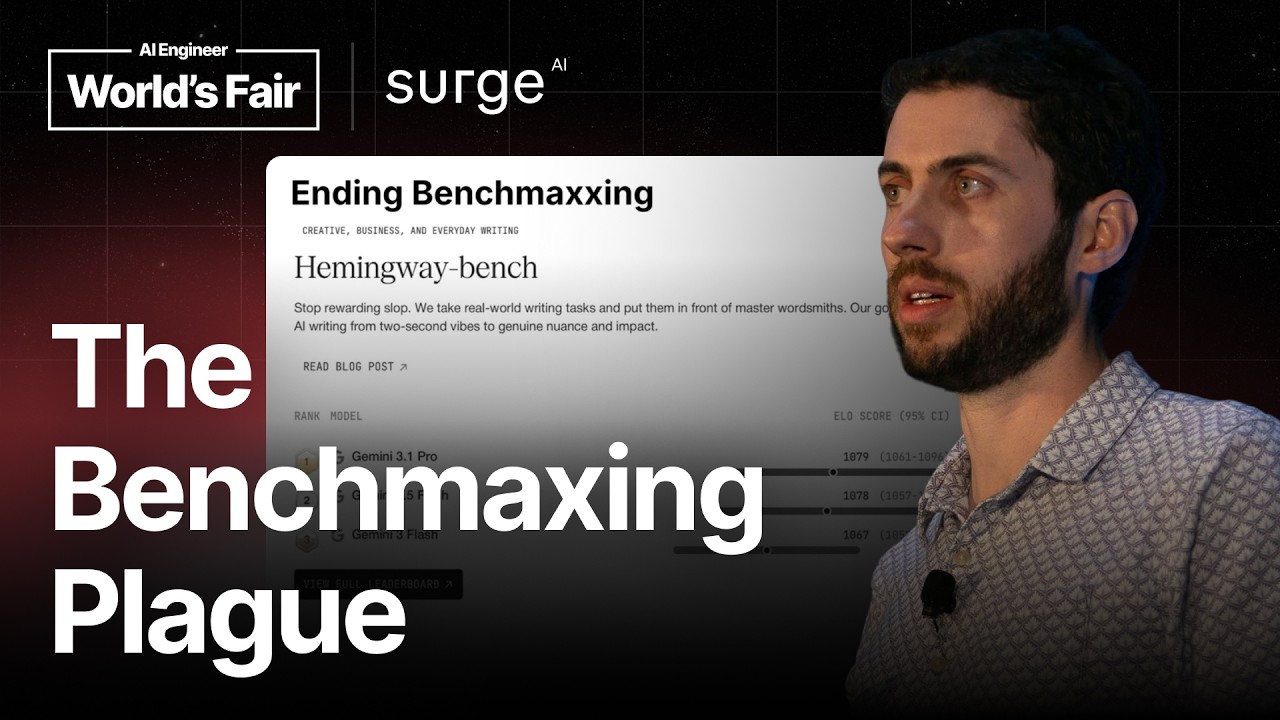
When Will The Benchmaxxing Plague End? — Nick Heiner, Surge AI
Aug 2, 2026 · 17:25
Nick Heiner of Surge AI argues that benchmaxxing — labs gaming benchmarks rather than improving real-world value — is driven by benchmark misalignment and poor methodology, and can end with rigorous human evaluation. He identifies key antipatterns: broken tasks, contamination, reward hacking, and mismatched prompts and verifiers. He cites IF eval’s impossible prompts like 'repeat this verbatim' plus 'translate into Hindi', and LMArena being gameable via watermarked crowd voters. He shows evidence that Anthropic’s Opus 4.8 memorized much of SWE-bench verified without disclosing it. Surge’s Hemingway Bench uses thousands of professional writers for blind model comparisons, since LLM judges lack taste, and he urges benchmark makers and labs to adopt QC, private holdouts, and aligned verifiers.

Don't Let the LLM Drive - Ornella Bahidika & Joel Allou, Microsoft
Jul 20, 2026 · 6:08
Ornella Bahidika and Joel Allou of Microsoft present their voice tutor Ace, arguing that the LLM should never control the flow in multi-step agents. They built Ace with a state machine that confines the model to narrow contracts per step, letting the harness validate outputs and decide next actions. This design allows them to use a cheaper, faster model (Haiku 4.5) instead of a heavy reasoning model (Opus 4.7 Cloud). They identify three decisions the LLM must never own: when the lesson ends, whether the student answered correctly, and what comes next. By engineering these checks outside the model, Ace achieves reliability in production, avoiding loops and early terminations that plague prompted-only approaches. The pattern applies to any flow agent, including coding agents, runbooks, and onboarding flows.

Your Voice Agent Doesn't Need a Frontier Model - Joel Allou & Ornella Bahidika, Microsoft
Jul 20, 2026 · 5:45
Joel Allou and Ornella Bahidika from Microsoft present ACE, an AI voice tutor that deliberately uses a small model instead of a frontier model, arguing that latency—not intelligence—is the critical constraint in voice applications. They demonstrate that a frontier model's reasoning time of multiple seconds breaks conversational flow, while their system keeps model latency under 950 milliseconds by extracting all logic and planning into a deterministic state machine. This scaffolding handles lesson progression, student mastery tracking, and response generation, leaving the small model (Haiku 4.5) with only the task of speaking. The result: a 900-millisecond response time that feels instantaneous. They acknowledge that scaffolding requires strict rules to prevent drift, but call it a one-time code investment that unlocks cost-effective, real-time performance. The episode’s core lesson: pick the fastest model your latency budget allows, then invest in external scaffolding to make it smart.

Claude Fable, Claude Tag, and Anthropic's Culture — Cat Wu & Thariq Shihipar ft Simon Willison
Jul 15, 2026 · 51:30
This episode features Anthropic's Cat Wu and Thariq Shihipar discussing Claude Code, Claude Tag, and Claude Fable, arguing that these tools have shifted engineering from slow spec-driven processes to rapid, ambitious building. Thariq notes that with each model generation, delegation increased, and Claude Fable now enables one-shot features. Cat says engineers now need product taste over execution, as timelines shrink from six months to a week. Claude Tag, a proactive multiplayer agent, lands 65% of product engineering PRs internally by monitoring channels and remembering preferences. The team reduced Claude Code's system prompt by 80% for frontier models by removing examples and hard constraints, relying on model judgment. Auto mode, used internally since January, mitigates prompt injection through thousands of evals and Sonnet classifiers. Cultural hacks include default-public channels and a 'don't negotiate against ourselves' mindset, leading to ambitious builds like Thariq's Claude-powered video editing and a Street Fighter game.

Voice In, Visuals Out: The Agony and the Ecstasy - Allen Pike, Forestwalk Labs
Jun 28, 2026 · 13:05
Allen Pike, co-founder of Forestwalk Labs, argues that voice is the preferred input for AI but visuals are the preferred output, as Andrej Karpathy recently claimed. He explains that while voice-in, voice-out requires sub-200ms latency for seamless conversation, voice-in, visuals-out can work within a more forgiving one-second response envelope. Pike shares three techniques his team uses to achieve this: using a fast model like Haiku with low p95 latency, sending inference every one to two seconds as the user speaks rather than waiting for silence, and leveraging stable prefix caching to keep the first 90% of the context identical, reducing cost and latency. He illustrates with a real example where a voice agent filed a Linear issue in under a second during a team call, demonstrating how the approach creates a natural, non-interruptive experience.

Your Coding Agent Should Do AI System Engineering — Ben Burtenshaw, Hugging Face
May 21, 2026 · 18:25
Ben Burtenshaw from Hugging Face demonstrates how coding agents can take on AI systems engineering tasks—writing CUDA kernels, fine-tuning models, and running multi-agent research labs—by leveraging skills and the Hugging Face Hub. He shows a 1.88x speedup on H100s with an RMSNorm kernel written by Claude Code, and a fine-tuned Qwen3 0.6B achieving 35% on LiveCodeBench. Skills compress years of specialization into hours by turning zero-shot tasks into few-shot workflows. For multi-agent research, a Planner generates hypotheses from papers, Workers implement them as training scripts, and a Reporter monitors results via the open-source Trackio dashboard, with all jobs running on Hub compute. The key is exposing open primitives like kernels, Trackio, and HF jobs as agent-controllable tools.

Replacing 12K LoC with a 200 LoC Skill — David Gomes, Cursor
Apr 30, 2026 · 19:22
David Gomes shows how Cursor replaced 12,000 lines of code for Git WorkTrees and best-of-en features with roughly 200 lines of Markdown using agent skills and subagents. He explains the original implementation's complexity (15,000 lines deleted) and the new slash commands: /worktree, /best-of-en, /apply, /delete. Pros include less maintenance, ability to switch mid-chat, multi-repo support, and better judging with the parent agent stitching results. Cons: models sometimes forget to stay in the WorkTree over long sessions, perceived slowness, and reduced discoverability. He details future improvements through evals and RL training, plus a native WorkTrees implementation in Cursor 3.0 and exploration of non-Git parallelization primitives.
Powered by PodHood