
GPQA
ProductA product discussed on AI Engineer.
3 episodes

State of Data — Sean Cai, Independent / State of Data
Jul 26, 2026 · 18:22
Sean Cai argues data markets, not compute, are now the binding constraint for turning generalist AI into expert systems, with the supply chain unbundling from vertical giants into specialist vendors. He distinguishes Type I (real workflow capture) from contrived Type II data, noting the industry sells Type II as Type I. He introduces Verifier's Law—ease of training proportional to task verifiability—to predict domain maturity: code first, then biology, security, finance. He exposes benchmark psychosis: a single number under one scaffold is a noisy sample, requiring cross-harness differencing. Labs like Anthropic's data spending forecasts product launches (e.g., cybersecurity data in January led to Claude Cyber in March). Data companies like Mercor pivot to enterprise, and Cai builds Antikythera mechanisms to monetize real-world workflows and provide RL-as-a-service.
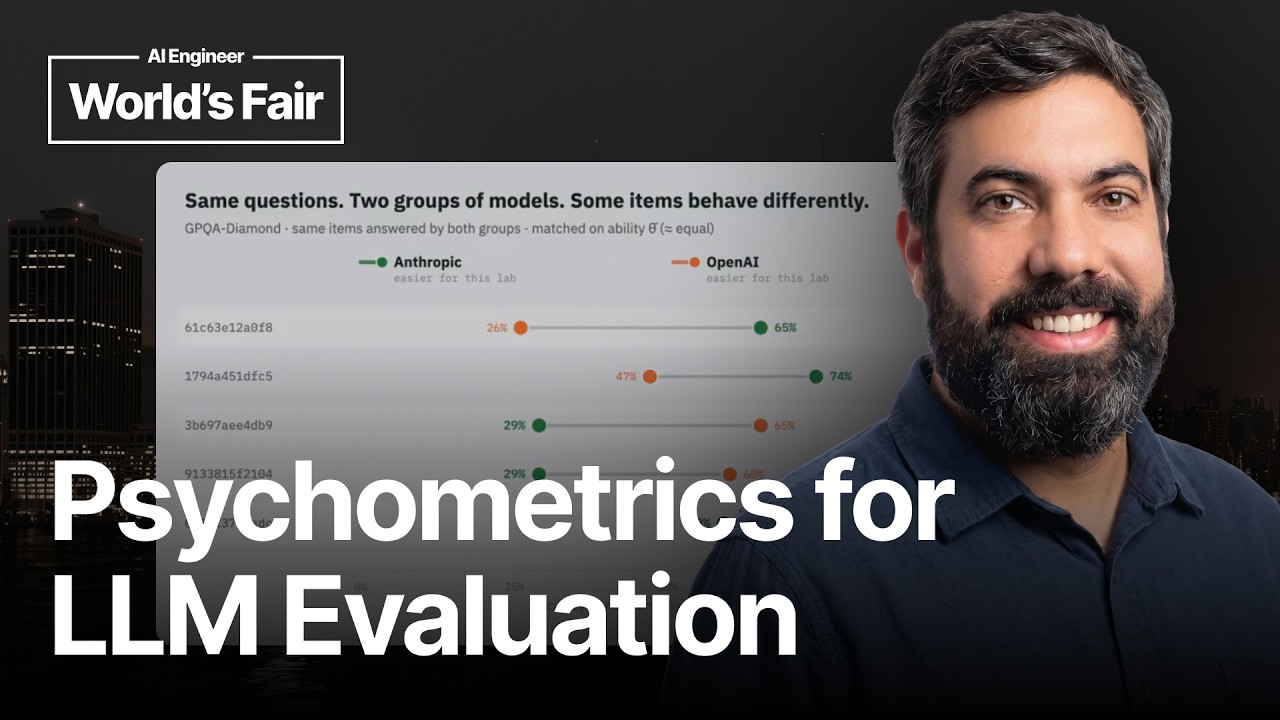
Stop Evaluating Models Like It's the 50s - Alejandro Vidal, Mindmakers
Jul 13, 2026 · 23:35
Alejandro Vidal of Mindmakers argues that counting correct answers in LLM benchmarks—classical test theory—should be replaced by item response theory (IRT) from psychometrics for richer evaluations. Using real data from Epoch.ai, he shows that while Claude Opus 4.1 scored 245 right and Gemini 3 Pro 247, IRT reveals Gemini is nearly one standard deviation more intelligent because it answers harder questions. IRT assigns each item difficulty (B) and discrimination (A), enabling benchmark auditing—Vidal flagged mislabeled items like a question about passengers whose gold answer was actually total people killed. He demonstrates reducing a 484-item benchmark to 97 items with 99% ranking correlation by selecting high-discrimination items, saving tokens and money. IRT also detects contamination via unexpected residuals, protects benchmarks through adaptive testing with unique fingerprint sets, and identifies model families (e.g., DeepSeek distillations correlate 0.38). Vidal previews future extensions like multidimensional models and alignment measurement.

The Art & Science of Benchmarking Agents — Vincent Chen, Snorkel AI
Jun 4, 2026 · 23:25
Vincent Chen, a research fellow at Snorkel AI, argues that the ability to measure AI has fallen behind the ability to build it, and benchmarks must shape future capabilities rather than just measure past progress. Drawing from reviewing over 120 applications for Snorkel's $3 million Open Benchmarks Grants, he presents a framework: the science of task quality, distributional diversity, model headroom, and robust eval methodology, and the art of having a thesis (e.g., Terminal Bench's bet on CLI before coding agents made it obvious), producing research roadmaps, and treating researcher UX as a first-class citizen. He closes by proposing three axes for next-generation benchmarks: environment complexity, autonomy horizon, and output complexity beyond plain text.
Powered by PodHood