
GCP
ProductA product discussed on AI Engineer.
6 episodes

Building Turbopuffer: Gergely Orosz (@pragmaticengineer ) × Simon Eskildsen (CEO)
Aug 3, 2026 · 56:30
Gergely Orosz talks with Turbopuffer CEO Simon Eskildsen about how napkin-math engineering took him from high-school Shopify hire to building the S3-based vector database that cut Cursor's bill by 95%. Eskildsen recounts scaling Shopify's infra to 1M RPS, building failure-injection proxy ToxyProxy, and launching Turbopuffer at $1 per million vectors on S3 with an Nginx cache. Cursor became the first customer after he helped debug Postgres/autovacuum issues; he also tells how Jensen Huang ribbed him for choosing CPUs over GPUs. He argues RL workloads are gobbling CPU capacity, making CPU SKUs scarce, and lists six reasons to raise capital, noting his first raise funded R&D and the second let employees cash out. He closes on Turbopuffer's remote culture of campfires and turbo credits for business-class flights.
Emulated: The Data for Fully Autonomous Software Engineers and Companies — Joseph Wang
Jul 31, 2026 · 16:33
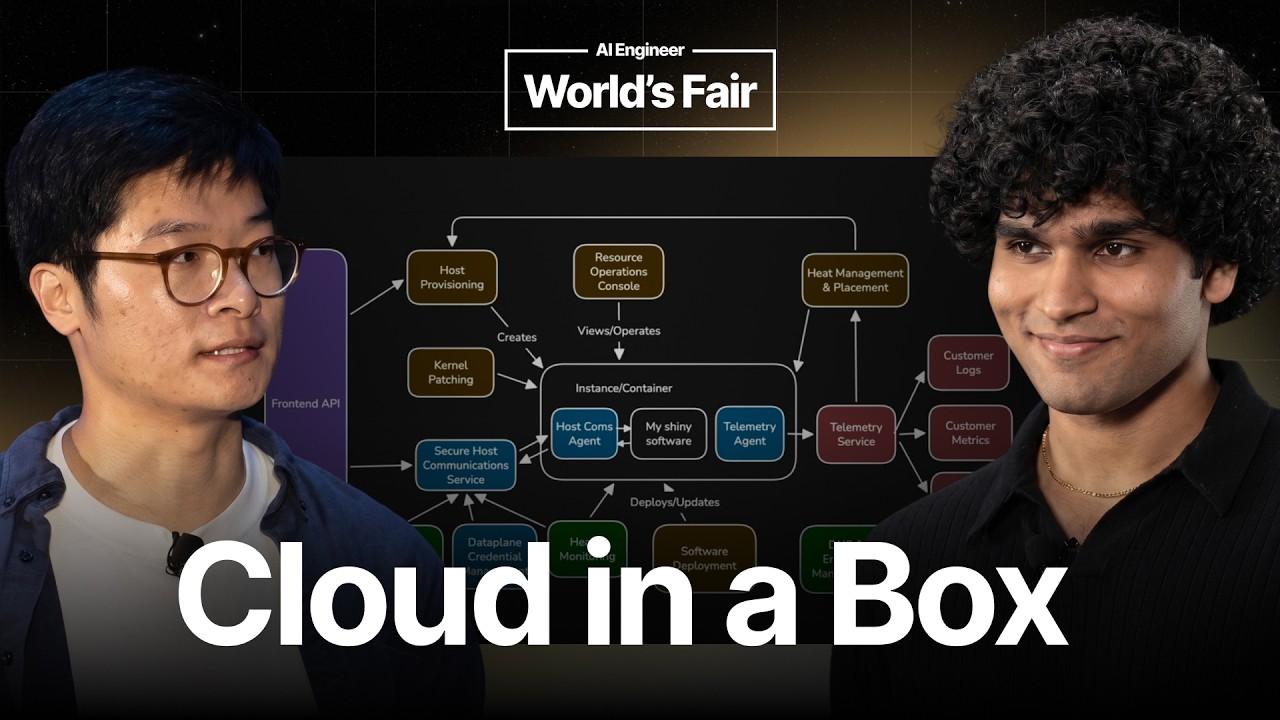
Joseph Wang and his co-founder Sid from Emulated argue that AI agents struggle with infrastructure work because training data misses the messy reality of production, so Emulated simulates entire companies inside sandboxes. Tasks run 50 to 100 turns, with live traffic, failing nodes, data corruption, clock skew, deployments, and customer conversations — not clean code diffs. They argue single-node sandboxes break down when provisioning real resources like VPCs, subnets, and security groups, and meeting bars for throttling, auth, and authorization, plus managing costs and gradual rollouts. Their goal is making agents own entire companies by emulating the real world at full fidelity; they start with infra because domain expertise improves data quality and infra's problem statements are clear.

The Dirty Secret of Forward Deployed Engineering — Natalie Meurer, Sierra
Jul 28, 2026 · 16:49
Natalie Meurer argues that forward deployed engineering (FDE) has become a meaningless label because it has stretched from DevOps at Palantir in 2008 to data integration, ontology work in Slate and Foundry, solution architecture, and enablement—but its durable core is customer accountability and outcome-based pricing. Tracing FDE's history at Palantir, she shows how the role evolved from keeping the platform stable (2008) to data integration (2012), custom dashboarding in Slate (2016), and finally customer enablement in Foundry (2020). As coding agents make software cheap, she contends the lasting value lies in integrating data, understanding customers, and owning outcomes. Pricing tells the story: seat-based assumes a tool, while usage or outcome pricing puts the provider on the hook—exactly what FDEs have always done. She concludes agent engineering is FDE reborn, and that product, infra, and AI engineering are all trending toward the same customer-accountable model.
Building the platform for agent coordination — Tom Moor, Linear
Jul 28, 2025 · 19:43
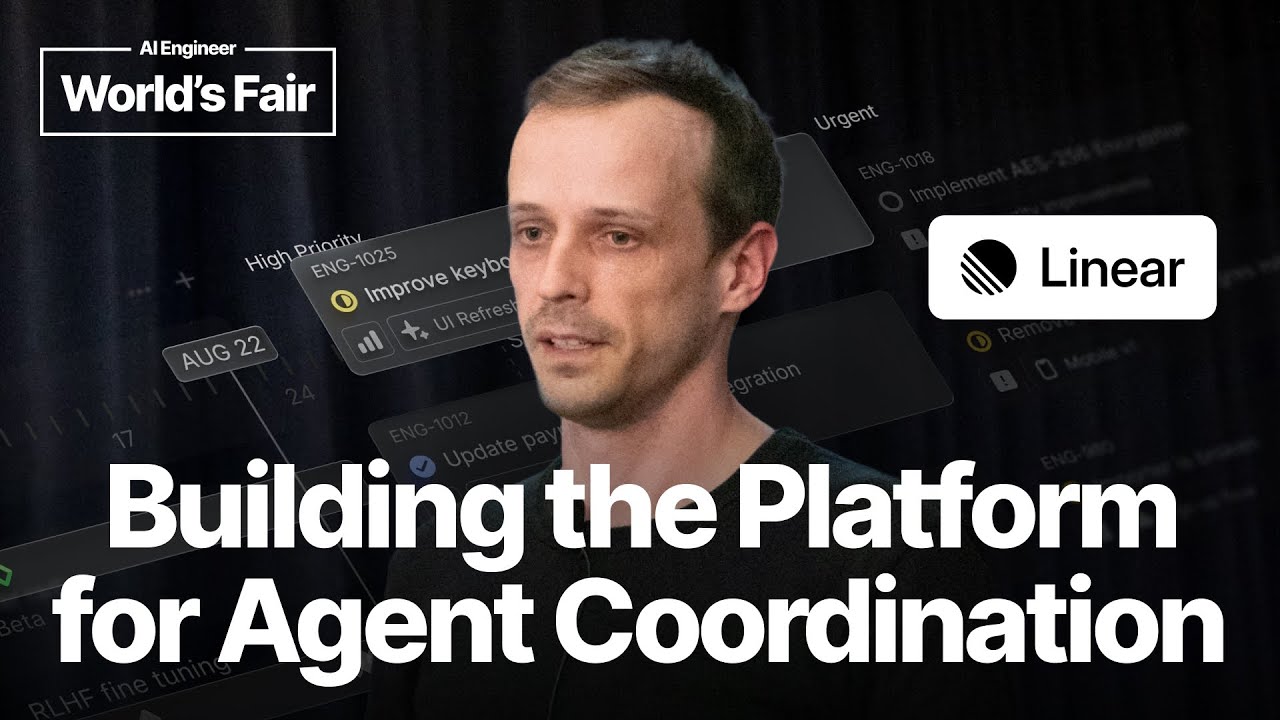
Tom Moor, Head of Engineering at Linear, explains how the company is evolving from an issue tracker into an operating system for engineering teams that treats AI agents as first-class teammates. He details Linear's pragmatic AI journey: starting with embeddings and PG vector, then moving to a hybrid search index using TurboPuffer and Cohere embeddings, leading to features like Product Intelligence (query rewriting, reranking, deterministic rules for suggestions), natural language filters, Slack-to-issue creation, and daily audio pulses. The core of the talk is Linear's agent platform, launched two weeks ago, where coding agents like CodeGen, Bucket, and Charlie integrate via OAuth, GraphQL, and new webhooks, allowing users to assign, mention, and interact with agents just like human teammates. Moor emphasizes best practices for builders: respond fast, inhabit the platform's language, move issues to 'in progress,' and clarify plans before acting, all while keeping interactions concise and value-adding. The episode argues that with this platform, engineering teams can build more, faster, and with higher quality by offloading grunt work to infinitely scalable cloud-based teammates.
Building agent fleet architectures your CISO doesn't hate — Lou Bichard, Gitpod
Jun 27, 2025 · 13:52
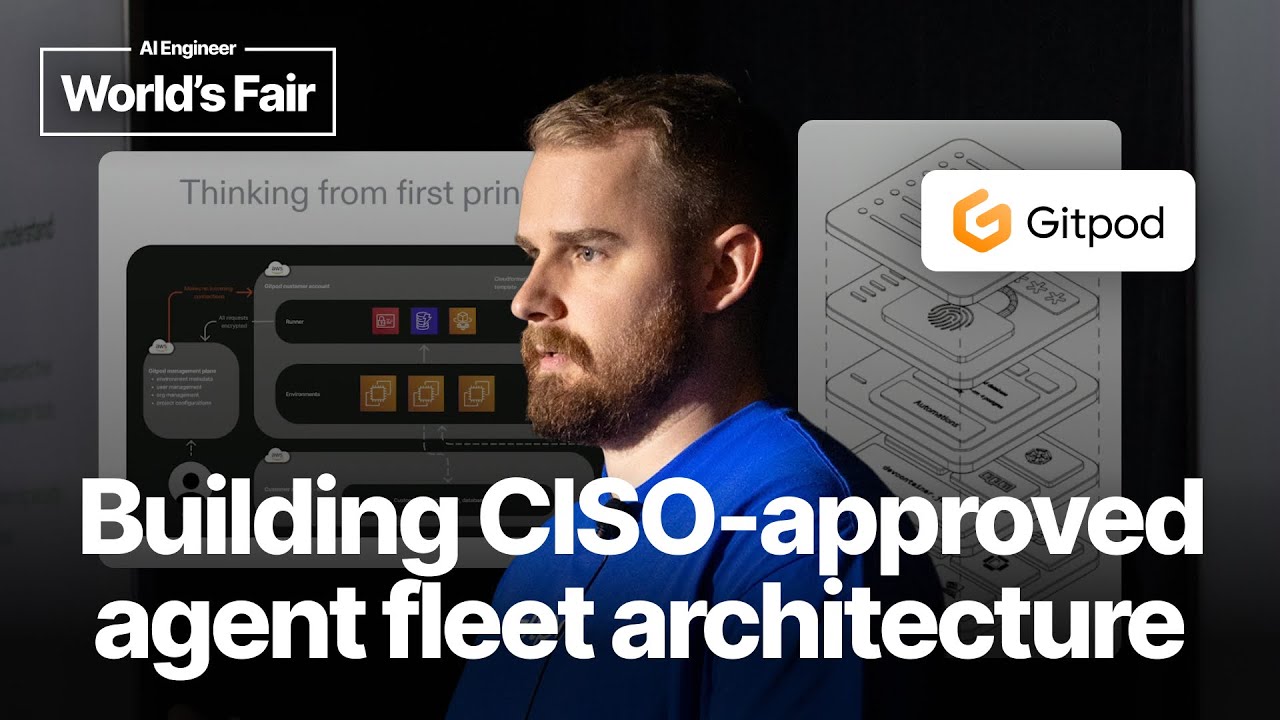
Lou Bichard explains how Gitpod evolved from a managed SaaS to a 'bring your own cloud' architecture that satisfies CISOs in regulated industries by running secure dev environments—and now agent fleets—on customer infrastructure via a simple runner (a single ECS task) instead of complex Kubernetes. The platform, used by banks and healthcare firms for 37 hours per week per developer, reduces operational overhead through a cloud-formation-based setup that takes three minutes. For agents, the same infrastructure provides source code access and audit logging, ensuring privacy and compliance. Bichard argues that vendors should simplify architectures to lower customers' day-two costs, and advises buyers to prioritize security and ownership models when selecting AI tools.

Decoding Mistral AI's Large Language Models: Devendra Chaplot
Nov 21, 2024 · 18:16
Devendra Singh Chaplot of Mistral AI details the company's open-source large language models, including Mistral 7B, Mixtral 8x7B, Mixtral 8x22B, and CodeStral 22B, arguing that open models complement rather than compete with profit by serving as branding tools and driving customer acquisition for proprietary upgrades. He explains the three-stage LLM training process—pre-training on trillions of tokens, instruction tuning with prompt-response pairs, and learning from human feedback via preference optimization—emphasizing that more data does not guarantee better performance due to noise. The episode highlights Mistral's focus on optimizing the performance-to-cost ratio, with CodeStral 22B outperforming larger models like Code LLaMA 70B while being smaller and multilingual across 80+ programming languages. Practical guidance is given: prototype with high-end commercial models, then fine-tune open models for specific tasks to balance performance and cost.
Powered by PodHood