
Effect
ProductA product discussed on AI Engineer.
5 episodes
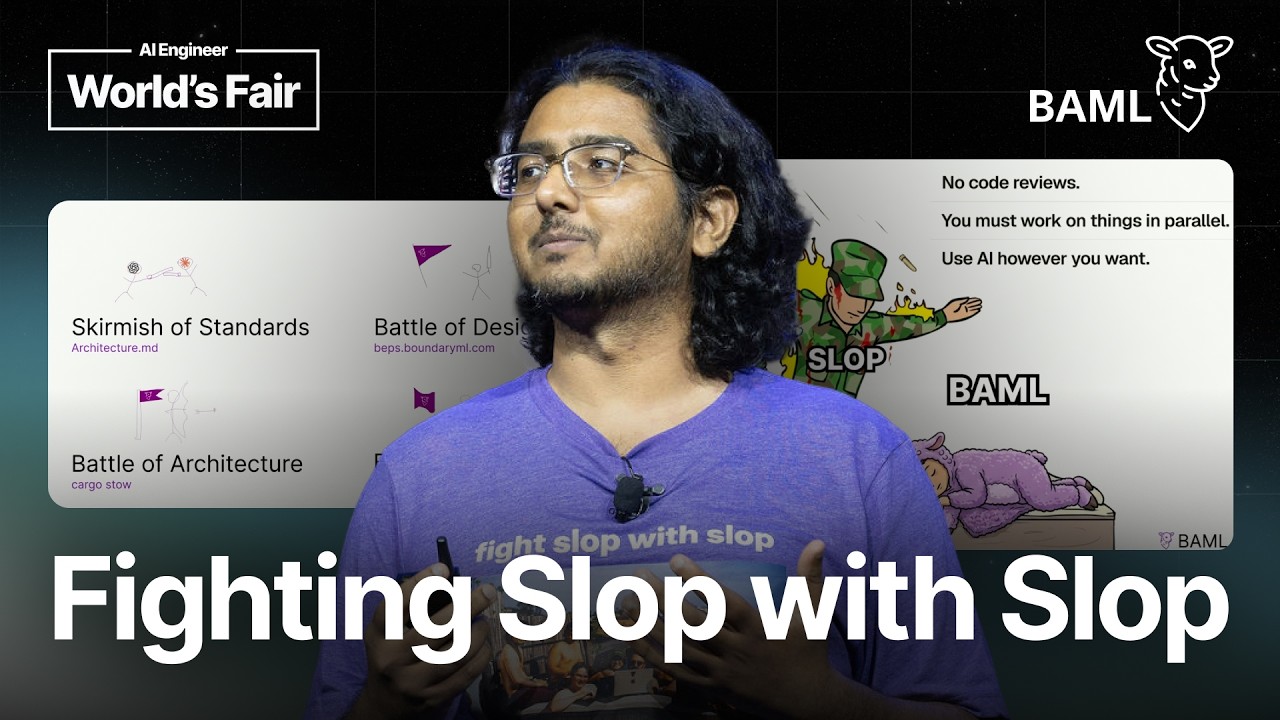
fighting slop with slop — Vaibhav Gupta, Boundary
Jul 31, 2026 · 21:32
Vaibhav Gupta of Boundary argues that AI slop can be fought with slop: instead of code reviews, his team relies on agents that read other agents' transcripts and on hard invariants like architecture.md files and CLI checks. He explains how they ship a stable programming language, BAML, without reading all code, using agents that flag hallucinations, tool-call errors, and inefficiencies from Claude transcripts, then A/B test language features by token spend and error rates. He attacks TypeScript as baking slop in—string coercion on sort, unsafe any—and designs BAML with inferred error types that prove division-by-zero is handled or the build fails. BAML works across Python, TypeScript, Rust, and more, with type-safe functions, lambdas, and generics across boundaries, plus zero-cost execution traces and generated CLI tools. His closing challenge: build these sloppy tools yourself, constrain the systems underneath, and rethink foundational layers like Git, databases, and programming languages.

Loop Engineering from First Principles — Kyle Mistele, HumanLayer
Jul 25, 2026 · 17:57
Kyle Mistele argues that the fix for AI-generated 40,000-line pull requests is not a better prompt but a better loop, borrowing from control theory: a sensor measures the gap between current and desired codebase state, a controller picks the smallest incremental change, and an actuator agent applies it using hand-written golden patterns. Mistele illustrates with HumanLayer's own loop that migrates their RPC API to Effect one procedure at a time, using AST grep as a deterministic sensor, a controller that selects the smallest unmigrated procedure, and an actuator agent gated by deterministic CI running a single iteration per day. The loop tracks its own PRs in version control, refuses to stack a new change while an earlier one is still open, and includes a feedback file and comment trigger for humans to re-steer it. Mistele concludes that this design makes the code incrementally better, readable, and verifiable, solving the problem of unreadable mass-generated code.
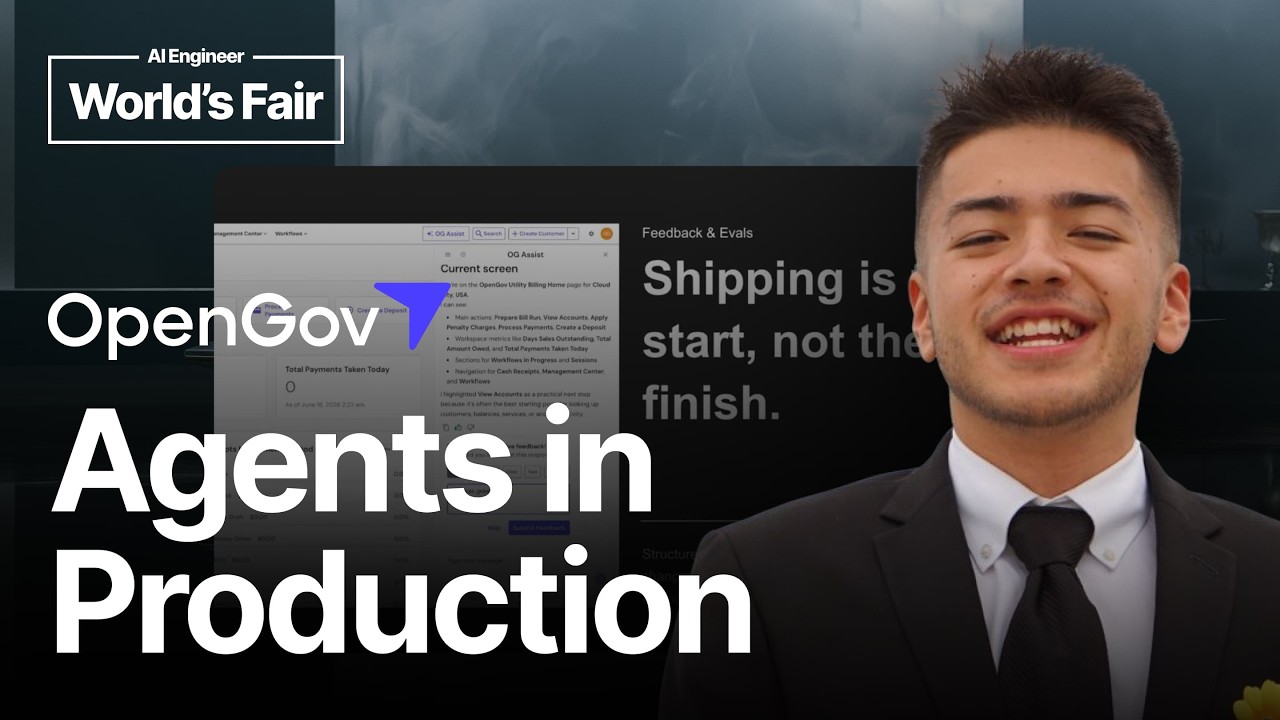
Agents in Production: How OpenGov Built and Scaled OG Assist - Gabe De Mesa, OpenGov
Jun 26, 2026 · 18:30
Gabe De Mesa of OpenGov explains how the company built and scaled OG Assist, an AI agent embedded across its government ERP products, using the Effect TypeScript library for full control over the agent loop and adopting Google's A2A protocol for agent-to-agent communication. The team moved from LangGraph to a custom Effect-native loop to gain fine-grained control over tracing, error handling, and structured concurrency. They implement feedback and automated evals with thumbs-up/down and CI checks, human-in-the-loop approvals for mutating tool calls, and sandboxed code execution to keep production safe. Long conversations are managed via rolling summarization with memory recall. Observability comes from Effect's built-in tracing, enabling bottleneck profiling. Tools and skills are built as Effect toolkits, and internally OpenGov uses Claude and Cursor to accelerate development workflows.
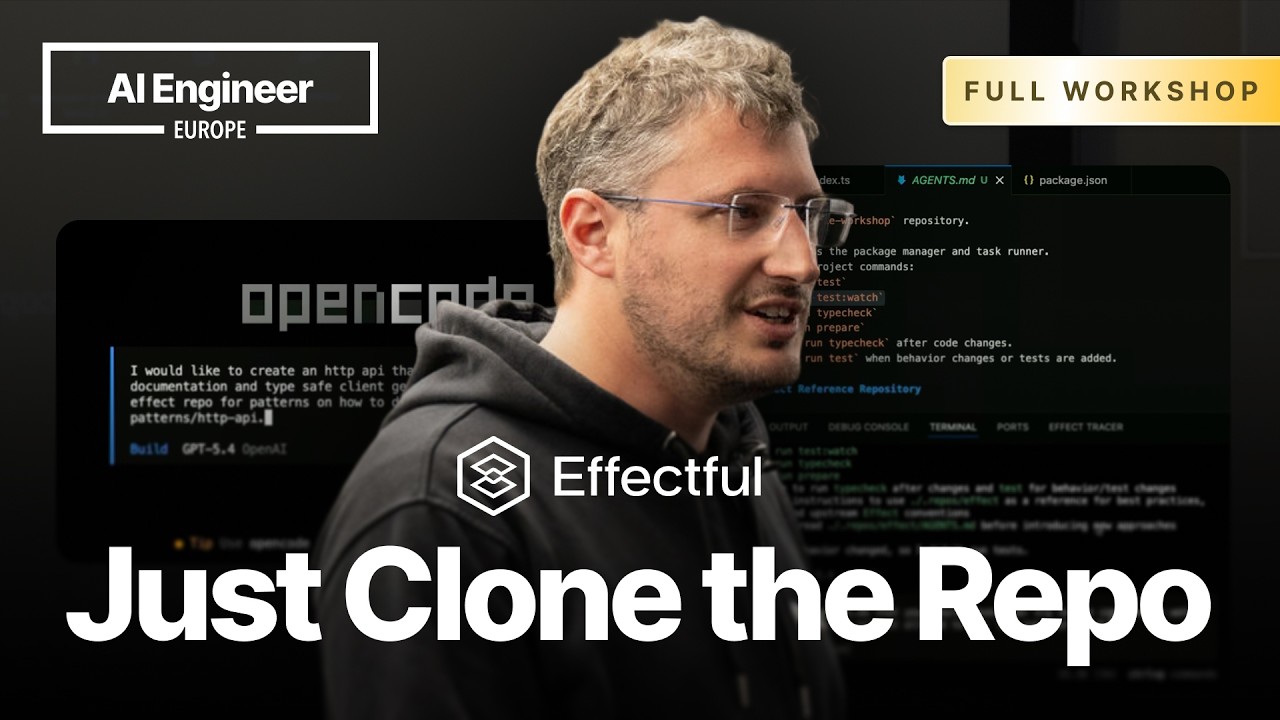
Vibe Engineering Effect Apps — Michael Arnaldi, Effectful
May 7, 2026 · 1:43:04
Michael Arnaldi demonstrates that cloning the Effect library's repository into a project, rather than relying on prompts, is the most effective way to give coding agents the context they need to build reliably with Effect. Starting from an empty repo, he sets up a Bun, Vitest, and TypeScript project, adds the Effect repo as a git subtree, and creates an agents.md to guide the agent. He then uses the agent to research patterns, resulting in a fully functional Todo HTTP API with OpenAPI docs, SQLite persistence, and tests — all from scratch in under two hours. The workshop stresses that treating the library code as part of the project, combined with strict diagnostics and pattern files, makes agents effective even in unfamiliar codebases. Arnaldi also discusses the importance of workflow systems like Effect Cluster for long-running AI processes, where server failures become likely.

Building Reliable Support Agents Using the Effect Typescript Library - Michael Fester
Jun 3, 2025 · 7:22
Michael Fester, co-founder and CTO of Fourteen.ai, explains how his team built production-ready AI support agents using the Effect TypeScript library, arguing it provides strong type safety, composability, and reliability for systems that rely on LLMs. The architecture uses Effect across the entire stack, including Effect RPC, Effect HTTP, Effect SQL, and a custom DSL for agent workflows. Reliability features include fallback between LLM providers (e.g., GPT-4.0 mini to Gemini Flash 2.0), retry policies with state tracking, and duplicated token streams for analytics. Dependency injection allows easy mocking of LLM providers for testing. However, Fester warns of pitfalls like silently losing errors from upstream catches and the steep learning curve. He recommends incremental adoption, starting with a single service.
Powered by PodHood