
dbt
ProductA product discussed on AI Engineer.
3 episodes

The Building Blocks of GTM Orchestration — Arman Vaziri, Ramp
Aug 26, 2026 · 19:55
Arman Vaziri, who leads product and sales led growth engineering at Ramp, details go-to-market orchestration: an intent — offering Pro V1 golf balls to golfers at East Coast construction companies — becomes targeted outbound, paid creative, landing page and in-app nudges. He argues the bottleneck was never ideas but messy data, rep busy work, and coordination cost; Ramp's answer was an internal CDP on Kafka and Postgres, plus embedded unstructured data for search. Pre-meeting briefs for account managers map attendee emails to accounts and run as durable Temporal threads; a skill library for custom brief formats drove adoption. For smaller teams, build narrow automations first — three years ago two people used GPT-3.5 for outbound — because nobody gets a year to design a perfect architecture.

Enterprise Agents Have a Structure Problem - Ishita Daga, Tesla
Jul 20, 2026 · 12:08
Ishita Daga, a senior machine learning engineer at Tesla, argues that enterprise agents fail because of three structural problems — ambiguity, staleness, and preference — rather than needing bigger models or more RAG. For ambiguity, she proposes a hierarchy of sources of truth: a curated semantic layer (best for known KPIs), canonical tables (parametric queries for flexibility), and a database graph (full schema but hard to maintain). To solve staleness, she recommends a context lifecycle embedding live data sources (GitHub, CRM, semantic layers) and a feedback loop that logs events, evaluates agent performance, and updates context automatically. On preference, she notes that different teams calculate the same metric differently (e.g., average milestone time by start vs. completion) and that current solutions like semantic layers or agent memory still fail to capture user-level routing, calling this an open problem requiring further research.
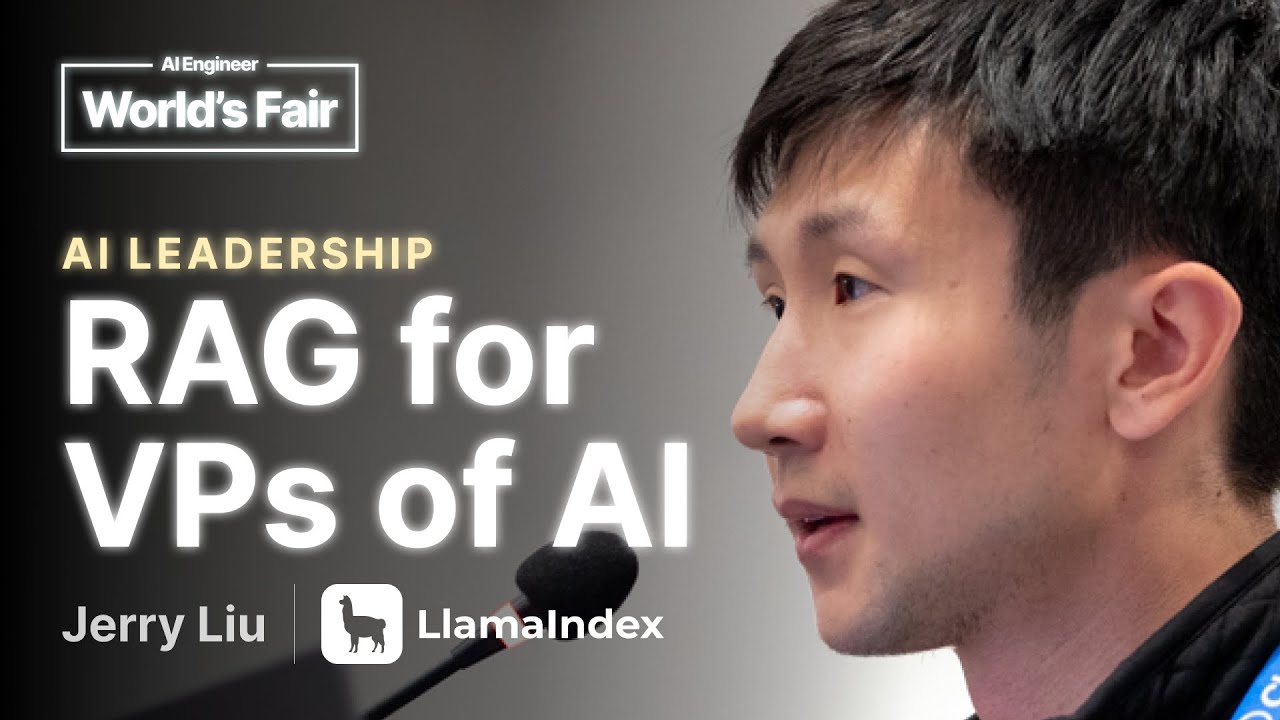
RAG for VPs of AI: Jerry Liu
Dec 31, 2024 · 26:51
Jerry Liu, CEO of LlamaIndex, argues that building production RAG systems requires a new data processing stack distinct from traditional ETL, emphasizing data quality through advanced parsing (Llama Parse) and rigorous eval over chunk size tuning. He explains that while longer context windows may eliminate fine-grained chunking, retrieval from external storage remains vital for multi-doc enterprise systems. Liu addresses data privacy with VPC deployment options, and notes that Llama Cloud processes but does not store data. He also highlights Llama Agents, an open-source multi-agent framework for deploying agentic microservices, and shares that Llama Parse processes tens of millions of pages monthly.
Powered by PodHood