
Claude Tag
ProductA product discussed on AI Engineer.
4 episodes

Claude Managed Agents and Evolution of Agentic Surfaces — Gagan Bhat & Isabella Kai He, Anthropic
Aug 11, 2026 · 31:24
Gagan Bhat and Isabella Kai He of Anthropic's Applied AI team explain how agentic surfaces evolved from the Messages API to the Claude Agent SDK and now Claude-managed agents, arguing that harnesses encode assumptions about model limits that go stale as models improve. They detail decoupling the brain (agent loop) from the hands (tool execution sandbox), which cut time to first token by 60% at P50 and over 90% at P95, and made failures recoverable via durable session logs. The session log also powers observability, context recovery, and 'dreaming,' a batch process that rewrites agent memory for self-improvement. They cover production lessons: keeping credentials in vaults, self-hosted sandboxes for VPC control, MCP tunnels for private servers, and the 'outcomes' feature that uses a grader agent to enforce success criteria.
Claude for Long-Horizon Tasks — Lance Martin, Anthropic
Jul 22, 2026 · 25:19
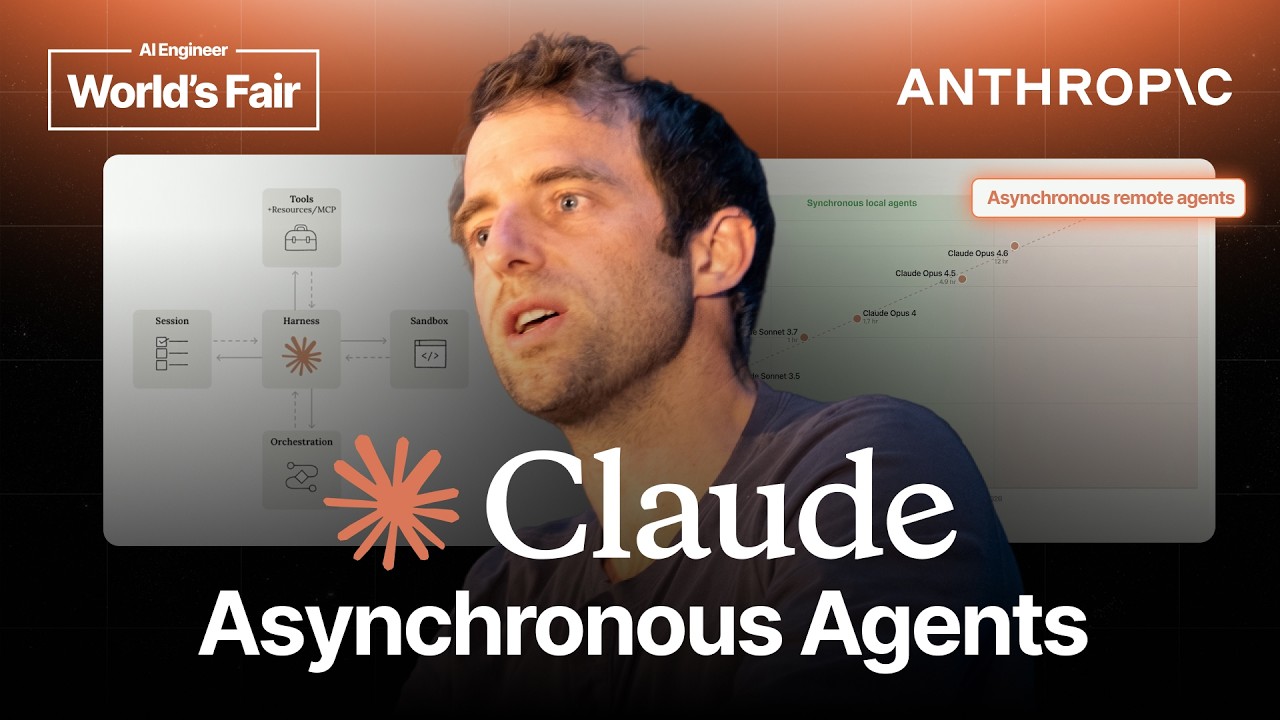
Lance Martin from Anthropic discusses how Claude's increasing task horizon enables asynchronous agents through decoupled architecture, verifier loops, and self-improving memory systems. He explains the shift from short task horizons (10–20 minutes) to 12+ hours, necessitating decoupling the brain (harness) from hands (sandboxes) for reliability and security. Verifier loops using separate contexts allow models to self-correct, demonstrated on the Parameter Golf benchmark with Opus 4.7. Memory systems inspired by human dreaming correct errors in-band, as shown in a Pokémon example where dreaming prevented repeated failures. Finally, org-level harnesses like Claude Tag provide shared identity and context for multiplayer proactive agents.

Claude Fable, Claude Tag, and Anthropic's Culture — Cat Wu & Thariq Shihipar ft Simon Willison
Jul 15, 2026 · 51:30
This episode features Anthropic's Cat Wu and Thariq Shihipar discussing Claude Code, Claude Tag, and Claude Fable, arguing that these tools have shifted engineering from slow spec-driven processes to rapid, ambitious building. Thariq notes that with each model generation, delegation increased, and Claude Fable now enables one-shot features. Cat says engineers now need product taste over execution, as timelines shrink from six months to a week. Claude Tag, a proactive multiplayer agent, lands 65% of product engineering PRs internally by monitoring channels and remembering preferences. The team reduced Claude Code's system prompt by 80% for frontier models by removing examples and hard constraints, relying on model judgment. Auto mode, used internally since January, mitigates prompt injection through thousands of evals and Sonnet classifiers. Cultural hacks include default-public channels and a 'don't negotiate against ourselves' mindset, leading to ambitious builds like Thariq's Claude-powered video editing and a Street Fighter game.
Field Guide to Fable — Thariq Shihipar, Anthropic
Jul 6, 2026 · 19:28
Thariq Shihipar of Anthropic discusses Fable and argues models improve in "spiky" ways: a chat model fails to list Pokémon ending in "aw" (Croconaw and Dreadnaw), but Claude Code fetches and filters the list in seconds – a gap he calls "capability overhang." He explains that to unlock Fable, Claude Code cut 80% of its system prompt because heavy instructions now constrain a more imaginative model, and the "ask user question" tool evolved from barely working under Opus 4 to generating embedded HTML questionnaires. He shares techniques like blind-spot passes and interviews to surface unknown unknowns, and reflects on the grief of moving from hand-coded programming to agentic workflows. Shihipar urges engineers to reject trade-offs – "good, fast, cheap: pick three" – and instead demand all three, citing a four-hour keynote deck built with Fable as proof that agents can deliver ambitious work faster.
Powered by PodHood