
ARC
ProductA product discussed on AI Engineer.
3 episodes
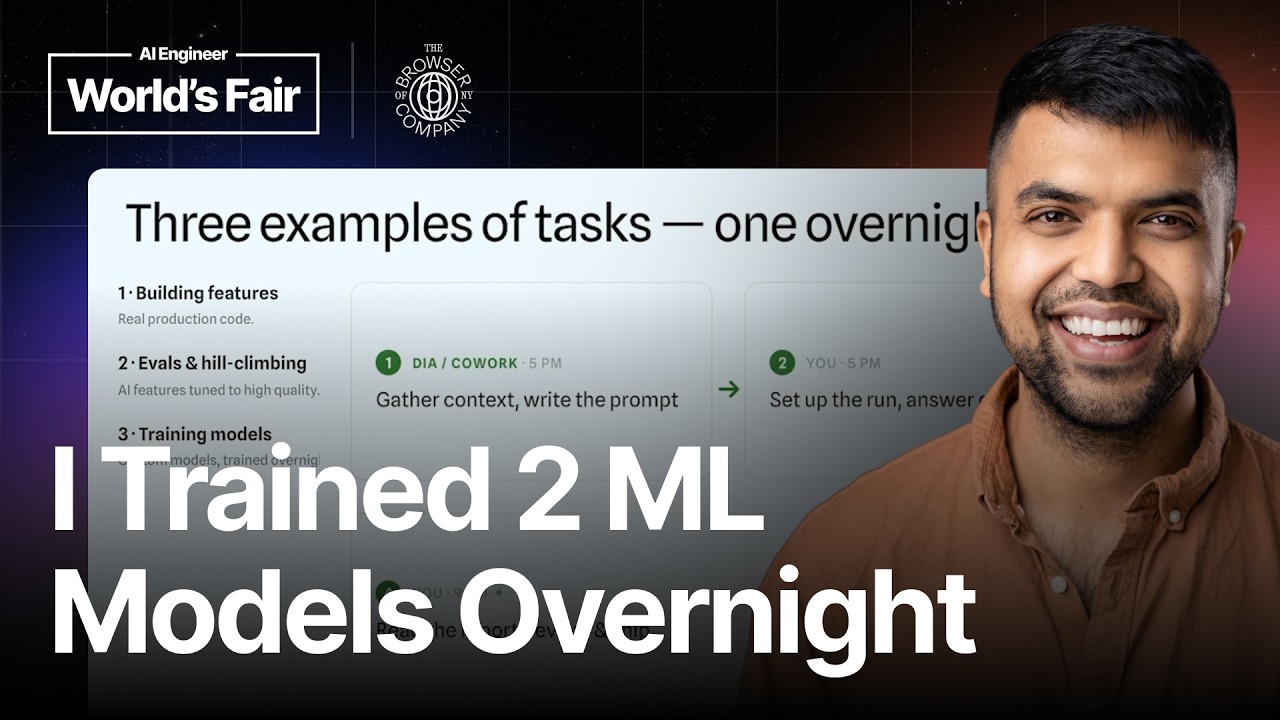
Prototyping as Leadership: How a CTO Ships with AI Agents — Hursh Agrawal, The Browser Company
Aug 20, 2026 · 18:18
Hursh Agrawal, CTO and co-founder of The Browser Company, argues AI coding agents let leaders keep building: despite 15+ meetings, 7 direct reports, and a toddler, he ships 2–10 PRs/week. He says frontier models turn over every three months, so hands-on building is the only way to judge them and show engineers working prototypes. His method is an overnight loop: a coworker agent gathers Slack/Jira/Notion context into a prompt at 5pm, coding agent runs for hours, and a morning hour reviews tests, CI, and AI code review. He details three overnight uses: building features, hill-climbing evals from feedback JSONs, and training custom models like a PII classifier on AWS. He warns leaders to avoid critical path work and to rely on trustworthy CI, feature flags, a prototype branch, and readable PRs.

From Arc to Dia: Lessons learned building AI Browsers – Samir Mody, The Browser Company of New York
Dec 19, 2025 · 17:48
Samir Mody, Head of AI Engineering at The Browser Company, explains how the team built Dia, an AI-native browser, after learning from their earlier browser Arc. He details three core lessons: optimizing tools for faster iteration by embedding prompt editors into the product itself; treating model behavior as a craft through a dedicated team formed after a strategy and ops employee rewrote all prompts in a weekend; and designing AI security as an emergent property, using confirmation steps for features like autofill to mitigate prompt injections despite the 'lethal trifecta' of private data, untrusted content, and external communication. The talk emphasizes that building an AI product required not just a technology shift, but a company-wide transformation in hiring, training, and collaboration.

LLM Scientific Reasoning: How to Make AI Capable of Nobel Prize Discoveries: Hubert Misztela
Sep 23, 2024 · 20:00
Hubert Misztela, an AI researcher at Novartis, argues that LLMs require more than naive RAG to achieve scientific reasoning capable of Nobel-level discoveries. He uses the 1990s petunia flower experiment — where three separate biological phenomena (including RNA interference) went unexplained for eight years until their common cause was found — as a benchmark. Misztela classifies question complexity from one-to-one to multi-needle problems and demonstrates that reasoning before retrieval (e.g., routing, GraphRAG) and after retrieval (e.g., relevance classifiers) improves hypothesis generation. His experiments show that strict prompting and a relevance classifier that evaluates each paper's contribution to advancing a hypothesis can recover the correct RNA/DNA link without post-discovery knowledge. He concludes that harder problems demand reasoning steps and that brute-force checking with LLMs may outperform embedding distances.
Powered by PodHood