
AlphaZero
ProductA product discussed on AI Engineer.
4 episodes

Local Agentic Theory For Mobile Games — Shafik Quoraishee & Joanne Song, The New York Times
Jul 23, 2026 · 18:04
Shafik Quoraishee and Joanne Song of The New York Times argue that on-device AI agents can transform mobile game accessibility by tuning difficulty and assistance in real time as a single continuous dial rather than separate toggles. They demonstrate a Space Invaders agent that perceives, predicts, and dodges entirely on the phone within a 16 ms frame, and a mini crossword solver using constraint backtracking. The pair explains the on-device budget—space for weights, time within refresh cycles, and energy drain—and shows how gaze estimation and tap analysis let the agent resize controls or break keyboard traps dynamically. They ground their approach in WCAG accessibility standards and propose a future where billions of local brains, each personalized to a user, replace centralized cloud AI.
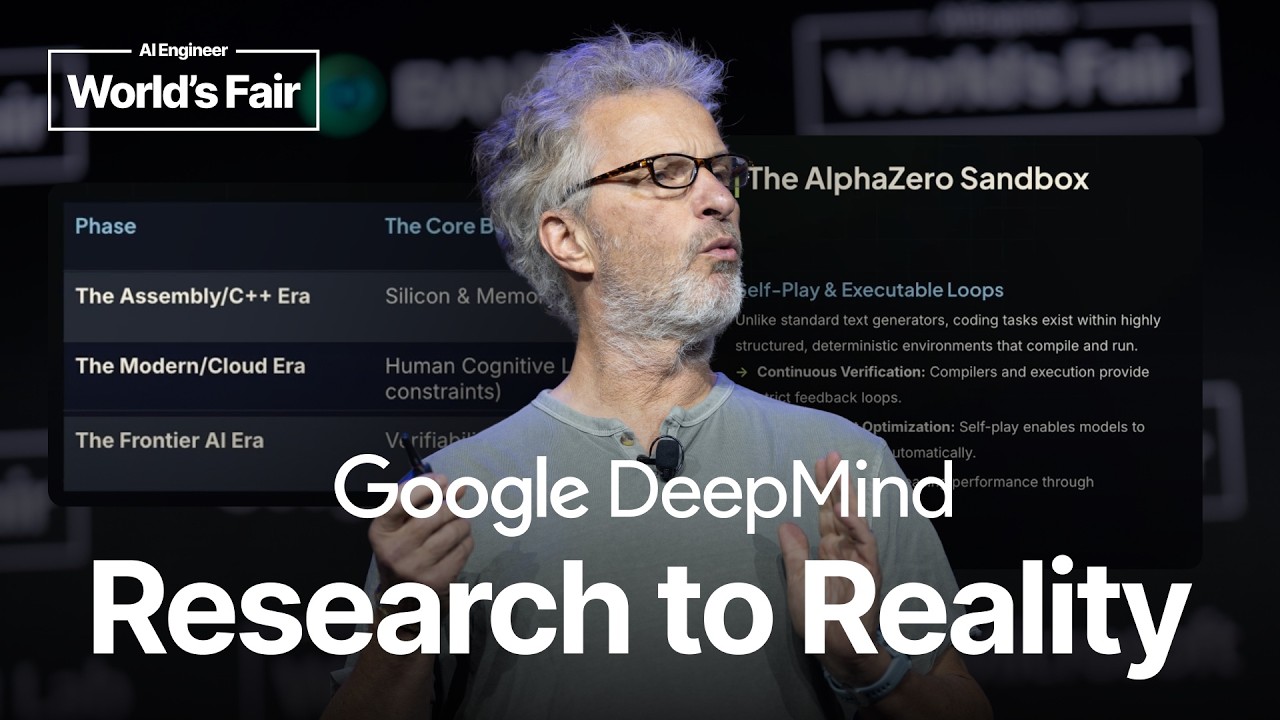
"Software engineering is not about writing code" — Benoit Schillings, Google DeepMind VP of Research
Jul 17, 2026 · 20:26
Benoit Schillings, VP of Technology at Google DeepMind, argues that the era of syntax generation is over, with AI now capable of superhuman code writing, shifting the bottleneck to architecture and validation. He explains that 80% of new code on GitHub is machine-generated, leading to a saturation of human training data and the need for self-play techniques inspired by AlphaZero. Schillings highlights DeepMind's use of self-play to generate and verify coding challenges, enabling models to reach superhuman performance. He emphasizes the shift to inductive architecture, where models must plan, decompose complex problems, and transfer knowledge across domains. Additionally, he calls for new programming languages designed for models rather than humans, and explores how AI's rapid experimentation will transform fields like chemistry and biology by uncovering patterns invisible to humans.

Building a Chess Coach — Anant Dole and Asbjorn Steinskog, Take Take Take
May 13, 2026 · 18:22
Anant Dole and Asbjørn Steinskog of Take Take Take, Magnus Carlsen's chess app, built an AI chess coach that keeps LLMs as translators rather than reasoners. Stockfish evaluates positions, tactical and positional detectors extract forks, pins, and structural weaknesses, and the LLM only converts those structured signals into English—preventing hallucination. They target sub-3-second latency using Gemini Flash. When a user flags bad commentary, it posts to Slack and injects into a running Claude Code channel via MCP. Claude investigates, modifies prompts or detectors, regenerates commentary, and asks clarifying questions. They run automated evals across 16 scenarios: Gemini Flash at 75%, Claude thinking below 60%, GPT-5 Mini lower. Their key insight: separate data pipeline from language generation, and close the loop with autonomous agents.

RL for Autonomous Coding — Aakanksha Chowdhery, Reflection.ai
Jul 16, 2025 · 19:27
Aakanksha Chowdhery, CEO of Reflection AI and former lead researcher on PaLM and Gemini at Google, argues that reinforcement learning (RL) scaling is the next frontier for autonomous coding agents. She explains that inference-time techniques like majority voting and self-revision improve accuracy but require many samples (e.g., 10,000 for rare correct generations). RL training can learn to generate correct outputs directly, especially in verifiable domains like code with unit tests. Reflection AI aims to build superintelligence starting with autonomous coding, leveraging automated verification to design better reward functions. She notes challenges in scaling RL, including system complexity and reward hacking, but sees coding as ideal due to execution feedback.
Powered by PodHood