
ACP
ProductA product discussed on AI Engineer.
4 episodes

ACP: The Universal Remote Control for AI Agents — Alex Hancock, Block
Sep 9, 2026 · 11:01
Alex Hancock, a Block engineer who works on the Goose harness and the MCP Rust SDK, argues agentic AI has a standard for agents reaching outward (MCP) but none for clients telling harnesses what to do — in the worst case one client per harness, like needing a different browser per website. His answer is ACP, the agent client protocol from Zed and JetBrains: JSON-RPC-based, carrying sessions, user messages, tool calls, and permission requests, and extensible via underscore-prefixed custom methods so shared patterns can move onto a standards track. He demos Zed and a Poolside terminal client driving the same Goose agent, plus a new HTTP and websocket remote transport. With remote transports for protocol, MCP, and models, all four pieces of the stack become independently placeable.

The Agentic Commerce Stack — Ahnaf Prio, Best Buy
Aug 27, 2026 · 20:38
Ahnaf Prio, Senior Engineering Manager at Best Buy, argues agentic shopping now runs on standardized commerce primitives rather than browser automation, with 45% of agent sessions on ChatGPT and Gemini already touching shopping. He explains why screenshot/DOM agents failed and maps MCP, A2A, OpenAI's ACP, Google's UCP, and AP2 payment mandates. Merchants push product feeds because M merchants times N products does not scale; payments today use shared tokens or Google Pay. His live demo has his cat Jenny as a bakery agent on Cerebras at 3,000 tokens per second, showing checkout state transitions and an AP2 token with spend ceiling and revocation URL. He closes with evals for behavior, protocol compliance and latency, citing Chipotle's agent answering programming questions as a whack-a-mole caution.
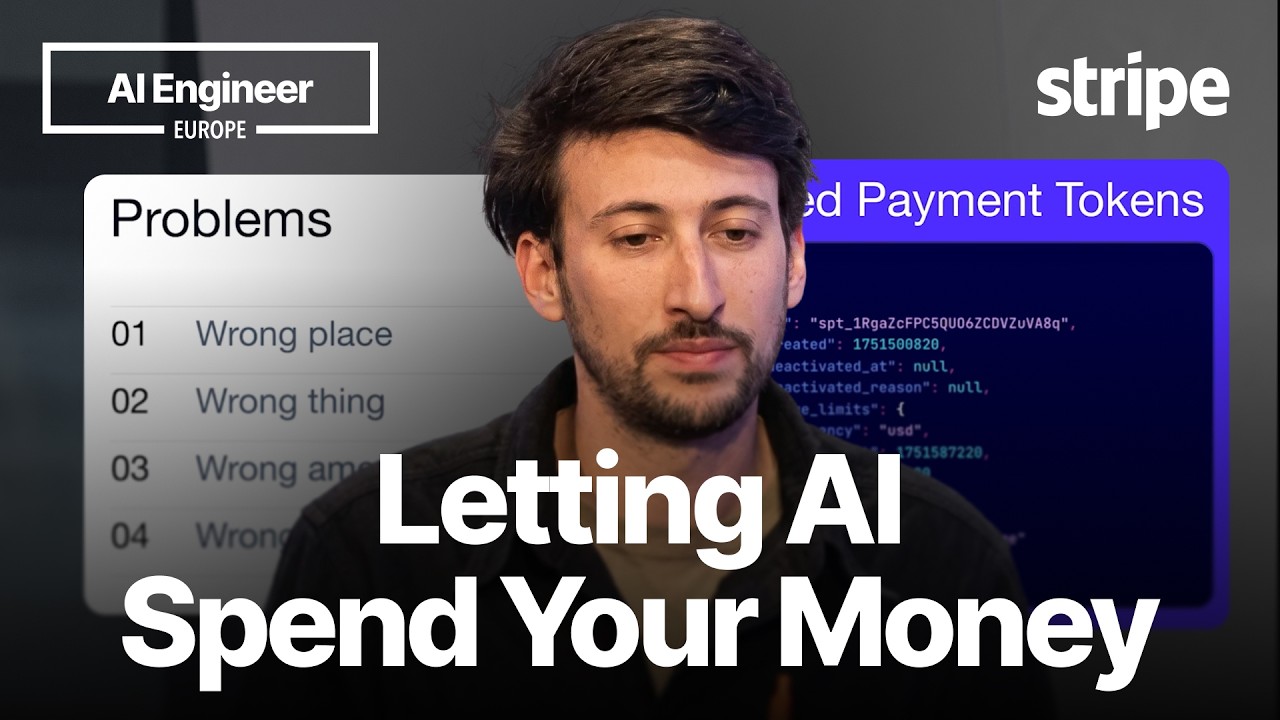
Building safe Payment Infrastructure for the autonomous economy — Steve Kaliski, Stripe
Jun 6, 2026 · 18:46
Steve Kaliski, Principal Software Engineer at Stripe, explains how to build safe payment infrastructure for the autonomous economy, focusing on enabling AI agents to spend money without catastrophic risk. He argues that discovery benefits from non-determinism (e.g., LLMs), but payments and credentials require determinism. Stripe's solutions include shared payment tokens that enforce spend limits per seller, amount, currency, and time; the machine payments protocol with Tempo for paying for API calls via HTTP status codes; and the agent e-commerce protocol with OpenAI for structured checkout flows. Kaliski also demonstrates how Stripe projects wraps these primitives. The goal is to minimize blast radius through verifiable identities, spend policies, and API-driven interactions.

The Missing Primitive for Agent Swarms — Lou Bichard, Ona
May 23, 2026 · 18:37
Lou Bichard, field CTO at Owner, argues that agent swarm infrastructure for coding agents is missing a coordination primitive, while runtimes and orchestration are largely solved. He defines a Software Factory as incrementally removing humans from the SDLC and highlights internal systems from Stripe (Minions) and RAMP (Inspect) as real-world examples. Owner provides VM-level isolation for agent fleets and sub-agent patterns, demonstrated with a demo of process-based and VM-based swarms. Bichard identifies GitHub as a poor coordination layer for hundreds of parallel pull requests and proposes solutions like state machines, durable execution, and a CLI gateway that any local agent can invoke to check progress. He notes context rot and agents skipping steps as key challenges, and announces a public two-week project to build a Software Factory from scratch starting next week.
Powered by PodHood