
Vinoo Ganesh
GuestGuest on AI Engineer.
2 episodes
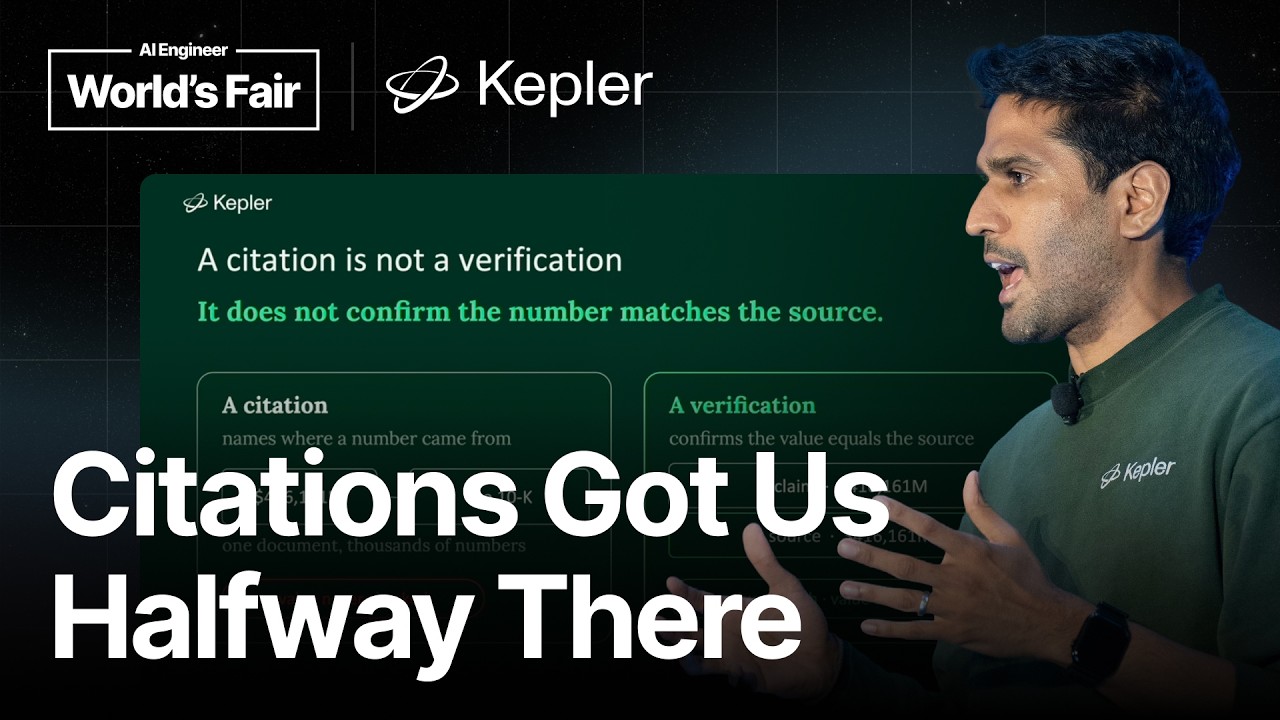
How Kepler Built Verifiable AI for Financial Services — Vinoo Ganesh
Jul 29, 2026 · 22:30
Vinoo Ganesh, CEO of Kepler, argues that AI in financial services must be augmented with a deterministic substrate to produce verifiable work product, because language models are probability machines unreliable for arithmetic. Kepler's three tenets—atomic provenance (every number ties to its source and stripped if unverifiable), scope determinism (model plans but never computes; deterministic tools handle math), and derivation chains (every number's origin replayable)—ensure numerical accuracy. The system treats each extracted number like a pull request, with reconciliation ensuring entities are caught and nothing invented. Ganesh contrasts citations (after-the-fact audit) with verification (deterministic proof), and notes that compliance with regulators like the SEC requires traceable decision-making. Customers are most excited about reclaiming analyst time from tasks like reading earnings transcripts and building financial models, rather than replacing portfolio managers.

How Forward Deployed Engineering is done at Kepler — Vinoo Ganesh
Jul 28, 2026 · 22:20
Vinoo Ganesh, a former Palantir engineer who built the Frontline rotation program, argues that Forward Deployed Engineering is a product strategy, not a go-to-market motion, and shows how Kepler applies this philosophy. He illustrates with stories from Palantir: solving a shipping customer's 47-page requirements with a four-hour Slack alert, building a Parquet viewer after watching a data quality engineer manually spot-check CSVs, and the Groovy script that became a product supporting 100,000 people. Ganesh emphasizes detecting real problems by observing users' actions—any repeated task hints at a missing feature, and pulling out a phone mid-workflow is a bug report you'll never find in documentation. He also explains defining ontology: when different teams call the same entity 'clients,' 'billing,' or 'accounts,' the FDE must canonicalize terms to become the linguistic foundation. The hardest skill is discarding—ship everything as if it will run 18 months, because every hack goes into production. Ganesh concludes that FDEs drive product leverage by solving small problems on-site, then generalizing solutions into the core product.
Powered by PodHood