
Olive Song
GuestGuest on AI Engineer.
3 episodes

Why AI Agents Need Million-Token Context — Thomas Wolf & Olive Song, MiniMax
Sep 4, 2026 · 20:48
MiniMax's M3 pairs a functional one-million-token context window with coding and multimodal abilities in a 400-billion-parameter, 20-billion-activated model, explain Olive Song, RL Lead at MiniMax, and Thomas Wolf, co-founder of Hugging Face. Song says short context fails when agents handle multi-round tool responses; MiniMax Sparse Attention — an index branch selecting what matters plus a sparse branch computing on selected blocks — was designed by an intern. She argues multimodal training from the very first step beats post-hoc adapters that harm text performance and risk collapse; interleaved data and reward modeling solved this. Its apps reach over 300 million people in 200 countries; anyone can propose projects, and community feedback and internal agent harnesses now drive M3.1.
Agents at Scale: Inside MiniMax's Model and the Infrastructure Behind It — Dan Fu and Olive Song
Jul 31, 2026 · 20:14
Olive Song, RL lead at MiniMax, and Dan, Together AI's VP of Kernels, argue that open-weight MiniMax M3 is closing the gap to frontier labs via community feedback and inference optimization. Dan details the day-zero stack: GPU kernels for M3's sparse attention, KV cache at million-token contexts, and adapting to agentic workloads that upload codebases. Song says M3 trains multimodal from scratch to prevent text-vision collapse, and uses RL with environment design and rewards for long-horizon tasks like replicating a 12-hour iClear paper, plus validation/test splits to avoid hacking. Together's Parallel Kernel Bench holds unsolved problems, so overfitting it yields kernels the company deploys. Both see self-evolution and better GPU utilization as why open models keep accelerating.
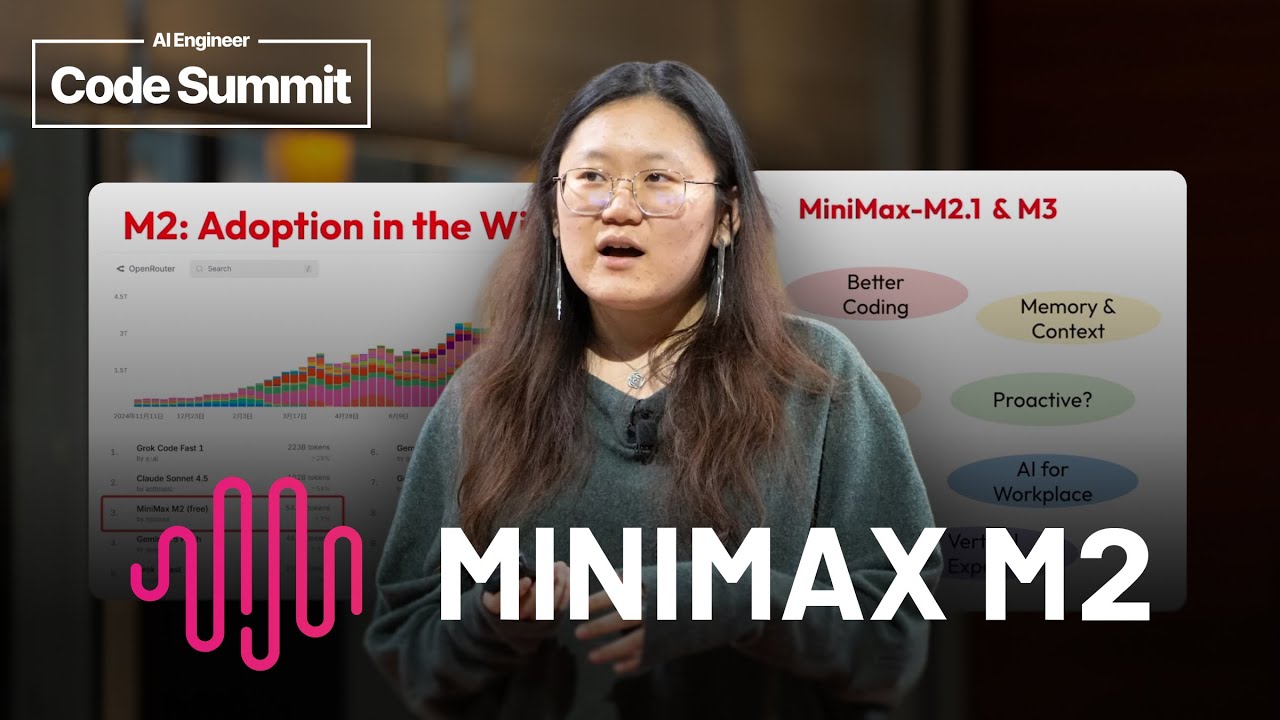
Minimax M2: Building the #1 Open Model – Olive Song, MiniMax
Dec 13, 2025 · 13:41
Olive Song, Senior Researcher at MiniMax, presents the Minimax M2, an open-weight model with 10 billion active parameters that achieves top rankings in intelligence and agentic benchmarks while being cost-efficient for real-world coding tasks. The model's success is attributed to four key characteristics: scaled environments and expert developer feedback for code experience, interleaved thinking with reinforcement learning for long-horizon tasks, perturbation pipelines for robust generalization across agent scaffolds, and small size enabling multi-agent scalability. Song details how these features allow M2 to handle noisy, dynamic environments, perform multi-tool workflows autonomously, and adapt to various scaffolds and prompts. The talk also previews future developments like M2.1 and M3, with plans to integrate audio and video generation capabilities.
Powered by PodHood