
Merve Noyan
GuestGuest on AI Engineer.
2 episodes

Compression at the Edge — NVIDIA, Unsloth, HuggingFace, Ollama
Aug 7, 2026 · 46:01
NVIDIA's Chris Alexiuk, Unsloth's Daniel Han, NVIDIA's Asma Beevi, Hugging Face's Merve Noyan, and Ollama's Parth Sareen argue compression democratizes AI: GLM 5.2 shrinks from 1.5 terabytes to 250 GB, 86% smaller without being 86% dumber. Han says layers are unequal—first/last critical, middle near-useless, and one 'super weight' can make a model 20% dumber—so layer choice is a combinatorial search. Asma details NVFP4, 4-bit floats sharing an FP8 scale per 16 values, targeting under 1% accuracy loss and working out of the box above ~20B parameters. Benchmarks only verify tasks—Han uses KL divergence of BF16 vs quantized logits, Ollama tests quants in real harnesses—and linear-attention models can break heuristics before KV-cache compression pushes models to phones.
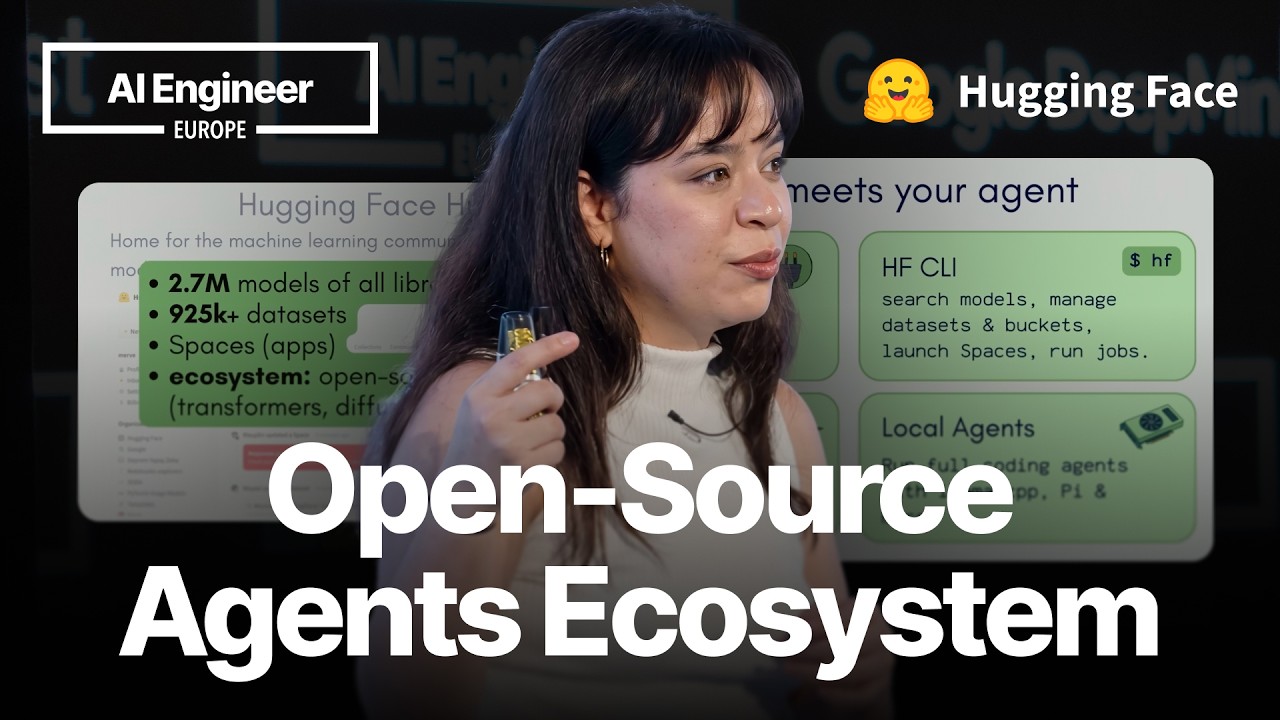
Self-Training Agents: Hermes Agent, HF Traces, Skills, MCP & Finetuning — Merve Noyan, Hugging Face
May 13, 2026 · 19:11
Merve Noyan from Hugging Face argues that open-weight and open-source models have caught up with closed models, citing GLM 5.1 topping the Artificial Analysis Intelligence index. She walks through Hugging Face’s ecosystem for agentic AI: benchmark datasets on the Hub to filter models by SWE-bench or AIME scores; inference providers that route to the cheapest or fastest option per model; a traces repository type for storing and exploring agent sessions; and skills that plug into coding agents (e.g., Claude Code) to fine-tune vision-language models on a dataset by name—calculating VRAM, selecting an instance, and launching the job. She demos an agent-driven fine-tuning of Qwen2-VL on a vision-language dataset, and a case study where an LLM agent orchestrated OCR of 30,000 AI papers using open OCR models and Hugging Face Jobs, eliminating napkin math. The MCP server also enables querying Hub models, datasets, and spaces from agents.
Powered by PodHood