
Denys Linkov
GuestGuest on AI Engineer.
2 episodes

Benchmarking Coding Agents on New vs Legacy Codebases — Denys Linkov, Wisedocs
Aug 8, 2026 · 18:08
Denys Linkov of Wisedocs, whose medical-claims ML pipeline ran across ten legacy repos, argues his team's six-month monorepo refactor was worthwhile even as coding agents improve fast. A refactor task that took o3 three hours and ten major mistakes now takes about one-fifth the time: Sonnet 4.6 needed one extra iteration, Opus 4.8 nearly one-shot it. Yet GPT 5.5 extra high 'completed' the job in 10 minutes 22 seconds, writing 2,000 lines of scaffolding with models missing and admitting no deployment or bootstrap command. So Linkov reads METR's task-length curve at 80-90% success, not 50%; an hour-long agent run at coin-flip odds wastes the hour and your attention. The payoff was social too: commit velocity never flattened, months-long features ship in under a week, and developers now volunteer across the monorepo.
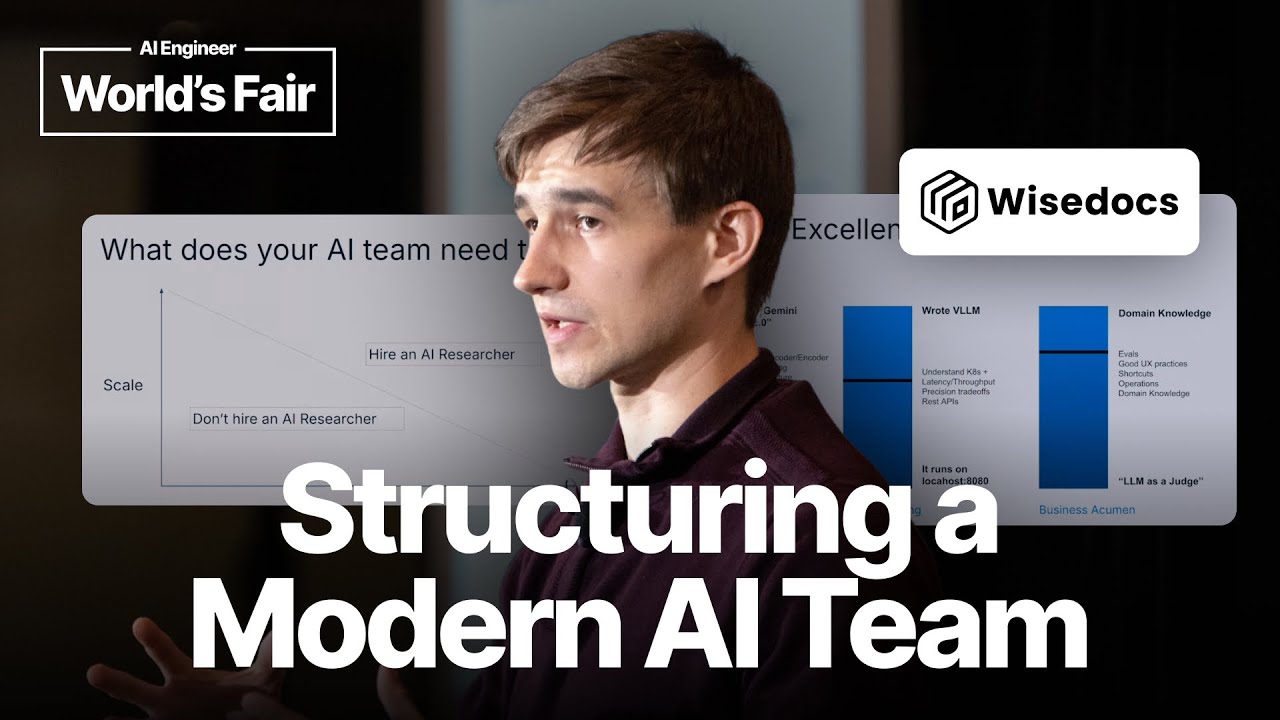
Structuring a modern AI team — Denys Linkov, Wisedocs
Jul 24, 2025 · 17:40
Denys Linkov, who leads ML at Wisedocs, argues that building a modern AI team hinges on identifying your company's bottleneck—shipping features, acquiring users, or scalability—rather than reflexively hiring AI researchers. He introduces Ampere's Wager: trading your entire domain-savvy team for five top-lab researchers is usually a losing bet. For early-stage AI strategy, generalists who blend model training, serving, and business acumen outperform specialists; Linkov lived this in 2021 building a custom MLOps platform for a conversational AI startup and again in 2024 using advanced open-source tools for medical record processing. He stresses reskilling existing teams through weekly learning cadences and moving domain experts from giving feedback to writing evaluations. Hiring should hold context and act on it, verifying trends like 'don't hire juniors' against YC's AI school drawing 2,000 young people.
Powered by PodHood