
Unblocked
CompanyA company discussed on AI Engineer.
4 episodes

Your agents lack context: Here's how to fix "You're absolutely right!" — Brandon Waselnuk, Unblocked
Sep 9, 2026 · 14:09
Brandon Waselnuk of Unblocked argues that AI-generated code should feel like it was written by someone who has been on your team for years, and that the gap is no longer intelligence but context. He traces how bad context compounds as teams move from tab completion to parallel and background agents, producing correction doom loops, wasted search tokens, and a review tax. Two common fixes stall: the curated context trap, where markdown files rot and someone must curate them for everyone, and the MCP plateau, where an agent may never call the server or stops at the first plausible answer due to satisfaction of search bias, missing last night's Slack correction. A context engine must resolve conflicts between an old architecture diagram and a fresh CTO Slack thread, personalize relevance, enforce permissions, and deliver token-optimized context. Running the same prompt with and without context cut tokens from 21 million to 10.8 million and finished about two hours sooner. He closes by demoing three open source tools, including a workshop that builds a relational context engine from scratch.

How to Generate Mergeable Code with a Context Engine — Peter Werry, Unblocked
Aug 27, 2026 · 18:36
Peter Werry of Unblocked argues that access to information does not equal understanding—organizational context is the bottleneck for AI agents. He likens agents to expert engineers resetting knowledge every task, falling prey to radiology's 'satisfaction of search'; million-token windows distract. Werry demos the context engine generating an architecture diagram, then runs the same optimization plan in Claude Code twice: with it, under a dollar and about a minute; without, roughly double the time and more cost, because later steps loop on wrong assumptions. He also shows a review agent boosting comments by seniority, a drop in flagged issues traced to a Slack thread, and open-source tools: a GitHub-history query engine and a social graph showing thin review coverage.

Building Agents Is Trivial Now, Context Is the Next Frontier — Jeff Ng, Unblocked
Aug 21, 2026 · 13:22
Jeff Ng, founding engineer at Unblocked, argues building agents is trivial but missing context makes them confidently wrong. Cloud primitives and frameworks have removed plumbing that six months ago took a team a quarter. In a demo, an agent enriching a Linear ticket recommended re-enabling async dispatch, missing that a support engineer had disabled it after an outage; it lacked the Slack thread and postmortem. Background agents fail silently when no human supplies that context. Ng's context engine connects docs, code, tickets, and conversations, reconciles conflicts, and returns a synthesized understanding scoped to permissions. MCP provides access, not understanding; rerunning the same agent grounded in the engine flips its recommendation from repeating the outage to preventing it.
Stop babysitting your agents... — Brandon Waselnuk, Unblocked
May 26, 2026 · 18:54
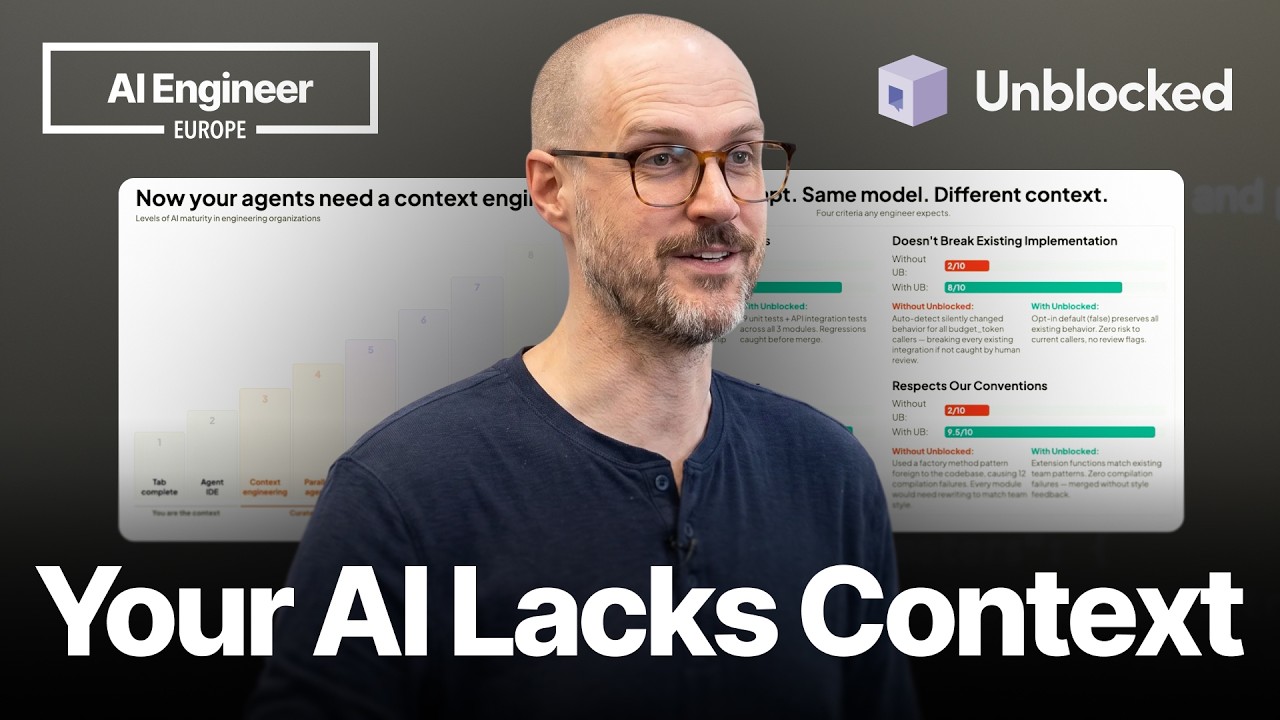
Brandon Waselnuk of Unblocked argues that the bottleneck for AI coding agents is not access (MCPs, tools) but understanding—they need a context engine that builds a research packet from codebase, Slack, PRs, and org structure before generating code. He debunks three myths: naive RAG suffers from satisfaction of search, more MCPs don't provide reasoning, and million-token windows don't enable effective reasoning. His team's context engine reduced a Zendesk integration task from 2.5 hours and 20.9M tokens (with MCPs only, but code that would have broken production) to 25 minutes and 10.8M tokens, earning a senior engineer's approval with one nitpick. Three hard lessons: optimize for understanding not access, resolve conflicts rather than hide them (e.g., Slack thread where CTO says code is wrong), and never cache answers because context changes daily. He demonstrates a social graph tool (open-sourced Monday) that maps engineers to code areas and collaborators, and shows a demo where the agent's MCP calls the context engine to generate a plan covering factory patterns, library modules, and client registration.
Powered by PodHood