
Stripe
CompanyA company discussed on AI Engineer.
20 episodes

Everyone Gets A Software Company — Benjamin Guo, Zo Computer
Sep 3, 2026 · 15:09
Zo Computer cofounder Ben Guo argues people have lost their home on the internet to technofeudalism, paying rent to SaaS, cloud and chip providers like Nvidia while their data sits in silos they don't control. His answer is Zo, a personal cloud server with AI built in, for hosting sites, APIs and agents. He cites non-technical users: Charlotte, a private chef and life coach running her business on Zo, and Anthia, a free diving instructor on track to make $100,000 after canceling Squarespace, Calendly and other SaaS, calling leads at the moment of intent to close deals. A demo shows any-model chat, files, automations and a built-in browser; he closes arguing Claude Tag's intelligence bubbles up to Anthropic — 'intelligence feudalism' — when agents should be owned and self-improve by their publishers.

x402 isn’t good (yet) — Jan Curn, Apify
Sep 1, 2026 · 20:48
Jan Curn, founder and CEO of Apify, argues that x402, Coinbase's HTTP 402-based agentic payments standard, is promising but still has rough edges. Drawing on Apify's launch of 20,000 tools on x402 alongside Coinbase, he explains how the protocol works: a client signs a payment, a facilitator verifies it, and only then does the server settle on-chain. He details the double-spending window between verification and settlement, the conflict between x402's mandatory 402 response and MCP's 401, and why metered billing pushed Apify to charge fixed amounts and refund the remainder. He also explains why crypto, unlike credit cards, suits micropayments and one-way agent transactions where buyers cannot dispute payments.

When AI Agents Pay and Sellers Monetize: Building x402 Apps on AWS — Anil Nadiminti, AWS
Sep 1, 2026 · 20:41
Anil Nadiminti, Senior Solutions Architect at AWS, presents AgentCore Payments — a service that lets AI agents autonomously discover, authorize, and execute payments for premium content over the x402 protocol. He explains how AgentCore handles paywalls through wallet support via Coinbase, with KMS-secured secret storage keeping private keys safe. Bot detection verifies trusted agents while blocking malicious ones, and per-session budgets with spend limits keep settlement instantaneous at internet speed. Real-time traffic analysis and observability throughout the stack ensure payment connectors, MCP5 integration, and web scraping all operate without exposing credentials — no centralization required, no SDK change, and no friction for developers building agentic applications.

Teaching agents to pay — Anna Spysz, Stripe
Sep 1, 2026 · 19:10
Anna Spysz of Stripe walks through how agentic commerce works in a talk based on her own experience building a shopping agent. She demonstrates how agents discover and buy products: reading structured catalog data rather than rendered pages, speaking protocols like UCP, and operating within guardrails like disclosed fees and logged decisions. Using her headphones purchase as the running example, she shows how a merchant capabilities manifest makes a store visible to agents, and how a persona config change can flip an agent from pushy to trustworthy. The episode's core claim is that agentic commerce demands deliberate design from both sides of a transaction, not just a checkout API.

How to avoid disaster when vibe-coding a billing engine — Andrew Garvin, Stripe
Aug 28, 2026 · 17:49
Andrew Garvin, co-founder of Metronome, the usage-billing platform Stripe acquired this year in its largest deal ever, argues that billing engines carry deep business logic, so a coding agent should build a test environment while a human stays in the loop — demonstrated by a Stripe Projects workflow replicating Lovable's pricing model. He demonstrates a billing sandbox that provisions a customer, metered usage, scoped credit pools for builds, plan mode, cloud and gateway calls, and a draft invoice, using portable skills files and verbose errors so the agent can self-correct. He separates agent as product, buyer, and user, pointing to HubSpot's move from seats to credits as one agent does the work of many logins. Stripe's CLI use by coding agents has risen exponentially.

How We Got LLMs to Recommend Our Open Source Library — Christopher Burns, Inth
Aug 26, 2026 · 16:27
Christopher Burns, founder of Inth and creator of the open source consent banner library c15t, explains how he got LLMs to recommend his library: after April 13th, Claude, ChatGPT, Codex, and Gemini became its number one inbound source, with c15t at 3 million NPM downloads and 45% month-on-month growth. He argues no single fix works, so he built LeadType, a framework-neutral docs pipeline that generates agent-facing files from MDX. He recommends hand-writing llms.txt (40 good lines beat 1,000), shipping markdown via .md, content negotiation, or mode=agent, and bundling markdown docs plus AGENTS.md in the npm package since coding agents read node_modules, not websites, saving nearly 50% of tokens. He also covers Web MCP tools and Aura AI's agent-readiness score.
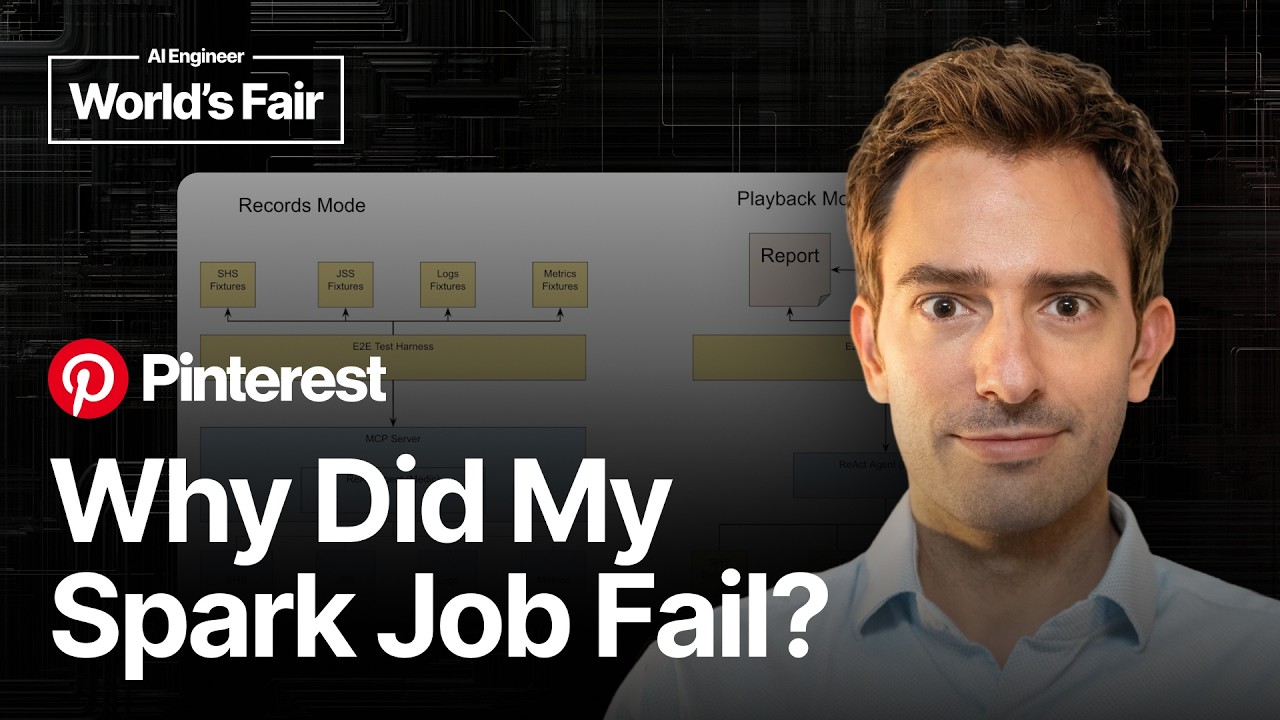
Medic for Apache Spark - First Aid for Failing Jobs - Drasko Profirovic, Pinterest
Jul 20, 2026 · 11:21
Drasko Profirovic, a Staff Engineer at Pinterest, presents Medic for Apache Spark, an agentic diagnostics tool that automatically troubleshoots Spark job failures by ingesting logs, correlating context, and producing human-quality diagnoses and actionable recommendations in minutes. The talk covers the journey from a single React agent with unsustainable prompt tuning to a multi-agent architecture built on LangGraph's deep agent library, where specialized agents handle triage, research, and healing. Key improvements include an exception classifier pipeline that filters benign exceptions from logs, converting raw time-series metrics into annotated graphs for token efficiency, and an end-to-end test harness that snapshots production state for offline evaluations. Profirovic shares lessons on handling ambiguity, reducing hallucinations, and balancing automation with human oversight, plus unexpected failure modes that informed iterations. The system now extends to optimizing Spark SQL…

Building safe Payment Infrastructure for the autonomous economy — Steve Kaliski, Stripe
Jun 6, 2026 · 18:46
Steve Kaliski, Principal Software Engineer at Stripe, explains how to build safe payment infrastructure for the autonomous economy, focusing on enabling AI agents to spend money without catastrophic risk. He argues that discovery benefits from non-determinism (e.g., LLMs), but payments and credentials require determinism. Stripe's solutions include shared payment tokens that enforce spend limits per seller, amount, currency, and time; the machine payments protocol with Tempo for paying for API calls via HTTP status codes; and the agent e-commerce protocol with OpenAI for structured checkout flows. Kaliski also demonstrates how Stripe projects wraps these primitives. The goal is to minimize blast radius through verifiable identities, spend policies, and API-driven interactions.

The Missing Primitive for Agent Swarms — Lou Bichard, Ona
May 23, 2026 · 18:37
Lou Bichard, field CTO at Owner, argues that agent swarm infrastructure for coding agents is missing a coordination primitive, while runtimes and orchestration are largely solved. He defines a Software Factory as incrementally removing humans from the SDLC and highlights internal systems from Stripe (Minions) and RAMP (Inspect) as real-world examples. Owner provides VM-level isolation for agent fleets and sub-agent patterns, demonstrated with a demo of process-based and VM-based swarms. Bichard identifies GitHub as a poor coordination layer for hundreds of parallel pull requests and proposes solutions like state machines, durable execution, and a CLI gateway that any local agent can invoke to check progress. He notes context rot and agents skipping steps as key challenges, and announces a public two-week project to build a Software Factory from scratch starting next week.

Mastering AI Pricing — Mayank Pant, Stripe
May 1, 2026 · 24:19
Mayank Pant from Stripe explains that AI companies, growing 3x faster than traditional SaaS, face margin risk from power users and unpredictable compute costs, making hybrid pricing (base fee + usage fee) essential—56% of AI leaders now use it. He presents a five-step framework: define customer-perceived value (e.g., automation, augmentation, enhanced service, improved results), choose a charge metric (consumption, workflow, or outcome-based), adopt hybrid pricing with guardrails like usage caps and automated notifications, and iterate pricing frequently—84% agree fast adaptation is a competitive advantage. Pant illustrates with examples: Gamma charges per deck (not API calls), Intercom prices per resolved ticket. To keep customer-facing prices stable while changing features, he advises abstracting value with credits (e.g., 100 credits/month) that can be internally revalued. Stripe's billing infrastructure supports this iteration, with 78% of AI companies building on Stripe using its subscription, usage, and hybrid billing, plus Metronome for enterprise contracts.

#define AI Engineer - Greg Brockman, OpenAI (ft. Jensen Huang)
Aug 10, 2025 · 41:05
Greg Brockman, co-founder and president of OpenAI, discusses his journey from Stripe's first CTO (growing from 40 to 250 people) to leading AI development, sharing insights on independent study (completing three years of high school math in one year), the engineering-research partnership at OpenAI (emphasizing technical humility), and scaling challenges like ChatGPT hitting 1 million users in five days and ImageGen reaching 100 million in five days. He explains how Codex transforms coding (low double-digit percent of internal PRs written by Codex, 24,000 PRs merged in public GitHub in one day) and introduces "vibe coding" as an empowerment mechanism. In response to Jensen Huang's questions, Brockman predicts a future with diverse AI infrastructure (homogeneous accelerators as default, purpose-built for specific workloads) and a menagerie of domain-specific agents leveraging distillation, driving 10x more economic activity. He identifies basic research as a renewed scaling bottleneck alongside compute, data, algorithms, power, and money.

Shipping something to someone always wins — Kenneth Auchenberg (ex. Stripe, VSCode)
Jul 28, 2025 · 16:17
Kenneth Auchenberg, former VSCode and Stripe developer platform lead, argues that great AI products come from rapid iterative loops — shipping continuously viable 'skateboards' to real users rather than aiming for a perfect final product. He advocates for writing launch blog posts before building, working intimately with a few real customers (even texting them), and ignoring constraints like legal initially to design the best product. APIs are harder to change than UI, so early user feedback is critical. In AI, the fundamentals haven't changed: customer knowledge and iteration velocity matter more than ever, even as AI tools accelerate building. The goal should be to run a product feedback loop in under a day.

AX is the only Experience that Matters - Ivan Burazin, Daytona
Jul 24, 2025 · 15:25
Ivan Burazin, co-founder of Daytona, argues that agent experience (AX) is the only experience that matters, as AI agents will soon outnumber human developers and tools must be built for agents to autonomously operate. He cites that 25% of YC startups say AI writes 95% of their code and 37% of the latest YC batch build agents as products. Burazin outlines three AX pillars—seamless authentication, agent-readable docs (like Stripe's .md and LLMs.txt), and API-first design—then introduces Daytona's agent-native runtime, which spins up sandboxes in 27 milliseconds and includes features like a declarative image builder, network-mounted volumes for large datasets, and parallel execution for agents to fork environments. He concludes that any tool requiring a human in the loop is built for the past, and if agents cannot use a product, no one will.
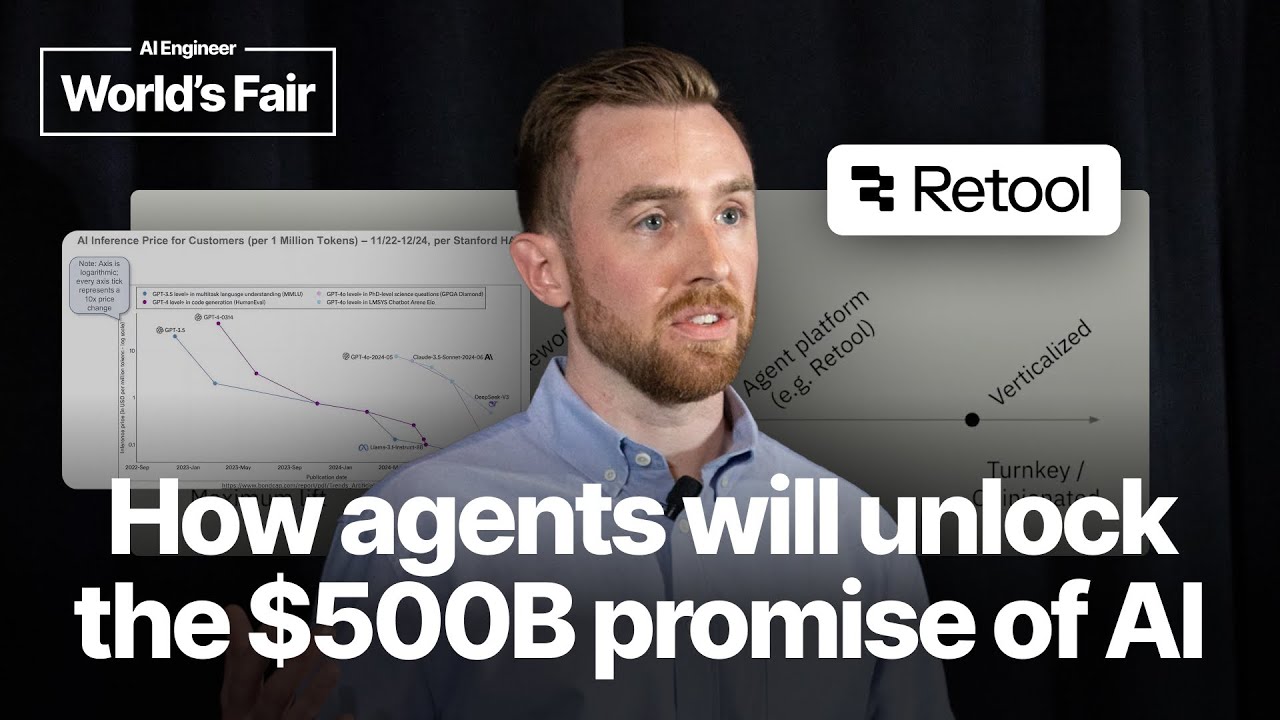
How agents will unlock the $500B promise of AI - Donald Hruska, Retool
Jul 23, 2025 · 16:22
Donald Hruska, engineering lead for Retool's Agents product, argues that AI agents will unlock the $500B promise of AI by moving enterprises beyond toy chatbots into production-grade systems. He explains that building a basic agent is easy (e.g., 100 lines of code using React) but getting it into production requires solving security, cost overruns, observability, and compliance. Hruska outlines four options—build from scratch, use a framework like LangGraph, a managed platform like Retool Agents, or verticalized agents—and advises building for core differentiators and buying for commodity workflows. He cites Retool customers like ClickUp saving over $200,000 in vendor costs and Descript saving hundreds of hours weekly, while noting inference costs dropped 99.7% from 2022-2024. Retool charges $3 per hour for its cheapest agent and supports on-prem deployment.

Machines of Buying and Selling Grace - Adam Behrens, New Generation
Jul 23, 2025 · 19:37
Adam Behrens, CEO of New Gen, argues that AI will transform commerce from static websites to agentic interactions where buyer and seller agents negotiate via intent infrastructure. He traces the evolution from clerk-assisted stores to e-commerce, now to AI-natives where ChatGPT and Claude act as shopping interfaces. Behrens details three challenges: payment delegation (solved via Viza's delegated authentication), product discovery (a unified API akin to Plaid for merchants), and preference representation (two-sided, dynamic, with market-design solutions). He cites Samsung's adoption of an MCP server for chat clients and notes that AI-sourced users convert at higher rates. Behrens predicts revenue sharing via affiliate models and that agents may bypass credit cards for stablecoins, while merchants retain control by embedding transportable data into model providers' surfaces.

Building Agents (the hard parts!) - Rita Kozlov, Cloudflare
Jul 23, 2025 · 21:12
Rita Kozlov, VP of Product for Cloudflare's developer platform, presents the building blocks of AI agents—client, AI reasoning, workflows, and tools—arguing that effective agents require all four components. She highlights the Model Context Protocol (MCP) as a standard for exposing APIs to LLMs, and demonstrates Cloudflare's Agents SDK, which simplifies hosting remote MCP servers with built-in OAuth, state management via durable objects, and real-time WebSocket communication. Kozlov cites real-world impact: companies using agents for sales automation see 20% revenue increases, 90% faster support response times, and 50–75% time savings. She walks through a human-in-the-loop credit card approval workflow built with Nok, showing how durable objects maintain long-running state, prevent duplicate actions, and route approvals across Slack, email, or in-app notifications. The talk emphasizes that once an MCP server is deployed, it can be used directly from Cursor, Claude, ChatGPT, or a custom client, including voice interfaces via WebRTC-to-WebSocket translation.

The rise of the agentic economy on the shoulders of MCP — Jan Curn, Apify
Jul 18, 2025 · 18:08
Jan Curn, founder of Apify, argues that MCP (Model Context Protocol) enables a future agentic economy where AI agents autonomously discover and purchase tools from other agents or businesses (B2A/A2A). He explains that Apify's marketplace of 5,000 Actors (Docker-based tools) now integrates with MCP, allowing agents to dynamically discover and call any Actor via tool discovery — a key MCP feature. Curn demonstrates this with Claude Desktop, where an agent uses Apify's MCP server to find a venue, scrape Twitter, and even fill a form via a nested MCP server from Browserbase, all without prior configuration. He notes that Apify pays creators over $250,000 monthly, with total Actor revenue exceeding $1.5M/month, and that any developer can publish an Actor to monetize their tools instantly across the ecosystem. The talk closes with open questions about reliability, trust, and whether autonomous agent interaction can lead to AGI.

Recsys Keynote: Improving Recommendation Systems & Search in the Age of LLMs - Eugene Yan, Amazon
Jul 16, 2025 · 20:54
Eugene Yan's keynote presents three innovations for recommendation systems: Semantic IDs, LLM-augmented data, and unified models. Kuaishou’s trainable multimodal Semantic IDs increased cold-start coverage by 3.6% and velocity by 3.5% by clustering content embeddings. Indeed used GPT-4 fine-tuning and distillation to filter bad job recommendations, reducing bad recs by 20% while boosting application rate 4% and cutting unsubscribes 5%. Spotify’s LLM-generated exploratory search queries drove a 9% increase in exploratory queries for new categories like podcasts. Netflix’s Unicorn unified ranker matched or exceeded specialized models across search and recommendations, while Etsy’s unified embeddings with a quality vector achieved a 2.6% sitewide conversion lift and 5% more search purchases.

From PM at Stripe to Building an AI startup, a recent founder's journey - Mounir Mouawad
Jun 3, 2025 · 11:59
Mounir Mouawad, CEO and co-founder of Porsche AI, explains how building an AI startup differs from product roles at Stripe, Google, and Amazon, using video game analogies. He argues user problems are an 'emergent property' requiring hypothesis-driven iteration rather than conventional roadmaps. Product development is gratifying with releases in hours or days, but velocity is a 'stable stick' as opportunities like MCP come and go quickly. The hardest part is outreach without big brand support—like playing Crash Bandicoot without boosters—so he finds people followers, advocates, and partnerships (e.g., with Browserbase) essential. He asks listeners to star Porsche AI's GitHub repo.

Building Agents with Model Context Protocol - Full Workshop with Mahesh Murag of Anthropic
Mar 1, 2025 · 1:44:12
Mahesh Murag of Anthropic presents the Model Context Protocol (MCP) as an open standard that replaces fragmented integrations with a single protocol for connecting AI systems to data sources, enabling context-rich AI applications and agentic experiences. He explains MCP's philosophy, inspired by APIs and LSP, and its three interfaces: tools (model-controlled), resources (application-controlled), and prompts (user-controlled). Murag highlights adoption with over 1,100 community-built servers and official integrations from companies like Cloudflare and Stripe. He demonstrates building agents with MCP using the MCP-Agent framework, showing how agents can use tools dynamically and composably across hierarchical systems. Future plans include remote server support with OAuth 2.0, a centralized registry for discovery and verification, and enabling agents to self-evolve by dynamically finding new capabilities via registry search.
Powered by PodHood