
Scale AI
CompanyA company discussed on AI Engineer.
3 episodes
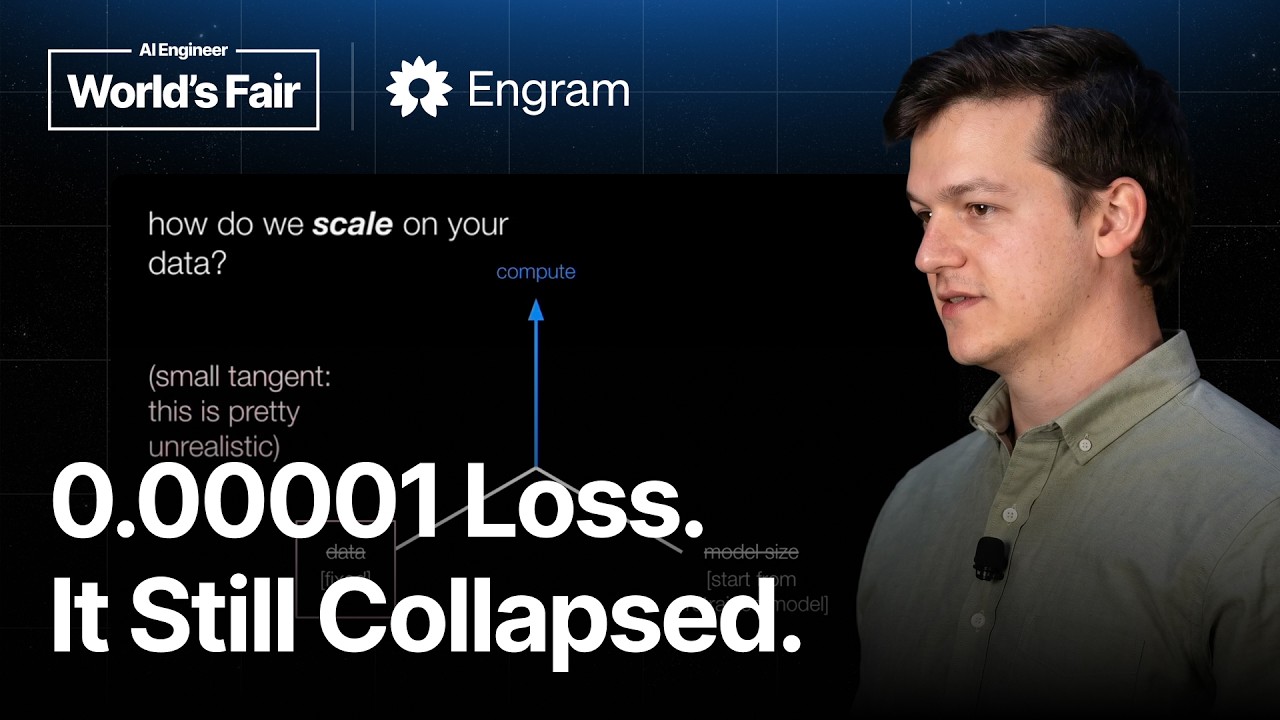
Scaling Compute on Context — Jack Morris, Engram
Aug 12, 2026 · 19:42
Jack Morris of Engram frames scaling compute on context as the pursuit of depth in AI, contrasting it with the breadth of public-data pre-training. He argues models trained on public data know nothing about your emails, meetings, or company, and that with a fixed private corpus, compute is the only scalable axis. He critiques naive fine-tuning (loss 0.00001 on 10K financial reports then collapse), KV compaction, on-policy distillation, and synthetic continued pretraining, noting each hits a synthetic data wall. The goal is self-improvement like AlphaGo, where better models generate harder training questions, enabling indefinite compute scaling on your context.

State of Data — Sean Cai, Independent / State of Data
Jul 26, 2026 · 18:22
Sean Cai argues data markets, not compute, are now the binding constraint for turning generalist AI into expert systems, with the supply chain unbundling from vertical giants into specialist vendors. He distinguishes Type I (real workflow capture) from contrived Type II data, noting the industry sells Type II as Type I. He introduces Verifier's Law—ease of training proportional to task verifiability—to predict domain maturity: code first, then biology, security, finance. He exposes benchmark psychosis: a single number under one scaffold is a noisy sample, requiring cross-harness differencing. Labs like Anthropic's data spending forecasts product launches (e.g., cybersecurity data in January led to Claude Cyber in March). Data companies like Mercor pivot to enterprise, and Cai builds Antikythera mechanisms to monetize real-world workflows and provide RL-as-a-service.

Training an LLM from Scratch, Locally — Angelos Perivolaropoulos, ElevenLabs
May 4, 2026 · 1:21:26
Angelos Perivolaropoulos from ElevenLabs walks through building a small GPT-2-like LLM from scratch on a local machine, demonstrating that the core techniques used by major labs are accessible in a few hundred lines of PyTorch code. The workshop uses character-level tokenization (65 tokens) on a Shakespeare dataset to enable fast training with limited compute. The model architecture includes multi-head self-attention, MLP layers, residual connections, and layer normalization, totaling 10 million parameters across six transformer blocks with a 256-token context window. The training loop employs next-token prediction with a warm-up cosine decay learning rate schedule and validation loss to detect overfitting. Inference uses temperature sampling (default 0.7) and top-k sampling to improve creativity. Perivolaropoulos explains that audio and multimodal models share the same transformer foundation but differ in tokenization (e.g., mel-spectrograms for audio) and use specialized losses like L2 or KL divergence, while reasoning models result from post-training base models with high-quality chain-of-thought data.
Powered by PodHood