
PostHog
CompanyA company discussed on AI Engineer.
3 episodes
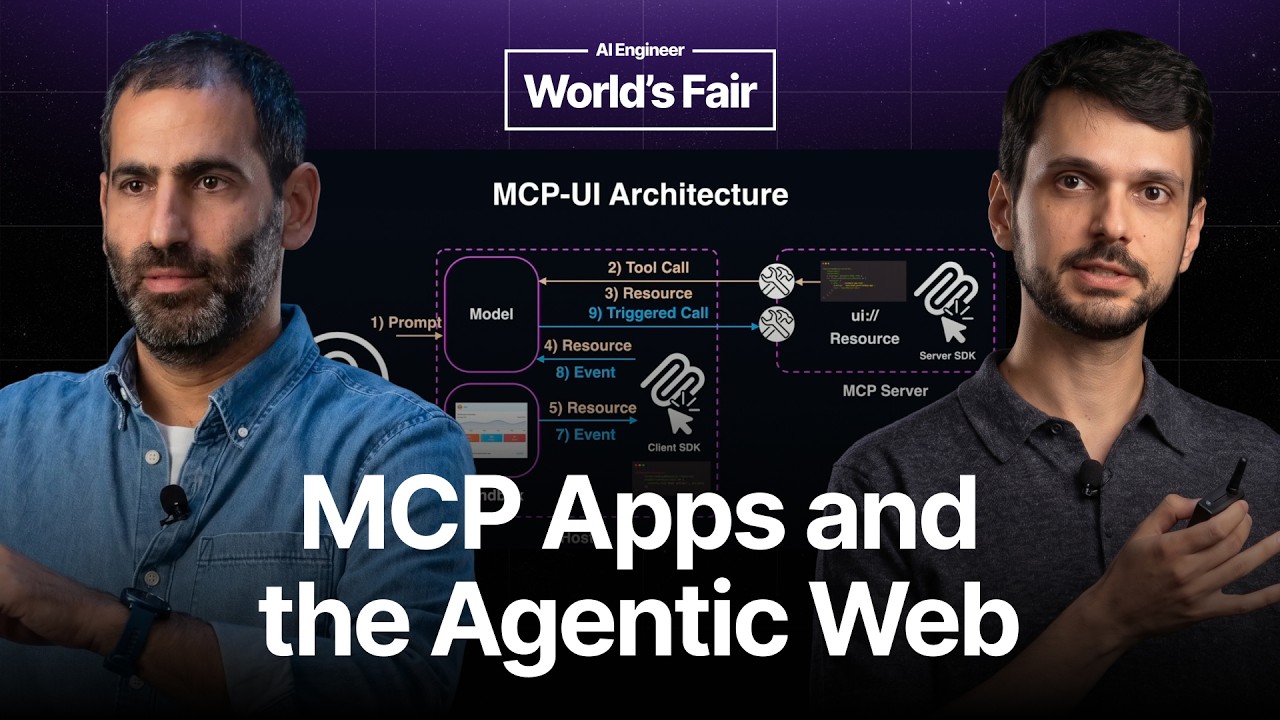
MCP Apps: Extending the Frontier — Ido Salomon & Liad Yosef
Aug 2, 2026 · 18:38
Ido Salomon and Liad Yosef, creators of MCP UI and co-creators of the MCP Apps spec, explain how MCP Apps lets servers ship interactive branded UI instead of text into any supporting host. The official MCP extension, built with Anthropic and OpenAI and supported by Claude, VS Code, ChatGPT, Copilot, Cursor and Slack, links a tool call to a resource; the host renders returned HTML as a sandboxed web component and clicks flow back through a callback to the model. Early adopters include 11 Labs, Shopify and Postman; the payoff is distribution: with ChatGPT at 800 million weekly users, you write once and run everywhere. The spec is still evolving, with an open working group meeting every three weeks and live work on reusable views, AppTools/ViewTools for host-to-app control, and interoperability with generative UI standards like A2UI.

Self Driving Products: Product Signals to Pull Requests — Joshua Snyder, PostHog
Jun 10, 2026 · 15:39
Joshua Snyder of PostHog explains how they're building a pipeline that turns product signals—errors, Slack messages, session replays—into automated pull requests. He reveals that off-the-shelf embedding models cluster signals by structural similarity, so they embed LLM-generated queries instead. He argues specificity determines whether the agent produces a useful PR, with error tracking being immediately actionable while Slack and replay usually are not. He advises starting with costly agents to discover patterns, then collapsing expensive steps into one-shot calls.

LLM codegen fails and how to stop 'em — Danilo Campos, PostHog
Apr 30, 2026 · 19:18
Danilo Campos, who builds the PostHog wizard, explains how to make LLM code generation reliable by sharing practical strategies from a system that helps 15,000 users per month. He identifies 'Model ROT'—models becoming stale—and counters it by shoving fresh Markdown documentation into context. To avoid weird architecture, he maintains 'model airplanes': thin, auth-shaped simulacra that provide correct integration patterns. He limits improvisation by breadcrumbing the agent step by step, starting with detecting business-value files before even mentioning PostHog. Campos stresses that human errors (contradictory instructions, missing tools) are the biggest threat, solved by asking the agent after each run what could be improved. He also details locking down tool usage to prevent shenanigans like reading .env files, replacing that with a limited key-check and write tool. The core shift: code is a depreciating asset, so 90% of the wizard's value is now in Markdown files and prose, which improve with better models.
Powered by PodHood