
Palantir
CompanyA company discussed on AI Engineer.
8 episodes
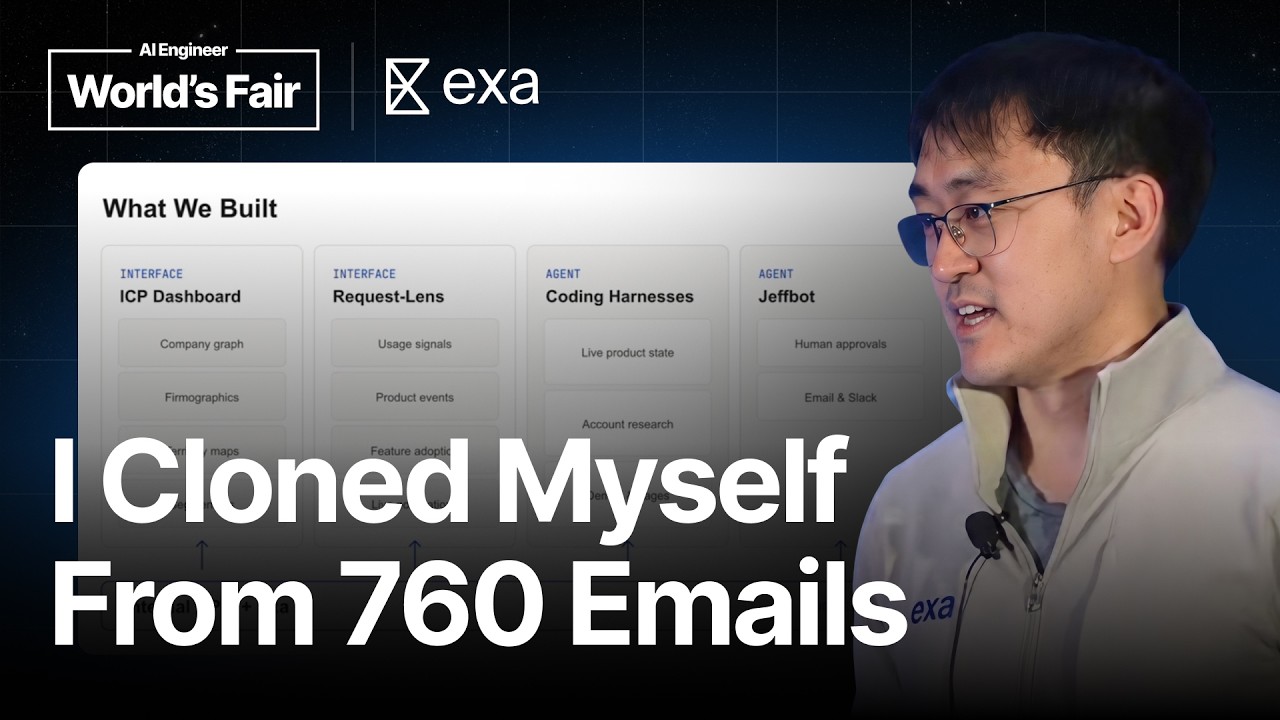
Knowledge Systems: The New GTM Stack — Jeffrey Wang, Exa
Aug 26, 2026 · 18:49
Jeffrey Wang, cofounder of Exa, argues go-to-market is an AI engineering problem and details Exa's stack: an ICP dashboard classifying nearly every company in its addressable market with anticipated spend, and Request Lens alerting on meaningful customer events. The team runs about a dozen Slack agents plus Jeffbot, an AI clone of Wang trained on 760 emails—he averages 18 words and signs 'best' not 'sincerely'—and limited to drafts when others use it. He closes on three principles: agent-first means API-first, not everything should be a chatbot, and buy-versus-build is false—Salesforce exposed as MCP is arbitrarily customizable. He also notes an eight- or nine-person FDE org runs deals and builds the sales systems.
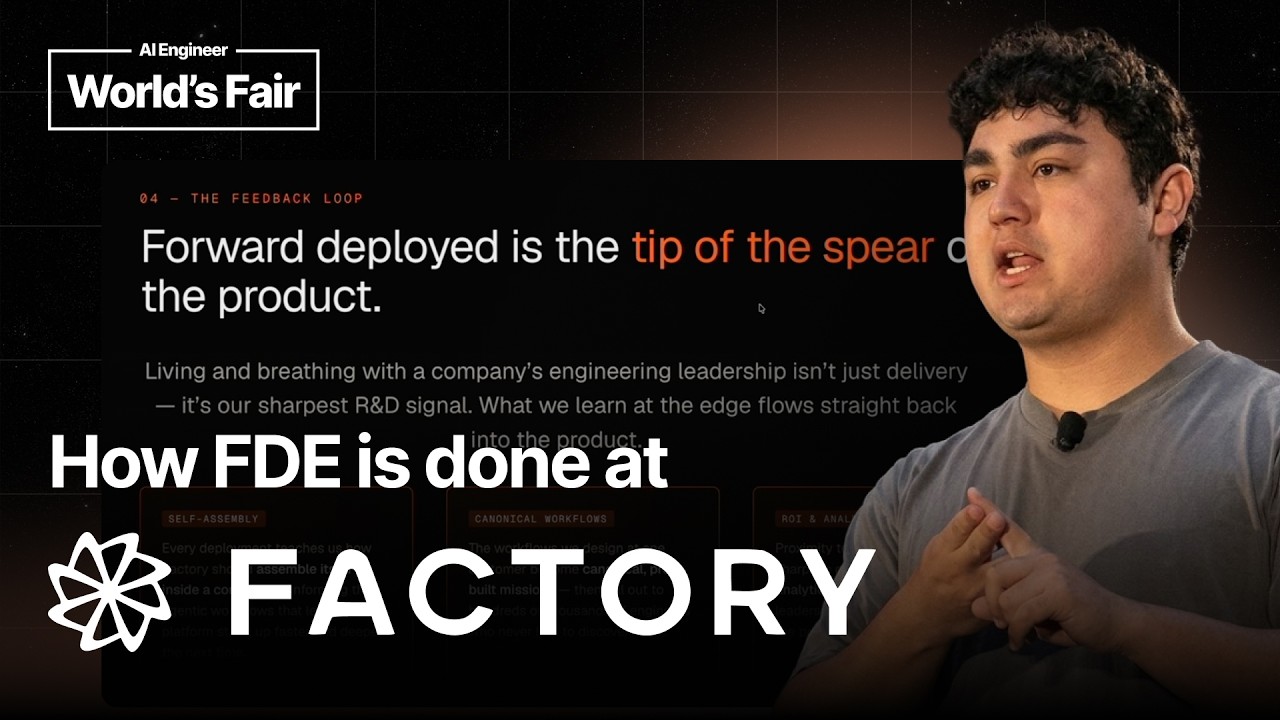
How Forward Deployed Engineering is done at Factory — Eno Reyes
Jul 28, 2026 · 21:21
Factory's forward deployed engineers serve as the tip of the spear, embedding with customers to build software factories where signals flow through validation stages and ship outcomes autonomously. Co-founder and CTO Eno Reyes stresses a model-independent harness the customer owns, enabling air-gapped operation in finance, healthcare, or government. The autonomy maturity model scores codebases on agent readiness: linters, type checkers, and verifiable tasks let agents work longer without humans—enabling migrations of 30–50 million line codebases at banks. Reyes uses Disney's Epcot analogy to warn: build achievable future cities, not theme parks, or adoption stalls. Factory runs with an autonomy ratio in the upper 80%; legal Droid is fully autonomous, and the role demands business judgment, systems thinking, and communication skills as much as engineering.

The Dirty Secret of Forward Deployed Engineering — Natalie Meurer, Sierra
Jul 28, 2026 · 16:49
Natalie Meurer argues that forward deployed engineering (FDE) has become a meaningless label because it has stretched from DevOps at Palantir in 2008 to data integration, ontology work in Slate and Foundry, solution architecture, and enablement—but its durable core is customer accountability and outcome-based pricing. Tracing FDE's history at Palantir, she shows how the role evolved from keeping the platform stable (2008) to data integration (2012), custom dashboarding in Slate (2016), and finally customer enablement in Foundry (2020). As coding agents make software cheap, she contends the lasting value lies in integrating data, understanding customers, and owning outcomes. Pricing tells the story: seat-based assumes a tool, while usage or outcome pricing puts the provider on the hook—exactly what FDEs have always done. She concludes agent engineering is FDE reborn, and that product, infra, and AI engineering are all trending toward the same customer-accountable model.

How Forward Deployed Engineering is done at Kepler — Vinoo Ganesh
Jul 28, 2026 · 22:20
Vinoo Ganesh, a former Palantir engineer who built the Frontline rotation program, argues that Forward Deployed Engineering is a product strategy, not a go-to-market motion, and shows how Kepler applies this philosophy. He illustrates with stories from Palantir: solving a shipping customer's 47-page requirements with a four-hour Slack alert, building a Parquet viewer after watching a data quality engineer manually spot-check CSVs, and the Groovy script that became a product supporting 100,000 people. Ganesh emphasizes detecting real problems by observing users' actions—any repeated task hints at a missing feature, and pulling out a phone mid-workflow is a bug report you'll never find in documentation. He also explains defining ontology: when different teams call the same entity 'clients,' 'billing,' or 'accounts,' the FDE must canonicalize terms to become the linguistic foundation. The hardest skill is discarding—ship everything as if it will run 18 months, because every hack goes into production. Ganesh concludes that FDEs drive product leverage by solving small problems on-site, then generalizing solutions into the core product.

Forward Deployed Engineering 101 — Kevin Bai, Anthropic, ex Palantir & Rippling Founding FDE
Jul 28, 2026 · 17:48
Kevin Bai of Anthropic, formerly at Palantir and Rippling, argues that Forward Deployed Engineering (FDE) is the go-to-market motion for selling highly technical platforms to non-technical buyers, as Palantir did with its Foundry platform. The key is not building bespoke solutions from scratch but assembling outcomes on a reusable platform of shared primitives; otherwise it becomes a dev shop. FDE targets a specific quadrant: complex product + non-technical buyer, exemplified by Palantir's $4M average contract value vs. ServiceNow's $1.2M and Workday's $600K. Two questions determine need: is your product complex enough to require hand-holding, and do you have engineers who can carry that? AI has made building easy and nearly everything agentic, pushing FDE toward the center of software sales.

Forward Deployed Engineering at Cursor — Pauline Brunet
Jul 14, 2026 · 20:47
Pauline Brunet, VP of Forward Deployed Engineering at Cursor, explains how to build an effective FDE team by mapping customer digital maturity and product customization to the right engagement model—self-service, traditional SaaS deployment, advisory, or embedded transformation. She defines the ideal FDE as a highly technical engineer with strong customer-facing skills, capable of scoping impactful projects, co-developing with customer teams, and feeding insights back to product. Cursor’s FDE team uses a project-based approach, hires experienced unicorns (5+ year software engineers), and structures around geographies, industries, and product SMEs. Best practices include solving the right problem, defining success metrics upfront, keeping scope directional, involving customers at every step, measuring ROI (revenue, cost, risk), and leaving documentation behind. Brunet advises learning fast, pivoting, partnering with system integrators, and not being afraid to say no to mismatched use cases.
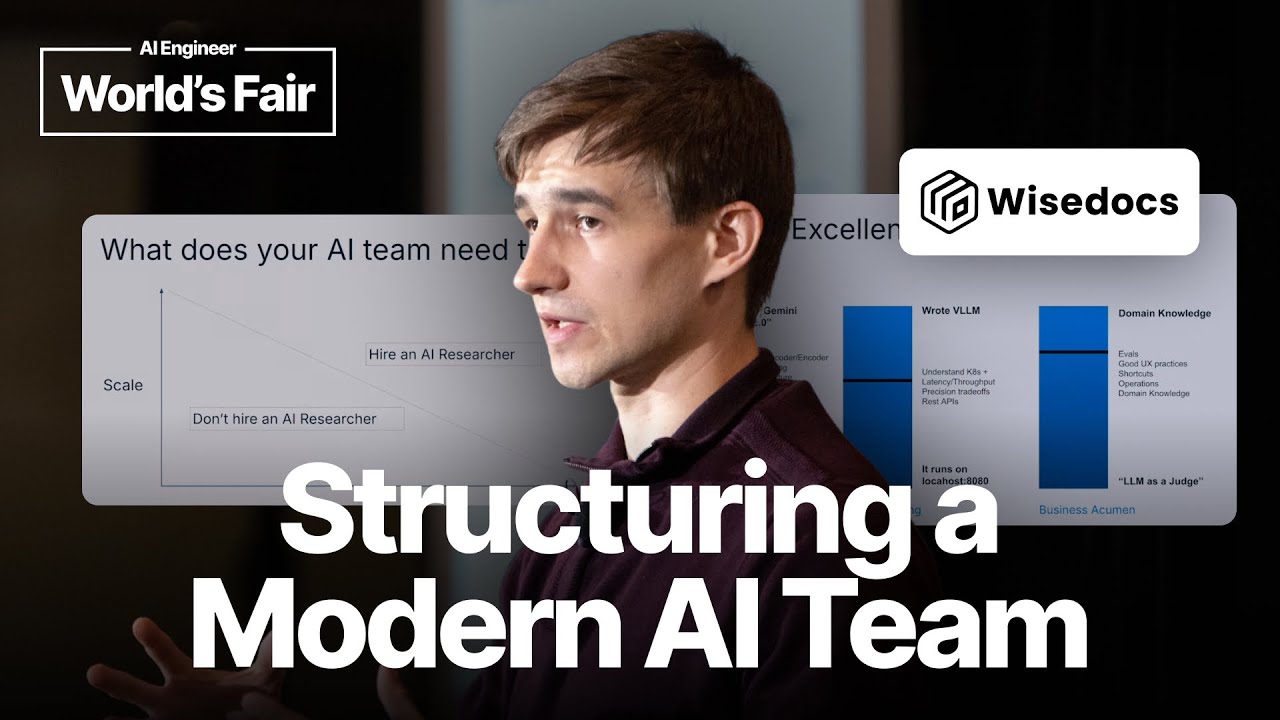
Structuring a modern AI team — Denys Linkov, Wisedocs
Jul 24, 2025 · 17:40
Denys Linkov, who leads ML at Wisedocs, argues that building a modern AI team hinges on identifying your company's bottleneck—shipping features, acquiring users, or scalability—rather than reflexively hiring AI researchers. He introduces Ampere's Wager: trading your entire domain-savvy team for five top-lab researchers is usually a losing bet. For early-stage AI strategy, generalists who blend model training, serving, and business acumen outperform specialists; Linkov lived this in 2021 building a custom MLOps platform for a conversational AI startup and again in 2024 using advanced open-source tools for medical record processing. He stresses reskilling existing teams through weekly learning cadences and moving domain experts from giving feedback to writing evaluations. Hiring should hold context and act on it, verifying trends like 'don't hire juniors' against YC's AI school drawing 2,000 young people.

The New Lean Startup — Sid Bendre, Oleve
Jul 1, 2025 · 13:26
Sid Bendre, co-founder of Oleve, explains how his tiny team of four scaled a profitable, multi-product portfolio to $6M ARR by embracing a 'new lean startup' philosophy centered on AI tooling, operating principles, and organizational structure. Oleve's two products hit the top 10 in the App Store Education charts, competing with Duolingo and Photomath, with one reaching #4 in 2024 and #5 in 2025. Bendre details three pillars: operating principles like hiring only 10x generists, a profit-first mentality, and continuous process refinement; organizational structure modeled after Palantir's Harvester-Cultivator split, where Harvesters own product metrics and Cultivators build an agentic operating system; and AI tooling augmentation that turns 10x engineers into 100x. He shares how they repurpose tools like LaunchDarkly for load balancing and on-the-fly infrastructure changes, and invest in blueprints—reusable code templates and shared infrastructure—that enabled a third product to launch in three weeks and become profitable immediately. The episode culminates in Oleve's vision of one-person billion-dollar companies, where a single strategic leader commands clusters of autonomous…
Powered by PodHood