
Linux Foundation
CompanyA company discussed on AI Engineer.
4 episodes

ACP: The Universal Remote Control for AI Agents — Alex Hancock, Block
Sep 9, 2026 · 11:01
Alex Hancock, a Block engineer who works on the Goose harness and the MCP Rust SDK, argues agentic AI has a standard for agents reaching outward (MCP) but none for clients telling harnesses what to do — in the worst case one client per harness, like needing a different browser per website. His answer is ACP, the agent client protocol from Zed and JetBrains: JSON-RPC-based, carrying sessions, user messages, tool calls, and permission requests, and extensible via underscore-prefixed custom methods so shared patterns can move onto a standards track. He demos Zed and a Poolside terminal client driving the same Goose agent, plus a new HTTP and websocket remote transport. With remote transports for protocol, MCP, and models, all four pieces of the stack become independently placeable.

When AI Agents Pay and Sellers Monetize: Building x402 Apps on AWS — Anil Nadiminti, AWS
Sep 1, 2026 · 20:41
Anil Nadiminti, Senior Solutions Architect at AWS, presents AgentCore Payments — a service that lets AI agents autonomously discover, authorize, and execute payments for premium content over the x402 protocol. He explains how AgentCore handles paywalls through wallet support via Coinbase, with KMS-secured secret storage keeping private keys safe. Bot detection verifies trusted agents while blocking malicious ones, and per-session budgets with spend limits keep settlement instantaneous at internet speed. Real-time traffic analysis and observability throughout the stack ensure payment connectors, MCP5 integration, and web scraping all operate without exposing credentials — no centralization required, no SDK change, and no friction for developers building agentic applications.

Structuring the Unstructured - Cedric Clyburn, Red Hat
Jun 28, 2026 · 20:41
Cedric Clyburn (Red Hat) demonstrates how Docling, an open-source tool from the Linux Foundation, converts unstructured documents like PDFs, tables, and images into structured formats (Markdown/JSON) for AI workflows. He shows that naive PDF parsers lose table structure and image content, while proprietary VLMs are expensive and non-deterministic. Docling uses OCR and layout analysis to preserve context, achieving 50x cost savings compared to VLMs on CPU. The demo covers extracting tables and images from an 8-page PDF, using a local Granite vision model for image annotation, and implementing chunkless RAG where an LLM queries a Docling document outline directly. Scaling is addressed via Docling Serve (REST API) and Docling MCP server for agentic document processing with tools like Claude Code.
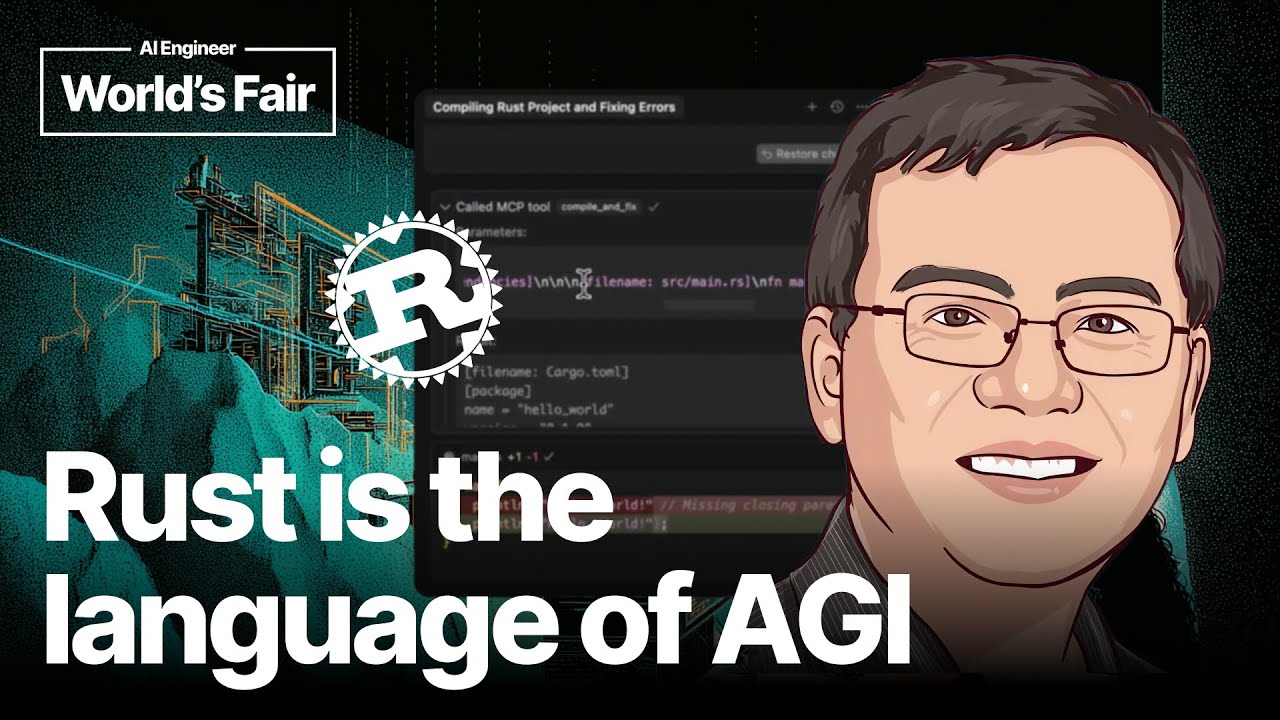
Rust is the language of the AGI - Michael Yuan
Jun 3, 2025 · 29:14
Michael Yuan argues that Rust, with its strong type system and compiler feedback, is the ideal language for AI code generation, unlike human-friendly Python or JavaScript. He presents Rust Coder, an open-source project supported by two Linux Foundation Mentorship grants, which uses MCP tools to generate, compile, and fix Rust projects. The system integrates a coding LLM (e.g., Qwen Coder) with a self-improving knowledge base of compiler errors, enabling it to generate correct code and automatically fix bugs. Yuan demonstrates its use in a Rust camp of 1000+ students and envisions future AI agents generating and deploying Rust code autonomously for tasks like drone control. He invites contributions to expand the knowledge base and enhance the tools for AGI.
Powered by PodHood