
Krea
CompanyA company discussed on AI Engineer.
4 episodes

Infra behind Krea 2: How to train and serve at scale — Gabriel Jorge Menezes, Krea.ai
Aug 18, 2026 · 16:55
Gabriel Jorge Menezes of Krea explains how Krea 2 was trained from scratch on thousands of GPUs, arguing metrics, not mystery-solving, made scale survivable. He calls GPU utilization a lie, tracking tensor core utilization instead, which climbs as resolution steps from 128 to 1024. Any GPU above 78 degrees gets pulled without debugging; custom InfiniBand and NVLink error collection caught most failures, which were silent cross-node timeouts. Aggressive checkpointing on a Wekker filesystem writing nearly a terabyte per second let crashes restart and run 24 hours on same nodes. Production and training share one cluster: gang scheduling kicks inference to external providers via a Virtual Kubelet fake node; taints stop wasted GPUs; a descheduler migrates pods back so the site never drops.
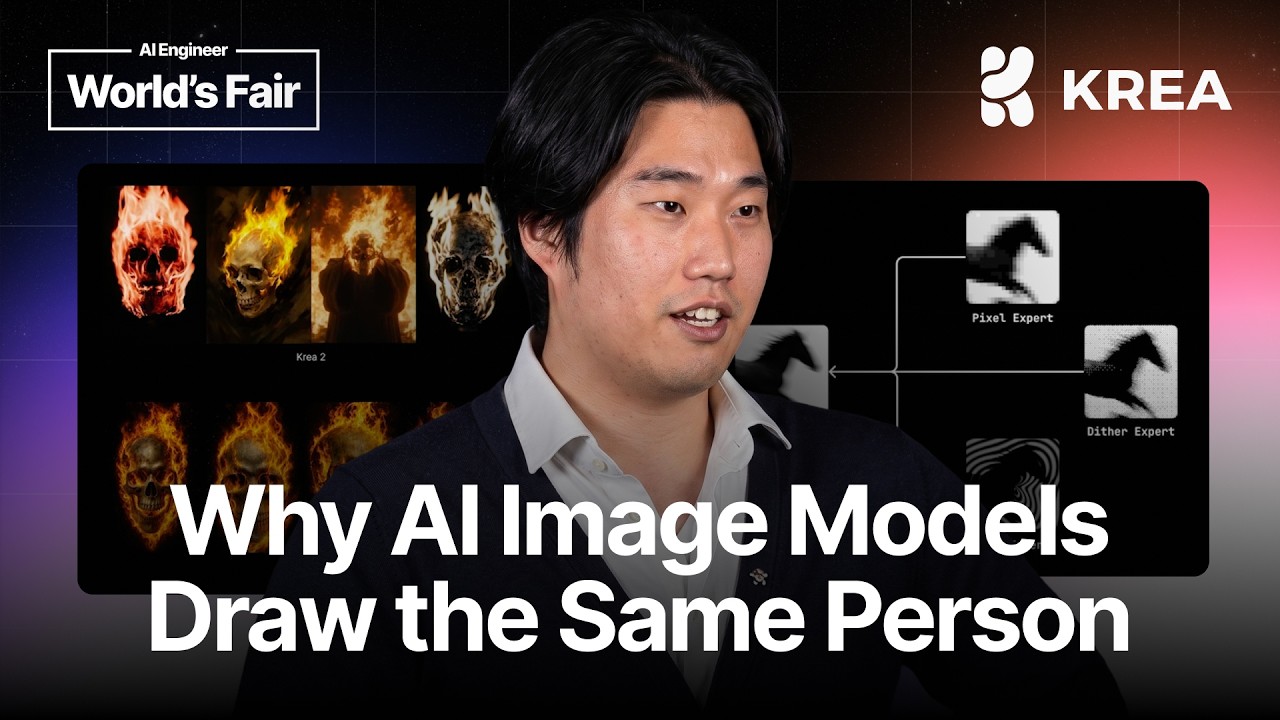
Training Krea 2: What matters in generative model training — Sangwu Lee, Krea.ai
Aug 18, 2026 · 21:46
Sangwu Lee of Krea.ai explains what went into training Krea 2, its open-sourced image foundation model, arguing that once architecture is locked, data is everything. To keep stylistic diversity over the 'most boring average person' consistency of production models, Krea filters billions of images: no AI images, OCR and vision-language captions, hash and embedding dedup, distilled VLM classifiers, sparse autoencoders as unsupervised taggers for watermarks and borders. World knowledge is checked against Wikipedia concepts by PageRank. Training goes from 256 to 1K resolution through pre-training, mid-training, SFT, preference optimization, and GRPO-style RL, plus a prompt expander. Lee wants a single clean transformer without VAEs/text encoders and VLM-generated bounding boxes or scene graphs.

Perceptual Evaluations: Evals for Aesthetics — Diego Rodriguez, Krea.ai
Aug 23, 2025 · 16:28
Diego Rodriguez, cofounder of Krea.ai, argues that current AI evaluations fail to capture human perception and aesthetics, leading to metrics that misjudge generative media. He traces how compression standards like JPEG and MP3 exploit human sensory limits yet their artifacts poison AI training data, making models blind to what humans instantly see wrong. Standard metrics like FID score penalize perceptually identical images, while models cannot evaluate subjective qualities like artistic meaning. Rodriguez calls for new "perceptually aware" metrics trained on human opinions, echoing a friend's insight that predicting cars was easy but traffic was hard — the real challenge is evaluating AI's impact on creative expression. Krea.ai, an 8-person startup, invites researchers to join work on aesthetics research and hyper-personalization for generative multimedia.

The Next Unicorns: 7 Top AI startups from the HF0 Residency
Aug 21, 2025 · 22:16
Diego Rodriguez (Krea) presents an AI creative suite that generated 1M images/day for a Fox ad, while OpenHome debuts the first AI smart speaker with 10K developers and 500 free dev kits. Josh’s Coframe made $20M for a travel firm by making websites adaptive, and Eugene’s Featherless AI built QWERTY 72B without transformer attention, claiming scale is dead in favor of reliability. Jonas Bauer’s Upside uses LLMs to structure enterprise data, Lengyue’s OpenAudio introduces S1, the first instructable voice model beating ElevenLabs, and Alex Atallah’s OpenRouter provides a single API for all LLMs, growing 10–100% monthly.
Powered by PodHood