
Factory
CompanyA company discussed on AI Engineer.
7 episodes

Bringing agents onto the world wide web — Paul Klein IV, Browserbase
Aug 14, 2026 · 18:26
Paul Klein IV, founder of Browserbase, argues browser agents are no longer held back by models; the missing piece is engineering. He details a three-part harness: multimodal agents that write code and intercept network requests, skills and memory that compress page context, and consistent infrastructure, mocking the 'SOC 2 compliant Mac Mini at scale' problem. Klein says the web itself must improve for agents, pointing to accessibility trees, Chrome's new Web MCP, and unsolved problems of agent login and trust certification. He contends the payoff is the logistics company in Singapore, the bank in South Africa, and the lumber factory in Mexico running on PHP forms, not San Francisco, and introduces Browserbase Agents as a battery-included solution.
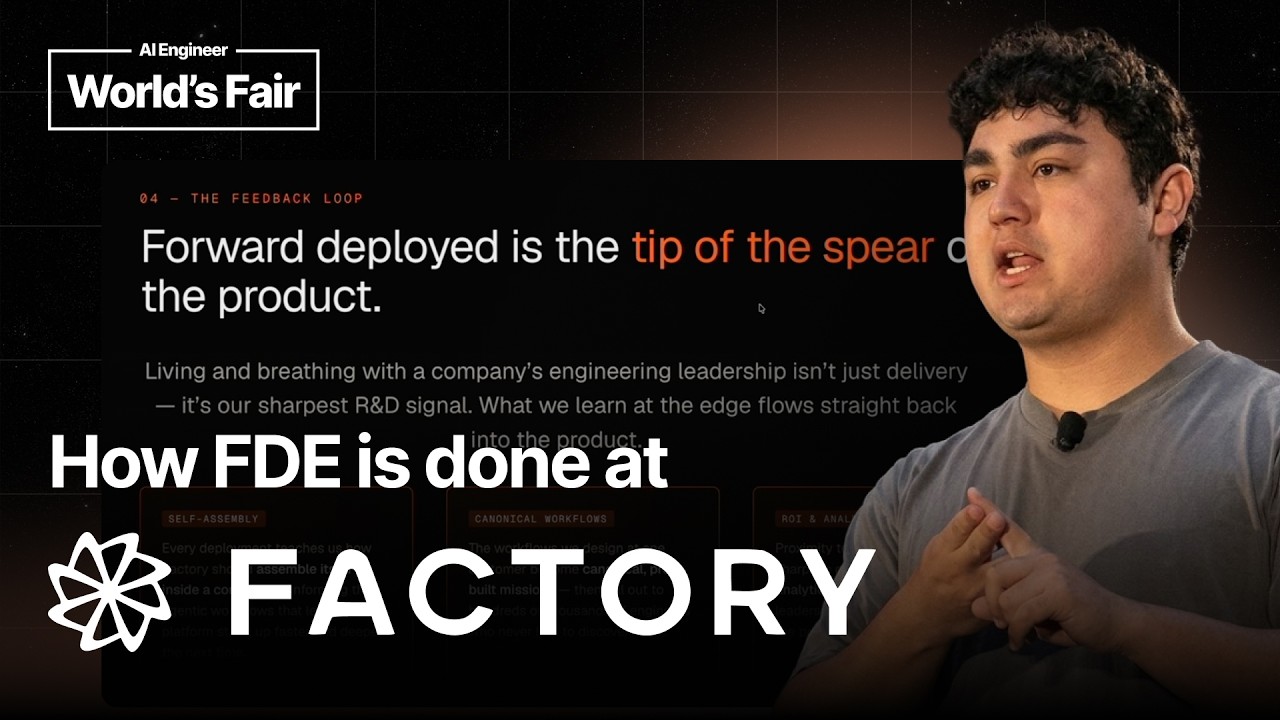
How Forward Deployed Engineering is done at Factory — Eno Reyes
Jul 28, 2026 · 21:21
Factory's forward deployed engineers serve as the tip of the spear, embedding with customers to build software factories where signals flow through validation stages and ship outcomes autonomously. Co-founder and CTO Eno Reyes stresses a model-independent harness the customer owns, enabling air-gapped operation in finance, healthcare, or government. The autonomy maturity model scores codebases on agent readiness: linters, type checkers, and verifiable tasks let agents work longer without humans—enabling migrations of 30–50 million line codebases at banks. Reyes uses Disney's Epcot analogy to warn: build achievable future cities, not theme parks, or adoption stalls. Factory runs with an autonomy ratio in the upper 80%; legal Droid is fully autonomous, and the role demands business judgment, systems thinking, and communication skills as much as engineering.
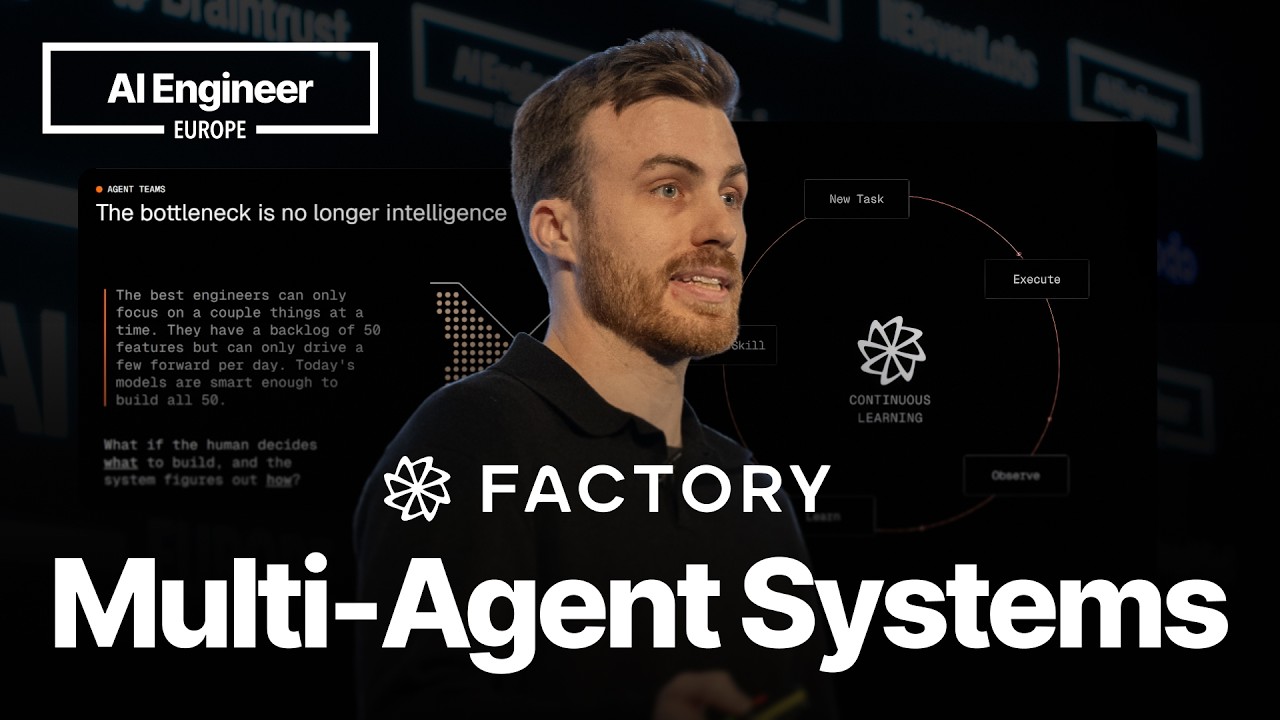
The Multi-Agent Architecture That Actually Ships — Luke Alvoeiro, Factory
May 6, 2026 · 18:31
Luke Alvoeiro from Factory presents Missions, a multi-agent architecture that combines delegation, creator-verifier, broadcast, and negotiation into a three-role system of orchestrator, workers, and validators. The central claim is that human attention, not AI intelligence, is now the bottleneck in software engineering. Missions uses validation contracts written before any code to define correctness independently, structured handoffs to maintain context across 16-day runs, and serial execution with targeted internal parallelization to reduce errors. Strategic model selection per role—planning, implementation, validation—compounds advantages across model generations. Production data from building a Slack clone shows 60% of time and tokens spent on implementation, validation never succeeds on first go, and 50% of final code lines are tests with 90% coverage. The system is designed to improve with each model release by keeping orchestration logic in prompts and skills rather than hard-coded state machines.

How Claude Code Works - Jared Zoneraich, PromptLayer
Dec 26, 2025 · 1:05:43
Jared Zoneraich from PromptLayer dissects how Claude Code works, arguing its success stems from a radical simplification: a single-threaded master loop with tool calls, relying on capable models rather than complex DAG-based architectures. He breaks down the core internal tools—Bash, FileEdit, Grep—and the to-do planning mechanism that is purely prompt-based and not deterministically enforced. Zoneraich contrasts Claude Code with other coding agents: Codex (Rust core, kernel-level sandboxing), Amp (handoff context management, model-agnostic), and Cursor Composer (UI-first, distilled model). He emphasizes that Bash is the most important tool, acting as a universal adapter, and that context management via sub-agents and summarization is critical. Key takeaways include trusting the model, simple design, rigorous tool testing, and that different agent philosophies (not one winner) will serve different use cases.

Making Codebases Agent Ready – Eno Reyes, Factory AI
Dec 22, 2025 · 15:33
Eno Reyes of Factory AI argues that the primary bottleneck for AI agents in software engineering is not model capability but the 'agent readiness' of the codebase, measured by eight categories of automated verification including linters, tests, and documentation. He describes a shift from specification-based to verification-based development (Software 2.0), where agents succeed only when environments have fast feedback loops and explicit constraints. Reyes presents a flywheel: better validation enables better agents, which in turn improve validation, and claims this investment can yield 5x, 6x, 7x engineering velocity. He advises organizations to measure their readiness across pillars like style validation, build systems, and observability, and to remediate gaps using agents themselves. The talk emphasizes that organizational practices, not tool selection, determine agent success.

Ship Production Software in Minutes, Not Months — Eno Reyes, Factory
Jul 25, 2025 · 16:06
Eno Reyes, cofounder and CTO of Factory, argues that AI agents can orchestrate the entire software development lifecycle, moving beyond vibe coding to agent-native development where enterprises delegate planning, coding, testing, and incident response to autonomous droids. He explains that AI tools are only as good as the context they receive—missing context from meetings, whiteboards, or Slack is the primary cause of failure, not LLM quality. Factory's droids search codebases, leverage organizational memory, and question unclear tasks before executing, from generating PRDs and tickets to creating runbooks and RCAs from sentry alerts. Reyes demonstrates how an agent can convert user transcripts and ad-hoc notes into a full feature plan, then break it into parallel tickets for multiple code droids. For incident response, droids pull logs, historical runbooks, and team discussions to produce mitigation plans in minutes, cutting response times in half and shifting from reactive to predictive operations. He emphasizes that the future belongs to engineers who manage agents—thinking clearly and communicating effectively—rather than those writing every line of code.

Building Reliable Agentic Systems: Eno Reyes
Aug 20, 2024 · 18:14
Eno Reyes, CTO of Factory.ai, explains how his team builds reliable agentic systems—called Droids—for automating software development tasks by applying techniques from robotics and control systems to handle planning, decision making, and environmental grounding. Reyes describes a pseudo-Kalman filter that passes intermediate reasoning through plan steps, converging reasoning but risking error propagation. He advocates for explicit plan criteria and hard-coded logic to improve reliability, despite reducing generalizability. On decision making, he recommends consensus mechanisms like self-consistency, explicit reasoning with checklists, fine-tuning for out-of-distribution decisions, and simulation via Monte Carlo tree search. For environmental grounding, he emphasizes building custom AI computer interfaces for domain-specific workflows, designing explicit feedback processing (e.g., parsing CI/CD logs), balancing bounded exploration with long-context models, and incorporating human guidance to boost reliability from 30–40% to 90–100%.
Powered by PodHood