
Decagon
CompanyA company discussed on AI Engineer.
5 episodes

Scaling up Continual Learning — Ronak Malde, Trajectory
Aug 12, 2026 · 23:03
Ronak Malde, founder of Trajectory and former Windsurf research lead, explains how on-policy self-distillation (OPSD) scales continual learning beyond GRPO's limits. He argues GRPO requires parallel rollouts and collapses feedback into one sequence-level score, like being handed 87 out of 100 on an essay. OPSD instead matches per-token log probs between a student and a teacher given privileged hints, optimizing the entire vocabulary and reducing tokens to solve tasks. Scaling to 120B models with 100+ tool calls reveals the 'but wait' problem—models hedge into 'maybe'—solved via step-level KL weighting, and hint leakage, countered with residual guidance. Trajectory applies this to production agent traces for Harvey, Decagon, and Rogo.
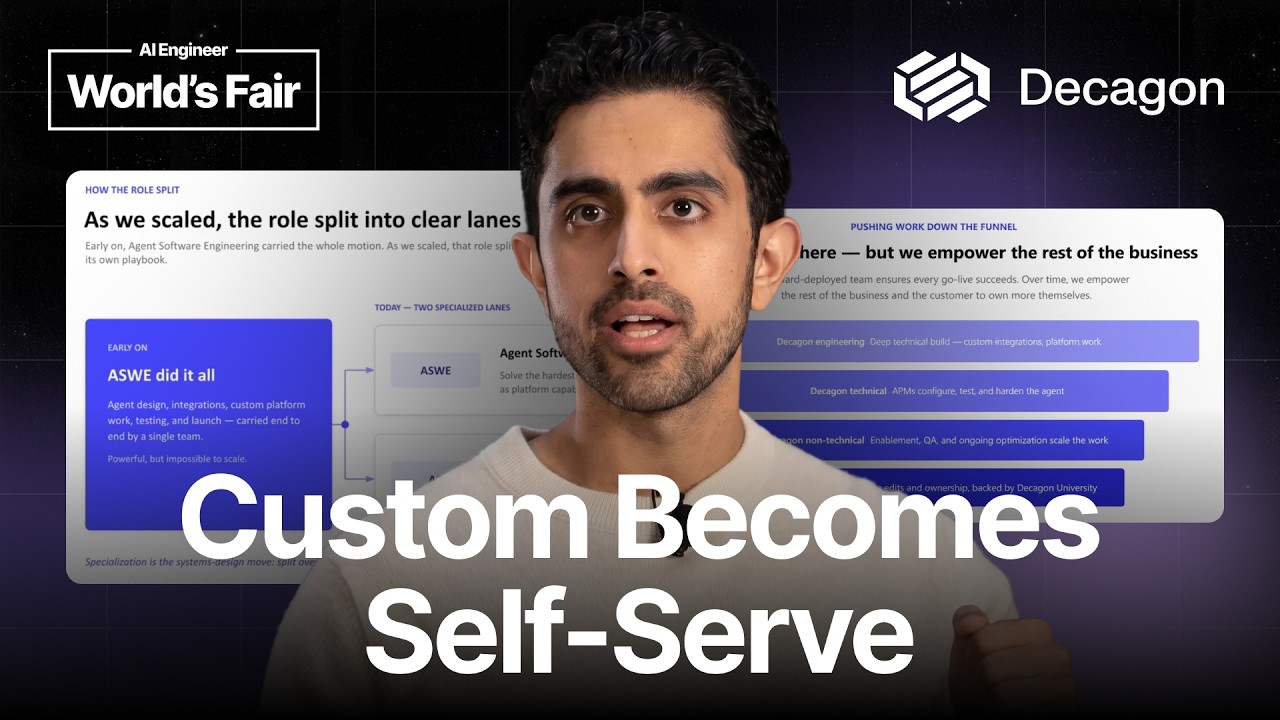
How Forward Deployed Engineering is done at Decagon — Sunny Rekhi
Jul 28, 2026 · 18:09
Sunny Rekhi, CTO of Forward Deployed Engineering at Decagon, explains that forward deployed engineering is identical to product engineering, with two kinds of work: configuring the AI agent's brain (instructions and handoff rules) and solving customer asks in a way that scales to all customers. Decagon, which builds 24/7 AI customer service agents, grew from 50 to 500 people in a year, breaking the original role into specialized lanes: agent builders who configure within the UI, and agent software engineers who productize customer requests. Rekhi stresses restraint—avoiding one-off patches—and proving value fast in the first weeks of a partnership. A key ethos is that custom work never stays custom: every integration built for one customer gets upstreamed into the platform, becoming self-serve for the next. Forward deployed engineers also act as advisors, using their cross-customer knowledge to guide enterprises on where they will see the highest ROI based on historical data.

Notion's Token Town — Sarah Sachs, Notion
Jul 23, 2026 · 23:55
Sarah Sachs, Notion's AI engineering lead and contract negotiator, argues that AI companies must stop competing on token economics and instead build model-agnostic products that win on data flywheels, orchestration, and security. She advises treating every model supplier as a competitor, because frontier labs charge a markup on a markup for tokens they sell for first-party use. Notion's auto model routes 75% of traffic through a Switzerland-like system that swaps providers underneath, avoiding vendor lock-in. Sachs advocates routing by cost per capability per second, using open weight models for the moderate middle, and reaching for CPUs over GPUs (e.g., no LLM needed to turn a CSV into a PDF). She highlights the 'lethal trifecta' of private data, untrusted content, and external communication as the next security challenge, and demos Notion agents scoping a task, tagging teammates, and opening a PR. Her core message: optionality is leverage, and the product must transcend tokens.

What Lies Beneath the API — Benjamin Cowen, Modal
Jun 2, 2026 · 12:40
In this episode, Ben Cowen from Modal argues that as AI products mature, fine-tuning becomes essential, citing cases like Intercom beating their frontier API at 1/10th the cost. He identifies three signals it's time to fine-tune: paying more for the API than customers pay you, evaluative plateaus, and latency requirements that shared endpoints can't meet. Cowen explains that supervised fine-tuning now fits in 300 lines of Python and that reinforcement learning rollouts can scale to 50,000 sandboxes using serverless platforms like Modal. He contends that frontier labs aim to win at everything, while businesses need to win at their specific logic, making fine-tuning a natural destination. The episode provides practical guidance on when and how to make the leap, emphasizing that building an agent harness and collecting eval data already sets the stage for training.

The New Application Layer - Malte Ubl, CTO Vercel
Apr 20, 2026 · 18:52
Vercel CTO Malte Ubl argues that AI engineering is the legitimate successor to web development and that the real value lies in the application layer, not the model labs. He identifies four effective agent archetypes—24/7 support, compressed research, surfacing existing information, and eliminating boring work—and reveals that over 60% of vercel.com page views now come from AI agents. Ubl predicts model companies will commoditize, driving costs down and empowering engineers, while citing Europe's leadership in AI engineering through Vercel's AI SDK, Pi (a coding agent from Austria), and OpenClaw. He stresses the need for open-mindedness toward paradigm shifts and new infrastructure, such as sandboxed agent runtimes, and warns of impending security challenges.
Powered by PodHood